A line with direction ratios 2, 1, 2 meets the lines x=y+2=z$x=y+2=z$ and x+2=2y=2z$x+2=2y=2z$ respectively at the point P and Q. if the length of the perpendicular from the point (1, 2, 12)$(1, 2, 12)$ to the line PQ is l$l$, then l²$l^2$ is
Numerical Answer Type:
Enter a numerical valueAnswer: 65 to 65+4 marks
Solution & Explanation
Related Formula
Dot Product for Orthogonality: A · B = 0 a₁b₁ + a₂b₂ + a₃b₃ = 0$$\text{Dot Product for Orthogonality: } \vec{A} \cdot \vec{B} = 0 \implies a_1b_1 + a_2b_2 + a_3b_3 = 0$$Distance between 3D points: d = √((x₂-x₁)²+(y₂-y₁)²+(z₂-z₁)²)$$\text{Distance between 3D points: } d = \sqrt{(x_2-x_1)^2+(y_2-y_1)^2+(z_2-z_1)^2}$$
Core Logic
Let the first line be L₁: x = y+2 = z = t$L_1: x = y+2 = z = t$.
Any point P$P$ on L₁$L_1$ has coordinates (t, t-2, t)$(t, t-2, t)$.
Let the second line be L₂: (x+2)/(2) = y = z = s$L_2: \frac{x+2}{2} = y = z = s$.
Any point Q$Q$ on L₂$L_2$ has coordinates (2s-2, s, s)$(2s-2, s, s)$.
The line segment PQ$PQ$ has direction ratios given by the difference of coordinates:
(s-t+2)/(1) = (s-t)/(2)$$\frac{s-t+2}{1} = \frac{s-t}{2}$$2s - 2t + 4 = s - t ⇒ s - t = -4 ⇒ t = s + 4$$2s - 2t + 4 = s - t \Rightarrow s - t = -4 \Rightarrow t = s + 4$$
Let F$F$ be the foot of the perpendicular from point A(1, 2, 12)$A(1, 2, 12)$ to the line PQ$PQ$.
Any general point on line PQ$PQ$ is F(2λ+2, λ+2, 2λ+2)$F(2\lambda+2, \lambda+2, 2\lambda+2)$.
Whenever you must link two skew lines with a third intersecting line given constant direction ratios, immediately construct generic parametric points on each skew line. Subtraction yields a vector that is directly proportional to the given constants, instantly solving the system.
Keywords:#length of the perpendicular#JEE Main 2024 Morning Q30#Three Dimensional Geometry JEE Main 2024#Shortest Distance Between Lines JEE Main 2024
More Three Dimensional Geometry Previous-Year Questions — Page 2
Q10jee_main_2026_22_january_eveningDistance Between Points on Line
Let L$L$ be the line (x+1)/(2) = (y+1)/(3) = (z+3)/(6)$\frac{x+1}{2} = \frac{y+1}{3} = \frac{z+3}{6}$ and let S$S$ be the set of all points (a,b,c)$(a,b,c)$ on L$L$, whose distance from the line (x+1)/(2) = (y+1)/(3) = (z-9)/(0)$\frac{x+1}{2} = \frac{y+1}{3} = \frac{z-9}{0}$ along the line L$L$ is 7$7$. Then Σ(a,b,c) in S (a+b+c)$\sum_{(a,b,c) \in S} (a+b+c)$ is equal to:
A. 34
B. 28
C. 40
D. 6
Solution
Related Formula
Distance along a line from intersection point M$M$ using parametric coordinates.
Core Logic
Find intersection point M$M$ of L₁$L_1$ and L₂$L_2$:
Point of intersection M = (3, 5, 9)$M = (3, 5, 9)$.
Any parametric point P$P$ on L₁$L_1$ is (2K-1, 3K-1, 6K-3)$(2K-1, 3K-1, 6K-3)$.
Step 1: Solve for Points P and Q
Distance PM = 7$PM = 7$:
√((2K-4)² + (3K-6)² + (6K-12)²) = 7 7|K-2| = 7 K = 1 or 3$$\sqrt{(2K-4)^2 + (3K-6)^2 + (6K-12)^2} = 7 \implies 7|K-2| = 7 \implies K = 1 \text{ or } 3$$
For K=1$K=1$: P = (1, 2, 3)$P = (1, 2, 3)$, sum = 6$= 6$
For K=3$K=3$: Q = (5, 8, 15)$Q = (5, 8, 15)$, sum = 28$= 28$
Step 2: Total Sum
Total sum = 6 + 28 = 34$= 6 + 28 = 34$.
Pattern Recognition
Intersection point gives central reference; unit direction vector gives required offset points along the line.
Chapter Mix
Class 12 Maths: Three Dimensional Geometry
Q15jee_main_2026_23_january_morningLines in 3D
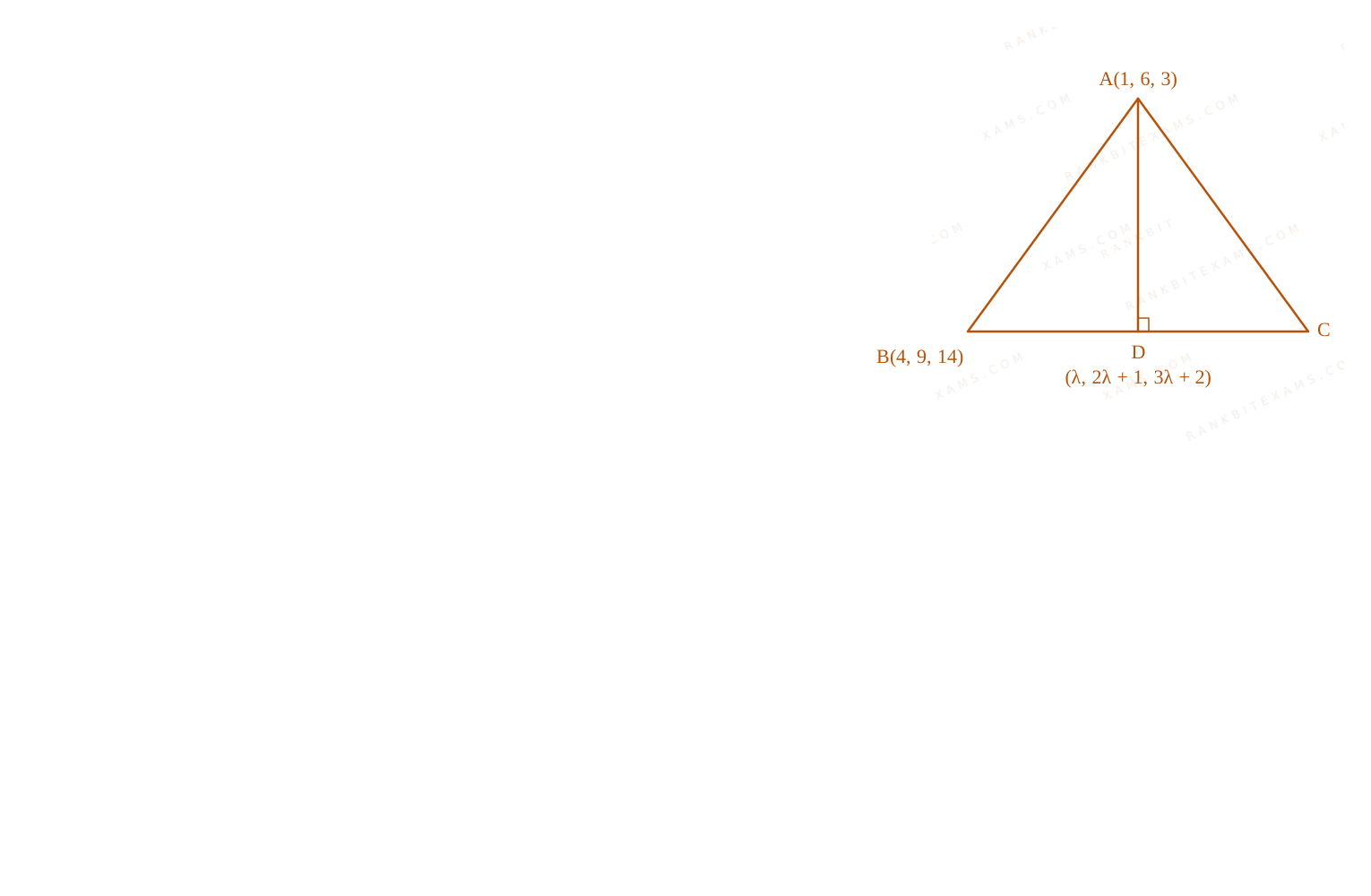
The vertices B$B$ and C$C$ of a triangle ABC$ABC$ lie on the line (x)/(1) = (1 - y)/(-2) = (z - 2)/(3)$\frac{x}{1} = \frac{1 - y}{-2} = \frac{z - 2}{3}$. The coordinates of A$A$ and B$B$ are (1, 6, 3)$(1, 6, 3)$ and (4, 9, α)$(4, 9, \alpha)$ respectively and C$C$ is at a distance of 10$10$ units from B$B$. The area (in sq. units) of Δ ABC$\Delta ABC$ is:
A.5√(13)$5\sqrt{13}$
B.15√(13)$15\sqrt{13}$
C.20√(13)$20\sqrt{13}$
D.10√(13)$10\sqrt{13}$
Solution
Related Formula
Area of Δ = (1)/(2) × base × height = (1)/(2) × BC × AD$$\text{Area of } \Delta = \frac{1}{2} \times \text{base} \times \text{height} = \frac{1}{2} \times BC \times AD$$
Core Logic
The line is standardly written as (x)/(1) = (y - 1)/(2) = (z - 2)/(3) = λ$\frac{x}{1} = \frac{y - 1}{2} = \frac{z - 2}{3} = \lambda$.
Point B$B$(4, 9, α)$(4, 9, \alpha)$ lies on this line, so we can solve for α$\alpha$ by substituting it in:
Thus, B$B$ is (4, 9, 14)$(4, 9, 14)$.
Lines in 3D diagram for Q15 - JEE Main 2026 Morning
Step 1: Find the Perpendicular Foot (D)
Let D$D$ be the foot of the perpendicular from A(1, 6, 3)$A(1, 6, 3)$ to the line BC$BC$.
The coordinates of a general point on the line are D = (λ, 2λ + 1, 3λ + 2)$D = (\lambda, 2\lambda + 1, 3\lambda + 2)$.
The direction vector of AD$AD$ is AD = (λ - 1) i + (2λ - 5) j + (3λ - 1) k$\vec{AD} = (\lambda - 1)\hat{i} + (2\lambda - 5)\hat{j} + (3\lambda - 1)\hat{k}$.
Since AD$AD$ is perpendicular to the line whose direction ratios are 1, 2, 3$\langle 1, 2, 3 \rangle$:
We are given that the base BC$BC$ is 10$10$ units.
Area = (1)/(2) × BC × AD = (1)/(2) × 10 × √(13) = 5√(13)$$\text{Area} = \frac{1}{2} \times BC \times AD = \frac{1}{2} \times 10 \times \sqrt{13} = 5\sqrt{13}$$
Pattern Recognition
When a triangle area is requested given a line equation containing the base, dropping a generic lambda-perpendicular establishes height (AD$AD$), decoupling the problem from finding the exact coordinate of C$C$.
Let the direction cosines of two lines satisfy the equations: 4 + m - n = 0$4\ell + m - n = 0$ and 2mn + 10n + 3 m = 0$2mn + 10n\ell + 3\ell m = 0$. Then the cosine of the acute angle between these lines is:
From the first linear equation, isolate n$n$:
n = 4 + m$n = 4\ell + m$
Substitute this into the second quadratic relation:
2m(4 + m) + 10 (4 + m) + 3 m = 0$$2m(4\ell + m) + 10\ell(4\ell + m) + 3\ell m = 0$$8 m + 2m² + 40 ² + 10 m + 3 m = 0$$8\ell m + 2m^2 + 40\ell^2 + 10\ell m + 3\ell m = 0$$40 ² + 21 m + 2m² = 0$$40\ell^2 + 21\ell m + 2m^2 = 0$$
When direction cosines are entangled in one linear and one quadratic equation, isolate the single-degree variable from the linear plane equation and plug it into the cone equation to split it into two generating lines.
Chapter Mix
Class 12 Maths: Three Dimensional Geometry
Q22jee_main_2026_23_january_eveningLine in 3D
If the image of the pointP(a, 2, a)$P(a, 2, a)$ in the line (x)/(2) = (y + a)/(1) = (z)/(1)$\frac{x}{2} = \frac{y + a}{1} = \frac{z}{1}$ is Q$Q$ and the image of Q$Q$ in the line (x - 2b)/(2) = (y - a)/(1) = (z + 2b)/(-5)$\frac{x - 2b}{2} = \frac{y - a}{1} = \frac{z + 2b}{-5}$ is P$P$, then a + b$a + b$ is equal to
Numerical Answer.Answer: 3 to 3
Solution
Related Formula
For a point and its image across a line, the midpoint of the segment connecting them lies exactly on the line. The segment itself is perpendicular to the line.
Core Logic
Line in 3D diagram for Q22 - JEE Main 2026 Evening
Let the first line be L₁$L_1$: (x)/(2) = (y + a)/(1) = (z)/(1) = λ$\frac{x}{2} = \frac{y + a}{1} = \frac{z}{1} = \lambda$.
A general point on L₁$L_1$ is (2λ, λ - a, λ)$(2\lambda, \lambda - a, \lambda)$. This is the midpoint M₁$M_1$ of P(a, 2, a)$P(a, 2, a)$ and Q(x₁, y₁, z₁)$Q(x_1, y_1, z_1)$.
Now, the image of Q$Q$ across L₂$L_2$: (x - 2b)/(2) = (y - a)/(1) = (z + 2b)/(-5) = μ$\frac{x - 2b}{2} = \frac{y - a}{1} = \frac{z + 2b}{-5} = \mu$ is P(a, 2, a)$P(a, 2, a)$.
The midpoint M₂$M_2$ of PQ$PQ$ lies on L₂$L_2$. But M₂$M_2$ is the exact same set of coordinates in space as M₁$M_1$ since they are both the midpoint of the segment PQ$PQ$!
Step 1: Equating Midpoints
General point on L₂$L_2$ is (2μ + 2b, μ + a, -5μ - 2b)$(2\mu + 2b, \mu + a, -5\mu - 2b)$.
Since the midpoint must be the same:
(a + (4λ - a))/(2) = 2μ + 2b 2λ = 2μ + 2b λ - μ = b$\frac{a + (4\lambda - a)}{2} = 2\mu + 2b \implies 2\lambda = 2\mu + 2b \implies \lambda - \mu = b$(2 + (2λ - 2a - 2))/(2) = μ + a λ - a = μ + a λ - μ = 2a$\frac{2 + (2\lambda - 2a - 2)}{2} = \mu + a \implies \lambda - a = \mu + a \implies \lambda - \mu = 2a$(a + (2λ - a))/(2) = -5μ - 2b λ = -5μ - 2b λ + 5μ = -2b$\frac{a + (2\lambda - a)}{2} = -5\mu - 2b \implies \lambda = -5\mu - 2b \implies \lambda + 5\mu = -2b$
Step 2: Solving System
From the first two equations, b = 2a$b = 2a$.
Substitute b = 2a$b = 2a$ into the third: λ + 5μ = -4a$\lambda + 5\mu = -4a$.
Also λ - μ = 2a$\lambda - \mu = 2a$. Subtracting gives 6μ = -6a μ = -a$6\mu = -6a \implies \mu = -a$.
Thus λ = a$\lambda = a$.
Line in 3D diagram for Q22 - JEE Main 2026 Evening
The direction vector of segment PQ$PQ$ is proportional to the vector from P$P$ to M₁$M_1$.
PM₁ = (2λ - a) i + (λ - a - 2) j + (λ - a) k$\vec{PM_1} = (2\lambda - a)\hat{i} + (\lambda - a - 2)\hat{j} + (\lambda - a)\hat{k}$.
Since λ = a$\lambda = a$:
PM₁ = a i - 2 j + 0 k$\vec{PM_1} = a\hat{i} - 2\hat{j} + 0\hat{k}$.
This vector must be perpendicular to L₁$L_1$ (direction vector 2 i + j + k$2\hat{i} + \hat{j} + \hat{k}$):
(a)(2) + (-2)(1) + (0)(1) = 0 2a - 2 = 0 a = 1$(a)(2) + (-2)(1) + (0)(1) = 0 \implies 2a - 2 = 0 \implies a = 1$.
Step 3: Final Values
Since a = 1$a = 1$, and b = 2a$b = 2a$, we have b = 2$b = 2$.
Therefore, a + b = 1 + 2 = 3$a + b = 1 + 2 = 3$.
Pattern Recognition
If P$P$ is the image of Q$Q$ on L₁$L_1$, and Q$Q$ is the image of P$P$ on L₂$L_2$, then L₁$L_1$ and L₂$L_2$ must intersect segment PQ$PQ$ at the exact same midpoint. Using the midpoint consistency across both lines creates a rapid linear system.
Chapter Mix
Class 12 Maths: Three Dimensional Geometry
Q3jee_main_2026_24_january_morningIntersection of Lines and Distances
Let the lines L₁: r = i + 2 j + 3 k + λ(2 i + 3 j + 4 k)$L_{1}: \vec{r} = \hat{i} + 2\hat{j} + 3\hat{k} + \lambda(2\hat{i} + 3\hat{j} + 4\hat{k})$, λ in R$\lambda \in \mathbb{R}$ and L₂: r = (4 i + j) + μ(5 i + 2 j + k)$L_{2}: \vec{r} = (4\hat{i} + \hat{j}) + \mu(5\hat{i} + 2\hat{j} + \hat{k})$, μ in R$\mu \in \mathbb{R}$, intersect at the point R$R$. Let P$P$ and Q$Q$ be the points lying on lines L₁$L_{1}$ and L₂$L_{2}$, respectively, such that | PR| = √(29)$|\overrightarrow{PR}| = \sqrt{29}$ and | PQ| = √((47)/(3))$|\overrightarrow{PQ}| = \sqrt{\frac{47}{3}}$. If the point P$P$ lies in the first octant, then 27(QR)²$27(QR)^{2}$ is equal to
Find the point of intersection R$R$ by equating general points on L₁$L_1$ and L₂$L_2$:
General point on L₁$L_1$: (2λ + 1, 3λ + 2, 4λ + 3)$(2\lambda + 1, 3\lambda + 2, 4\lambda + 3)$
General point on L₂$L_2$: (5μ + 4, 2μ + 1, μ)$(5\mu + 4, 2\mu + 1, \mu)$
When given fixed line parameters and distances, expressing all points in terms of their single parameter (λ$\lambda$ or μ$\mu$) converts 3D distance problems into simple single-variable quadratic equations.
Chapter Mix
Class 12 Maths: Three Dimensional Geometry
More Three Dimensional Geometry Questions — jee_main_2024_29_jan_morning
Practice past-year questions one chapter at a time. Pick an exam → subject → chapter and get every PYQ for that topic — pulled together from all past papers — with the chapter's key formulas alongside.