If the shortest distance between the lines fracx-lambda-2=fracy-21=fracz-11 and fracx-sqrt31=fracy-1-2=fracz-21 is 1, then the sum of all possible values of lambda is:

Solution & Explanation

### Related Formula The shortest distance between two skew lines vecr = veca_1 + svecb_1 and vecr = veca_2 + tvecb_2 is given by: d = frac|(veca_2 - veca_1) cdot (vecb_1 times vecb_2)||vecb_1 times vecb_2| ### Core Logic Identify the vectors from the equations of the lines: - Line 1 passes through veca_1 = lambdahati + 2hatj + hatk with direction vecb_1 = -2hati + hatj + hatk. - Line 2 passes through veca_2 = sqrt3hati + hatj + 2hatk with direction vecb_2 = hati - 2hatj + hatk. Calculate the coordinate difference vector: veca_2 - veca_1 = (sqrt3 - lambda)hati - hatj + hatk ### Step 1: Compute the Cross Product of the Direction Vectors Find the cross product matrix: vecb_1 times vecb_2 = beginvmatrix hati & hatj & hatk \\ -2 & 1 & 1 \\ 1 & -2 & 1 endvmatrix vecb_1 times vecb_2 = hati(1 - (-2)) - hatj(-2 - 1) + hatk(4 - 1) = 3hati + 3hatj + 3hatk Compute its magnitude: |vecb_1 times vecb_2| = sqrt3^2 + 3^2 + 3^2 = sqrt27 = 3sqrt3
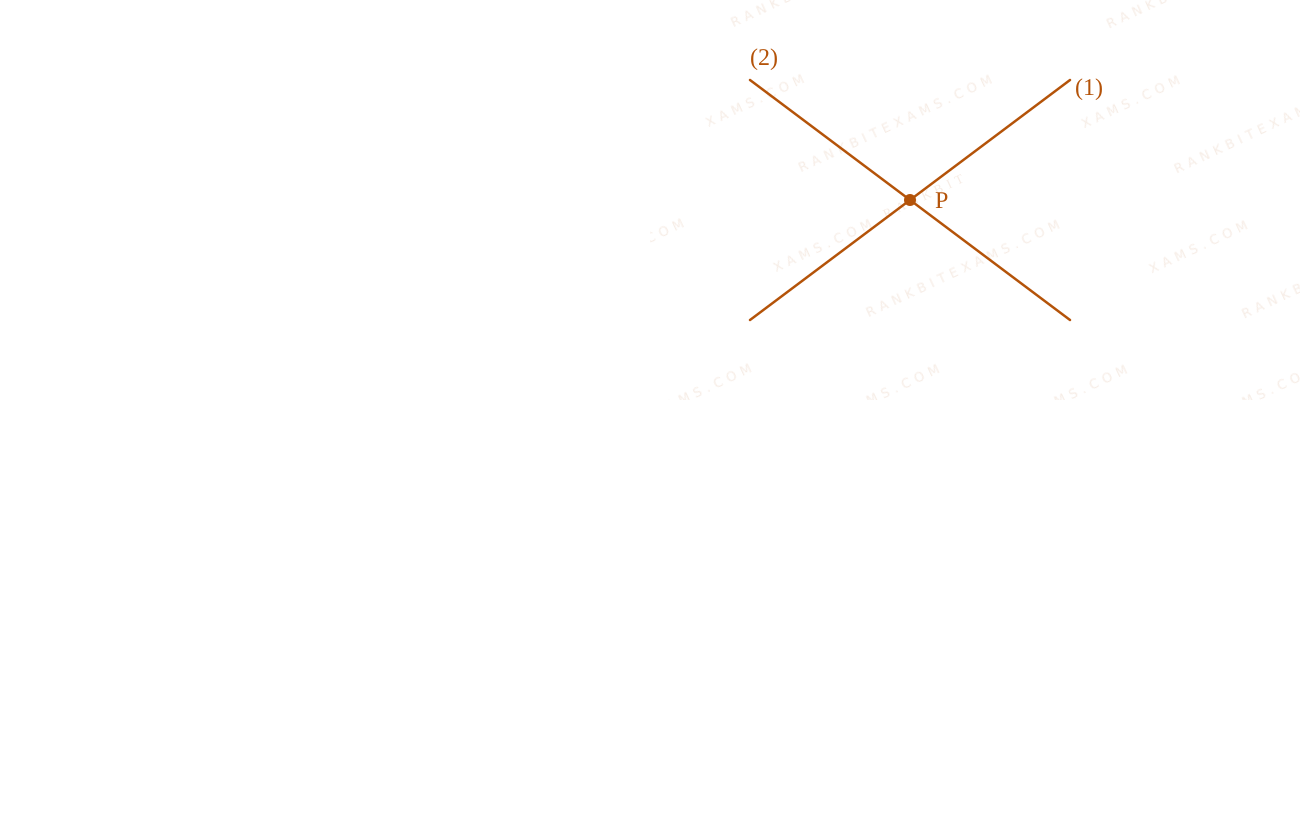
Shortest distance between skew lines vector representation for Q20 - JEE Main 2024 01 February Morning
The figure details the spatial arrangement of the two skew lines along with their common perpendicular normal vector representing the shortest path.
### Step 2: Solve the Absolute Distance Equation for lambda Substitute these values into the shortest distance formula: 1 = frac|((sqrt3 - lambda)hati - hatj + hatk) cdot (3hati + 3hatj + 3hatk)|3sqrt3 1 = frac|3(sqrt3 - lambda) - 3 + 3|3sqrt3 = frac3|sqrt3 - lambda|3sqrt3 = frac|sqrt3 - lambda|sqrt3 This gives: |sqrt3 - lambda| = sqrt3 Unfolding the absolute value gives two cases: - **Case A:** sqrt3 - lambda = sqrt3 implies lambda = 0 - **Case B:** sqrt3 - lambda = -sqrt3 implies lambda = 2sqrt3 ### Step 3: Calculate the Final Sum The sum of all possible values of lambda is: textSum = 0 + 2sqrt3 = 2sqrt3 ### Pattern Recognition Sees: Shortest distance setup between vector paths containing free variables. Shortcut: In equations like |c - lambda| = d, the sum of the roots is simply equal to 2c, because the roots are symmetrically balanced around the center point c. Thus, textSum = 2 times sqrt3 = 2sqrt3 holds instantly without calculating individual values. ### Evaluation Rubric / Model Answer null ### Chapter Mix Class 12 Mathematics: Three Dimensional Geometry Class 12 Mathematics: Vector Algebra

Reference Study Guides

More Three Dimensional Geometry Previous-Year Questions — Page 9

Q22 jee_main_2024_30_january_evening Lines in Space
Let a line passing through the point (-1, 2, 3) intersect the lines L_1: fracx - 13 = fracy - 22 = fracz + 1-2 at M(alpha, beta, gamma) and L_2: fracx + 2-3 = fracy - 2-2 = fracz - 14 at N(a, b, c). Then the value of frac(alpha + beta + gamma)^2(a + b + c)^2 equals
Numerical Answer. Answer: 196 to 196

Solution

### Related Formula textParametric form of a line: vecr = veca + lambdavecb ### Core Logic Let the given point be P(-1, 2, 3). A line passing through P intersects L_1 at M and L_2 at N. Write general coordinates for M on L_1 and N on L_2: L_1: fracx-13 = fracy-22 = fracz+1-2 = lambda Rightarrow M(3lambda + 1, 2lambda + 2, -2lambda - 1) L_2: fracx+2-3 = fracy-2-2 = fracz-14 = mu Rightarrow N(-3mu - 2, -2mu + 2, 4mu + 1) ### Step 1: Collinearity Condition Since P, M, N lie on the same straight line, the direction vectors vecPM and vecPN must be proportional. vecPM = (3lambda + 1 - (-1))hati + (2lambda + 2 - 2)hatj + (-2lambda - 1 - 3)hatk = (3lambda + 2)hati + (2lambda)hatj + (-2lambda - 4)hatk vecPN = (-3mu - 2 - (-1))hati + (-2mu + 2 - 2)hatj + (4mu + 1 - 3)hatk = (-3mu - 1)hati + (-2mu)hatj + (4mu - 2)hatk Proportionality yields: frac3lambda + 2-3mu - 1 = frac2lambda-2mu = frac-2lambda - 44mu - 2 ### Step 2: Solving for Lambda and Mu
Lines in Space diagram for Q22 - JEE Main 2024 Evening
From the first pair: frac3lambda + 2-3mu - 1 = frac-lambdamu mu(3lambda + 2) = -lambda(-3mu - 1) 3lambdamu + 2mu = 3lambdamu + lambda Rightarrow 2mu = lambda From the second pair (using 2mu = lambda): frac-lambdamu = frac-lambda - 22mu - 1 -2mu = frac-2mu - 22mu - 1 -2mu(2mu - 1) = -2mu - 2 -4mu^2 + 2mu = -2mu - 2 -4mu^2 + 4mu + 2 = 0 quad text(Wait, alternative grouping): Re-checking the second pair with 2mu = lambda: frac2lambda-2mu = frac-lambdamu frac-lambdamu = frac-2lambda - 44mu - 2 Substitute lambda = 2mu: frac-2mumu = frac-4mu - 44mu - 2 -2(4mu - 2) = -4mu - 4 -8mu + 4 = -4mu - 4 8 = 4mu Rightarrow mu = 2 Then lambda = 2(2) = 4. ### Step 3: Finalizing Target Coordinates For lambda = 4: alpha + beta + gamma = (3(4)+1) + (2(4)+2) + (-2(4)-1) = 13 + 10 - 9 = 14 For mu = 2: a + b + c = (-3(2)-2) + (-2(2)+2) + (4(2)+1) = -8 - 2 + 9 = -1 Finally, compute the target fraction: frac(alpha + beta + gamma)^2(a + b + c)^2 = frac(14)^2(-1)^2 = frac1961 = 196 ### Pattern Recognition A line crossing two given lines acts as a transversal holding 3 collinear points. Setting vecPM = k cdot vecPN rapidly locks the parametric constants lambda and mu. ### Evaluation Rubric / Model Answer null ### Chapter Mix Class 12 Maths: Three Dimensional Geometry
Q10 jee_main_2024_30_jan_morning Line in 3D
Let (alpha, beta, gamma) be the foot of perpendicular from the point (1, 2, 3) on the line fracx + 35 = fracy - 12 = fracz + 43. then 19(alpha + beta + gamma) is equal to:
  • A. 102
  • B. 101
  • C. 99
  • D. 100

Solution

### Related Formula a_1 a_2 + b_1 b_2 + c_1 c_2 = 0 quad text(Condition for perpendicular vectors) ### Core Logic
Line in 3D diagram for Q10 - JEE Main 2024 Morning
Let the given point be A(1, 2, 3). Let the foot of the perpendicular on the line be P(alpha, beta, gamma). The equation of the line is fracx + 35 = fracy - 12 = fracz + 43 = k. So, any point on the line can be written as (5k - 3, 2k + 1, 3k - 4). Let this point be P. Thus, P(alpha, beta, gamma) equiv (5k - 3, 2k + 1, 3k - 4). ### Step 1: Finding Direction Ratios Direction ratios (DR's) of the line segment AP are: ((5k - 3) - 1, (2k + 1) - 2, (3k - 4) - 3) equiv (5k - 4, 2k - 1, 3k - 7) Direction ratios of the given line are (5, 2, 3). ### Step 2: Using Perpendicularity Condition Since AP is perpendicular to the given line, the dot product of their direction ratios is zero: 5(5k - 4) + 2(2k - 1) + 3(3k - 7) = 0 (25k - 20) + (4k - 2) + (9k - 21) = 0 38k - 43 = 0 k = frac4338 ### Step 3: Calculating target expression We need to find 19(alpha + beta + gamma). alpha + beta + gamma = (5k - 3) + (2k + 1) + (3k - 4) alpha + beta + gamma = 10k - 6 Substituting k = frac4338: 19(alpha + beta + gamma) = 19 left(10left(frac4338right) - 6right) = 19 left( frac43038 - 6 right) = frac4302 - 114 = 215 - 114 = 101 ### Pattern Recognition To find coordinates of a foot of perpendicular, define a general point on the line using parameter k, create the direction vector, and dot it with the line's direction vector set to zero. ### Evaluation Rubric / Model Answer null ### Chapter Mix Class 12 Maths: Three Dimensional Geometry
Q22 jee_main_2024_30_jan_morning Line in 3D
If d_1 is the shortest distance between the lines x + 1 = 2y = -12z, x = y + 2 = 6z - 6 and d_2 is the shortest distance between the lines fracx - 12 = fracy + 8-7 = fracz - 45, fracx - 12 = fracy - 21 = fracz - 6-3, then the value of frac32sqrt3d_1d_2 is:
Numerical Answer. Answer: 16 to 16

Solution

### Related Formula textShortest distance between vecr = veca_1 + lambda vecb_1 text and vecr = veca_2 + mu vecb_2 text is d = frac|(veca_2 - veca_1) cdot (vecb_1 times vecb_2)||vecb_1 times vecb_2| ### Core Logic For d_1, rewrite L_1 and L_2 into standard form: L_1: fracx + 11 = fracy1/2 = fracz-1/12 veca_1 = (-1, 0, 0), vecb_1 = left(1, frac12, -frac112right) propto (12, 6, -1) L_2: x = y + 2 = 6(z - 1) Rightarrow fracx1 = fracy + 21 = fracz - 11/6 veca_2 = (0, -2, 1), vecb_2 = left(1, 1, frac16right) propto (6, 6, 1) ### Step 1: Computing d1 veca_2 - veca_1 = (1, -2, 1) vecb_1 times vecb_2 = beginvmatrix hati & hatj & hatk \\ 12 & 6 & -1 \\ 6 & 6 & 1 endvmatrix = hati(6 + 6) - hatj(12 + 6) + hatk(72 - 36) = 12hati - 18hatj + 36hatk propto 2hati - 3hatj + 6hatk |vecb_1 times vecb_2| = sqrt4 + 9 + 36 = sqrt49 = 7 d_1 = frac|(1, -2, 1) cdot (2, -3, 6)|7 = frac|2 + 6 + 6|7 = frac147 = 2 ### Step 2: Computing d2 L_3: fracx - 12 = fracy + 8-7 = fracz - 45 veca_3 = (1, -8, 4), vecb_3 = (2, -7, 5) L_4: fracx - 12 = fracy - 21 = fracz - 6-3 veca_4 = (1, 2, 6), vecb_4 = (2, 1, -3) veca_4 - veca_3 = (0, 10, 2) vecb_3 times vecb_4 = beginvmatrix hati & hatj & hatk \\ 2 & -7 & 5 \\ 2 & 1 & -3 endvmatrix = hati(21 - 5) - hatj(-6 - 10) + hatk(2 + 14) = 16hati + 16hatj + 16hatk propto hati + hatj + hatk |vecb_3 times vecb_4| = sqrt1 + 1 + 1 = sqrt3 d_2 = frac|(0, 10, 2) cdot (1, 1, 1)|sqrt3 = frac|0 + 10 + 2|sqrt3 = frac12sqrt3 ### Step 3: Evaluating final expression Target: frac32sqrt3d_1d_2 = frac32sqrt3 times 212 / sqrt3 = frac64sqrt3 cdot sqrt312 = frac64 times 312 = frac19212 = 16 ### Pattern Recognition Extracting direction ratios efficiently by normalizing the denominator scaling is crucial to avoid fraction arithmetic errors in cross products. ### Evaluation Rubric / Model Answer null ### Chapter Mix Class 12 Maths: Three Dimensional Geometry
Q6 jee_main_2024_31_jan_evening Mirror Image of a Point
Let (alpha, beta, gamma) be mirror image of the point (2, 3, 5) in the line fracx - 12 =fracy - 23 =fracz - 34. Then 2alpha + 3beta + 4gamma is equal to
  • A. 32
  • B. 33
  • C. 31
  • D. 34

Solution

### Related Formula textDot product constraint: vecPR cdot vecd = 0 text where vecd text is direction of the line. ### Core Logic
Mirror Image of a Point diagram for Q6 - JEE Main 2024 Evening
Let P = (2, 3, 5) and its mirror image be R(alpha, beta, gamma). The vector connecting the point and its mirror image, vecPR, is strictly perpendicular to the given line. The direction ratios of the line are vecd = (2, 3, 4). Therefore, the dot product must be zero: vecPR cdot vecd = 0 (alpha - 2, beta - 3, gamma - 5) cdot (2, 3, 4) = 0 2(alpha - 2) + 3(beta - 3) + 4(gamma - 5) = 0 2alpha - 4 + 3beta - 9 + 4gamma - 20 = 0 2alpha + 3beta + 4gamma = 33 ### Pattern Recognition When asked for a linear combination of image coordinates matching the direction ratios of the line, skip finding the exact foot of perpendicular. Just use the orthogonality condition directly. ### Evaluation Rubric / Model Answer null ### Chapter Mix Class 12 Maths: Three Dimensional Geometry
Q20 jee_main_2024_31_jan_evening Shortest Distance between two lines
The shortest distance between lines L_1 and L_2, where L_1:fracx-12=fracy+1-3=fracz+42 and L_2 is the line passing through the points A(-4,4,3), B(-1,6,3) and perpendicular to the line fracx-3-2=fracy3=fracz-11, is
  • A. frac121sqrt221
  • B. frac24sqrt117
  • C. frac141sqrt221
  • D. frac42sqrt117

Solution

### Related Formula textShortest distance = frac|(veca_2 - veca_1) cdot (vecn_1 times vecn_2)||vecn_1 times vecn_2| ### Core Logic For L_1: point a_1(1, -1, -4) and direction vecn_1 = (2, -3, 2). For L_2: passes through A(-4, 4, 3) and B(-1, 6, 3). Direction vecn_2 = vecAB = (-1 - (-4), 6 - 4, 3 - 3) = (3, 2, 0). The condition "perpendicular to..." is extra confirming information, since (3,2,0) cdot (-2,3,1) = 0. Cross product of directions: vecn_1 times vecn_2 = beginvmatrix hati & hatj & hatk \\ 2 & -3 & 2 \\ 3 & 2 & 0 endvmatrix = (-4, 6, 13) Magnitude: |vecn_1 times vecn_2| = sqrt(-4)^2 + 6^2 + 13^2 = sqrt16 + 36 + 169 = sqrt221. Vector connecting lines: veca_2 - veca_1 = (-4 - 1, 4 - (-1), 3 - (-4)) = (-5, 5, 7) Numerator of distance formula: |(veca_2 - veca_1) cdot (vecn_1 times vecn_2)| = |-5(-4) + 5(6) + 7(13)| = |20 + 30 + 91| = 141 Shortest Distance = frac141sqrt221 ### Evaluation Rubric / Model Answer null ### Chapter Mix Class 12 Maths: Three Dimensional Geometry

More Three Dimensional Geometry Questions — jee_main_2024_01_february_morning

Practice all Three Dimensional Geometry previous-year questions →

Rankbit System
JEE Physics: Waves (+15.5%) | Electrostatics: Concentric Shells (-29.7%) | Modern Physics: Photoelectric Clones (+34.2%) | Mathematics: Definite Integrals (+18.1%) | Chemistry: Coordination Splitting (-11.4%) | JEE Physics: Waves (+15.5%) | Electrostatics: Concentric Shells (-29.7%) | Modern Physics: Photoelectric Clones (+34.2%) | Mathematics: Definite Integrals (+18.1%) | Chemistry: Coordination Splitting (-11.4%)