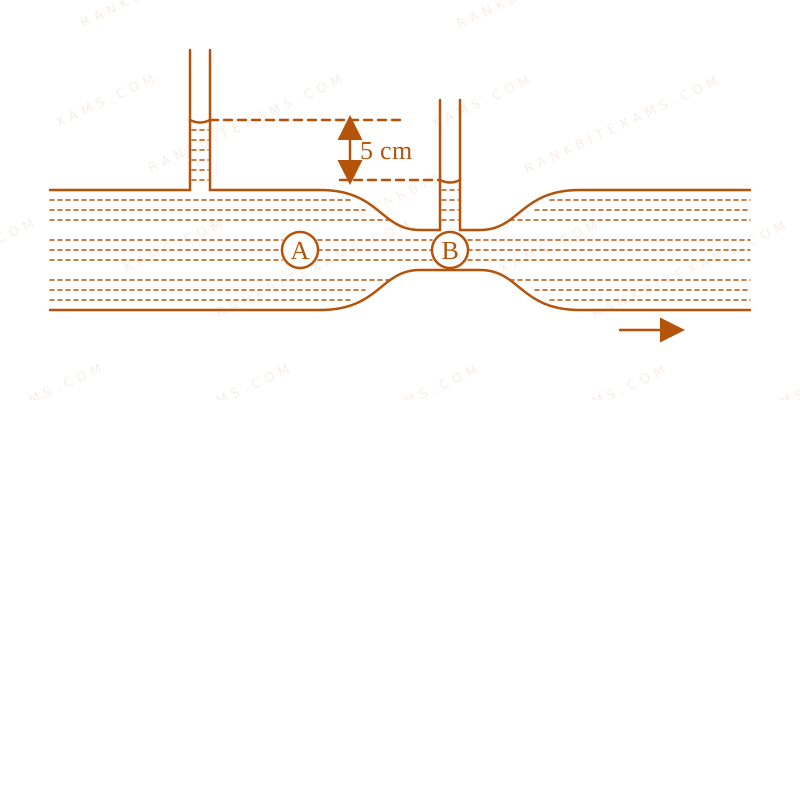
Water flows through a horizontal tube as shown in the figure. The difference in height between the water columns in vertical tubes is 5 cm and the area of cross-sections at A and B are 6text cm^2 and 3text cm^2 respectively. The rate of flow will be ____ textcm^3/s. (take g = 10 textm/s^2)
Bernoulli's Principle diagram for Q29 - JEE Main 2026 Morning
The figure illustrates a Venturi meter setup with water flowing through a variable cross-section tube.

Solution & Explanation

### Related Formula A_1 V_1 = A_2 V_2 P_1 + frac12rho V_1^2 = P_2 + frac12rho V_2^2 P_1 - P_2 = rho g h ### Core Logic From the continuity equation between A and B: A_AV_A = A_BV_B implies 6V_A = 3V_B implies V_B = 2V_A Applying Bernoulli's equation between A and B for a horizontal pipe: P_A + frac12rho V_A^2 = P_B + frac12rho V_B^2 P_A - P_B = frac12rho(V_B^2 - V_A^2) Since the height difference is h = 5text cm = 0.05text m, the pressure difference is rho gh. rho g times 0.05 = frac12rho( (2V_A)^2 - V_A^2 ) g times 0.05 = frac12(3V_A^2) ### Step 1: Calculate Velocity and Volume Flow Rate Solving for V_A: V_A = sqrtfrac2 times 10 times 0.053 = sqrtfrac13 = frac1sqrt3text m/s V_A = frac100sqrt3text cm/s Volume flow rate Q = A_A V_A: Q = 6text cm^2 times frac100sqrt3text cm/s = frac600sqrt3 = 200sqrt3text cm^3text/s ### Pattern Recognition In a horizontal Venturi meter, substituting V_2 = V_1 (A_1/A_2) directly into rho g h = frac12rho (V_2^2 - V_1^2) is the standard path. Working in CGS vs MKS units requires careful tracking; convert V_A to cm/s before multiplying by A_A in cm². ### Evaluation Rubric / Model Answer null ### Chapter Mix Class 11 Physics: Mechanical Properties of Fluids
More Mechanical Properties of Fluids Previous-Year Questions — Page 4

Q58 jee_main_2024_01_february_morning Bernoulli's Principle
A plane is in level flight at constant speed and each of its two wings has an area of 40mathrm~m^2. If the speed of the air is 180mathrm~km/h over the lower wing surface and 252mathrm~km/h over the upper wing surface, the mass of the plane is _______ mathrmkg. (Take air density to be 1mathrm~kg\ m^-3 and g = 10mathrm~ms^-2)
Numerical Answer. Answer: 9600 to 9600

Solution

### Related Formula Bernoulli's pressure balance equation for aerofoils: Delta P = P_1 - P_2 = frac12rho(v_2^2 - v_1^2) Dynamic Lift force balancing plane weight: F_textlift = Delta P cdot A_texttotal = mg ### Core Logic Convert velocity limits to SI units: v_1 = 180mathrm~km/h = 180 times frac518 = 50mathrm~ms^-1 v_2 = 252mathrm~km/h = 252 times frac518 = 70mathrm~ms^-1 Total effective wing area layout (2 wings): A_texttotal = 2 times 40 = 80mathrm~m^2 ### Step 1: Calculate Mass Balance Substitute these values into the dynamic lift equation: mg = frac12 rho (v_2^2 - v_1^2) A_texttotal m(10) = frac12 times 1 times (70^2 - 50^2) times 80 10m = 40 times (4900 - 2500) = 40 times 2400 = 96000 m = 9600mathrm~kg ### Pattern Recognition Remember to multiply individual wing areas by 2 for standard multi-wing lift structures (A_texttotal = 2A). ### Evaluation Rubric / Model Answer null ### Chapter Mix Class 11 Physics: Mechanical Properties of Fluids

Q41 jee_main_2024_29_january_evening Surface Tension
A small liquid drop of radius R is divided into 27 identical liquid drops. If the surface tension is T, then the work done in the process will be:
  • A. 8pi R^2 T
  • B. 3pi R^2 T
  • C. frac18pi R^2 T
  • D. 4pi R^2 T

Solution

### Related Formula The work done in changing the surface area of a liquid is given by: W = T cdot Delta A where: * T is the surface tension of the liquid. * Delta A = A_f - A_i is the change in the total surface area. ### Core Logic Since the total volume remains constant during splitting: V_i = V_f frac43pi R^3 = 27 times frac43pi r^3 R^3 = 27r^3 implies r = fracR3 ### Step 1: Calculate the Change in Surface Area Initial surface area of the single drop: A_i = 4pi R^2 Final surface area of 27 small drops: A_f = 27 times (4pi r^2) = 27 times 4pi left(fracR3right)^2 A_f = 27 times 4pi fracR^29 = 12pi R^2 Change in surface area: Delta A = A_f - A_i = 12pi R^2 - 4pi R^2 = 8pi R^2 ### Step 2: Calculate Work Done Substituting the change in area into the work done formula: W = T cdot Delta A = 8pi R^2 T ### Pattern Recognition For splitting a large drop of radius R into n identical small drops, the change in surface area is given by Delta A = 4pi R^2 (n^1/3 - 1). Substituting n = 27 gives Delta A = 4pi R^2 (3 - 1) = 8pi R^2, leading immediately to 8pi R^2 T. ### Evaluation Rubric / Model Answer null ### Chapter Mix Class 11 Physics: Mechanical Properties of Fluids
Q32 jee_main_2024_27_jan_morning Viscosity and Surface Tension
Given below are two statements: Statement (I): Viscosity of gases is greater than that of liquids. Statement (II): Surface tension of a liquid decreases due to the presence of insoluble impurities. In the light of the above statements, choose the most appropriate answer from the options given below:
  • A. textStatement I is correct but Statement II is incorrect
  • B. textStatement I is incorrect but Statement II is correct
  • C. textBoth Statement I and Statement II are incorrect
  • D. textBoth Statement I and Statement II are correct

Solution

### Core Logic Statement (I): Liquids have much stronger intermolecular forces compared to gases, leading to significantly higher viscosity in liquids than in gases. Thus, Statement I is incorrect. Statement (II): The presence of insoluble impurities (like soap or detergents) disrupts the cohesive forces between liquid molecules at the surface, which decreases the surface tension. Thus, Statement II is correct. ### Pattern Recognition Viscosity in liquids decreases with temperature, whereas in gases it increases with temperature due to molecular collisions. Insoluble impurities act as surface-active agents that lower surface tension cohesive stability. ### Evaluation Rubric / Model Answer null ### Chapter Mix Class 11 Physics: Mechanical Properties of Fluids
Q33 jee_main_2024_29_jan_morning Surface Tension and Capillarity
Given below are two statements: Statement I: If a capillary tube is immersed first in cold water and then in hot water, the height of capillary rise will be smaller in hot water. Statement II: If a capillary tube is immersed first in cold water and then in hot water, the height of capillary rise will be smaller in cold water. In the light of the above statements, choose the most appropriate from the options given below:
  • A. Both Statement I and Statement II are true
  • B. Both Statement I and Statement II are false
  • C. Statement I is true but Statement II is false
  • D. Statement I is false but Statement II is true

Solution

### Related Formula The height of capillary rise (h) is given by: h = frac2T cos thetarho g r where, T = surface tension of the liquid theta = angle of contact rho = density of the liquid r = radius of the capillary tube ### Core Logic As the temperature of water increases, its intermolecular cohesive forces decrease. This leads to a decrease in surface tension (T). Since h propto T (assuming rho and theta remain relatively constant), height of capillary rise decreases with increase in temperature. ### Step 1: Evaluate Statement I and II Because T_texthot lt T_textcold, it follows that h_texthot lt h_textcold. * **Statement I** states: the height of capillary rise will be smaller in hot water. This is **True**. * **Statement II** states: the height of capillary rise will be smaller in cold water. This is **False**. ### Pattern Recognition Remember the key physical dependence: **Temperature Up implies Surface Tension Down implies Capillary Rise Down**. This basic trend of cohesive/adhesive properties versus thermal energy frequently appears in competitive conceptual physical chemistry/fluid physics questions. ### Evaluation Rubric / Model Answer null ### Chapter Mix Class 11 Physics: Mechanical Properties of Fluids
Q60 jee_main_2024_29_jan_morning Bernoulli's Principle
In a test experiment on a model aeroplane in wind tunnel, the flow speeds on the upper and lower surfaces of the wings are 70~mathrmms^-1 and 65~mathrmms^-1 respectively. If the wing area is 2~mathrmm^2 the lift of the wing is ________ N. (Given density of air = 1.2~mathrmkg\,mathrmm^-3)
Numerical Answer. Answer: 810 to 810

Solution

### Related Formula From Bernoulli's Principle (ignoring small height differences across the wing thickness): P_1 + frac12 rho v_1^2 = P_2 + frac12 rho v_2^2 Delta P = P_2 - P_1 = frac12 rho (v_1^2 - v_2^2) Net aerodynamic lift force (F) acting on wing area A is: F = Delta P cdot A = frac12 rho (v_1^2 - v_2^2) A ### Core Logic Given values: * Flow speed on upper surface (v_1) = 70 mathrm~ms^-1 * Flow speed on lower surface (v_2) = 65 mathrm~ms^-1 * Wing area (A) = 2 mathrm~m^2 * Density of air (rho) = 1.2 mathrm~kgcdot m^-3 ### Step 1: Compute Lift Force Substituting these metrics directly into the dynamic lift equation: F = frac12 times 1.2 times left(70^2 - 65^2right) times 2 Notice that the factors frac12 and 2 cancel out perfectly: F = 1.2 times left(4900 - 4225right) F = 1.2 times 675 = 810 mathrm~N Therefore, the net lift force on the wing is 810 mathrm~N. ### Pattern Recognition Use the algebraic difference of squares shortcut a^2 - b^2 = (a-b)(a+b) to solve velocity square differences quickly: 70^2 - 65^2 = (70-65)(70+65) = 5 times 135 = 675, bypassing squaring heavy multi-digit calculations. ### Evaluation Rubric / Model Answer null ### Chapter Mix Class 11 Physics: Mechanical Properties of Fluids

More Mechanical Properties of Fluids Questions — jee_main_2026_21_jan_morning

Practice all Mechanical Properties of Fluids previous-year questions →

Rankbit System
JEE Physics: Waves (+15.5%) | Electrostatics: Concentric Shells (-29.7%) | Modern Physics: Photoelectric Clones (+34.2%) | Mathematics: Definite Integrals (+18.1%) | Chemistry: Coordination Splitting (-11.4%) | JEE Physics: Waves (+15.5%) | Electrostatics: Concentric Shells (-29.7%) | Modern Physics: Photoelectric Clones (+34.2%) | Mathematics: Definite Integrals (+18.1%) | Chemistry: Coordination Splitting (-11.4%)
YOUR FIRST PREP STEP STARTS HERE

We Map Every Repeating Question in Competitive Exams.

Say goodbye to generic mock test fatigue. RankBit uses smart analysis to group past exam questions into their foundational Repeating Question Types. Find chapter weightage, track repeating questions, and score higher with targeted practice.

Select Your Target Exam

Choose an exam track below to find formulas per chapter and patterns.

Syncing Exam Intelligence

Mapping formulas and patterns across all tracks…

PATH A — FULL LENGTH PRACTICE

Full Mock Test Hub

Simulate real NTA exam conditions with fully tracked mocks. Time yourself against past papers.

Now Live Open
PATH B — TARGETED PRACTICE

Topic-wise Practice Hub

Practice past-year questions one chapter at a time. Pick an exam → subject → chapter and get every PYQ for that topic — pulled together from all past papers — with the chapter's key formulas alongside.

Loading Questions... Browse Topics
Latest from the Blog
View all →

Loading articles...