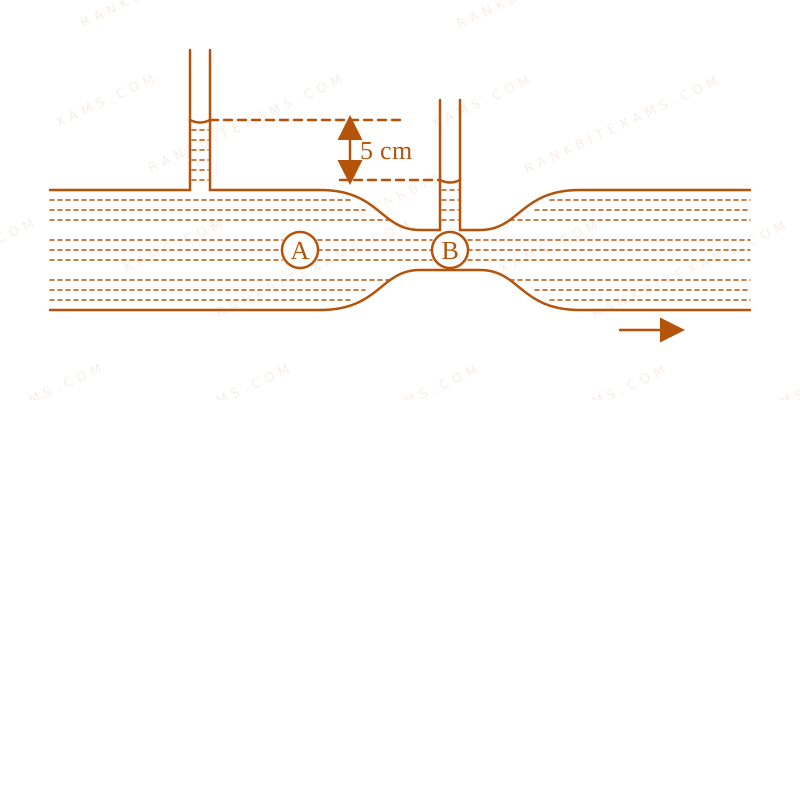
Water flows through a horizontal tube as shown in the figure. The difference in height between the water columns in vertical tubes is 5 cm and the area of cross-sections at A and B are 6text cm^2 and 3text cm^2 respectively. The rate of flow will be ____ textcm^3/s. (take g = 10 textm/s^2)
Bernoulli's Principle diagram for Q29 - JEE Main 2026 Morning
The figure illustrates a Venturi meter setup with water flowing through a variable cross-section tube.

Solution & Explanation

### Related Formula A_1 V_1 = A_2 V_2 P_1 + frac12rho V_1^2 = P_2 + frac12rho V_2^2 P_1 - P_2 = rho g h ### Core Logic From the continuity equation between A and B: A_AV_A = A_BV_B implies 6V_A = 3V_B implies V_B = 2V_A Applying Bernoulli's equation between A and B for a horizontal pipe: P_A + frac12rho V_A^2 = P_B + frac12rho V_B^2 P_A - P_B = frac12rho(V_B^2 - V_A^2) Since the height difference is h = 5text cm = 0.05text m, the pressure difference is rho gh. rho g times 0.05 = frac12rho( (2V_A)^2 - V_A^2 ) g times 0.05 = frac12(3V_A^2) ### Step 1: Calculate Velocity and Volume Flow Rate Solving for V_A: V_A = sqrtfrac2 times 10 times 0.053 = sqrtfrac13 = frac1sqrt3text m/s V_A = frac100sqrt3text cm/s Volume flow rate Q = A_A V_A: Q = 6text cm^2 times frac100sqrt3text cm/s = frac600sqrt3 = 200sqrt3text cm^3text/s ### Pattern Recognition In a horizontal Venturi meter, substituting V_2 = V_1 (A_1/A_2) directly into rho g h = frac12rho (V_2^2 - V_1^2) is the standard path. Working in CGS vs MKS units requires careful tracking; convert V_A to cm/s before multiplying by A_A in cm². ### Evaluation Rubric / Model Answer null ### Chapter Mix Class 11 Physics: Mechanical Properties of Fluids
More Mechanical Properties of Fluids Previous-Year Questions — Page 5

Q52 jee_main_2024_30_january_evening Surface Energy of Drops
A big drop is formed by coalescing 1000 small identical drops of water. If mathrmE_1 be the total surface energy of 1000 small drops of water and mathrmE_2 be the surface energy of single big drop of water, the mathrmE_1:mathrmE_2 is x:1 where x =
Numerical Answer. Answer: 10 to 10

Solution

### Related Formula V_textinitial = V_textfinal E = S times A ### Core Logic When small drops coalesce to form a large drop, the total volume is conserved. 1000 times frac43 pi r^3 = frac43 pi R^3 R^3 = 1000 r^3 implies R = 10r ### Step 1: Calculate Surface Energies The total surface energy of 1000 small drops (mathrmE_1) is: mathrmE_1 = 1000 times 4pi r^2 times S The surface energy of the single big drop (mathrmE_2) is: mathrmE_2 = 4pi R^2 times S = 4pi (10r)^2 times S = 100 times 4pi r^2 times S ### Step 2: Find the Ratio fracmathrmE_1mathrmE_2 = frac1000100 = frac101 Thus, the ratio is 10:1, which means x = 10. ### Pattern Recognition When N droplets merge to form one big drop, the radius scales as R = N^1/3 r. The ratio of total initial surface energy to final surface energy is N^1/3. ### Evaluation Rubric / Model Answer null ### Chapter Mix Class 11 Physics: Mechanical Properties of Fluids

Q47 jee_main_2024_31_jan_evening Viscosity and Terminal Velocity
A small spherical ball of radius r, falling through a viscous medium of negligible density has terminal velocity 'v'. Another ball of the same mass but of radius 2r, falling through the same viscous medium will have terminal velocity:
  • A. fracv2
  • B. fracv4
  • C. 4v
  • D. 2v

Solution

### Related Formula At terminal velocity, downward force equals upward drag (assuming negligible buoyancy): Mg = 6pi eta r v v = fracMg6pi eta r ### Core Logic Since the density of the medium is negligible, we ignore buoyant forces. The mass M of the ball is specified to remain the same in both cases, despite the change in radius (implying the material density of the second ball is lower). ### Step 1: Setup Proportionality Since M, g, and eta are all constants: v propto frac1r ### Step 2: Evaluating the Ratio For the second ball, r' = 2r. Therefore, the new terminal velocity v' is: v' = v times left(fracrr'right) = v times left(fracr2rright) = fracv2 ### Pattern Recognition Read the constraints carefully. Usually, questions keep material density uniform (v propto r^2). However, this specifically says "same mass". This shifts the formula dependency from v propto r^2 entirely to v propto 1/r because M acts as a constant numerator. ### Evaluation Rubric / Model Answer null ### Chapter Mix Class 11 Physics: Mechanical Properties of Fluids
Q46 jee_main_2024_31_jan_morning Viscosity And Terminal Velocity
A small steel ball is dropped into a long cylinder containing glycerine. Which one of the following is the correct representation of the velocity time graph for the transit of the ball?
  • A. textGraph 1
  • B. textGraph 2
  • C. textGraph 3
  • D. textGraph 4

Solution

### Related Formula mg - F_B - F_v = ma F_v = 6pieta r v ### Core Logic
Viscosity And Terminal Velocity diagram for Q46 - JEE Main 2024 Morning
When dropped, three forces act on the ball: Gravity downwards, Buoyant force upwards, and Viscous drag upwards. mg - F_B - F_v = m fracdvdt left(rho frac43pi r^3right)g - left(rho_L frac43pi r^3right)g - 6pieta rv = m fracdvdt Let frac4pi r^3 g(rho - rho_L)3m = K_1 and frac6pieta rm = K_2. fracdvdt = K_1 - K_2 v Integrating from t=0, v=0: int_0^v fracdvK_1 - K_2 v = int_0^t dt -frac1K_2 ln left(fracK_1 - K_2 vK_1right) = t v = fracK_1K_2 left( 1 - e^-K_2 t right) This is an exponential curve starting from the origin and asymptotically approaching the terminal velocity V_T = K_1 / K_2. ### Evaluation Rubric / Model Answer null ### Chapter Mix Class 11 Physics: Mechanical Properties Of Fluids

More Mechanical Properties of Fluids Questions — jee_main_2026_21_jan_morning

Practice all Mechanical Properties of Fluids previous-year questions →

Rankbit System
JEE Physics: Waves (+15.5%) | Electrostatics: Concentric Shells (-29.7%) | Modern Physics: Photoelectric Clones (+34.2%) | Mathematics: Definite Integrals (+18.1%) | Chemistry: Coordination Splitting (-11.4%) | JEE Physics: Waves (+15.5%) | Electrostatics: Concentric Shells (-29.7%) | Modern Physics: Photoelectric Clones (+34.2%) | Mathematics: Definite Integrals (+18.1%) | Chemistry: Coordination Splitting (-11.4%)
YOUR FIRST PREP STEP STARTS HERE

We Map Every Repeating Question in Competitive Exams.

Say goodbye to generic mock test fatigue. RankBit uses smart analysis to group past exam questions into their foundational Repeating Question Types. Find chapter weightage, track repeating questions, and score higher with targeted practice.

Select Your Target Exam

Choose an exam track below to find formulas per chapter and patterns.

Syncing Exam Intelligence

Mapping formulas and patterns across all tracks…

PATH A — FULL LENGTH PRACTICE

Full Mock Test Hub

Simulate real NTA exam conditions with fully tracked mocks. Time yourself against past papers.

Now Live Open
PATH B — TARGETED PRACTICE

Topic-wise Practice Hub

Practice past-year questions one chapter at a time. Pick an exam → subject → chapter and get every PYQ for that topic — pulled together from all past papers — with the chapter's key formulas alongside.

Loading Questions... Browse Topics
Latest from the Blog
View all →

Loading articles...