A 400g$400\mathrm{g}$ solid cube having an edge of length 10cm$10\mathrm{cm}$ floats in water. How much volume of the cube is outside the water?
(Given: density of water = 1000kgm⁻³$= 1000\mathrm{kg}\mathrm{m}^{-3}$ )
A.1400cm³$1400\mathrm{cm}^3$
B.4000cm³$4000\mathrm{cm}^3$
C.400cm³$400\mathrm{cm}^3$
D.600~cm³$600~\mathrm{cm}^3$
Solution & Explanation
Related Formula
By the law of flotation, the weight of a floating body must exactly balance the buoyant force exerted by the displaced fluid volume:
M · g = ρfluid · Vsubmerged · g$$M \cdot g = \rho_{\text{fluid}} \cdot V_{\text{submerged}} \cdot g$$
Core Logic
Given parameters:
Mass of the cube, M = 400 g = 0.4 kg$M = 400 \text{ g} = 0.4 \text{ kg}$
Total volume of the cube, Vtotal = (10 cm)³ = 1000 cm³ = 10⁻³ m³$V_{\text{total}} = (10 \text{ cm})^3 = 1000 \text{ cm}^3 = 10^{-3} \text{ m}^3$
Density of water, ρwater = 1000 kg/m³$\rho_{\text{water}} = 1000 \text{ kg/m}^3$
Equating weight to buoyant force to find the submerged volume Vd$V_d$ :
The fraction of a floating body's volume that is submerged equals the ratio of the body's density to the fluid's density: VsubmergedVtotal = ρbodyρfluid$\frac{V_{\text{submerged}}}{V_{\text{total}}} = \frac{\rho_{\text{body}}}{\rho_{\text{fluid}}}$. Here, the cube's effective density is 0.4 g/cm³$0.4 \text{ g/cm}^3$, meaning 40%$40\%$ is submerged and 60%$60\%$ stays outside.
Keywords:#volume of cube outside water flotation#JEE Main 2025 Evening Q18#Mechanical Properties of Fluids JEE Main 2025#buoyant force archimedes principle
More Mechanical Properties of Fluids Previous-Year Questions
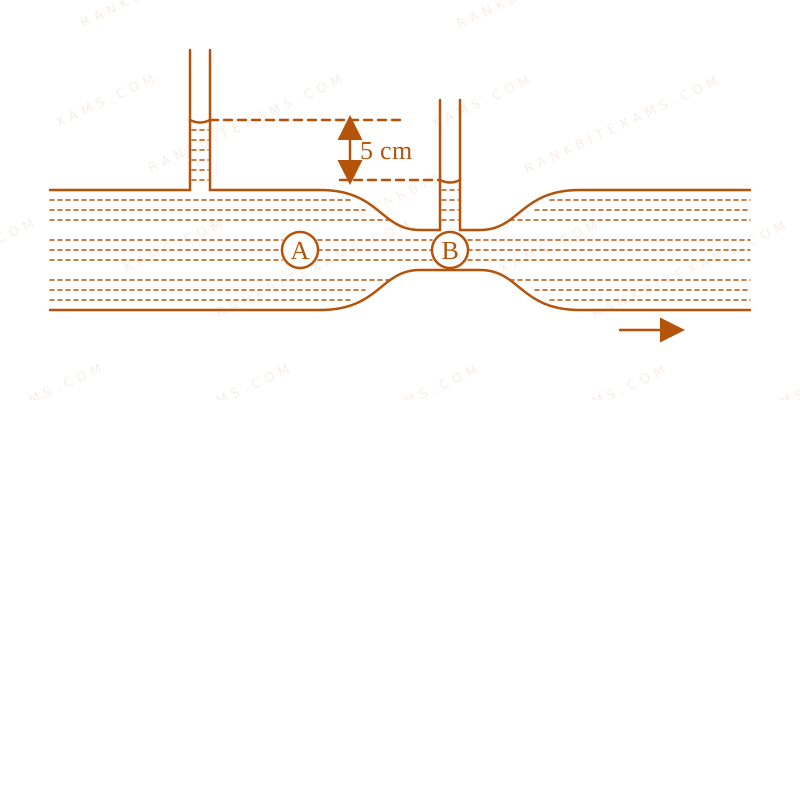
Water flows through a horizontal tube as shown in the figure. The difference in height between the water columns in vertical tubes is 5 cm and the area of cross-sections at A and B are 6 cm²$6\text{ cm}^{2}$ and 3 cm²$3\text{ cm}^{2}$ respectively. The rate of flow will be ____ cm³$\text{cm}^{3}$/s. (take g = 10 m/s²$\text{m/s}^{2}$)
The figure illustrates a Venturi meter setup with water flowing through a variable cross-section tube.
In a horizontal Venturi meter, substituting V₂ = V₁ (A₁/A₂)$V_2 = V_1 (A_1/A_2)$ directly into ρ g h = (1)/(2)ρ (V₂² - V₁²)$\rho g h = \frac{1}{2}\rho (V_2^2 - V_1^2)$ is the standard path. Working in CGS vs MKS units requires careful tracking; convert VA$V_A$ to cm/s before multiplying by AA$A_A$ in cm².
Chapter Mix
Class 11 Physics: Mechanical Properties of Fluids
Q38jee_main_2026_21_jan_eveningSurface Tension
Surface tension of two liquids (having same densities), T₁$T_{1}$ and T₂$T_{2}$, are measured using capillary rise method utilizing two tubes with inner radii of r₁$r_{1}$ and r₂$r_{2}$ where r₁ > r₂$r_{1} > r_{2}$. The measured liquid heights in these tubes are h₁$h_{1}$ and h₂$h_{2}$ respectively. [Ignore the weight of the liquid about the lowest point of miniscus]. The heights h₁$h_{1}$ and h₂$h_{2}$ and surface tensions T₁$T_{1}$ and T₂$T_{2}$ satisfy the relation :
A.h₁ < h₂ and T₁ = T₂$h_1 < h_2 \text{ and } T_1 = T_2$
B.h₁ = h₂ and T₁ = T₂$h_1 = h_2 \text{ and } T_1 = T_2$
C.h₁ > h₂ and T₁ = T₂$h_1 > h_2 \text{ and } T_1 = T_2$
D.h₁ > h₂ and T₁ < T₂$h_1 > h_2 \text{ and } T_1 < T_2$
Solution
Related Formula
h = (2T θ)/(ρ g r)$$h = \frac{2T\cos\theta}{\rho g r}$$
Core Logic
Since we are assessing surface tension T$T$ as a property of the liquids, the question intends to compare liquids that are identical (implying T₁ = T₂$T_1 = T_2$ and same density).
Capillary rise formula block for Q38 - JEE Main 2026 Evening
By Jurin's Law, for identical liquids, the height of capillary rise is inversely proportional to the radius of the tube:
h ∝ (1)/(r)$$h \propto \frac{1}{r}$$
Step 1: Final Conclusion
Given r₁ > r₂$r_1 > r_2$, the inverse proportionality directly implies that the liquid will rise less in the wider tube.
Therefore, h₁ < h₂$h_1 < h_2$ and naturally T₁ = T₂$T_1 = T_2$ for the intrinsic property.
Pattern Recognition
Wider tubes (r$r$ large) cause lower capillary rises (h$h$ small). h ∝ 1/r$h \propto 1/r$ is a foundational inverse relationship in capillary action.
Chapter Mix
Class 11 Physics: Mechanical Properties of Fluids
Q47jee_main_2026_21_jan_eveningTerminal Velocity
The terminal velocity of a metallic ball of radius 6 mm$6 \text{ mm}$ in a viscous fluid is 20 cm/s$20 \text{ cm/s}$. The terminal velocity of another ball of same material and having radius 3 mm$3 \text{ mm}$ in the same fluid will be ________ cm/s.
For balls of the same material falling through the same fluid, all terms in the terminal velocity equation except the radius r$r$ are constant.
Therefore, vT ∝ r²$v_T \propto r^2$.
Terminal velocity is directly proportional to the square of the radius. Halving the radius (6 → 3$6 \to 3$) will drop the terminal velocity by a factor of 1/4$1/4$.
Chapter Mix
Class 11 Physics: Mechanical Properties of Fluids
Q33jee_main_2026_22_january_morningPascal's Law and Surface Tension
Given below are two statements:
Statement I : Pressure of fluid is exerted only on a solid surface in contact as the fluid-pressure does not exist everywhere in a still fluid.
Statement II: Excess potential energy of the molecules on the surface of a liquid, when compared to interior, results in surface tension.
In the light of the above statements, choose the correct answer from the options given below:
A.Statement I is true but Statement II is false$\text{Statement I is true but Statement II is false}$
B.Both Statement I and Statement II are false$\text{Both Statement I and Statement II are false}$
C.Both Statement I and Statement II are true$\text{Both Statement I and Statement II are true}$
D.Statement I is false but Statement II is true$\text{Statement I is false but Statement II is true}$
According to Pascal's law, pressure exists at every point in a liquid at rest, not just at boundaries. Thus, Statement I is false.
For interior molecules, net cohesive forces are zero, whereas surface molecules possess excess potential energy leading to surface tension. Thus, Statement II is correct.
Pattern Recognition
Sees: Fluid pressure definition + surface tension origin.
Shortcut: Recall Pascal's law (pressure everywhere) and surface energy excess.
Check: Matches option (4). ✓
Chapter Mix
Class 11 Physics: Mechanical Properties of Fluids
Q34jee_main_2026_22_january_eveningCapillarity and Surface Tension
When a part of a straight capillary tube is placed vertically in a liquid, the liquid raises up to certain height h. If the inner radius of the capillary tube, density of the liquid and surface tension of the liquid decrease by 1 % each, then the height of the liquid in the tube will change by ____%.
Practice past-year questions one chapter at a time. Pick an exam → subject → chapter and get every PYQ for that topic — pulled together from all past papers — with the chapter's key formulas alongside.