Given below are two statements:
Statement I : Pressure of fluid is exerted only on a solid surface in contact as the fluid-pressure does not exist everywhere in a still fluid.
Statement II: Excess potential energy of the molecules on the surface of a liquid, when compared to interior, results in surface tension.
In the light of the above statements, choose the correct answer from the options given below:
A.textStatement I is true but Statement II is false$\text{Statement I is true but Statement II is false}$
B.textBoth Statement I and Statement II are false$\text{Both Statement I and Statement II are false}$
C.textBoth Statement I and Statement II are true$\text{Both Statement I and Statement II are true}$
D.textStatement I is false but Statement II is true$\text{Statement I is false but Statement II is true}$
Solution & Explanation
### Related Formula
P = fracFA, quad textSurface Tension propto Delta U$$P = \frac{F}{A}, \quad \text{Surface Tension} \propto \Delta U$$
### Core Logic
According to Pascal's law, pressure exists at every point in a liquid at rest, not just at boundaries. Thus, Statement I is false.
For interior molecules, net cohesive forces are zero, whereas surface molecules possess excess potential energy leading to surface tension. Thus, Statement II is correct.
### Pattern Recognition
Sees: Fluid pressure definition + surface tension origin.
Shortcut: Recall Pascal's law (pressure everywhere) and surface energy excess.
Check: Matches option (4). ✓
### Chapter Mix
Class 11 Physics: Mechanical Properties of Fluids
Keywords:#Given below are two statements Pressure of fluid is exerted#JEE Main 2026 Morning Q33#Mechanical Properties of Fluids JEE Main 2026#Pascal's Law and Surface Tension JEE Main 2026
More Mechanical Properties of Fluids Previous-Year Questions
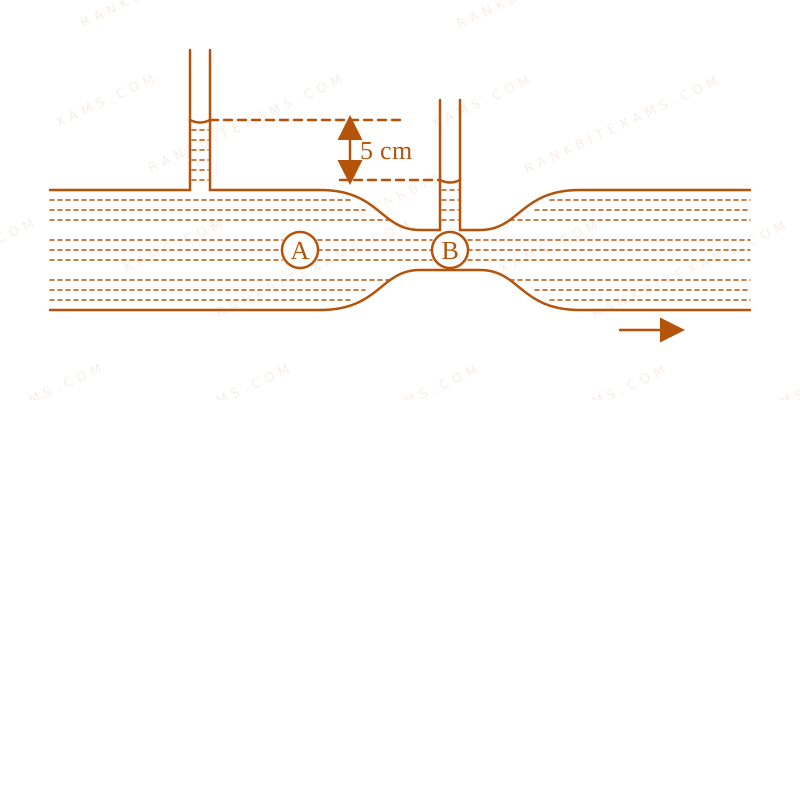
Water flows through a horizontal tube as shown in the figure. The difference in height between the water columns in vertical tubes is 5 cm and the area of cross-sections at A and B are 6text cm^2$6\text{ cm}^{2}$ and 3text cm^2$3\text{ cm}^{2}$ respectively. The rate of flow will be ____ textcm^3$\text{cm}^{3}$/s. (take g = 10 textm/s^2$\text{m/s}^{2}$)
The figure illustrates a Venturi meter setup with water flowing through a variable cross-section tube.
A.frac200sqrt3$\frac{200}{\sqrt{3}}$
B.200sqrt6$200\sqrt{6}$
C.200sqrt3$200\sqrt{3}$
D.100sqrt3$100\sqrt{3}$
Solution
### Related Formula
A_1 V_1 = A_2 V_2$$A_1 V_1 = A_2 V_2$$P_1 + frac12rho V_1^2 = P_2 + frac12rho V_2^2$$P_1 + \frac{1}{2}\rho V_1^2 = P_2 + \frac{1}{2}\rho V_2^2$$P_1 - P_2 = rho g h$$P_1 - P_2 = \rho g h$$
### Core Logic
From the continuity equation between A and B:
A_AV_A = A_BV_B implies 6V_A = 3V_B implies V_B = 2V_A$$A_{A}V_{A} = A_{B}V_{B} \implies 6V_{A} = 3V_{B} \implies V_{B} = 2V_{A}$$
Applying Bernoulli's equation between A and B for a horizontal pipe:
P_A + frac12rho V_A^2 = P_B + frac12rho V_B^2$$P_{A} + \frac{1}{2}\rho V_{A}^{2} = P_{B} + \frac{1}{2}\rho V_{B}^{2}$$P_A - P_B = frac12rho(V_B^2 - V_A^2)$$P_{A} - P_{B} = \frac{1}{2}\rho(V_{B}^{2} - V_{A}^{2})$$
Since the height difference is h = 5text cm = 0.05text m$h = 5\text{ cm} = 0.05\text{ m}$, the pressure difference is rho gh$\rho gh$.
rho g times 0.05 = frac12rho( (2V_A)^2 - V_A^2 )$$\rho g \times 0.05 = \frac{1}{2}\rho( (2V_A)^2 - V_A^2 )$$g times 0.05 = frac12(3V_A^2)$$g \times 0.05 = \frac{1}{2}(3V_{A}^{2})$$
### Step 1: Calculate Velocity and Volume Flow Rate
Solving for V_A$V_A$:
V_A = sqrtfrac2 times 10 times 0.053 = sqrtfrac13 = frac1sqrt3text m/s$$V_{A} = \sqrt{\frac{2 \times 10 \times 0.05}{3}} = \sqrt{\frac{1}{3}} = \frac{1}{\sqrt{3}}\text{ m/s}$$V_A = frac100sqrt3text cm/s$$V_A = \frac{100}{\sqrt{3}}\text{ cm/s}$$
Volume flow rate Q = A_A V_A$Q = A_{A} V_{A}$:
Q = 6text cm^2 times frac100sqrt3text cm/s = frac600sqrt3 = 200sqrt3text cm^3text/s$$Q = 6\text{ cm}^2 \times \frac{100}{\sqrt{3}}\text{ cm/s} = \frac{600}{\sqrt{3}} = 200\sqrt{3}\text{ cm}^{3}\text{/s}$$
### Pattern Recognition
In a horizontal Venturi meter, substituting V_2 = V_1 (A_1/A_2)$V_2 = V_1 (A_1/A_2)$ directly into rho g h = frac12rho (V_2^2 - V_1^2)$\rho g h = \frac{1}{2}\rho (V_2^2 - V_1^2)$ is the standard path. Working in CGS vs MKS units requires careful tracking; convert V_A$V_A$ to cm/s before multiplying by A_A$A_A$ in cm².
### Evaluation Rubric / Model Answer
null
### Chapter Mix
Class 11 Physics: Mechanical Properties of Fluids
Q38jee_main_2026_21_jan_eveningSurface Tension
Surface tension of two liquids (having same densities), T_1$T_{1}$ and T_2$T_{2}$, are measured using capillary rise method utilizing two tubes with inner radii of r_1$r_{1}$ and r_2$r_{2}$ where r_1 > r_2$r_{1} > r_{2}$. The measured liquid heights in these tubes are h_1$h_{1}$ and h_2$h_{2}$ respectively. [Ignore the weight of the liquid about the lowest point of miniscus]. The heights h_1$h_{1}$ and h_2$h_{2}$ and surface tensions T_1$T_{1}$ and T_2$T_{2}$ satisfy the relation :
A.h_1 < h_2 text and T_1 = T_2$h_1 < h_2 \text{ and } T_1 = T_2$
B.h_1 = h_2 text and T_1 = T_2$h_1 = h_2 \text{ and } T_1 = T_2$
C.h_1 > h_2 text and T_1 = T_2$h_1 > h_2 \text{ and } T_1 = T_2$
D.h_1 > h_2 text and T_1 < T_2$h_1 > h_2 \text{ and } T_1 < T_2$
Solution
### Related Formula
h = frac2Tcosthetarho g r$$h = \frac{2T\cos\theta}{\rho g r}$$
### Core Logic
Since we are assessing surface tension T$T$ as a property of the liquids, the question intends to compare liquids that are identical (implying T_1 = T_2$T_1 = T_2$ and same density).
Capillary rise formula block for Q38 - JEE Main 2026 Evening
By Jurin's Law, for identical liquids, the height of capillary rise is inversely proportional to the radius of the tube:
h propto frac1r$$h \propto \frac{1}{r}$$
### Step 1: Final Conclusion
Given r_1 > r_2$r_1 > r_2$, the inverse proportionality directly implies that the liquid will rise less in the wider tube.
Therefore, h_1 < h_2$h_1 < h_2$ and naturally T_1 = T_2$T_1 = T_2$ for the intrinsic property.
### Pattern Recognition
Wider tubes (r$r$ large) cause lower capillary rises (h$h$ small). h propto 1/r$h \propto 1/r$ is a foundational inverse relationship in capillary action.
### Evaluation Rubric / Model Answer
null
### Chapter Mix
Class 11 Physics: Mechanical Properties of Fluids
Q47jee_main_2026_21_jan_eveningTerminal Velocity
The terminal velocity of a metallic ball of radius 6 text mm$6 \text{ mm}$ in a viscous fluid is 20 text cm/s$20 \text{ cm/s}$. The terminal velocity of another ball of same material and having radius 3 text mm$3 \text{ mm}$ in the same fluid will be ________ cm/s.
Numerical Answer.Answer: 5 to 5
Solution
### Related Formula
v_T = frac2r^2 g9eta (sigma - rho)$$v_T = \frac{2r^2 g}{9\eta} (\sigma - \rho)$$
### Core Logic
For balls of the same material falling through the same fluid, all terms in the terminal velocity equation except the radius r$r$ are constant.
Therefore, v_T propto r^2$v_T \propto r^2$.
### Step 1: Setting up the Ratio
frac(v_T)_1(v_T)_2 = left(fracr_1r_2right)^2$$\frac{(v_T)_1}{(v_T)_2} = \left(\frac{r_1}{r_2}\right)^2$$
Substituting the given values:
r_1 = 6 text mm$r_1 = 6 \text{ mm}$, (v_T)_1 = 20 text cm/s$(v_T)_1 = 20 \text{ cm/s}$r_2 = 3 text mm$r_2 = 3 \text{ mm}$
### Step 2: Final Conclusion
frac20(v_T)_2 = left(frac63right)^2$$\frac{20}{(v_T)_2} = \left(\frac{6}{3}\right)^2$$frac20(v_T)_2 = 2^2 = 4$$\frac{20}{(v_T)_2} = 2^2 = 4$$(v_T)_2 = frac204 = 5 text cm/s$$(v_T)_2 = \frac{20}{4} = 5 \text{ cm/s}$$
### Pattern Recognition
Terminal velocity is directly proportional to the square of the radius. Halving the radius (6 to 3$6 \to 3$) will drop the terminal velocity by a factor of 1/4$1/4$.
### Evaluation Rubric / Model Answer
null
### Chapter Mix
Class 11 Physics: Mechanical Properties of Fluids
Q4jee_main_2025_02_april_eveningSurface Tension and Surface Energy
Two water drops each of radius r$r$ coalesce to form a bigger drop. If T$T$ is the surface tension, the surface energy released in this process is:
A.4pi r^2 T left[2 - 2^frac23right]$4\pi r^2 T \left[2 - 2^{\frac{2}{3}}\right]$
B.4pi r^2 T left[2 - 2^frac13right]$4\pi r^2 T \left[2 - 2^{\frac{1}{3}}\right]$
C.4pi r^2 T left[1 + sqrt2right]$4\pi r^2 T \left[1 + \sqrt{2}\right]$
D.4pi r^2 T left[sqrt2 - 1right]$4\pi r^2 T \left[\sqrt{2} - 1\right]$
Solution
### Related Formula
1. Surface Energy:
U = T cdot A = T cdot (4pi R^2)$$U = T \cdot A = T \cdot (4\pi R^2)$$
2. Conservation of Volume during coalescence of drops:
2 times left(frac43pi r^3right) = frac43pi R^3$$2 \times \left(\frac{4}{3}\pi r^3\right) = \frac{4}{3}\pi R^3$$
### Core Logic
When two drops of radius r$r$ coalesce into a single larger drop of radius R$R$, volume is conserved:
R^3 = 2r^3 implies R = 2^1/3 r$$R^3 = 2r^3 \implies R = 2^{1/3} r$$
- Initial surface area of the two separate drops:
A_i = 2 times 4pi r^2 = 8pi r^2$$A_i = 2 \times 4\pi r^2 = 8\pi r^2$$
- Final surface area of the combined single drop:
A_f = 4pi R^2 = 4pi (2^1/3 r)^2 = 4pi r^2 2^2/3$$A_f = 4\pi R^2 = 4\pi (2^{1/3} r)^2 = 4\pi r^2 2^{2/3}$$
- Surface energy released:
Delta E = U_i - U_f = T(A_i - A_f)$$\Delta E = U_i - U_f = T(A_i - A_f)$$Delta E = T left( 8pi r^2 - 4pi r^2 2^2/3 right) = 4pi r^2 T left[ 2 - 2^2/3 right]$$\Delta E = T \left( 8\pi r^2 - 4\pi r^2 2^{2/3} \right) = 4\pi r^2 T \left[ 2 - 2^{2/3} \right]$$
### Pattern Recognition
Sees: Coalescence of N$N$ identical drops.
Trap: Forgetting to conserve volume first, or confusing initial and final surface areas.
Shortcut: Energy released when N$N$ drops coalesce into one big drop is:
Delta E = 4pi r^2 T left[ N - N^2/3 right]$$\Delta E = 4\pi r^2 T \left[ N - N^{2/3} \right]$$
Here, substituting N = 2$N = 2$ directly gives 4pi r^2 T left[ 2 - 2^2/3 right]$4\pi r^2 T \left[ 2 - 2^{2/3} \right]$.
### Evaluation Rubric / Model Answer
null
### Chapter Mix
Class 11 Physics: Mechanical Properties of Fluids
More Mechanical Properties of Fluids Questions — jee_main_2026_22_january_morning
We Map Every Repeating Question in Competitive Exams.
Say goodbye to generic mock test fatigue. RankBit uses smart analysis to group past exam questions into their foundational Repeating Question Types. Find chapter weightage, track repeating questions, and score higher with targeted practice.
Select Your Target Exam
Choose an exam track below to find formulas per chapter and patterns.
Syncing Exam Intelligence
Mapping formulas and patterns across all tracks…
PATH A — FULL LENGTH PRACTICE
Full Mock Test Hub
Simulate real NTA exam conditions with fully tracked mocks. Time yourself against past papers.
Practice past-year questions one chapter at a time. Pick an exam → subject → chapter and get every PYQ for that topic — pulled together from all past papers — with the chapter's key formulas alongside.