


JEE Main · Chemistry ↓ Falling

Organic Chemistry - Some Basic Principles and Techniques appeared 101 times across 3 years — 11.8% of Chemistry. This question is from Carbocation Stability.

Year 2026 2025 2024 Total
Questions 22 49 30 101

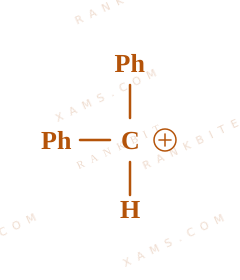
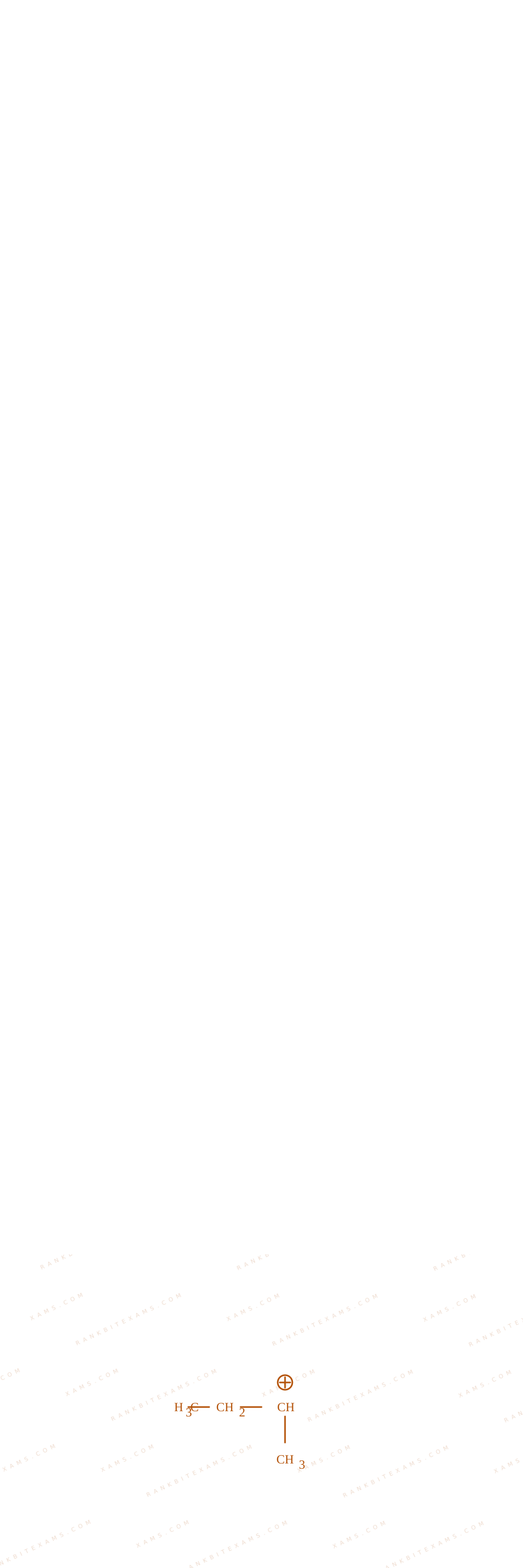
The correct order of stability of following carbocations is :
Carbocation structures for Q42 - JEE Main 2025 Morning
The images show different structural models labeled A, B, C, and D for evaluating stability variations.
A
Carbocation structures for Q42 - JEE Main 2025 Morning
The images show different structural models labeled A, B, C, and D for evaluating stability variations.
B
Carbocation structures for Q42 - JEE Main 2025 Morning
The images show different structural models labeled A, B, C, and D for evaluating stability variations.
C
Carbocation structures for Q42 - JEE Main 2025 Morning
The images show different structural models labeled A, B, C, and D for evaluating stability variations.
D

Solution & Explanation

Core Logic

To evaluate carbocation stability, apply the priority rules: Aromaticity > Resonance > Hyperconjugation.

  • C: Represents a cyclopropenyl cation derivative which achieves full aromatic stabilization due to its planar cyclic conjugated system satisfying Huckel's rule (2π electrons). This makes it the most stable.
  • A: Stabilized by extended resonance from multiple phenyl groups.
  • B: Contains fewer phenyl rings participating in active cross-conjugation relative to A.
  • D: Stabilized solely by simple aliphatic hyperconjugation, making it the least stable.
  • Visual alignment chart:

    Stability ranking structural chart for Q42 - JEE Main 2025 Morning
    The images show different structural models labeled A, B, C, and D for evaluating stability variations.

    Hence, the correct stability hierarchy is:

C > A > B > D
Pattern Recognition

Sees: Mixed aromatic, benzylic, and aliphatic carbocations. Shortcut: Isolate the cyclopropenyl system as an aromatic champion to confidently lead the sequence.

Chapter Mix

Class 11 Chemistry: Organic Chemistry - Some Basic Principles and Techniques

Reference Study Guides

More Organic Chemistry - Some Basic Principles and Techniques Previous-Year Questions — Page 9

Q28 jee_main_2025_29_jan_evening Chromatographic Techniques
Given below are two statements: Statement (I): In partition chromatography, stationary phase is thin film of liquid present in the inert support. Statement (II): In paper chromatography, the material of paper acts as a stationary phase. In the light of the above statements, choose the correct answer from the options given below:
  • A. Both Statement I and Statement II are false
  • B. Statement I is true but Statement II is false
  • C. Both Statement I and Statement II are true
  • D. Statement I is false but Statement II is true

Solution

Core Logic

Statement I is true: In partition chromatography, the stationary phase is indeed a thin film of liquid held on the surface of an inert solid support. Statement II is false: In paper chromatography, the water molecules trapped inside the cellulose network of the paper act as the stationary phase, not the paper material itself.

Pattern Recognition

Remember that paper chromatography is a type of partition chromatography where moisture content (water) adsorbed on the paper serves as the stationary liquid phase.

Chapter Mix

Class 11 Chemistry: Organic Chemistry - Some Basic Principles and Techniques

Q38 jee_main_2025_29_jan_evening Sigma and Pi Bond Counting
Total number of sigma (sigma) and pi(pi) bonds respectively present in hex-1-en-4-yne are:
  • A. 13 and 3
  • B. 11 and 3
  • C. 3 and 13
  • D. 14 and 3

Solution

Core Logic

The structural formula of hex-1-en-4-yne is given by:

CH₂ = CH - CH₂ - C equiv C - CH₃

Let's count the chemical bonds chronologically:

  • Number of C-H sigma bonds = 2 + 1 + 2 + 3 = 8
  • Number of C-C sigma bonds = 5
  • Total sigma bonds = 8 + 5 = 13.

    Sigma and Pi Bond Counting diagram for Q38 - JEE Main 2025 Evening
    Sigma and Pi Bond Counting diagram for Q38 - JEE Main 2025 Evening

  • Number of pi bonds: 1 from double bond + 2 from triple bond = 3 pi bonds.
Pattern Recognition

Every single bond is 1sigma, every double bond contains 1sigma + 1pi, and every triple bond contains 1sigma + 2pi.

Chapter Mix

Class 11 Chemistry: Organic Chemistry - Some Basic Principles and Techniques
Q49 jee_main_2025_29_jan_evening Quantitative Estimation of Sulphur
In the sulphur estimation, 0.20 g of a pure organic compound gave 0.40 g of barium sulphate. The percentage of sulphur in the compound is x × 10⁻¹%, where x = ________. (Molar mass: O=16, S=32, Ba=137 in g mol⁻¹)
Numerical Answer. Answer: 275 to 275

Solution

Related Formula
%S = (32)/(233) × Mass of BaSO₄Mass of organic compound × 100
Core Logic

Let's substitute the given values into the formula:

Mass of BaSO₄ = 0.40 g Mass of organic compound = 0.20 g Molar mass of BaSO₄ = 137 + 32 + (4 × 16) = 233 g/mol %S = (32)/(233) × (0.40)/(0.20) × 100 = (32 × 2 × 100)/(233) approx 27.468%
Step 1: Match with the Question Layout

Rounding to the standard value given in the official key:

%S = 27.5% = 275 × 10⁻¹% implies x = 275
Pattern Recognition

Carius method calculations depend heavily on standard conversion factors. The constant factor for sulphur gravimetry is (32)/(233).

Chapter Mix

Class 11 Chemistry: Organic Chemistry - Some Basic Principles and Techniques
Q43 jee_main_2025_28_jan_morning Acidity of Organic Compounds
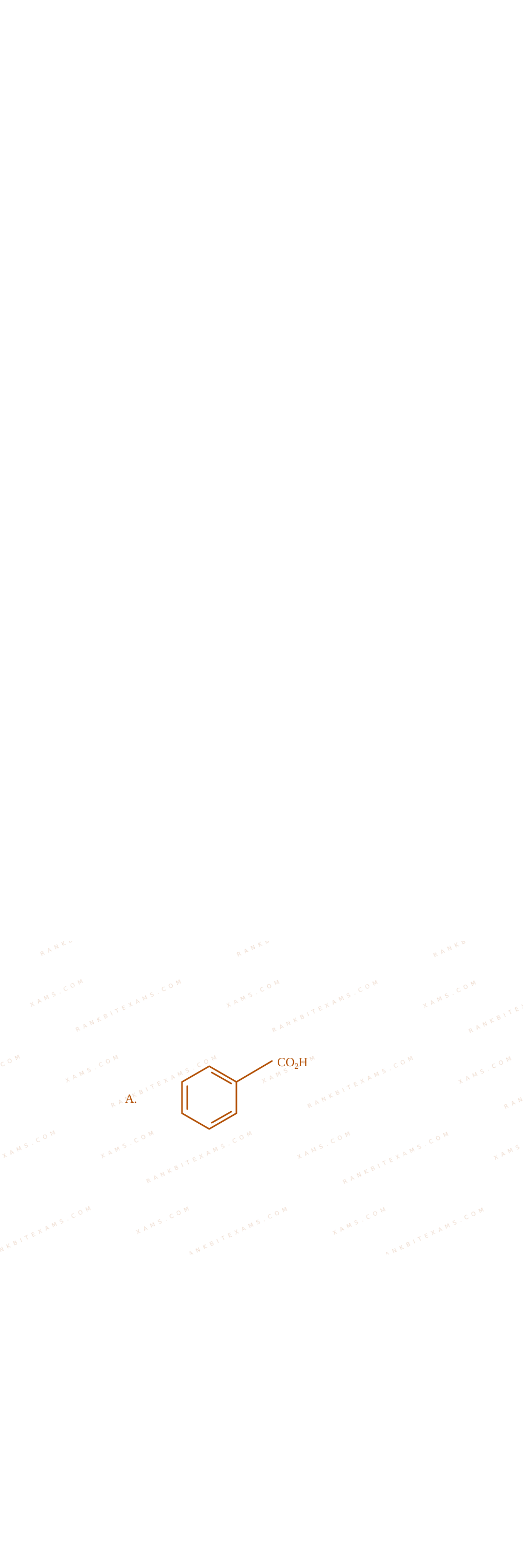
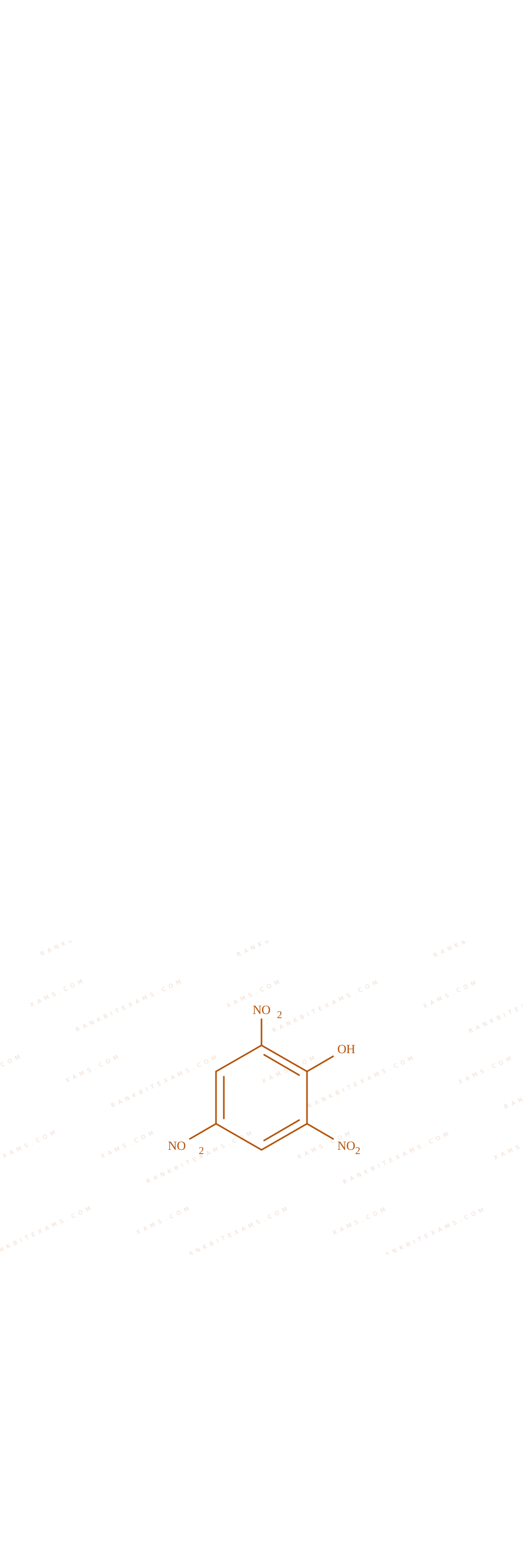
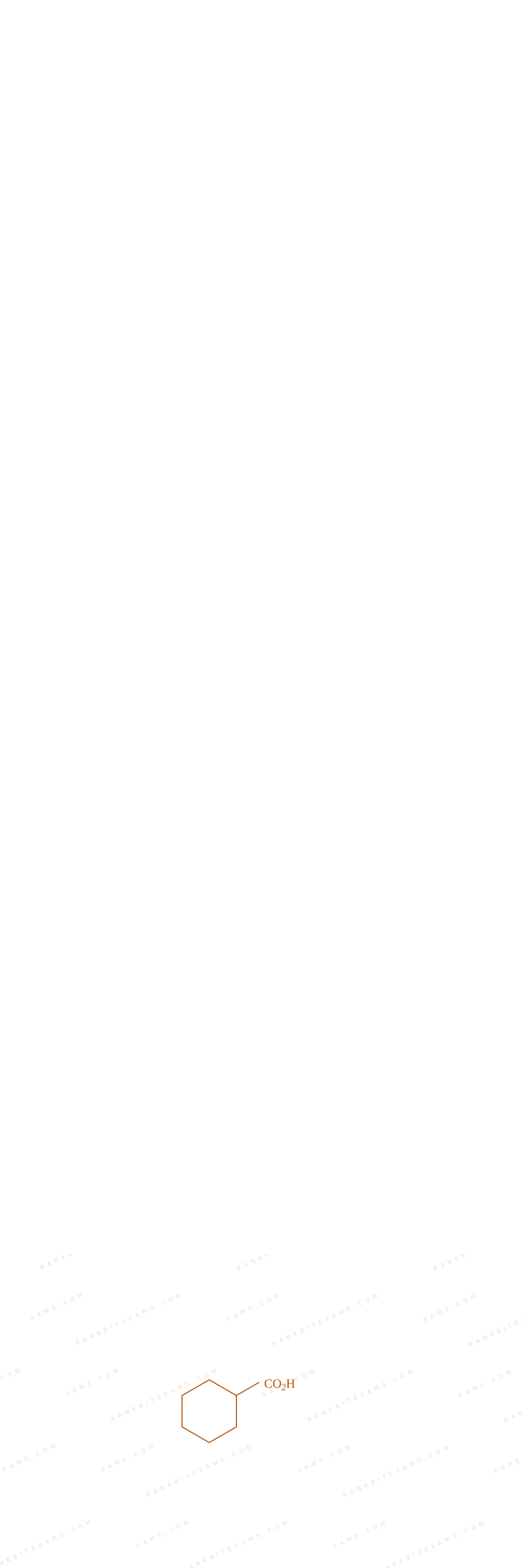
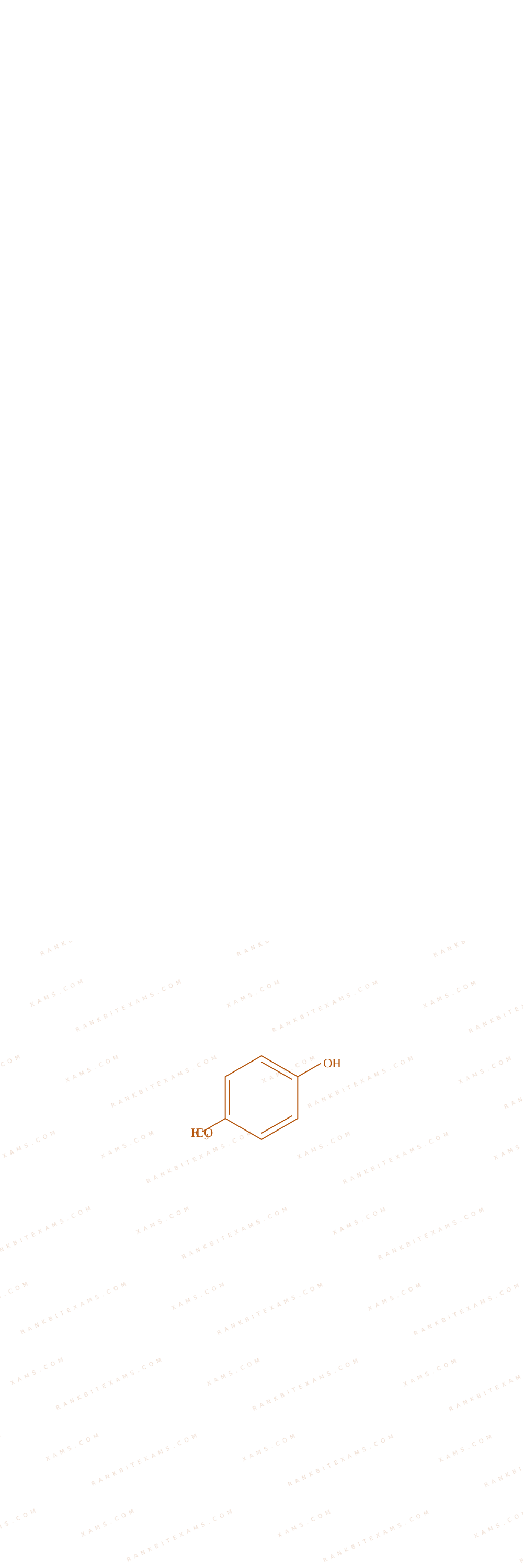
The compounds that produce CO₂ with aqueous NaHCO₃ solution are: A.
Acid structures profile for Q43 - JEE Main 2025 Morning
The prompt lists five structures labeled A through E evaluating structural acidities.
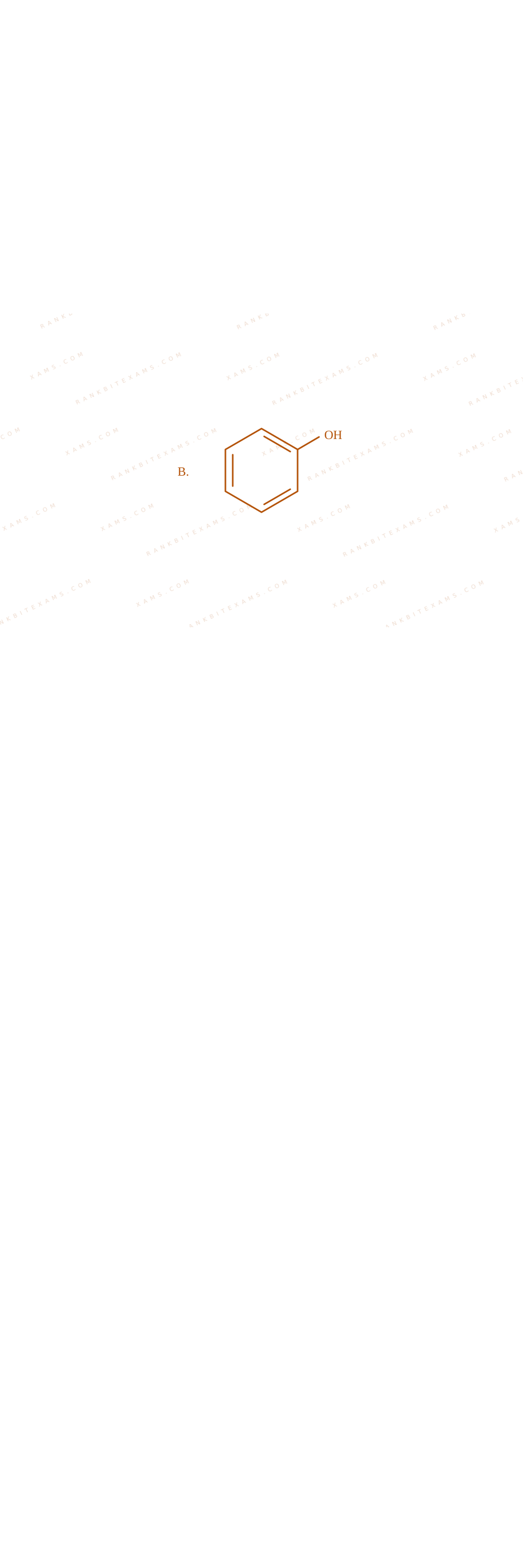
B.
Acid structures profile for Q43 - JEE Main 2025 Morning
The prompt lists five structures labeled A through E evaluating structural acidities.
C.
Acid structures profile for Q43 - JEE Main 2025 Morning
The prompt lists five structures labeled A through E evaluating structural acidities.
D.
Acid structures profile for Q43 - JEE Main 2025 Morning
The prompt lists five structures labeled A through E evaluating structural acidities.
E.
Acid structures profile for Q43 - JEE Main 2025 Morning
The prompt lists five structures labeled A through E evaluating structural acidities.
Choose the correct answer from the options given below:
  • A. A and C only
  • B. A, B and E only
  • C. A, C and D only
  • D. A and B only

Solution

Core Logic

Organic compounds react with sodium bicarbonate (NaHCO₃) to liberate CO₂ gas if they are stronger acids than carbonic acid (H₂CO₃). Evaluating the structures:

  • A: Benzoic acid, which is significantly more acidic than carbonic acid.
  • C: Picric acid (2,4,6-trinitrophenol). Due to three strong electron-withdrawing nitro groups, its acidity exceeds typical carboxylic acids and H₂CO₃.
  • D: Benzenesulfonic acid, a highly strong mineral-like organic acid.
  • B & E: Standard phenols or weakly substituted phenols, which are less acidic than carbonic acid and do not liberate CO₂.
  • Therefore, structures A, C, and D give a positive test result.

Pattern Recognition

Sees: Sodium bicarbonate test for organic systems. Shortcut: Only carboxylic acids, sulfonic acids, and highly nitrated phenols like picric acid possess sufficient proton acidity to displace CO₂ from bicarbonate ions.

Chapter Mix

Class 11 Chemistry: Organic Chemistry - Some Basic Principles and Techniques
More Organic Chemistry - Some Basic Principles and Techniques Questions — jee_main_2025_28_jan_morning
Practice all Organic Chemistry - Some Basic Principles and Techniques previous-year questions →
Rankbit System
JEE Physics: Waves (+15.5%) | Electrostatics: Concentric Shells (-29.7%) | Modern Physics: Photoelectric Clones (+34.2%) | Mathematics: Definite Integrals (+18.1%) | Chemistry: Coordination Splitting (-11.4%) | JEE Physics: Waves (+15.5%) | Electrostatics: Concentric Shells (-29.7%) | Modern Physics: Photoelectric Clones (+34.2%) | Mathematics: Definite Integrals (+18.1%) | Chemistry: Coordination Splitting (-11.4%)
