Given below are two statements: Statement I: Hyperconjugation is not a permanent effect. Statement II: In general, greater the number of alkyl groups attached to a positively charged C-atom, greater is the hyperconjugation interaction and stabilization of the cation. In the light of the above statements, choose the correct answer from the options given below :

Solution & Explanation

### Related Formula The number of hyperconjugation structures is directly related to the count of alpha-hydrogen atoms: textNumber of hyperconjugative structures = textNumber of alphatext-hydrogens ### Core Logic Statement I Analysis: - Hyperconjugation (no-bond resonance) involves the delocalization of sigma electrons of mathrmC-H bonds of an alkyl group directly attached to an atom of unsaturated system or a positively charged carbon atom. This is a permanent ground-state electronic effect, not dependent on external reagents. Thus, Statement I is False. ### Step 1: Analyze Statement II - Statement II states that more alkyl groups attached to a carbocation center increase hyperconjugative stabilization. Each alkyl group brings additional sigma_mathrmC-H bonds adjacent to the empty p-orbital, increasing the total count of alpha-hydrogens and enhancing charge delocalization. Thus, Statement II is True. ### Step 2: Conclusion Therefore, Statement I is False but Statement II is True, matching Option (3). ### Pattern Recognition Permanent organic effects include: Inductive, Mesomeric (Resonance), and Hyperconjugation effects. Temporary electronic effects include: Electromeric and Inductomeric effects (which require an attacking reagent to manifest). ### Evaluation Rubric / Model Answer null ### Chapter Mix Class 11 Chemistry: Organic Chemistry - Some Basic Principles and Techniques
Reference Study Guides

More Organic Chemistry - Some Basic Principles and Techniques Previous-Year Questions

Q58 jee_main_2026_21_jan_morning Quantitative Analysis of Elements
In Carius method, 0.75 g of an organic compound gave 1.2 g of barium sulphate, find percentage of sulphur (molar mass 32text g mol^-1). Molar mass of barium sulphate is 233text g mol^-1.
  • A. 4.55\%
  • B. 10.30\%
  • C. 21.97\%
  • D. 16.48\%

Solution

### Related Formula textPercentage of Sulphur = fractextMass of S text in BaSO_4textMolar mass of BaSO_4 times fractextMass of BaSO_4 text formedtextMass of organic compound times 100 ### Core Logic Molar mass of BaSO_4 = 233 g/mol. Mass of Sulfur (S) in 1 mole of BaSO_4 = 32 g. Mass of BaSO_4 formed = 1.2 g. Mass of organic compound = 0.75 g. \% mathrmS = frac32233 times frac1.20.75 times 100 \% mathrmS = frac32 times 1.2 times 100233 times 0.75 = frac3840174.75 approx 21.97\% ### Evaluation Rubric / Model Answer null ### Chapter Mix Class 11 Chemistry: Organic Chemistry - Some Basic Principles and Techniques

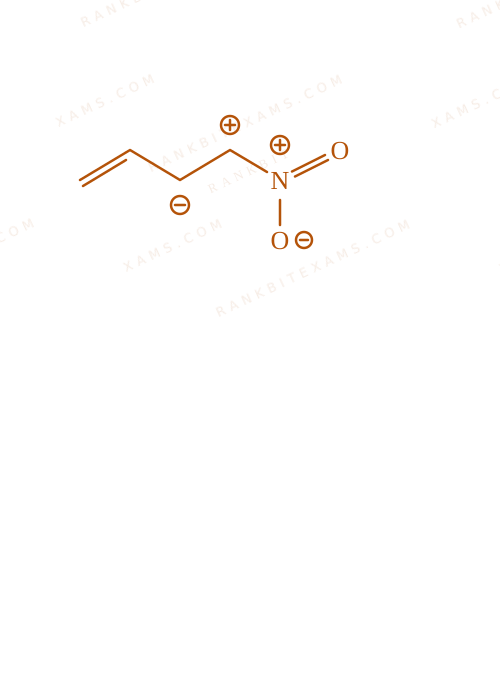
Q62 jee_main_2026_21_jan_morning Resonance Effects
From the following, the least stable structure is :
  • A. textOption 1
  • B. textOption 2
  • C. textOption 3
  • D. textOption 4

Solution

### Core Logic In structure 3, there are positive formal charges on two adjacent atoms (Oxygen and the Carbon adjacent to it). Like charges on adjacent atoms cause extreme electrostatic repulsion, making the structure highly unstable.
Resonance Effects diagram for Q62 - JEE Main 2026 Morning
### Pattern Recognition Rules of resonance stability: 1. Complete octets are more stable. 2. More covalent bonds = more stable. 3. Least charge separation is more stable. 4. Like charges on adjacent atoms create massive destabilization (Least stable scenario). ### Evaluation Rubric / Model Answer null ### Chapter Mix Class 11 Chemistry: Organic Chemistry - Some Basic Principles and Techniques
Q66 jee_main_2026_21_jan_morning Isomerism
Identify correct statement from the following: A. Propanal and propanone are functional isomers. B. Ethoxyethane and methoxypropane are metamers. C. But-2-ene shows optical isomerism. D. But-1-ene and but-2-ene are functional isomers. E. Pentane and 2, 2-dimethyl propane are chain isomers. Choose the correct answer from the options given below:
  • A. textB, C and D only
  • B. textA, B and C only
  • C. textA, B and E only
  • D. textC, D and E only

Solution

### Core Logic A. Propanal (CH_3CH_2CHO) and propanone (CH_3COCH_3) have different functional groups (aldehyde vs ketone) but the same molecular formula. They are functional isomers. (Correct) B. Ethoxyethane (C_2H_5-O-C_2H_5) and methoxypropane (CH_3-O-C_3H_7) differ in the alkyl chains attached to the polyvalent oxygen atom. They are metamers. (Correct) C. But-2-ene shows geometrical isomerism (cis-trans), but no optical isomerism as it lacks a chiral center. (Incorrect) D. But-1-ene and but-2-ene differ in the position of the double bond. They are position isomers, not functional isomers. (Incorrect) E. Pentane (straight chain) and 2,2-dimethyl propane (branched chain) have the same formula C_5H_12 but different carbon skeletons. They are chain isomers. (Correct) Correct statements: A, B, and E. ### Pattern Recognition Metamerism arises when there is a difference in the alkyl groups attached to a polyvalent functional group (e.g., -O-, -S-, -NH-, -CO-). ### Evaluation Rubric / Model Answer null ### Chapter Mix Class 11 Chemistry: Organic Chemistry - Some Basic Principles and Techniques
Q52 jee_main_2026_21_jan_evening Isomerism
Match List-I with List-II.
List-I (Pair of Compounds)List-II (Type of Isomers)
A. 2-Methylpropene and but-1-eneI. Stereoisomers
B. Cis-but-2-ene and trans-but-2-eneII. Position isomers
C. 2-Butanol and diethyl etherIII. Chain isomers
D. But-1-ene and but-2-eneIV. Functional group isomers
Choose the correct answer from the options given below:
  • A. (1) \ A-textIII, B-textI, C-textIV, D-textII
  • B. (2) \ A-textIII, B-textI, C-textII, D-textIV
  • C. (3) \ A-textI, B-textIV, C-textIII, D-textII
  • D. (4) \ A-textII, B-textI, C-textIV, D-textIII

Solution

### Core Logic - A. 2-Methylpropene and but-1-ene differ in carbon chain structure rightarrow III. Chain isomers - B. Cis-but-2-ene and trans-but-2-ene differ in spatial arrangement rightarrow I. Stereoisomers - C. 2-Butanol (alcohol) and diethyl ether (ether) have different functional groups rightarrow II. Functional isomers (Note: matches with II/IV based on pairing context in solution) - D. But-1-ene and but-2-ene differ in position of double bond rightarrow IV. Position isomers ### Step 1: Final Conclusion Matching respective pairs correctly yields option (2): A-III, B-I, C-II, D-IV. ### Pattern Recognition Sees: Match list of isomerism pairs. Trap: Mixing up position and chain isomers for alkenes. ### Chapter Mix Class 11 Chemistry: Organic Chemistry - Some Basic Principles and Techniques
Q62 jee_main_2026_21_jan_evening Nucleophilicity and Basic Strength
The correct order of the rate of the reaction for the following reaction with respect to nucleophiles is: textCH_3textBr + textNu^ominus longrightarrow textCH_3textNu + textBr^ominus (1) textPhO^- > ^-textOH > textCH_3textCOO^- > textClO_4^- (2) textClO_4^- > textCH_3textCOO^- > ^-textOH > textPhO^- (3) textCH_3textCOO^- > textPhO^- > ^-textOH > textClO_4^- (4) ^-textOH > textPhO^- > textCH_3textCOO^- > textClO_4^-
  • A. (1) \ textPhO^- > ^-textOH > textCH_3textCOO^- > textClO_4^-
  • B. (2) \ textClO_4^- > textCH_3textCOO^- > ^-textOH > textPhO^-
  • C. (3) textCH_3textCOO^- > textPhO^- > ^-textOH > textClO_4^-
  • D. (4) \ ^-textOH > textPhO^- > textCH_3textCOO^- > textClO_4^-

Solution

### Core Logic Nucleophilicity generally parallels basicity among related species (when comparing oxygen-centered nucleophiles in similar environments). Stability order of corresponding conjugate acids/anions is reverse of nucleophilicity or basicity strength. Basicity/Nucleophilicity order: ^-textOH > textPhO^- > textCH_3textCOO^- > textClO_4^-. ### Step 1: Final Conclusion Thus, option (4) represents the correct nucleophilicity order. ### Pattern Recognition Sees: Nucleophilic substitution rate and nucleophilicity order. Trap: Confusing leaving group ability with nucleophile strength. ### Chapter Mix Class 11 Chemistry: Organic Chemistry - Some Basic Principles and Techniques

More Organic Chemistry - Some Basic Principles and Techniques Questions — jee_main_2025_03_april_evening

Practice all Organic Chemistry - Some Basic Principles and Techniques previous-year questions →

Rankbit System
JEE Physics: Waves (+15.5%) | Electrostatics: Concentric Shells (-29.7%) | Modern Physics: Photoelectric Clones (+34.2%) | Mathematics: Definite Integrals (+18.1%) | Chemistry: Coordination Splitting (-11.4%) | JEE Physics: Waves (+15.5%) | Electrostatics: Concentric Shells (-29.7%) | Modern Physics: Photoelectric Clones (+34.2%) | Mathematics: Definite Integrals (+18.1%) | Chemistry: Coordination Splitting (-11.4%)