


JEE Main · Chemistry ↓ Falling

Organic Chemistry - Some Basic Principles and Techniques appeared 101 times across 3 years — 11.8% of Chemistry. This question is from Carbocation Stability.

Year 2026 2025 2024 Total
Questions 22 49 30 101

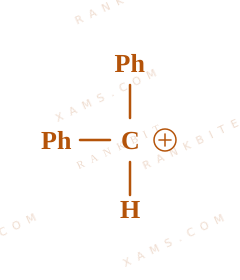
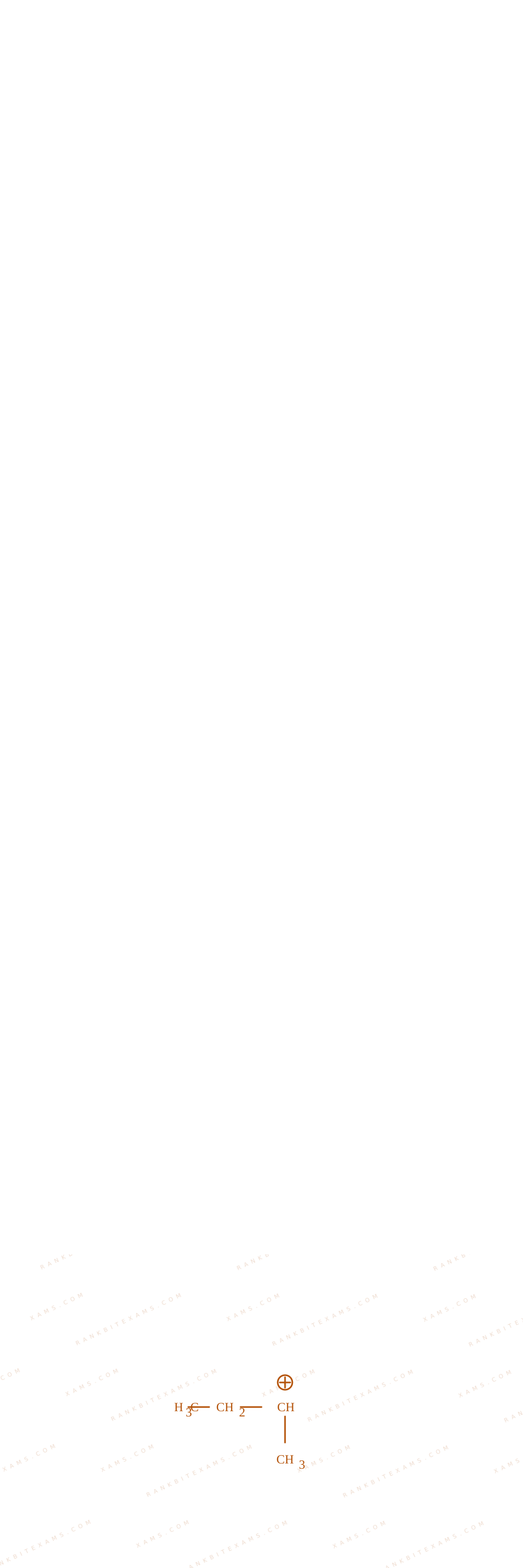
The correct order of stability of following carbocations is :
Carbocation structures for Q42 - JEE Main 2025 Morning
The images show different structural models labeled A, B, C, and D for evaluating stability variations.
A
Carbocation structures for Q42 - JEE Main 2025 Morning
The images show different structural models labeled A, B, C, and D for evaluating stability variations.
B
Carbocation structures for Q42 - JEE Main 2025 Morning
The images show different structural models labeled A, B, C, and D for evaluating stability variations.
C
Carbocation structures for Q42 - JEE Main 2025 Morning
The images show different structural models labeled A, B, C, and D for evaluating stability variations.
D

Solution & Explanation

Core Logic

To evaluate carbocation stability, apply the priority rules: Aromaticity > Resonance > Hyperconjugation.

  • C: Represents a cyclopropenyl cation derivative which achieves full aromatic stabilization due to its planar cyclic conjugated system satisfying Huckel's rule (2π electrons). This makes it the most stable.
  • A: Stabilized by extended resonance from multiple phenyl groups.
  • B: Contains fewer phenyl rings participating in active cross-conjugation relative to A.
  • D: Stabilized solely by simple aliphatic hyperconjugation, making it the least stable.
  • Visual alignment chart:

    Stability ranking structural chart for Q42 - JEE Main 2025 Morning
    The images show different structural models labeled A, B, C, and D for evaluating stability variations.

    Hence, the correct stability hierarchy is:

C > A > B > D
Pattern Recognition

Sees: Mixed aromatic, benzylic, and aliphatic carbocations. Shortcut: Isolate the cyclopropenyl system as an aromatic champion to confidently lead the sequence.

Chapter Mix

Class 11 Chemistry: Organic Chemistry - Some Basic Principles and Techniques

Reference Study Guides

More Organic Chemistry - Some Basic Principles and Techniques Previous-Year Questions — Page 8

Q46 jee_main_2025_07_april_morning Quantitative Elemental Analysis
An organic compound weighing 500 mg, produced 220 mg of CO₂ on complete combustion. The percentage composition of carbon in the compound is ______ %. (nearest integer) (Given molar mass in g mol⁻¹ of C: 12, O: 16)
Numerical Answer. Answer: 12 to 12

Solution

Related Formula
% C = (12)/(44) × Mass of CO₂ producedMass of organic compound taken × 100
Core Logic

Given:

  • Mass of organic compound taken = 500 mg = 500 × 10⁻³ g
  • Mass of CO₂ produced = 220 mg = 220 × 10⁻³ g
  • Using the formula:

% C = (12)/(44) × 220 × 10⁻³500 × 10⁻³ × 100 % C = (12)/(44) × (220)/(500) × 100 % C = (12)/(44) × 44 = 12 %

Thus, the percentage of carbon is 12.

Pattern Recognition

Carbon dioxide has exactly 12/44 ≈ 27.27% carbon by mass. Multiply the mass fraction of CO₂ (220/500 = 0.44) by 12/44 to directly get 0.12 or 12%.

Evaluation Rubric / Model Answer

A perfect step-by-step conversion of organic compound mass and combustion carbon dioxide mass to obtain a precise 12 percent carbon composition.

Chapter Mix

Class 11 Chemistry: Organic Chemistry - Some Basic Principles and Techniques
Q jee_main_2025_08_april_evening IUPAC Nomenclature
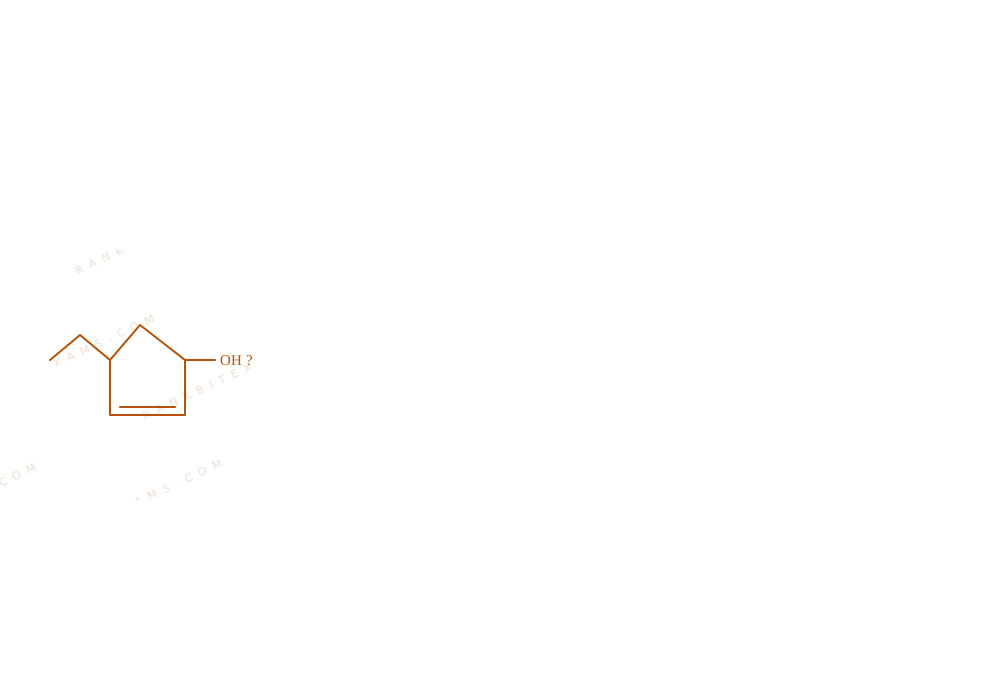
What is the correct IUPAC name of the following organic compound?
Cyclic substituted alkene organic molecule structure for Q35
The molecule contains a five-membered carbon ring with one double bond, a hydroxyl substituent, and an ethyl group.
  • A. 4-Ethyl-1-hydroxycyclopent-2-ene
  • B. 1-Ethyl-3-hydroxycyclopent-2-ene
  • C. 1-Ethylcyclopent-2-en-3-ol
  • D. 4-Ethylcyclopent-2-en-1-ol

Solution

Core Logic

Let us apply official IUPAC priority indexing rules:

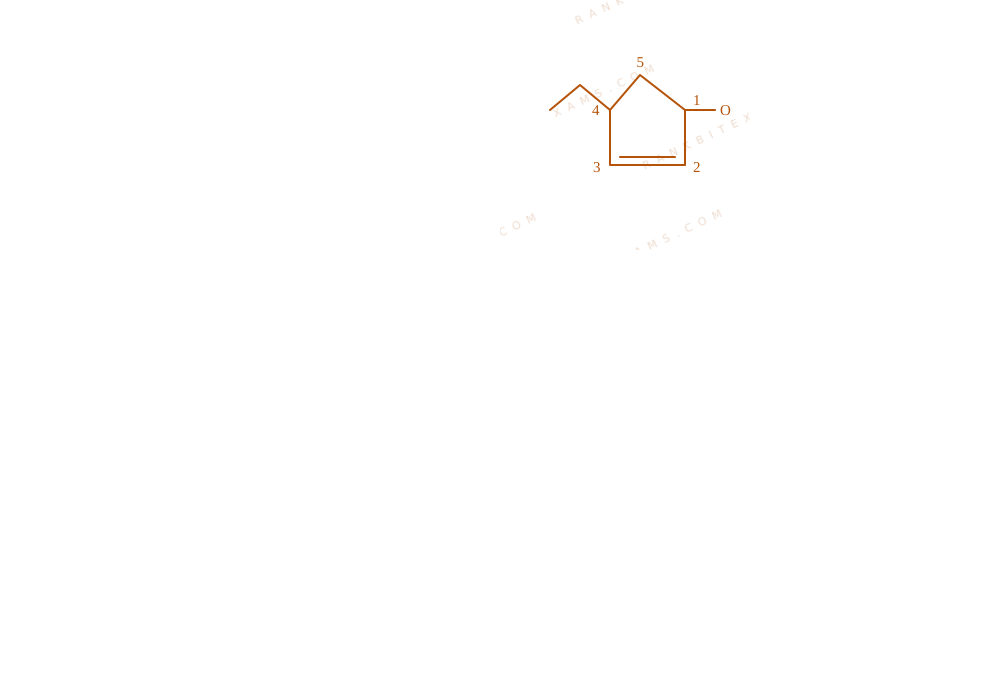
  • Principal Functional Group: The hydroxyl group (-OH) possesses higher naming priority over double bonds and simple alkyl side chains. Thus, the carbon bearing the -OH group is assigned position C-1.
  • Numbering Direction: We must number through the ring towards the double bond to assign it the lowest possible locant. Hence, the alkene carbons are given coordinates C-2 and C-3.
  • Locating Side Chains: Proceeding with this direction puts the ethyl group at position C-4.
    Numbered ring numbering system layout for 4-ethylcyclopent-2-en-1-ol
    The molecule contains a five-membered carbon ring with one double bond, a hydroxyl substituent, and an ethyl group.
  • Assembling the structural parts alphabetically:

  • Substituent: `4-Ethyl`
  • Parent root: `cyclopent-2-en`
  • Suffix: `1-ol`
  • Combined IUPAC format: 4-Ethylcyclopent-2-en-1-ol.

Pattern Recognition

Principal suffix priority hierarchy: -OH > Double bond > Alkyl side-chain. Always fix the highest priority suffix at index 1 and head instantly towards the alkene bond to safely restrict locant numbers.

Chapter Mix

Class 11 Chemistry: Organic Chemistry - Some Basic Principles and Techniques
Q27 jee_main_2025_08_april_evening Reactive Intermediates and Reagents
Match the LIST-I with LIST-II:
LIST-ILIST-II
A. CarbocationI. Species that can supply a pair of electrons.
B. C-Free radicalII. Species that can receive a pair of electrons.
C. NucleophileIII. sp² hybridized carbon with empty p-orbital.
D. ElectrophileIV. sp²/sp³ hybridized carbon with one unpaired electron.
Choose the correct answer from the options given below:
  • A. A-IV, B-II, C-III, D-I
  • B. A-II, B-III, C-I, D-IV
  • C. A-III, B-IV, C-II, D-I
  • D. A-III, B-IV, C-I, D-II

Solution

Core Logic

Let us analyze each term carefully:

  • A. Carbocation: Features a positively charged trivalent carbon atom. It represents an sp² hybridized carbon with an empty unhybridized p-orbital.
    Carbocation orbital hybridization diagram for Q27 - JEE Main 2025
    Carbocation orbital hybridization diagram for Q27 - JEE Main 2025
  • B. Carbon Free Radical: Contains a trivalent carbon carrying a single unpaired lone electron. It typically exhibits sp² or sp³ hybridization depending on structural environments.
    Carbocation orbital hybridization diagram for Q27 - JEE Main 2025
    Carbocation orbital hybridization diagram for Q27 - JEE Main 2025
  • C. Nucleophile: An electron-rich chemical species containing a lone pair or negative charge capable of donating/supplying a pair of electrons.
  • D. Electrophile: An electron-deficient chemical species possessing empty low-lying orbitals capable of accepting/receiving a pair of electrons.
Step 1: Alignment Matrix

Matching each item yields:

  • A arrow III
  • B arrow IV
  • C arrow I
  • D arrow II
  • This sequence aligns flawlessly with Option (4).

Pattern Recognition

Nucleophiles donate ('nucleo-loving' = seeks positive sites with its electrons), Electrophiles accept ('electro-loving' = seeks electron density). Carbocations explicitly harbor a vacant p-orbital because of their positive charge configuration, making identification extremely swift.

Chapter Mix

Class 11 Chemistry: Organic Chemistry - Some Basic Principles and Techniques

Q38 jee_main_2025_08_april_evening Quantitative Elemental Analysis
On complete combustion, 0.210 g of an organic compound containing C, H, and O yielded 0.127 g of H₂O and 0.307 g of CO₂. The mass percentages of hydrogen and oxygen in the given organic compound respectively are:
  • A. 53.41, 39.6
  • B. 6.72, 53.41
  • C. 7.55, 43.85
  • D. 6.72, 39.87

Solution

Related Formula

Percentage of Hydrogen in organic analysis:

%H = (2)/(18) × Mass of H₂OMass of Compound × 100

Percentage of Carbon:

%C = (12)/(44) × Mass of CO₂Mass of Compound × 100

Percentage of Oxygen:

%O = 100 - (%C + %H)
Execution

Step 1: Compute the mass percent of Hydrogen:

%H = (2)/(18) × (0.127)/(0.210) × 100 = (0.254)/(3.78) ≈ 6.72%

Step 2: Compute the mass percent of Carbon:

%C = (12)/(44) × (0.307)/(0.210) × 100 = (3.684)/(9.24) ≈ 39.87%

Step 3: Deduce the remaining mass percent of Oxygen:

%O = 100 - (39.87 + 6.72) = 100 - 46.59 = 53.41%

Thus, the values of hydrogen and oxygen percentage are 6.72% and 53.41%, matches with Option (2).

Pattern Recognition

Always focus on the order requested by the question stem. The query specifies 'hydrogen and oxygen respectively'. Option 2 and Option 4 both show these numbers but reversed—verifying the targeted sequence protects your score line.

Chapter Mix

Class 11 Chemistry: Organic Chemistry - Some Basic Principles and Techniques

Q42 jee_main_2025_08_april_evening Qualitative Analysis of Functional Groups
Match the reagents in LIST-I with the corresponding chemical functional groups they detect in LIST-II:
LIST-I (Reagent)LIST-II (Functional Group detected)
A. Sodium bicarbonate solutionI. double bond / unsaturation
B. Neutral ferric chlorideII. carboxylic acid
C. Ceric ammonium nitrateIII. phenolic - OH
D. Alkaline KMnO₄IV. alcoholic - OH
Choose the correct answer from the options given below:
  • A. A-II, B-III, C-IV, D-I
  • B. A-II, B-III, C-I, D-IV
  • C. A-III, B-II, C-IV, D-I
  • D. A-II, B-IV, C-III, D-I

Solution

Core Logic

Let us review the chemical basis for each qualitative test:

  • A. Sodium bicarbonate (NaHCO₃) solution: Carboxylic acids are sufficiently acidic to decompose NaHCO₃, liberating carbon dioxide gas observed as vigorous effervescence. Therefore, A arrow II.
  • B. Neutral ferric chloride (FeCl₃): Phenols react with neutral FeCl₃ solution to form characteristic deeply colored violet coordination complexes. Therefore, B arrow III.
  • C. Ceric ammonium nitrate (CAN): Alcohols react with CAN reagent to cause a distinct color shift to deep dark red due to complexation. Therefore, C arrow IV.
  • D. Alkaline KMnO₄ (Baeyer's Reagent): Reacts readily via syn-hydroxylation across carbon-carbon double/triple bonds, resulting in decolored solutions alongside brown MnO₂ precipitates. This detects unsaturation. Therefore, D arrow I.
Step 1: Assembly

Combining the validated relationships gives:

A-II, B-III, C-IV, D-I

This maps perfectly to Option (1).

Pattern Recognition

Baeyer's test (alkaline KMnO₄) always tests for alkenes/alkynes. NaHCO₃ is unique for acidic groups like carboxylic acids. Matching these two reliable pairs isolates the correct option without needing to review the entire table.

Chapter Mix

Class 11 Chemistry: Organic Chemistry - Some Basic Principles and Techniques Class 12 Chemistry: Alcohols, Phenols and Ethers

More Organic Chemistry - Some Basic Principles and Techniques Questions — jee_main_2025_28_jan_morning

Practice all Organic Chemistry - Some Basic Principles and Techniques previous-year questions →

Rankbit System
JEE Physics: Waves (+15.5%) | Electrostatics: Concentric Shells (-29.7%) | Modern Physics: Photoelectric Clones (+34.2%) | Mathematics: Definite Integrals (+18.1%) | Chemistry: Coordination Splitting (-11.4%) | JEE Physics: Waves (+15.5%) | Electrostatics: Concentric Shells (-29.7%) | Modern Physics: Photoelectric Clones (+34.2%) | Mathematics: Definite Integrals (+18.1%) | Chemistry: Coordination Splitting (-11.4%)