
Organic Chemistry - Some Basic Principles and Techniques appeared 101 times across 3 years — 11.8% of Chemistry.
This question is from Carbocation Stability.
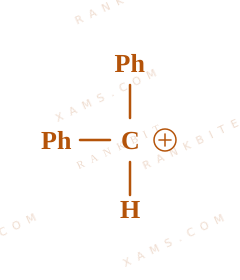
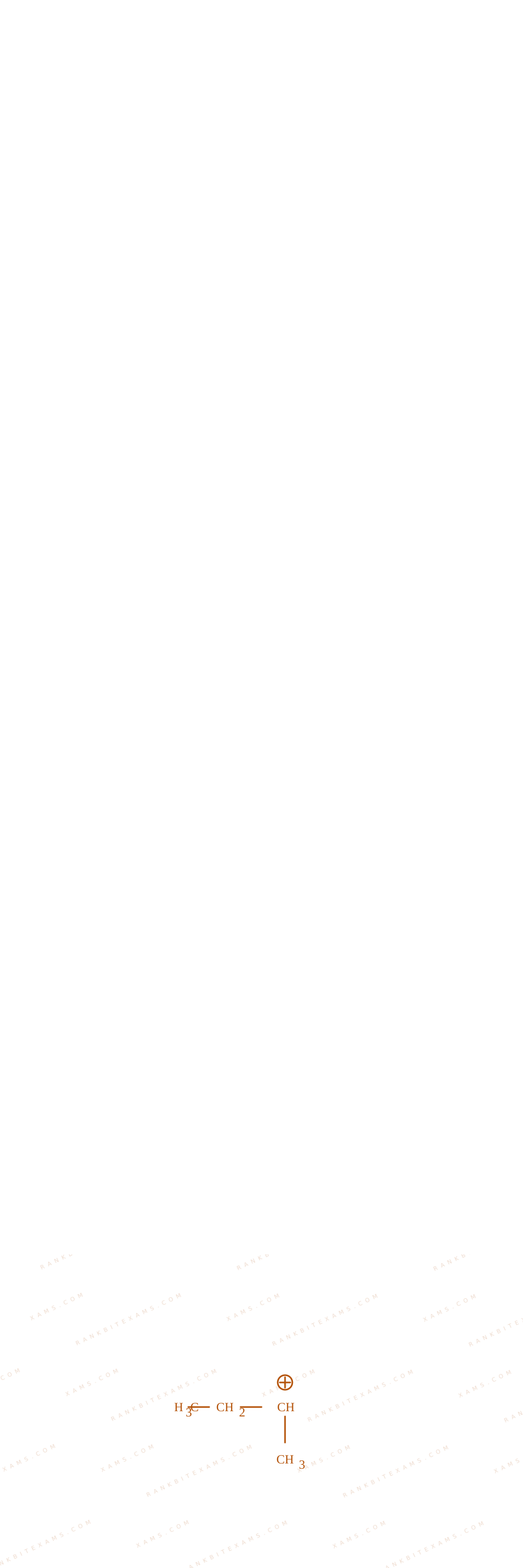
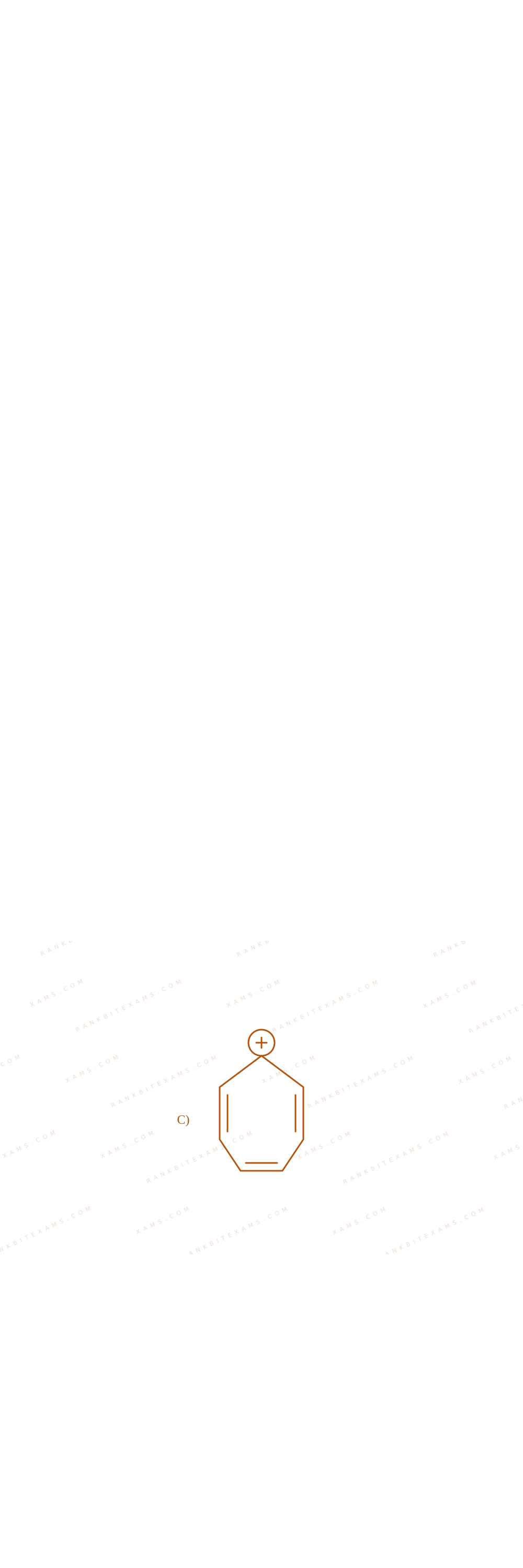
The correct order of stability of following carbocations is :
The images show different structural models labeled A, B, C, and D for evaluating stability variations.
A
The images show different structural models labeled A, B, C, and D for evaluating stability variations.
B
The images show different structural models labeled A, B, C, and D for evaluating stability variations.
C
The images show different structural models labeled A, B, C, and D for evaluating stability variations.
D
A.A > B > C > D$\mathrm{A} > \mathrm{B} > \mathrm{C} > \mathrm{D}$
B.B > C > A > D$\mathrm{B} > \mathrm{C} > \mathrm{A} > \mathrm{D}$
C.C > B > A > D$\mathrm{C} > \mathrm{B} > \mathrm{A} > \mathrm{D}$
D.C > A > B > D$\mathrm{C} > \mathrm{A} > \mathrm{B} > \mathrm{D}$
Solution & Explanation
Core Logic
To evaluate carbocation stability, apply the priority rules: Aromaticity > Resonance > Hyperconjugation.
C: Represents a cyclopropenyl cation derivative which achieves full aromatic stabilization due to its planar cyclic conjugated system satisfying Huckel's rule (2π$2\pi$ electrons). This makes it the most stable.
A: Stabilized by extended resonance from multiple phenyl groups.
B: Contains fewer phenyl rings participating in active cross-conjugation relative to A.
D: Stabilized solely by simple aliphatic hyperconjugation, making it the least stable.
Visual alignment chart:
The images show different structural models labeled A, B, C, and D for evaluating stability variations.
Hence, the correct stability hierarchy is:
C > A > B > D$$\mathrm{C} > \mathrm{A} > \mathrm{B} > \mathrm{D}$$
Pattern Recognition
Sees: Mixed aromatic, benzylic, and aliphatic carbocations.
Shortcut: Isolate the cyclopropenyl system as an aromatic champion to confidently lead the sequence.
Chapter Mix
Class 11 Chemistry: Organic Chemistry - Some Basic Principles and Techniques
Keywords:#correct order of stability of following carbocations#JEE Main 2025 Morning Q42#GOC Carbocation Stability JEE Main 2025#Aromaticity Resonance JEE Main 2025#Carbocation#Resonance stabilization#Aromatic cation
More Organic Chemistry - Some Basic Principles and Techniques Previous-Year Questions — Page 10
Identify the correct statements from the following:
Choose the correct answer from the options given below.
Structural Isomerism
A. C & D only
B. B & C only
C. A & B only
D. A, B & C only
Solution
Core Logic
Let us check the statements step-by-step:
Statement A: Pentan-3-one and pentan-2-one have different alkyl groups attached on either side of the divalent polyfunctional carbonyl group (-CO-$-\text{CO}-$). Hence, they are metamers. Metamerism illustration for Q32 - JEE Main 2025 Morning
Statement B: Cyanides (-CN$-\text{CN}$) and Isocyanides (-NC$-\text{NC}$) contain distinct functional groups, so they are functional isomers. Metamerism illustration for Q32 - JEE Main 2025 Morning
Statement C: Phenol structures containing a methyl substituent at positions 2 and 3 are structural position isomers.
Statement D: The given structures represent members of a homologous series because they differ sequentially by a -CH₂-$-\text{CH}_2-$ unit.
Step 1: Verification
Evaluating according to standard multi-choice options, statements A and B are perfectly validated.
Pattern Recognition
Shortcut: Metamers require variable alkyl distribution across a polyvalent heteroatom group. Functional isomers require changes like -CN$-\text{CN}$ vs -NC$-\text{NC}$.
Chapter Mix
Class 11 Chemistry: Organic Chemistry - Some Basic Principles and Techniques
Qjee_main_2025_03_april_morningAcidic Strength of Organic Compounds
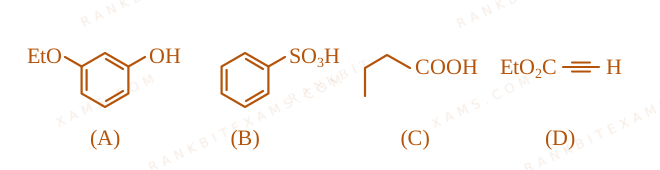
The least acidic compound, among the following is:
Acidic Strength of Organic Compounds
A. Compound (D)
B. Compound (A)
C. Compound (B)
D. Compound (C)
Solution
Core Logic
Let us check the conjugate bases formed upon losing a proton:
Compounds (A), (B), and (C) generate conjugate bases stabilized by resonance through the aromatic ring or strong electron-withdrawing groups.
Compound (D) represents an ethynyl group in a terminal alkyne structure (EtO₂C-C$\text{EtO}_2\text{C}-\text{C}\equiv\text{CH}$). Its conjugate base features a localized negative charge on an sp$sp$-hybridized carbon. Because there is no resonance stabilization present for this anion, it is significantly less stable than the conjugate bases of the other functional groups.
Step 1: Conclusion
Since a less stable conjugate base implies a weaker parent acid, the terminal alkyne compound (D) is the least acidic.
Pattern Recognition
Shortcut: A resonance-stabilized anion is always more stable than a localized one. Look for the alkyne carbon (sp-C-H$sp\text{-C}-\text{H}$) versus resonance-delocalized oxygen or active methylene centers.
Evaluation Rubric / Model Answer
Option (A)
Chapter Mix
Class 11 Chemistry: Organic Chemistry - Some Basic Principles and Techniques
During estimation of nitrogen by Dumas' method of compound X (0.42 g):
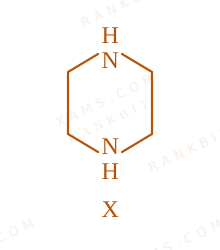
The image shows the molecular skeletal architecture of compound X with structural parameters revealing a formula corresponding to a molecular mass of 86 g/mol.
mL of N2$N{2}$ gas will be liberated at STP. (nearest integer)
(Given molar mass in g mol: C: 12, H: 1, N: 14)
The image shows the molecular skeletal architecture of compound X with structural parameters revealing a formula corresponding to a molecular mass of 86 g/mol.
Numerical Answer.Answer: 111 to 111
Solution
Related Formula
Using the Principle of Atom Conservation (POAC) for Nitrogen:
ncompound × (atoms of N per molecule) = 2 × nN₂$$n_{\text{compound}} \times (\text{atoms of N per molecule}) = 2 \times n_{\text{N}_2}$$
Core Logic
The molecular weight of the given heterocyclic amine organic structure X$X$ (piperazine, C₄H₁₀N₂$\text{C}_4\text{H}_{10}\text{N}_2$) is calculated as:
The image shows the molecular skeletal architecture of compound X with structural parameters revealing a formula corresponding to a molecular mass of 86 g/mol.
Given mass of compound = 0.42 g$= 0.42\text{ g}$:
Moles of compound X = (0.42)/(86) mol$$\text{Moles of compound } X = \frac{0.42}{86}\text{ mol}$$
Step 1: Calculating STP Volume
Since each molecule contains 2$2$ nitrogen atoms, 1 mol$1\text{ mol}$ of compound produces 1 mol$1\text{ mol}$ of N₂$\text{N}_2$ gas:
Using standard molar volume at STP (22700 mL/mol$22700\text{ mL/mol}$ per IUPAC convention, or 22400 mL/mol$22400\text{ mL/mol}$ in traditional calculations):
Volume of N₂ at STP = (0.42)/(86) × 22700 mL ≈ 110.86 mL ≈ 111 mL$$\text{Volume of } \text{N}_2\text{ at STP} = \frac{0.42}{86} \times 22700\text{ mL} \approx 110.86\text{ mL} \approx 111\text{ mL}$$
(Note: If calculated using 22400 mL/mol$22400\text{ mL/mol}$, Volume = (0.42)/(86) × 22400 ≈ 109.4 mL ≈ 109 mL$\text{Volume} = \frac{0.42}{86} \times 22400 \approx 109.4\text{ mL} \approx 109\text{ mL}$.)
Rounding to the nearest integer gives 111 (official accepted range: 109 to 111).
Pattern Recognition
Shortcut: Determine the molar mass (M = 86 g/mol$M = 86\text{ g/mol}$) and nitrogen atom count (2 N atoms 1 mol N₂ per mol of compound$2\text{ N atoms} \implies 1\text{ mol } \text{N}_2\text{ per mol of compound}$). Multiply moles directly by molar volume at STP to find the liberated gas volume.
Evaluation Rubric / Model Answer
111
Chapter Mix
Class 11 Chemistry: Organic Chemistry - Some Basic Principles and Techniques
Qjee_main_2025_03_april_morningQuantitative Analysis - Estimation of Carbon
0.5 g of an organic compound on combustion gave 1.46 g of CO₂$CO_{2}$ and 0.9 g of H₂O$H_{2}O$. The percentage of carbon in the compound is _____. (Nearest integer)
[Given: Molar mass (in g mol⁻¹$\text{g mol}^{-1}$) C: 12, H: 1, O: 16]
Numerical Answer.Answer: 80 to 80
Solution
Related Formula
The percentage of carbon via combustion analysis is given by:
% C = (12)/(44) × Mass of CO₂Mass of organic compound × 100$$\%\text{ C} = \frac{12}{44} \times \frac{\text{Mass of }\text{CO}_2}{\text{Mass of organic compound}} \times 100$$
Core Logic
Let us substitute the given parameters:
Mass of organic compound = 0.5 g$= 0.5\text{ g}$
Mass of CO₂$\text{CO}_2$ collected = 1.46 g$= 1.46\text{ g}$
Shortcut: (12)/(44) ≈ 0.2727$\frac{12}{44} \approx 0.2727$. Multiply 0.2727 × 1.46$0.2727 \times 1.46$ to find the mass of carbon (≈ 0.398 g$\approx 0.398\text{ g}$). Since 0.398 g$0.398\text{ g}$ out of 0.5 g$0.5\text{ g}$ is roughly (4)/(5)$\frac{4}{5}$, the value is right around 80%$80\%$.
Evaluation Rubric / Model Answer
80
Chapter Mix
Class 11 Chemistry: Organic Chemistry - Some Basic Principles and Techniques
Qjee_main_2025_04_april_eveningBasicity of Organic Bases
The correct order of basicity for the following molecules is:
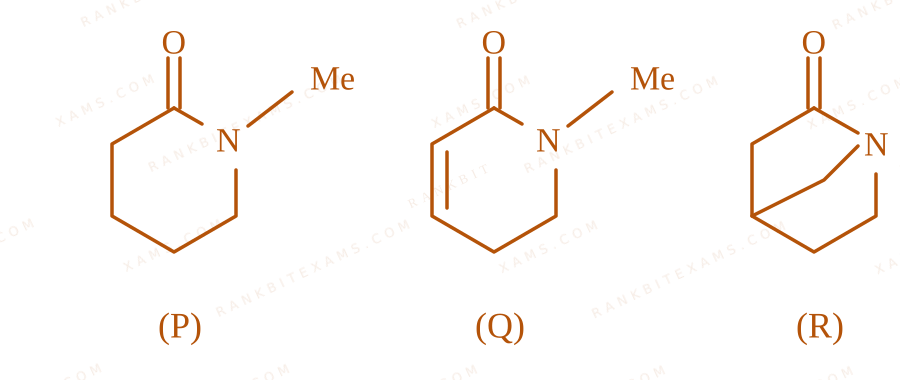
The diagram displays three nitrogen-containing organic structures labeled P, Q, and R for basicity comparison.The diagram displays three nitrogen-containing organic structures labeled P, Q, and R for basicity comparison.The diagram displays three nitrogen-containing organic structures labeled P, Q, and R for basicity comparison.The diagram displays three nitrogen-containing organic structures labeled P, Q, and R for basicity comparison.
A.P > Q > R$P > Q > R$
B.R > P > Q$R > P > Q$
C.Q > P > R$Q > P > R$
D.R > Q > P$R > Q > P$
Solution
Related Formula
Basicity ∝ Availability of lone pair of electrons on Nitrogen$$\text{Basicity} \propto \text{Availability of lone pair of electrons on Nitrogen}$$
Core Logic
Analyzing the molecules:
In molecule (R), according to Bredt's rule, the bridgehead nitrogen has a localized lone pair which cannot participate in resonance. Thus, it is highly available and most basic.
In molecule (Q), the nitrogen lone pair is involved in cross-conjugation with the carbonyl group, reducing its availability.
In molecule (P), the lone pair on nitrogen is directly conjugated with the carbonyl group (amide resonance), making it the least available.
Therefore, the correct basicity order is:
R > Q > P$R > Q > P$
Step 1: Final Identification
The diagram displays three nitrogen-containing organic structures labeled P, Q, and R for basicity comparison.
Comparing availability, structure R has localized electrons, Q has cross-conjugation, and P has standard amide resonance. Hence, option (4) is correct.
Pattern Recognition
Look for localized vs delocalized lone pairs on nitrogen. Bridgehead nitrogen lone pairs that violate Bredt's rule for double bond formation remain strictly localized, drastically increasing basicity compared to conjugated amides.
Chapter Mix
Class 11 Chemistry: Some Basic Principles of Organic Chemistry
More Organic Chemistry - Some Basic Principles and Techniques Questions — jee_main_2025_28_jan_morning
Practice past-year questions one chapter at a time. Pick an exam → subject → chapter and get every PYQ for that topic — pulled together from all past papers — with the chapter's key formulas alongside.