JEE Main · Chemistry ↓ Falling

Haloalkanes and Haloarenes appeared 40 times across 3 years — 4.7% of Chemistry. This question is from Ambident Nucleophiles Reactions.

Year 2026 2025 2024 Total
Questions 11 16 13 40

The products A and B in the following reactions, respectively are A A g - N O _ 2 C H _ 3 - C H _ 2 - C H _ 2 - B r A g C N B

Solution & Explanation

Core Logic

Both silver reagents exhibit significantly covalent bond characters:

  • Reaction with AgNO₂: The bond between silver and oxygen is covalent, making the lone pair on the nitrogen atom the primary nucleophilic site. Attack via nitrogen yields a nitroalkane product:
A = CH₃-CH₂-CH₂-NO₂
  • Reaction with AgCN: The covalent Ag-C bond directs the nucleophilic attack to proceed through the lone pair on nitrogen, yielding an isocyanide compound:
B = CH₃-CH₂-CH₂-NC

Hence, option (4) represents the correct combination.

Pattern Recognition

Sees: Alkyl halide reacting with covalent silver salts of ambident anions. Shortcut: Silver reagents (AgCN or AgNO₂) drive bond formatting via the nitrogen center, producing isocyanides and nitroalkanes respectively.

Chapter Mix

Class 12 Chemistry: Haloalkanes and Haloarenes

Reference Study Guides

More Haloalkanes and Haloarenes Previous-Year Questions — Page 7

Q79 jee_main_2024_27_jan_morning Nucleophilic Substitution Mechanisms
The correct statement regarding nucleophilic substitution reaction in a chiral alkyl halide is;
  • A. Retention occurs in SN1 reaction and inversion occurs in SN2 reaction.
  • B. Racemisation occurs in SN1 reaction and retention occurs in SN2 reaction.
  • C. Racemisation occurs in both SN1 and SN2 reactions.
  • D. Racemisation occurs in SN1 reaction and inversion occurs in SN2 reaction.

Solution

Core Logic

In an SN1 pathway, a planar carbocation intermediate is produced. Attack by the nucleophile can take place with equal probability from either side, resulting in complete/partial racemisation. In an SN2 pathway, the nucleophile attacks exclusively from the backside opposite the leaving group, causing an absolute structural inversion (Walden inversion).

Pattern Recognition

SN1 arrow planar intermediate carbocation arrow Racemisation. SN2 arrow direct backside launch arrow Inversion.

Chapter Mix

Class 12 Chemistry: Haloalkanes and Haloarenes

Q jee_main_2024_29_jan_morning Preparation of Haloarenes
Given below are two statements : one is labelled as Assertion A and the other is labelled as Reason R : Assertion A : Aryl halides cannot be prepared by replacement of hydroxyl group of phenol by halogen atom. Reason R : Phenols react with halogen acids violently. In the light of the above statements, choose the most appropriate from the options given below:
  • A. Both A and R are true but R is NOT the correct explanation of A
  • B. A is false but R is true
  • C. A is true but R is false
  • D. Both A and R are true and R is the correct explanation of A

Solution

Core Logic

Assertion (A): In phenols, the C-O bond possesses partial double bond character due to resonance (the lone pair of oxygen delocalizes into the benzene ring). Because of this strong C-O bond, nucleophilic substitution reactions where a halide ion would replace the hydroxyl group do not occur under normal conditions. Thus, aryl halides cannot be prepared directly from phenols by reaction with HX. The statement is True.

Reason (R): Phenols do NOT react violently with halogen acids. In fact, they practically do not react with halogen acids (HX) to form aryl halides because the C-O bond is difficult to break. The statement is False.

Step 1: Visualization

Preparation of Haloarenes diagram for Q70 - JEE Main 2024 Morning

Given reason is false.

Step 2: Conclusion

Assertion (A) is correct but Reason (R) is false.

Chapter Mix

Class 12 Chemistry: Haloalkanes and Haloarenes Class 12 Chemistry: Alcohols Phenols and Ethers
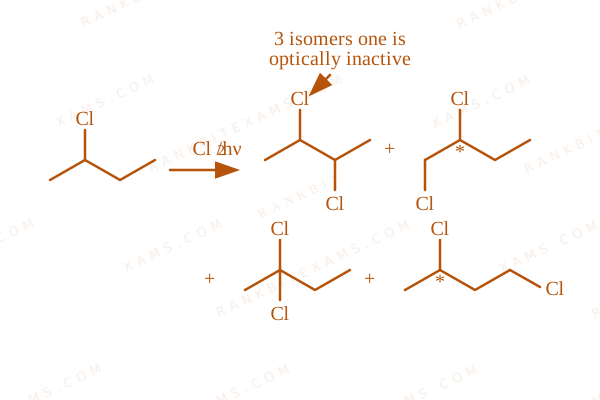
Q jee_main_2024_30_january_evening Stereochemistry of Halogenation
2-chlorobutane + Cl₂ arrow C₄H₈Cl₂ (isomers) Total number of optically active isomers shown by C₄H₈Cl₂, obtained in the above reaction is
Numerical Answer. Answer: 6 to 6

Solution

Core Logic

Free radical chlorination of 2-chlorobutane yields different constitutional isomers of dichlorobutane, each potentially existing as various stereoisomers.

Substrate: CH₃-CH(Cl)-CH₂-CH₃ (exists as 2 enantiomers: d and l) Chlorination can occur at 4 different carbons:

  • At C1: CH₂(Cl)-CH(Cl)-CH₂-CH₃ (1,2-dichlorobutane) arrow Two chiral centers, unsymmetrical. Forms 4 optically active isomers (2 pairs of enantiomers).
  • At C2: CH₃-C(Cl)₂-CH₂-CH₃ (2,2-dichlorobutane) arrow No chiral center. Achiral (0 optically active).
  • At C3: CH₃-CH(Cl)-CH(Cl)-CH₃ (2,3-dichlorobutane) arrow Symmetrical with 2 chiral centers. Forms 3 stereoisomers: 1 meso (achiral) and 2 optically active (1 enantiomeric pair).
  • At C4: CH₃-CH(Cl)-CH₂-CH₂(Cl) (1,3-dichlorobutane, numbering from other end) arrow One chiral center. Forms 2 optically active isomers (1 enantiomeric pair).
  • Optically active isomers of dichlorobutane diagram for Q89 - JEE Main 2024 Evening
    Optically active isomers of dichlorobutane diagram for Q89 - JEE Main 2024 Evening

Step 1: Sum the Optically Active Isomers

Total optically active isomers = 4 (from 1,2-dichloro) + 2 (from 2,3-dichloro) + 2 (from 1,3-dichloro) = 8.

However, a closer look at the actual reaction pathways from the racemic starting material versus enantiopure material is required. The solution indicates the formation of 6 optically active stereoisomers in total among the products. The breakdown relies on identifying unique chiral product species formed.

Pattern Recognition

When tracking total optically active products from a reaction, physically draw every stereocenter variation and eliminate meso compounds. Meso compounds have a plane of symmetry and are optically inactive.

Chapter Mix

Class 12 Chemistry: Haloalkanes and Haloarenes Class 11 Chemistry: Organic Chemistry Some Basic Principles and Techniques
Q63 jee_main_2024_30_january_evening Nucleophilic Substitution Reactions
Given below are two statements: Statement I: High concentration of strong nucleophilic reagent with secondary alkyl halides which do not have bulky substituents will follow SN2 mechanism. Statement II: A secondary alkyl halide when treated with a large excess of ethanol follows SN1 mechanism. In the light of the above statements, choose the most appropriate from the questions given below:
  • A. Statement I is true but Statement II is false.
  • B. Statement I is false but Statement II is true.
  • C. Both statement I and Statement II are false.
  • D. Both statement I and Statement II are true.

Solution

Core Logic

Statement I: Rate of SN2 ∝ [R-X][Nu^-]. Therefore, SN2 reaction is strongly favoured by a high concentration of a good/strong nucleophile and less steric crowding in the substrate molecule. Secondary alkyl halides without bulky substituents can undergo SN2 efficiently under these conditions. Thus, Statement I is true.

Statement II: Ethanol is a weak nucleophile and a polar protic solvent. When a secondary alkyl halide undergoes solvolysis (reaction where solvent is the nucleophile, like ethanol in large excess), it predominantly follows the SN1 mechanism involving a carbocation intermediate. Thus, Statement II is also true.

Step 1: Final Conclusion

Both Statement I and Statement II are correct.

Pattern Recognition

Strong nucleophile + high concentration = bimolecular pathway (SN2). Weak nucleophile (solvolysis) + polar protic solvent = unimolecular pathway (SN1).

Chapter Mix

Class 12 Chemistry: Haloalkanes and Haloarenes

Q jee_main_2024_30_jan_morning Classification
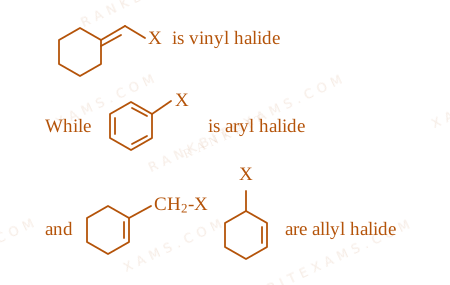
Example of vinylic halide is
  • A.
  • B.
  • C.
  • D.

Solution

Core Logic

A vinylic halide is a compound where the halogen atom is directly bonded to an sp² hybridized carbon of an aliphatic double bond (C=C).

Step 1: Identifying the functional groups

Option 1: The halogen (X) is directly attached to the double-bonded carbon of the ring. This is a vinyl halide.

Classification solution diagram for Q69 - JEE Main 2024 Morning
Option 2: The halogen is attached to an aromatic ring directly. This is an aryl halide.
Classification solution diagram for Q69 - JEE Main 2024 Morning
Options 3 & 4: The halogen is attached to an sp³ hybridized carbon adjacent to a C=C double bond. These are allylic halides.
Classification solution diagram for Q69 - JEE Main 2024 Morning

Chapter Mix

Class 12 Chemistry: Haloalkanes and Haloarenes

More Haloalkanes and Haloarenes Questions — jee_main_2025_28_jan_morning

Practice all Haloalkanes and Haloarenes previous-year questions →

Rankbit System
JEE Physics: Waves (+15.5%) | Electrostatics: Concentric Shells (-29.7%) | Modern Physics: Photoelectric Clones (+34.2%) | Mathematics: Definite Integrals (+18.1%) | Chemistry: Coordination Splitting (-11.4%) | JEE Physics: Waves (+15.5%) | Electrostatics: Concentric Shells (-29.7%) | Modern Physics: Photoelectric Clones (+34.2%) | Mathematics: Definite Integrals (+18.1%) | Chemistry: Coordination Splitting (-11.4%)