The correct order of reactivity of CH_3Br$CH_{3}Br$ in methanol with the following nucleophiles is
F^-$F^{-}$, I^-$I^{-}$, C_2H_5O^-$C_{2}H_{5}O^{-}$ and C_6H_5O^-$C_{6}H_{5}O^{-}$
### Related Formula
Rate propto textNucleophilicity$$Rate \propto \text{Nucleophilicity}$$
### Core Logic
The reaction of CH_3Br$CH_3Br$ (a primary halide) occurs via the S_N2$S_N2$ mechanism. The rate depends directly on the nucleophilicity of the attacking species.
Methanol is a polar protic solvent. In polar protic solvents, larger halide ions are better nucleophiles because they are less solvated. Therefore, I^-$I^-$ is a stronger nucleophile than F^-$F^-$.
For the alkoxide and phenoxide, C_2H_5O^-$C_2H_5O^-$ is a stronger nucleophile than C_6H_5O^-$C_6H_5O^-$ because the negative charge on phenoxide is delocalized over the benzene ring, reducing its electron-donating ability.
### Step 1: Final Order
Combining these factors, the overall order of nucleophilicity in methanol is:
I^- > C_2H_5O^- > C_6H_5O^- > F^-$$I^{-} > C_{2}H_{5}O^{-} > C_{6}H_{5}O^{-} > F^{-}$$
### Pattern Recognition
In polar protic solvents: Size dominates (down a group, nucleophilicity increases). For species of similar size, less resonance stabilization means stronger nucleophile.
### Evaluation Rubric / Model Answer
null
### Chapter Mix
Class 12 Chemistry: Haloalkanes and Haloarenes
Keywords:#order of reactivity of CH3Br#JEE Main 2026 Morning Q59#Haloalkanes and Haloarenes JEE Main 2026#Nucleophilicity Trends JEE Main 2026
More Haloalkanes and Haloarenes Previous-Year Questions
Q54jee_main_2026_21_jan_morningReactions of Haloalkanes
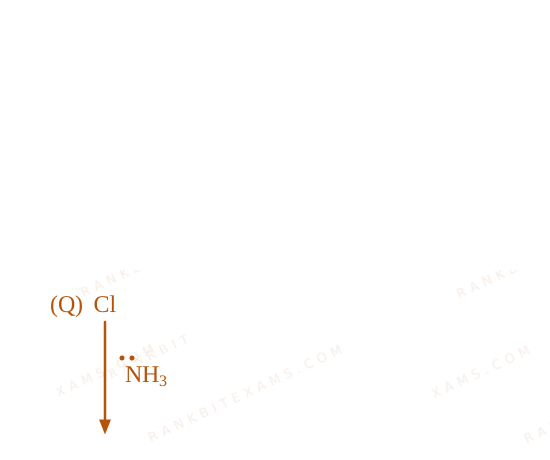
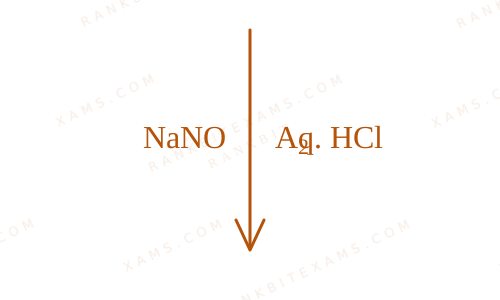
A hydrocarbon ‘P’ (C_4H_8$C_{4}H_{8}$) on reaction with HCl gives an optically active compound ‘Q’ (C_4H_9Cl$C_{4}H_{9}Cl$) which on reaction with one mole of ammonia gives compound ‘R’ (C_4H_11N$C_{4}H_{11}N$). ‘R’ on diazotization followed by hydrolysis gives ‘S’. Identify P, Q, R and S.
### Core Logic
Since P (C_4H_8$C_4H_8$) reacts with HCl to give an optically active compound Q (C_4H_9Cl$C_4H_9Cl$), P must be But-2-ene. Addition of HCl yields 2-chlorobutane, which possesses a chiral center.
mathrmCH_3-mathrmCH=mathrmCH-mathrmCH_3 xrightarrowmathrmHCl mathrmCH_3-mathrmCH_2-mathrmC^*mathrmH(mathrmCl)-mathrmCH_3 quad text(P is But-2-ene, Q is 2-chlorobutane)$$\mathrm{CH}_3-\mathrm{CH}=\mathrm{CH}-\mathrm{CH}_3 \xrightarrow{\mathrm{HCl}} \mathrm{CH}_3-\mathrm{CH}_2-\mathrm{C}^*\mathrm{H}(\mathrm{Cl})-\mathrm{CH}_3 \quad \text{(P is But-2-ene, Q is 2-chlorobutane)}$$Reactions of Haloalkanes diagram for Q54 - JEE Main 2026 Morning
Compound Q reacts with mathrmNH_3$\mathrm{NH}_3$ to undergo nucleophilic substitution forming a primary amine R:
mathrmCH_3-mathrmCH_2-mathrmCH(mathrmCl)-mathrmCH_3 xrightarrowmathrmNH_3 mathrmCH_3-mathrmCH_2-mathrmCH(mathrmNH_2)-mathrmCH_3 quad text(R is Butan-2-amine)$$\mathrm{CH}_3-\mathrm{CH}_2-\mathrm{CH}(\mathrm{Cl})-\mathrm{CH}_3 \xrightarrow{\mathrm{NH}_3} \mathrm{CH}_3-\mathrm{CH}_2-\mathrm{CH}(\mathrm{NH}_2)-\mathrm{CH}_3 \quad \text{(R is Butan-2-amine)}$$Reactions of Haloalkanes diagram for Q54 - JEE Main 2026 Morning
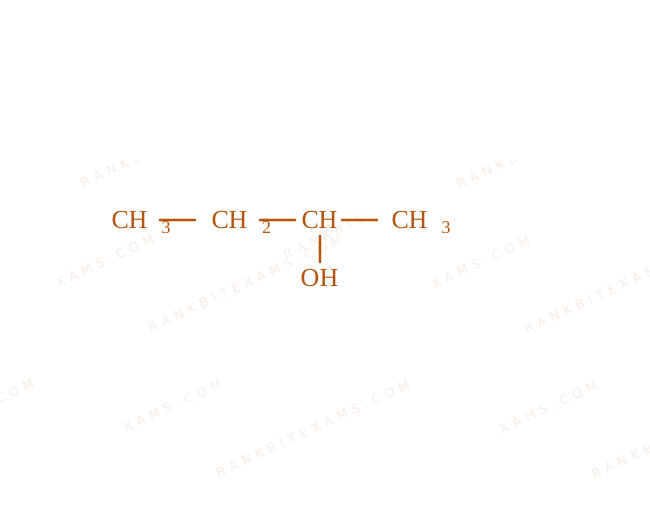
Diazotization of primary aliphatic amines followed by hydrolysis yields an alcohol via a carbocation intermediate (S):
mathrmCH_3-mathrmCH_2-mathrmCH(mathrmNH_2)-mathrmCH_3 xrightarrowmathrmNaNO_2 / mathrmHCl / mathrmH_2mathrmO mathrmCH_3-mathrmCH_2-mathrmCH(mathrmOH)-mathrmCH_3 quad text(S is Butan-2-ol)$$\mathrm{CH}_3-\mathrm{CH}_2-\mathrm{CH}(\mathrm{NH}_2)-\mathrm{CH}_3 \xrightarrow{\mathrm{NaNO}_2 / \mathrm{HCl} / \mathrm{H}_2\mathrm{O}} \mathrm{CH}_3-\mathrm{CH}_2-\mathrm{CH}(\mathrm{OH})-\mathrm{CH}_3 \quad \text{(S is Butan-2-ol)}$$Reactions of Haloalkanes diagram for Q54 - JEE Main 2026 Morning
### Pattern Recognition
An optically active alkyl halide formed from a C_4H_8$C_4H_8$ alkene with HX is a classic pointer to 2-halobutane originating from But-2-ene or But-1-ene. Diazotization of primary aliphatic amines (R-NH_2$R-NH_2$) with NaNO_2/HCl$NaNO_2/HCl$ yields alcohols (R-OH$R-OH$) with possible rearrangements, though here a secondary carbocation is already stable.
### Evaluation Rubric / Model Answer
null
### Chapter Mix
Class 12 Chemistry: Haloalkanes and Haloarenes
Class 12 Chemistry: Amines
Q59jee_main_2026_21_jan_eveningNucleophilic Substitution ($S_N1$) and Carbocation Stability
### Core Logic
The reaction proceeds via an S_N1$S_N1$ mechanism for activated benzyl halides or nucleophilic substitution rate depends on carbocation stability / electronic effects of substituents (-OH, -textNH_2$-\text{NH}_2$, -textNO_2$-\text{NO}_2$, etc.).
- Amino and hydroxy substituents strongly activate through +M effect.
- Nitro groups strongly deactivate through -M effect.
### Step 1: Final Conclusion
The correct order of reactivity is b > a > d > c$b > a > d > c$, corresponding to option (2).
### Pattern Recognition
Sees: benzyl halide reactivity with cyanide.
Trap: Confusing polar/inductive effects with resonance effects of substituents.
### Chapter Mix
Class 12 Chemistry: Haloalkanes and Haloarenes
Q65jee_main_2026_21_jan_eveningOptical Isomerism and Composition Percentage
Given below are four compounds:
(a) n-propyl chloride
(b) iso-propyl chloride
(c) sec-butyl chloride
(d) neo-pentyl chloride
Percentage of carbon in the one which exhibits optical isomerism is:
A.(1) \ 52$(1) \ 52$
B.(2) \ 56$(2) \ 56$
C.(3) \ 46$(3) \ 46$
D.(4) \ 40$(4) \ 40$
Solution
### Core Logic
Among the given compounds, sec-butyl chloride (2-chlorobutane) is optically active and contains a chiral center.
Molecular formula of 2-chlorobutane rightarrow textC_4textH_9textCl$\rightarrow \text{C}_4\text{H}_9\text{Cl}$.
Molar mass = 4(12) + 9(1) + 35.5 = 48 + 9 + 35.5 = 92.5 text g/mol$= 4(12) + 9(1) + 35.5 = 48 + 9 + 35.5 = 92.5 \text{ g/mol}$.
### Step 1: Calculating Percentage of Carbon
text\% of C = frac4892.5 times 100 = 51.89\% approx 52\%$$\text{\% of C} = \frac{48}{92.5} \times 100 = 51.89\% \approx 52\%$$
### Pattern Recognition
Sees: optical isomerism identification combined with elemental percentage composition calculation.
Trap: Selecting the wrong halogen derivative for optical activity.
### Chapter Mix
Class 12 Chemistry: Haloalkanes and Haloarenes
Q67jee_main_2026_22_january_morningSN1 Mechanism
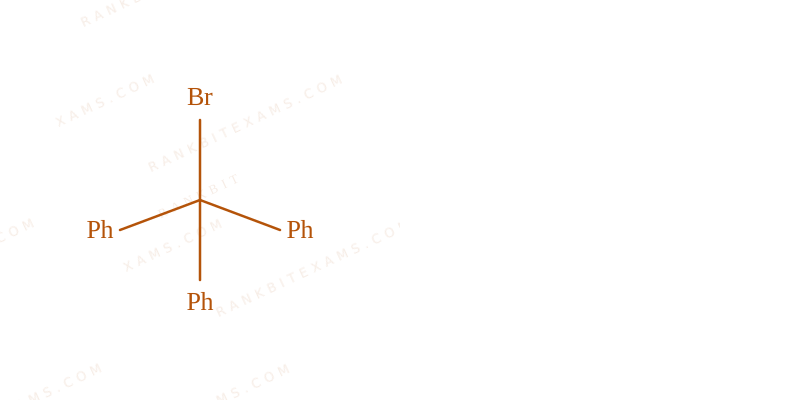
The correct order of the rate of reaction of the following reactants with nucleophile by S_N1$S_{N}1$ mechanism is:
(Given: Structure I and II are rigid)
Image depicts four bicyclic and aromatic structures labeled I through IV.
A.IV < III < II < I$IV < III < II < I$
B.III < I < II < IV$III < I < II < IV$
C.II < I < III < IV$II < I < III < IV$
D.I < II < III < IV$I < II < III < IV$
Solution
### Related Formula
textRate of S_N1 propto textStability of intermediate carbocation$$\text{Rate of } S_N1 \propto \text{Stability of intermediate carbocation}$$
### Core Logic
Evaluate the stability of the carbocations formed upon dissociation of the bromide ion:
Structure (I) and (II) form carbocations at bridgehead positions of rigid bicyclic systems. According to Bredt's rule, these are highly unstable because they cannot adopt the necessary planar sp^2$sp^2$ geometry. Among them, (I) has an additional methyl group which provides slight +I stabilization compared to (II). So, (II) is even less stable than (I).
Structure (III) forms a tertiary carbocation, but it's not a rigid bridgehead preventing planarity, so it's significantly more stable than I and II.
Structure (IV) is a highly stable trityl-like carbocation where the positive charge is stabilized by extensive resonance with the adjacent phenyl ring(s).
### Step 1: Final Ordering
Stability order: (II) < (I) < (III) < (IV)$(II) < (I) < (III) < (IV)$. Thus, the S_N1$S_{N}1$ rate follows the same order.
### Pattern Recognition
Bridgehead halides effectively do not undergo S_N1$S_N1$ (or S_N2$S_N2$) reactions due to Bredt's rule. Resonance stabilized carbocations always dominate.
### Evaluation Rubric / Model Answer
null
### Chapter Mix
Class 12 Chemistry: Haloalkanes and Haloarenes
More Haloalkanes and Haloarenes Questions — jee_main_2026_22_january_morning
We Map Every Repeating Question in Competitive Exams.
Say goodbye to generic mock test fatigue. RankBit uses smart analysis to group past exam questions into their foundational Repeating Question Types. Find chapter weightage, track repeating questions, and score higher with targeted practice.
Select Your Target Exam
Choose an exam track below to find formulas per chapter and patterns.
Syncing Exam Intelligence
Mapping formulas and patterns across all tracks…
PATH A — FULL LENGTH PRACTICE
Full Mock Test Hub
Simulate real NTA exam conditions with fully tracked mocks. Time yourself against past papers.
Practice past-year questions one chapter at a time. Pick an exam → subject → chapter and get every PYQ for that topic — pulled together from all past papers — with the chapter's key formulas alongside.