JEE Main · Chemistry ↓ Falling

Haloalkanes and Haloarenes appeared 40 times across 3 years — 4.7% of Chemistry. This question is from Ambident Nucleophiles Reactions.

Year 2026 2025 2024 Total
Questions 11 16 13 40

The products A and B in the following reactions, respectively are A A g - N O _ 2 C H _ 3 - C H _ 2 - C H _ 2 - B r A g C N B

Solution & Explanation

Core Logic

Both silver reagents exhibit significantly covalent bond characters:

  • Reaction with AgNO₂: The bond between silver and oxygen is covalent, making the lone pair on the nitrogen atom the primary nucleophilic site. Attack via nitrogen yields a nitroalkane product:
A = CH₃-CH₂-CH₂-NO₂
  • Reaction with AgCN: The covalent Ag-C bond directs the nucleophilic attack to proceed through the lone pair on nitrogen, yielding an isocyanide compound:
B = CH₃-CH₂-CH₂-NC

Hence, option (4) represents the correct combination.

Pattern Recognition

Sees: Alkyl halide reacting with covalent silver salts of ambident anions. Shortcut: Silver reagents (AgCN or AgNO₂) drive bond formatting via the nitrogen center, producing isocyanides and nitroalkanes respectively.

Chapter Mix

Class 12 Chemistry: Haloalkanes and Haloarenes

Reference Study Guides

More Haloalkanes and Haloarenes Previous-Year Questions — Page 6

Q34 jee_main_2025_28_jan_evening Nucleophilic Substitution Reactions
The product B formed in the following reaction sequence is :
Reaction sequence diagram for Q34 - JEE Main 2025
The image outlines an addition reaction followed by substitution using silver cyanide.
  • A. (1)
  • B. (2)
  • C. (3)
  • D. (4)

Solution

Related Formula

Markovnikov addition of HCl across an alkene:

R-CH=CH₂ + HCl arrow R-CHCl-CH₃

Nucleophilic substitution with AgCN favors coordinate carbon bonding over nitrogen, yielding covalent isocyanides (R-NC).

Core Logic

Step 1: The starting material contains a double bond. Treating it with HCl leads to addition. According to Markovnikov's rule, the chloride ion attaches to the secondary position, creating chloride intermediate [A].

Step 2: Compound [A] reacts with AgCN. Since AgCN is covalent, the lone pair on nitrogen acts as the attacking nucleophile, leading to substitution with an isocyanide group (-NC) rather than a cyanide group (-CN).

Step 1: Structural Synthesis

The intermediate [A] possesses a chlorine atom at the secondary carbon position. Substituting this chlorine with -NC provides the product corresponding to option (4).
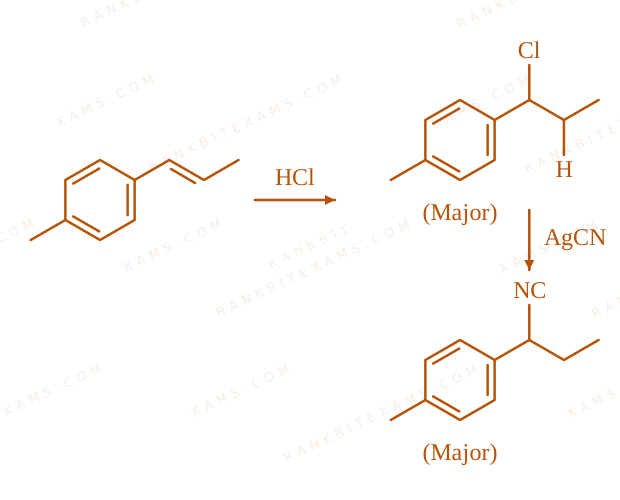
Detailed mechanism step for reaction sequence of Q34
The image outlines an addition reaction followed by substitution using silver cyanide.

Pattern Recognition

Distinguish between ionic vs covalent cyanide sources:

  • KCN / NaCN forms alkyl nitriles (R-CN)
  • AgCN forms alkyl isocyanides (R-NC)
Chapter Mix

Class 12 Chemistry: Haloalkanes and Haloarenes
Q jee_main_2025_29_jan_morning Nucleophilic Aromatic Substitution
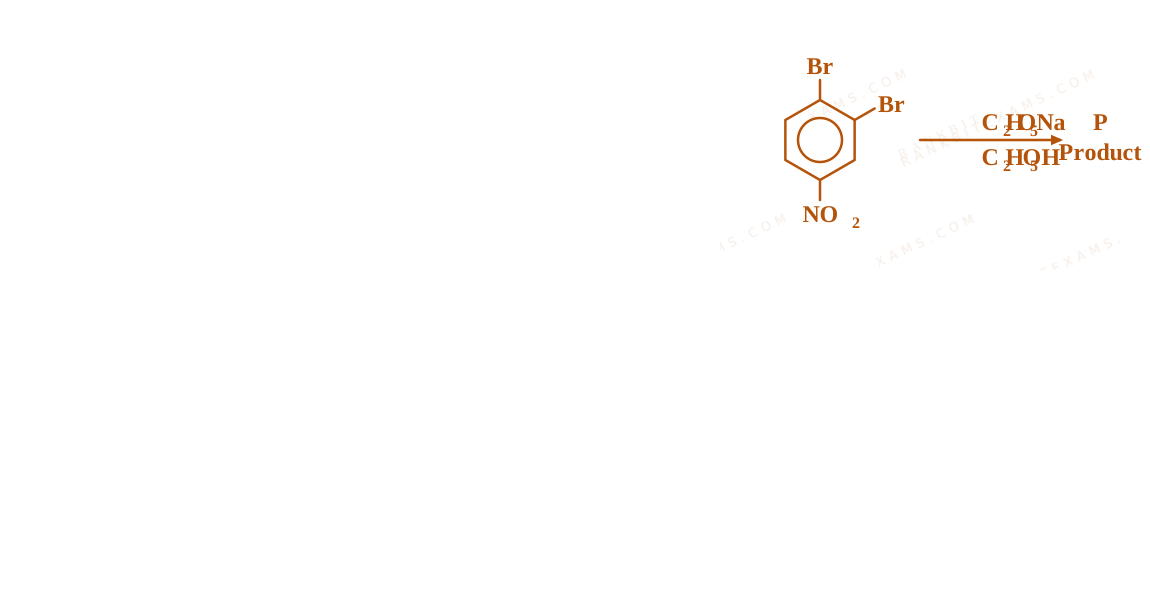
In the following substitution reaction:
Nucleophilic Aromatic Substitution diagram for Q34 - JEE Main 2025 Morning
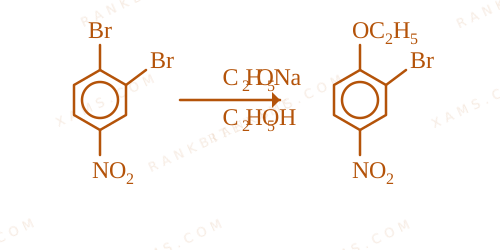
The structural layout depicts a 1,2-dibromo-4-nitrobenzene reacting with sodium ethoxide.
Product P formed is:
  • A.
  • B.
  • C.
  • D.

Solution

Related Formula

Nucleophilic Aromatic Substitution (SNAr) occurs via a Meisenheimer complex intermediate, where strong electron-withdrawing groups (-NO₂) activate positions strictly ortho and para to themselves.

Core Logic

The reactant is 1,2-dibromo-4-nitrobenzene. Let us evaluate the two bromine positions relative to the nitro group:

  • The bromine at C-1 is para to the strong activating -NO₂ group.
  • The bromine at C-2 is meta to the -NO₂ group.
  • Since the para position facilitates effective negative charge delocalization onto the oxygen atoms of the nitro group during intermediate formation, the para-bromine undergoes substitution exclusively by the ethoxide ion (^-OC₂H₅). This yields the final product shown below:

    Nucleophilic Aromatic Substitution diagram for Q34 - JEE Main 2025 Morning
    The structural layout depicts a 1,2-dibromo-4-nitrobenzene reacting with sodium ethoxide.

Pattern Recognition

In aromatic pathways activated by -NO₂, substitution happens exclusively at positions ortho or para relative to the nitro flag; meta positions remain unactivated.

Chapter Mix

Class 12 Chemistry: Haloalkanes and Haloarenes
Q jee_main_2024_01_february_morning Nucleophilic Substitution
Given below are two statements : one is labelled as Assertion (A) and the other is labelled as Reason (R). Assertion (A) : Haloalkanes react with KCN to form alkyl cyanides as a main product while with AgCN form isocyanide as the main product. Reason (R) : KCN and AgCN both are highly ionic compounds. In the light of the above statement, choose the most appropriate answer from the options given below:
  • A. (A) is correct but (R) is not correct
  • B. Both (A) and (R) are correct but (R) is not the correct explanation of (A)
  • C. (A) is not correct but (R) is correct
  • D. Both (A) and (R) are correct and (R) is the correct explanation of (A)

Solution

Core Logic

KCN is predominantly ionic and provides cyanide ions (CN^-) in solution. Although both carbon and nitrogen are in a position to donate electron pairs, the attack takes place mainly through carbon because C-C bond is more stable than C-N bond, forming alkyl cyanides (nitriles) as major product.

KCN + R-X arrow R-CN (Major)

However, AgCN is mainly covalent in nature and nitrogen is free to donate an electron pair forming isocyanide as the main product.

AgCN + R-X arrow R-NC (Major)
Step 1: Final Conclusion

Assertion (A) is correct. Reason (R) states both are highly ionic, which is incorrect because AgCN is largely covalent. Therefore, (A) is correct but (R) is not correct.

Pattern Recognition

Ambidentate nucleophile shortcut: Alkali metal cyanides (KCN, NaCN) are ionic arrow attack from Carbon arrow Cyanide. Heavy metal cyanides (AgCN) are covalent arrow attack from Nitrogen arrow Isocyanide.

Chapter Mix

Class 12 Chemistry: Haloalkanes and Haloarenes

Q jee_main_2024_01_february_morning Optical Isomerism
Number of optical isomers possible for 2-chlorobutane
Numerical Answer. Answer: 2 to 2

Solution

Core Logic

The structure of 2-chlorobutane is CH₃-CH(Cl)-CH₂-CH₃. There is exactly one chiral center in this molecule, which is the carbon atom at position 2 (bonded to H, Cl, CH₃, and CH₂CH₃).

For a molecule with n distinct chiral centers and no plane of symmetry, the number of optical isomers (stereoisomers) is 2ⁿ.

Step 1: Calculate Isomers

Number of chiral centers n = 1. Total optical isomers = 2¹ = 2 (one pair of enantiomers: the (R) and (S) configurations).

Optical Isomerism diagram for Q81 - JEE Main 2024 Morning

Pattern Recognition

1 chiral center always gives 2 optical isomers (a pair of enantiomers).

Chapter Mix

Class 12 Chemistry: Haloalkanes and Haloarenes Class 11 Chemistry: Organic Chemistry Some Basic Principles and Techniques

Q77 jee_main_2024_29_january_evening Nucleophilic Substitution of Alkyl Halides
Alkyl halide is converted into alkyl isocyanide by reaction with
  • A. NaCN
  • B. NH₄CN
  • C. KCN
  • D. AgCN

Solution

Related Formula
R-X + AgCN arrow R-NC + AgX
Core Logic

Cyanide (CN^-) is an ambident nucleophile that can attack through either carbon or nitrogen:

  • KCN and NaCN are predominantly ionic compounds, leaving the carbon atom free and highly nucleophilic to yield alkyl cyanides (R-CN) as the major product.
  • Silver cyanide (AgCN) is predominantly covalent. Because the silver-carbon bond is strong, the lone pair on nitrogen acts as the primary nucleophilic site, leading to the formation of alkyl isocyanides (R-NC).
Step 1: Selection

Therefore, reacting an alkyl halide with AgCN selectively produces an alkyl isocyanide.

Pattern Recognition

Ionic cyanides like KCN yield nitriles, whereas covalent cyanides like AgCN yield isocyanides due to the availability of the nitrogen lone pair.

Chapter Mix

Class 12 Chemistry: Organic Compounds Containing Halogens

More Haloalkanes and Haloarenes Questions — jee_main_2025_28_jan_morning

Practice all Haloalkanes and Haloarenes previous-year questions →

Rankbit System
JEE Physics: Waves (+15.5%) | Electrostatics: Concentric Shells (-29.7%) | Modern Physics: Photoelectric Clones (+34.2%) | Mathematics: Definite Integrals (+18.1%) | Chemistry: Coordination Splitting (-11.4%) | JEE Physics: Waves (+15.5%) | Electrostatics: Concentric Shells (-29.7%) | Modern Physics: Photoelectric Clones (+34.2%) | Mathematics: Definite Integrals (+18.1%) | Chemistry: Coordination Splitting (-11.4%)