JEE Main · Chemistry ↓ Falling

Haloalkanes and Haloarenes appeared 40 times across 3 years — 4.7% of Chemistry. This question is from Ambident Nucleophiles Reactions.

Year 2026 2025 2024 Total
Questions 11 16 13 40

The products A and B in the following reactions, respectively are A A g - N O _ 2 C H _ 3 - C H _ 2 - C H _ 2 - B r A g C N B

Solution & Explanation

Core Logic

Both silver reagents exhibit significantly covalent bond characters:

  • Reaction with AgNO₂: The bond between silver and oxygen is covalent, making the lone pair on the nitrogen atom the primary nucleophilic site. Attack via nitrogen yields a nitroalkane product:
A = CH₃-CH₂-CH₂-NO₂
  • Reaction with AgCN: The covalent Ag-C bond directs the nucleophilic attack to proceed through the lone pair on nitrogen, yielding an isocyanide compound:
B = CH₃-CH₂-CH₂-NC

Hence, option (4) represents the correct combination.

Pattern Recognition

Sees: Alkyl halide reacting with covalent silver salts of ambident anions. Shortcut: Silver reagents (AgCN or AgNO₂) drive bond formatting via the nitrogen center, producing isocyanides and nitroalkanes respectively.

Chapter Mix

Class 12 Chemistry: Haloalkanes and Haloarenes

Reference Study Guides

More Haloalkanes and Haloarenes Previous-Year Questions — Page 8

Q74 jee_main_2024_30_jan_morning Classification
Given below are two statement one is labeled as Assertion (A) and the other is labeled as Reason (R). Assertion (A): CH₂=CH-CH₂-Cl is an example of allyl halide Reason (R): Allyl halides are the compounds in which the halogen atom is attached to sp² hybridised carbon atom. In the light of the two above statements, choose the most appropriate answer from the options given below:
  • A. (A) is true but (R) is false
  • B. Both (A) and (R) are true but (R) is not the correct explanation of (A)
  • C. (A) is false but (R) is true
  • D. Both (A) and (R) are true and (R) is the correct explanation of (A)

Solution

Core Logic

Assertion (A): CH₂=CH-CH₂-Cl is an allyl halide. This statement is True. The halogen is attached to the carbon adjacent to the double bond (allylic position).

Reason (R): Allyl halides are compounds in which the halogen atom is attached to an sp² hybridized carbon atom. This statement is False. In allyl halides, the halogen is attached to an sp³ hybridized carbon atom which is next to an sp² hybridized carbon (C=C double bond).

Step 1: Conclusion

Therefore, (A) is true but (R) is false.

Pattern Recognition

Allylic = sp³ C adjacent to C=C. Vinylic = sp² C of the C=C itself.

Chapter Mix

Class 12 Chemistry: Haloalkanes and Haloarenes
Q jee_main_2024_31_jan_evening Nucleophilic Aromatic Substitution
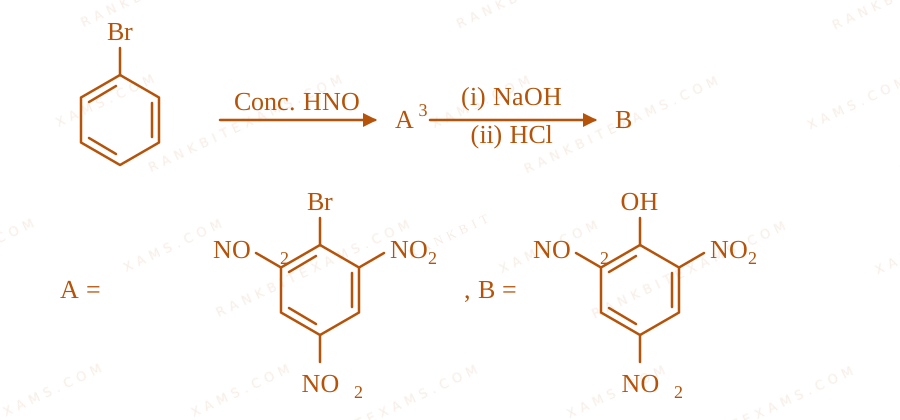
Identify A and B in the following reaction sequence.
Nucleophilic Aromatic Substitution diagram for Q63 - JEE Main 2024 Evening
The image shows a reaction scheme starting from bromobenzene undergoing nitration followed by substitution.
  • A.
  • B.
  • C.
  • D.

Solution

Core Logic
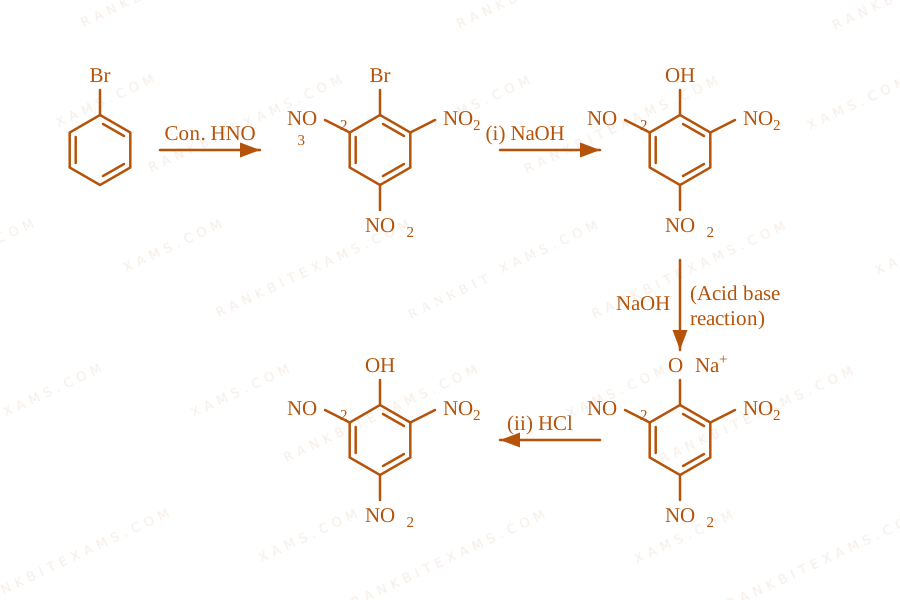
  • When bromobenzene reacts with concentrated HNO₃ (nitration), the bromine atom is ortho/para directing. However, under drastic conditions with excess concentrated nitrating mixture, 1-bromo-2,4,6-trinitrobenzene is formed (Compound A).
  • When 1-bromo-2,4,6-trinitrobenzene (Compound A) is treated with NaOH, the presence of three strong electron-withdrawing -NO₂ groups activates the aromatic ring toward Nucleophilic Aromatic Substitution (SNAr). The -Br is easily replaced by -OH to form 2,4,6-trinitrophenol (picric acid).
  • Subsequent acidification with HCl yields the neutral picric acid (Compound B).
  • Nucleophilic Aromatic Substitution diagram for Q63 - JEE Main 2024 Evening
    The image shows a reaction scheme starting from bromobenzene undergoing nitration followed by substitution.

Pattern Recognition

Multiple NO₂ groups drastically increase the susceptibility of halobenzenes to SNAr. Bromine is replaced completely by OH^- under alkaline conditions.

Chapter Mix

Class 12 Chemistry: Haloalkanes and Haloarenes Class 12 Chemistry: Alcohols, Phenols and Ethers
Q jee_main_2024_31_jan_evening IUPAC Nomenclature of Haloalkanes
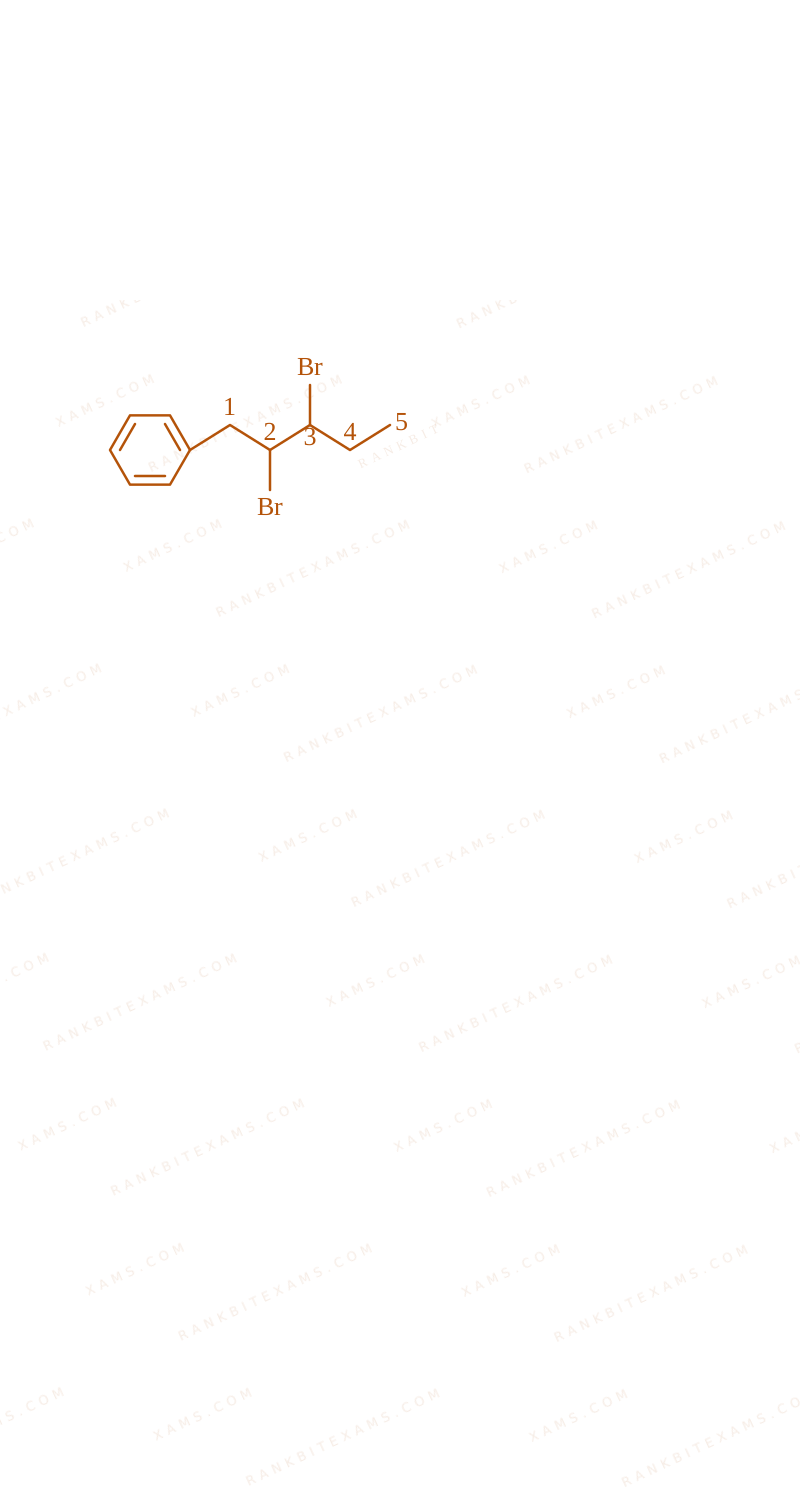
Identify structure of 2,3-dibromo-1-phenylpentane.
  • A.
  • B.
  • C.
  • D.

Solution

Core Logic

Decode the IUPAC name: 2,3-dibromo-1-phenylpentane.

  • Parent chain is pentane (5 carbon chain: C1-C2-C3-C4-C5).
  • Substituents:
  • Phenyl group at position 1.
  • Bromo groups at positions 2 and 3.
  • Option (3) correctly displays a 5-carbon straight chain. The first carbon attaches to the benzene ring (phenyl group), and the second and third carbons each hold a bromine atom.

    IUPAC Nomenclature of Haloalkanes diagram for Q67 - JEE Main 2024 Evening
    IUPAC Nomenclature of Haloalkanes diagram for Q67 - JEE Main 2024 Evening

Chapter Mix

Class 12 Chemistry: Haloalkanes and Haloarenes
Q jee_main_2024_31_jan_morning Elimination and Addition Reactions
The product (C) in the below mentioned reaction is: CH₃-CH₂-CH₂-Br [Δ]KOH(alc) A [Δ]HBr B [Δ]KOH(aq) C
  • A. Propan-1-ol
  • B. Propene
  • C. Propyne
  • D. Propan-2-ol

Solution

Step 1: Elimination to form Propene
CH₃-CH₂-CH₂-Br KOH (alc), Δ CH₃-CH=CH₂ (Compound A: Propene)
Step 2: Electrophilic Addition of HBr

Addition of HBr follows Markovnikov's rule:

CH₃-CH=CH₂ + HBr Δ CH₃-CH(Br)-CH₃ (Compound B: 2-Bromopropane)
Step 3: Nucleophilic Substitution

Reaction with aqueous KOH leads to SN2/SN1 substitution of Br^- with OH^-:

CH₃-CH(Br)-CH₃ KOH (aq), Δ CH₃-CH(OH)-CH₃ (Compound C: Propan-2-ol)
Pattern Recognition

Alc. KOH gives elimination (alkene). Aq. KOH gives substitution (alcohol). HBr on unsymmetrical alkene gives Markovnikov addition.

Chapter Mix

Class 12 Chemistry: Haloalkanes and Haloarenes

Q86 jee_main_2024_31_jan_morning Elimination and Substitution
CH₃CH₂Br + NaOH arrow Product A CH₃CH₂Br + NaOH / H₂O arrow Product B The total number of hydrogen atoms in product A and product B is
Numerical Answer. Answer: 10 to 10

Solution

Core Logic

Reaction 1: If the reagent is alcoholic NaOH (implied due to formation of a distinct product A to contrast B), elimination occurs:

CH₃CH₂Br + NaOH (alc) arrow CH₂=CH₂ (Ethene)

Hydrogen atoms in ethene (C₂H₄) = 4.

Reaction 2: If the reagent is aqueous NaOH (NaOH / H₂O), nucleophilic substitution (SN2) occurs:

CH₃CH₂Br + NaOH (aq) arrow CH₃CH₂OH (Ethanol)

Hydrogen atoms in ethanol (C₂H₆O) = 6.

Total hydrogen atoms = 4 + 6 = 10.

Chapter Mix

Class 12 Chemistry: Haloalkanes and Haloarenes

More Haloalkanes and Haloarenes Questions — jee_main_2025_28_jan_morning

Practice all Haloalkanes and Haloarenes previous-year questions →

Rankbit System
JEE Physics: Waves (+15.5%) | Electrostatics: Concentric Shells (-29.7%) | Modern Physics: Photoelectric Clones (+34.2%) | Mathematics: Definite Integrals (+18.1%) | Chemistry: Coordination Splitting (-11.4%) | JEE Physics: Waves (+15.5%) | Electrostatics: Concentric Shells (-29.7%) | Modern Physics: Photoelectric Clones (+34.2%) | Mathematics: Definite Integrals (+18.1%) | Chemistry: Coordination Splitting (-11.4%)