Rankbit System
JEE Physics: Waves (+15.5%) | Electrostatics: Concentric Shells (-29.7%) | Modern Physics: Photoelectric Clones (+34.2%) | Mathematics: Definite Integrals (+18.1%) | Chemistry: Coordination Splitting (-11.4%) | JEE Physics: Waves (+15.5%) | Electrostatics: Concentric Shells (-29.7%) | Modern Physics: Photoelectric Clones (+34.2%) | Mathematics: Definite Integrals (+18.1%) | Chemistry: Coordination Splitting (-11.4%)

Given below are two statements: Statement (I):
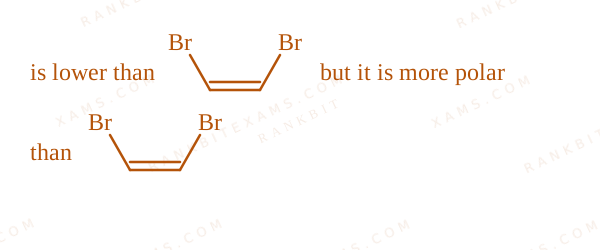
Physical Properties of Dihalobenzenes diagram for Q42 - JEE Main 2025 Evening
The structural layouts show ortho and para halobenzene isomers (1,2-dichlorobenzene vs 1,2-dibromobenzene, and para-dibromobenzene).
is more polar than
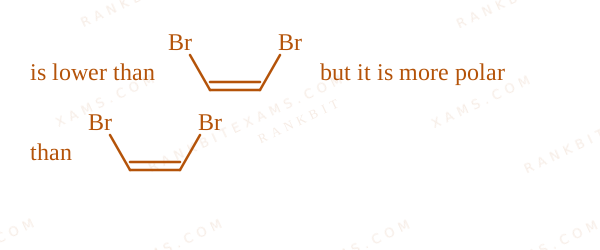
Physical Properties of Dihalobenzenes diagram for Q42 - JEE Main 2025 Evening
The structural layouts show ortho and para halobenzene isomers (1,2-dichlorobenzene vs 1,2-dibromobenzene, and para-dibromobenzene).
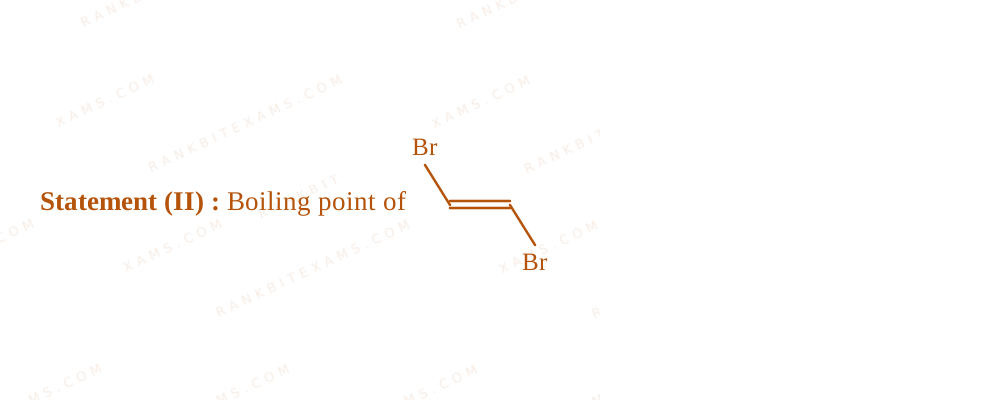
. Statement (II): Boiling point of
Physical Properties of Dihalobenzenes diagram for Q42 - JEE Main 2025 Evening
The structural layouts show ortho and para halobenzene isomers (1,2-dichlorobenzene vs 1,2-dibromobenzene, and para-dibromobenzene).
is lower than the ortho-isomer, but it is more polar than the meta-isomer. In the light of the above statements, choose the most appropriate answer from the options given below:

Solution & Explanation

### Related Formula mutextnet = sqrtmu_1^2 + mu_2^2 + 2mu_1mu_2costheta textBoiling point propto textDipole-dipole interactions + textVan der Waals forces ### Core Logic Let's analyze the visual structures alongside their scientific orientations: - Statement (I) compares 1,2-dichlorobenzene and 1,2-dibromobenzene. Chlorine has a higher electronegativity than bromine, creating a larger bond dipole. The vacant d-orbital interactions do not invert this baseline dipole trend. Thus, 1,2-dichlorobenzene is more polar, making Statement I correct. - Statement (II) evaluates dihalobenzene isomers. For the para-isomer, individual bond dipoles are oriented at 180^circ, cancelling out completely: mutextpara = 0 Since mu_textmeta > 0, the para-isomer is *less* polar than the meta-isomer. This directly falsifies Statement II. ### Step 1: Spatial Alignments The geometric configurations map out as follows:
Physical Properties of Isomers vector diagram for Q42 - JEE Main 2025 Evening
The structural layouts show ortho and para halobenzene isomers (1,2-dichlorobenzene vs 1,2-dibromobenzene, and para-dibromobenzene).
Physical Properties of Isomers vector diagram for Q42 - JEE Main 2025 Evening
The structural layouts show ortho and para halobenzene isomers (1,2-dichlorobenzene vs 1,2-dibromobenzene, and para-dibromobenzene).
Physical Properties of Isomers vector diagram for Q42 - JEE Main 2025 Evening
The structural layouts show ortho and para halobenzene isomers (1,2-dichlorobenzene vs 1,2-dibromobenzene, and para-dibromobenzene).
Hence, Statement I is correct, but Statement II is incorrect. ### Pattern Recognition Dipole tracking rule: Para-substituted benzenes with identical groups possess a structural center of inversion, guaranteeing a net dipole moment of exactly zero (mu = 0). They can never be more polar than any asymmetric ortho or meta structural isomer. ### Evaluation Rubric / Model Answer null ### Chapter Mix Class 12 Chemistry: Haloalkanes and Haloarenes

Reference Study Guides

More Haloalkanes and Haloarenes Previous-Year Questions

Q 2025 Chemical Reactions and Named Rules
Match List-I with List-II: beginarray|l|l| hline beginarrayc textbfList-I \\ textbf(Reaction) endarray & beginarrayc textbfList-II \\ textbf(Name of reaction) endarray \\ hline text(A) quad text2Ar-X + text2Na xrightarrowtextDry Ether textAr-Ar + text2NaX & text(I) quad textLucas reaction \\ hline text(B) quad mathrmArN_2^+X^- xrightarrowmathrmCu / HCl mathrmArCl + mathrmN_2 uparrow + mathrmCuX & text(II) quad textFinkelstein reaction \\ hline text(C) quad mathrmC_2H_5Br + mathrmNaI xrightarrowtextDry Acetone mathrmC_2H_5I + mathrmNaBr & text(III) quad textFittig reaction \\ hline text(D) quad mathrmCH_3C(OH)(CH_3)CH_3 xrightarrowmathrmHCl / ZnCl_2 mathrmCH_3C(Cl)(CH_3)CH_3 & text(IV) quad textGatterman reaction \\ hline endarray Choose the correct answer from the options given below:
  • A. text(A)-(III), (B)-(II), (C)-(IV), (D)-(I)
  • B. text(A)-(III), (B)-(IV), (C)-(II), (D)-(I)
  • C. text(A)-(IV), (B)-(III), (C)-(I), (D)-(II)
  • D. text(A)-(IV), (B)-(I), (C)-(II), (D)-(III)

Solution

### Related Formula textNamed Organic Transformations ### Core Logic Let us systematically match each reaction in List-I to its standardized organic reaction name in List-II: - **Reaction (A)**: Coupling of two aryl halides with sodium metal in dry ether to form biaryl is the classic **Fittig reaction** rightarrow **(III)**. - **Reaction (B)**: Conversion of benzene diazonium chloride to aryl halide using copper powder (mathrmCu) in halogen acids like mathrmHCl is the **Gatterman reaction** rightarrow **(IV)**. - **Reaction (C)**: Substitution of halogen in an alkyl halide with sodium iodide (mathrmNaI) in dry acetone solvent is the classic halogen exchange method called the **Finkelstein reaction** rightarrow **(II)**. - **Reaction (D)**: Replacement of the hydroxyl group in tertiary butyl alcohol with chlorine using conc. mathrmHCl in the presence of anhydrous mathrmZnCl_2 catalyst is the **Lucas reaction** rightarrow **(I)**. ### Step 1: Selection Combining the selections, the correct sequence is: **(A)-(III), (B)-(IV), (C)-(II), (D)-(I)** This maps directly to option (2). ### Pattern Recognition Named reaction matching questions are very straightforward. Keep a clear distinction between the Sandmeyer reaction (which uses cuprous halide, e.g. mathrmCu_2Cl_2) and the Gatterman reaction (which uses copper powder, mathrmCu). ### Evaluation Rubric / Model Answer null ### Chapter Mix Class 12 Chemistry: Haloalkanes and Haloarenes
Q48 2025 Elimination and Addition Reaction Sequences
Consider the following sequence of reactions: mathrmCH_3-CH_2-CH_2-CH(Br)-CH_3 xrightarrowtextalcoholic KOH mathrmP text (Major Product) xrightarrowmathrmBr_2 mathrmQ Consider the above sequence of reactions. 151~mathrmg of 2-bromopentane is made to react. Yield of major product mathrmP is 80\% whereas mathrmQ is 100\%. Mass of product mathrmQ obtained is _______ g. Given molar mass in mathrmg~mol^-1 H: 1, C: 12, O: 16, Br: 80
Numerical Answer. Answer: 184 to 184

Solution

### Related Formula textActual Yield = textTheoretical Yield times \% text Yield ### Core Logic Let us break down each chemical reaction step: - **Step 1**: 2-bromopentane undergoes dehydrohalogenation via an E2 mechanism using alcoholic mathrmKOH. According to Saytzeff's rule, the more substituted alkene is the major product. Thus, **pent-2-ene** is the major product mathrmP.
Chemical reaction showing elimination of 2-bromopentane to form pent-2-ene
- **Step 2**: Pent-2-ene undergoes electrophilic bromination with liquid bromine (mathrmBr_2) to give **2,3-dibromopentane** (product mathrmQ):
Chemical reaction showing elimination of 2-bromopentane to form pent-2-ene
### Step 1: Calculate Initial Moles of Reactant Calculate the molar mass of 2-bromopentane (mathrmC_5H_11Br): textMolar mass = 5(12) + 11(1) + 80 = 60 + 11 + 80 = 151~mathrmg~mol^-1 textInitial moles = frac151~mathrmg151~mathrmg~mol^-1 = 1~mathrmmol ### Step 2: Calculate Moles of Intermediate P and Q Since the yield of mathrmP is 80\%: textMoles of P formed = 1 times 0.80 = 0.8~mathrmmol Since the conversion of mathrmP rightarrow mathrmQ has a yield of 100\%, the mole count remains stoichiometric: textMoles of Q formed = 0.8 times 1.00 = 0.8~mathrmmol ### Step 3: Calculate Mass of Q Product mathrmQ is 2,3-dibromopentane (mathrmC_5H_10Br_2). Calculate its molar mass: textMolar mass of Q = 5(12) + 10(1) + 2(80) = 60 + 10 + 160 = 230~mathrmg~mol^-1 textMass of Q = 0.8 times 230 = 184~mathrmg ### Pattern Recognition Saytzeff vs Hofmann: Alcoholic mathrmKOH is a small, non-bulky base, which selectively targets the internal secondary proton to yield the thermodynamic trans-alkene (pent-2-ene) as the major product rather than the terminal 1-alkene. ### Evaluation Rubric / Model Answer null ### Chapter Mix Class 12 Chemistry: Haloalkanes and Haloarenes
Q 2025 Reactions of Alkyl Halides and Alkyne Hydration
An optically active alkyl halide mathrmC_4H_9Br [A] reacts with hot KOH dissolved in ethanol and forms alkene [B] as major product which reacts with bromine to give dibromide [C]. The compound [C] is converted into a gas [D] upon reacting with alcoholic mathrmNaNH_2. During hydration 18 gram of water is added to 1 mole of gas [D] on warming with mercuric sulphate and dilute acid at 333mathrmK to form compound [E]. The IUPAC name of compound [E] is :
  • A. (1)\ textBut-2-yne
  • B. (2)\ textButan-2-ol
  • C. (3)\ textButan-2-one
  • D. (4)\ textButan-1-al

Solution

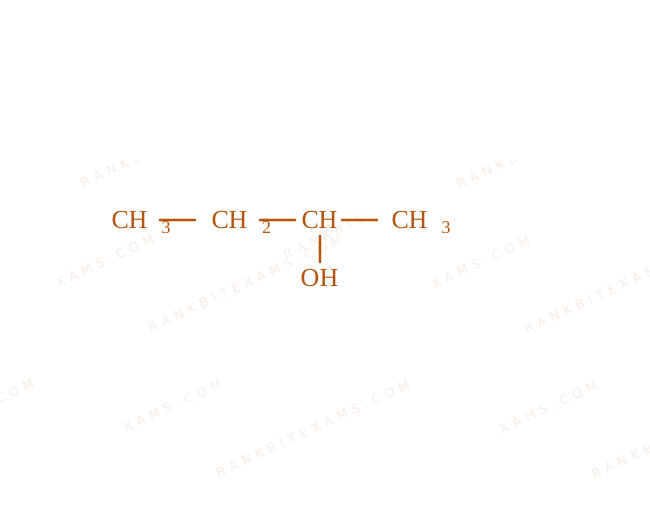
### Related Formula Dehydrohalogenation via alcoholic KOH follows E2 elimination mechanism: mathrmR-CH_2-CH(Br)-R' xrightarrowtextalc. KOH R-CH=CH-R' Hydration of alkynes using mathrmHgSO_4/H_2SO_4 yields ketones via keto-enol tautomerism. ### Core Logic Let's trace the full sequence line-by-row: 1. **[A]** is an optically active halide with formula mathrmC_4H_9Br rightarrow mathrmCH_3-CH(Br)-CH_2-CH_3 (2-Bromobutane). 2. Reaction of [A] with hot ethanolic KOH produces **[B]** as the major product: mathrmCH_3-CH=CH-CH_3 (But-2-ene). 3. Treatment of [B] with mathrmBr_2 yields a vicinal dibromide **[C]**: mathrmCH_3-CH(Br)-CH(Br)-CH_3 (2,3-Dibromobutane). 4. Reaction of [C] with alcoholic mathrmNaNH_2 converts it via double dehydrohalogenation into gas **[D]**: mathrmCH_3-Cequiv C-CH_3 (But-2-yne). 5. Hydration of 1 mole of [D] with mathrmH_2O in the presence of mathrmHg^2+/H^+ forms an enol intermediate that rapidly tautomerizes to compound **[E]**: mathrmCH_3-CO-CH_2-CH_3 (Butan-2-one). ### Step 1: Visualization
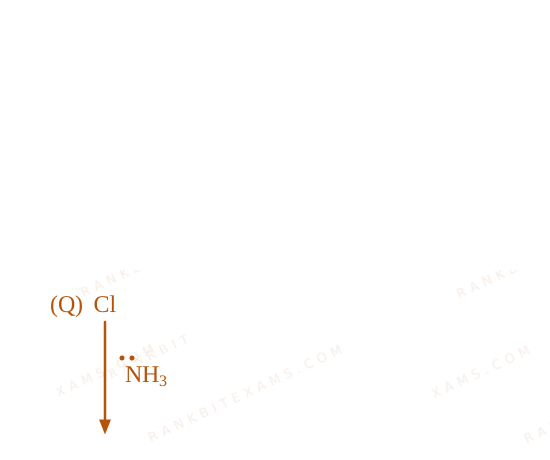
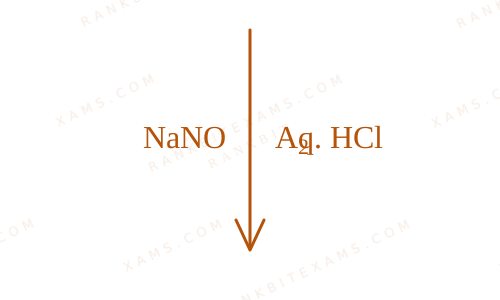
Reaction roadmap step verification for Q27
### Pattern Recognition Whenever you see a 4-carbon chain undergoing terminal/internal dehydrohalogenation followed by hydration of the resulting alkyne, look closely at the configuration: symmetric or unsymmetric alkyne hydration both systematically lead to Butan-2-one because a stable ketone cannot form on position 1 via standard Kucherov hydration of an internal chain. ### Evaluation Rubric / Model Answer null ### Chapter Mix Class 12 Physics: Haloalkanes and Haloarenes Class 11 Chemistry: Hydrocarbons Class 12 Chemistry: Aldehydes, Ketones and Carboxylic Acids
Q29 2025 Preparation and Reactions of Styrene derivatives
Choose the correct set of reagents for the following conversion: textEthyl benzene longrightarrow text4-bromostyrene {{Q_IMG1}}
Conversion scheme of ethylbenzene to 4-bromostyrene for Q29
The figure illustrates the multi-step conversion starting from ethylbenzene to yield a brominated styrene derivative.
Conversion scheme of ethylbenzene to 4-bromostyrene for Q29
The figure illustrates the multi-step conversion starting from ethylbenzene to yield a brominated styrene derivative.
  • A. textBr_2/textFe; textCl_2, Delta; textalc. KOH
  • B. textCl_2/textFe; textBr_2/textanhy. AlCl_3; textaq. KOH
  • C. textBr_2/textanhy. AlCl_3; textCl_2, Delta; textaq. KOH
  • D. textCl_2/textanhy. AlCl_3; textBr_2/textFe; textalc. KOH

Solution

### Core Logic To synthesize 4-bromostyrene starting from ethyl benzene, we must carry out ring functionalization prior to developing the side-chain double bond: 1. **Ring Bromination**: Treatment of ethylbenzene with textBr_2 in the presence of textFe (or textFeBr_3) acts via electrophilic aromatic substitution. The ethyl group is an ortho/para director, yielding 1-bromo-4-ethylbenzene as the major product owing to steric mitigation. 2. **Side-Chain Halogenation**: Free radical substitution with textCl_2 under thermal conditions (Delta) or UV light specifically chlorinates the benzylic position because the benzylic radical is exceptionally stable via resonance. 3. **Elimination**: Heating with alcoholic textKOH drives an E2 elimination of the benzylic chloride, cleanly synthesizing the terminal alkene linkage of the styrene system.
Detailed mechanism of 4-bromostyrene synthesis from ethylbenzene
The figure illustrates the multi-step conversion starting from ethylbenzene to yield a brominated styrene derivative.
### Pattern Recognition If you perform side-chain halogenation/alkene generation first, the ring substitution later would lack para-selectivity control and risk reacting across the alkene path. Hence, ring substitution MUST precede double bond creation. ### Evaluation Rubric / Model Answer null ### Chapter Mix Class 12 Chemistry: Haloalkanes and Haloarenes Class 11 Chemistry: Hydrocarbons
Q30 2025 Nucleophilic Substitution Mechanisms
Which among the following halides will generate the most stable carbocation in Nucleophilic substitution reaction?
  • A. Allylic halide option (1)
  • B. Secondary halide option (2)
  • C. Secondary benzylic halide option (3)
  • D. Triphenylmethyl halide option (4)

Solution

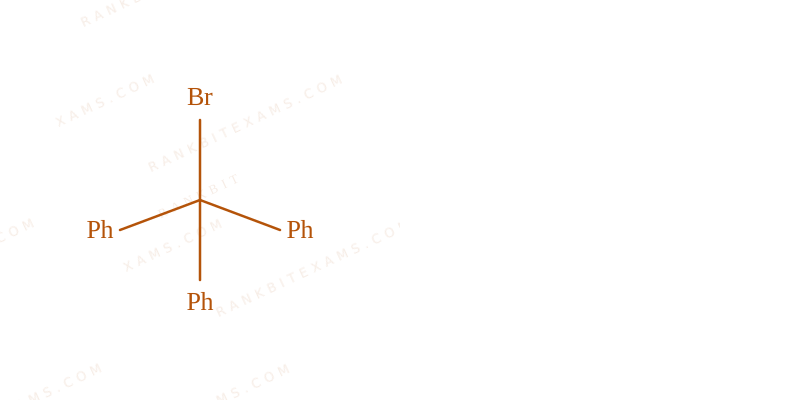
### Core Logic The mechanism of S_N1 substitution proceeds via carbocation intermediate formation. Option (4) gives a triphenylmethyl carbocation (Ph_3C^+), which is exceptionally stable due to extensive delocalization of positive charge across three phenyl rings (resonance stabilization via 9 canonical structures).
Nucleophilic Substitution Mechanisms diagram for Q30 - JEE Main 2025 Evening
### Step 1: Stability Comparison Stability sequence: Ph_3C^+ > textbenzylic > textallylic > textalkyl carbocations ### Pattern Recognition Look for maximum phenyl groups attached directly to the carbon bearing the leaving group to maximize resonance contribution. ### Evaluation Rubric / Model Answer null ### Chapter Mix Class 12 Chemistry: Haloalkanes and Haloarenes

More Haloalkanes and Haloarenes Questions — jee_main_2025_07_april_evening

Practice all Haloalkanes and Haloarenes previous-year questions →

YOUR FIRST PREP STEP STARTS HERE

We Map Every Repeating Question in Competitive Exams.

Say goodbye to generic mock test fatigue. RankBit uses smart analysis to group past exam questions into their foundational Repeating Question Types. Find chapter weightage, track repeating questions, and score higher with targeted practice.

Select Your Target Exam

Choose an exam track below to find formulas per chapter and patterns.

Syncing Exam Intelligence

Mapping formulas and patterns across all tracks…

PATH A — FULL LENGTH PRACTICE

Full Mock Test Hub

Simulate real NTA exam conditions with fully tracked mocks. Time yourself against past papers.

Under Development
PATH B — TARGETED PRACTICE

Topic-wise Practice Hub

Practice past-year questions one chapter at a time. Pick an exam → subject → chapter and get every PYQ for that topic — pulled together from all past papers — with the chapter's key formulas alongside.

Loading Questions... Browse Topics
Latest from the Blog
View all →

Loading articles...