Rate of SNAr ∝ Number of electron-withdrawing groups (-I, -M) at ortho/para positions$$\text{Rate of } S_N\text{Ar} \propto \text{Number of electron-withdrawing groups (-I, -M) at ortho/para positions} $$
Core Logic
Aryl halides are generally unreactive towards nucleophilic substitution due to resonance stabilization of the C-Cl$\text{C-Cl}$ bond. However, the presence of strong electron-withdrawing groups (-NO₂$-\text{NO}_2$) at ortho and para positions dramatically increases reactivity by stabilizing the intermediate carbanion:
- (A) Chlorobenzene: Needs extreme conditions: NaOH at 623 K, 300 atm$\text{NaOH at } 623\text{ K, } 300\text{ atm}$ (Dow's Process) arrow$\rightarrow$ (IV)
- (B) p-Nitrochlorobenzene: One para -NO₂$-\text{NO}_2$ group softens required temperature to 443 K$443\text{ K}$arrow$\rightarrow$ (III)
- (C) 2,4-Dinitrochlorobenzene: Two electron-withdrawing groups lower needed temperature further to 368 K$368\text{ K}$arrow$\rightarrow$ (II)
- (D) 2,4,6-Trinitrochlorobenzene: Highly activated picryl chloride hydrolyzes smoothly with just warm water arrow$\rightarrow$ (I)
The more -NO₂$-\text{NO}_2$ groups present on the ring, the less aggressive the reagent/temperature setup required. Count -NO₂$-\text{NO}_2$ groups: 0 arrow 623K$0 \rightarrow 623\text{K}$, 1 arrow 443K$1 \rightarrow 443\text{K}$, 2 arrow 368K$2 \rightarrow 368\text{K}$, 3 arrow warm water$3 \rightarrow \text{warm water}$.
Keywords:#Dows process chlorobenzene#JEE Main 2025 Evening Q32#nucleophilic aromatic substitution kinetics#picryl chloride hydrolysis
More Haloalkanes and Haloarenes Previous-Year Questions
Q54jee_main_2026_21_jan_morningReactions of Haloalkanes
A hydrocarbon ‘P’ (C₄H₈$C_{4}H_{8}$) on reaction with HCl gives an optically active compound ‘Q’ (C₄H₉Cl$C_{4}H_{9}Cl$) which on reaction with one mole of ammonia gives compound ‘R’ (C₄H₁₁N$C_{4}H_{11}N$). ‘R’ on diazotization followed by hydrolysis gives ‘S’. Identify P, Q, R and S.
Since P (C₄H₈$C_4H_8$) reacts with HCl to give an optically active compound Q (C₄H₉Cl$C_4H_9Cl$), P must be But-2-ene. Addition of HCl yields 2-chlorobutane, which possesses a chiral center.
CH₃-CH=CH-CH₃ HCl CH₃-CH₂-C^*H(Cl)-CH₃ (P is But-2-ene, Q is 2-chlorobutane)$$\mathrm{CH}_3-\mathrm{CH}=\mathrm{CH}-\mathrm{CH}_3 \xrightarrow{\mathrm{HCl}} \mathrm{CH}_3-\mathrm{CH}_2-\mathrm{C}^*\mathrm{H}(\mathrm{Cl})-\mathrm{CH}_3 \quad \text{(P is But-2-ene, Q is 2-chlorobutane)}$$
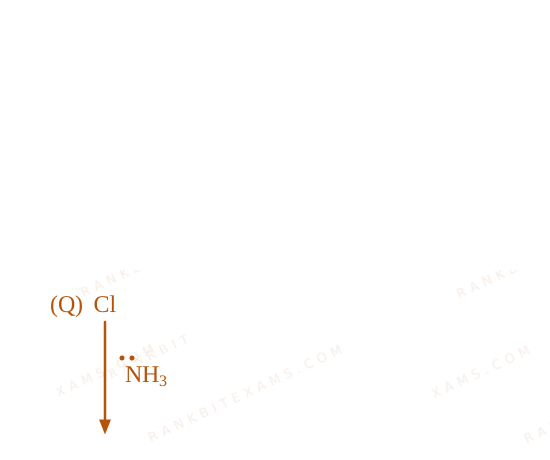
Reactions of Haloalkanes diagram for Q54 - JEE Main 2026 Morning
Compound Q reacts with NH₃$\mathrm{NH}_3$ to undergo nucleophilic substitution forming a primary amine R:
CH₃-CH₂-CH(Cl)-CH₃ NH₃ CH₃-CH₂-CH(NH₂)-CH₃ (R is Butan-2-amine)$$\mathrm{CH}_3-\mathrm{CH}_2-\mathrm{CH}(\mathrm{Cl})-\mathrm{CH}_3 \xrightarrow{\mathrm{NH}_3} \mathrm{CH}_3-\mathrm{CH}_2-\mathrm{CH}(\mathrm{NH}_2)-\mathrm{CH}_3 \quad \text{(R is Butan-2-amine)}$$
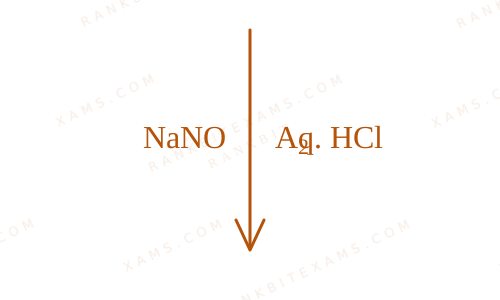
Reactions of Haloalkanes diagram for Q54 - JEE Main 2026 Morning
Diazotization of primary aliphatic amines followed by hydrolysis yields an alcohol via a carbocation intermediate (S):
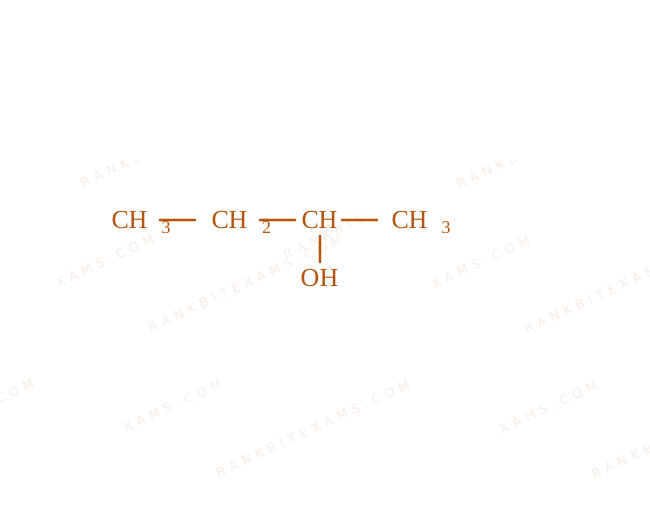
CH₃-CH₂-CH(NH₂)-CH₃ NaNO₂ / HCl / H₂O CH₃-CH₂-CH(OH)-CH₃ (S is Butan-2-ol)$$\mathrm{CH}_3-\mathrm{CH}_2-\mathrm{CH}(\mathrm{NH}_2)-\mathrm{CH}_3 \xrightarrow{\mathrm{NaNO}_2 / \mathrm{HCl} / \mathrm{H}_2\mathrm{O}} \mathrm{CH}_3-\mathrm{CH}_2-\mathrm{CH}(\mathrm{OH})-\mathrm{CH}_3 \quad \text{(S is Butan-2-ol)}$$
Reactions of Haloalkanes diagram for Q54 - JEE Main 2026 Morning
Pattern Recognition
An optically active alkyl halide formed from a C₄H₈$C_4H_8$ alkene with HX is a classic pointer to 2-halobutane originating from But-2-ene or But-1-ene. Diazotization of primary aliphatic amines (R-NH₂$R-NH_2$) with NaNO₂/HCl$NaNO_2/HCl$ yields alcohols (R-OH$R-OH$) with possible rearrangements, though here a secondary carbocation is already stable.
Chapter Mix
Class 12 Chemistry: Haloalkanes and Haloarenes
Class 12 Chemistry: Amines
Q59jee_main_2026_21_jan_eveningNucleophilic Substitution ($S_N1$) and Carbocation Stability
The reaction proceeds via an SN1$S_N1$ mechanism for activated benzyl halides or nucleophilic substitution rate depends on carbocation stability / electronic effects of substituents (-OH, -NH₂$-\text{NH}_2$, -NO₂$-\text{NO}_2$, etc.).
Amino and hydroxy substituents strongly activate through +M effect.
Nitro groups strongly deactivate through -M effect.
Step 1: Final Conclusion
The correct order of reactivity is b > a > d > c$b > a > d > c$, corresponding to option (2).
Pattern Recognition
Sees: benzyl halide reactivity with cyanide.
Trap: Confusing polar/inductive effects with resonance effects of substituents.
Chapter Mix
Class 12 Chemistry: Haloalkanes and Haloarenes
Q65jee_main_2026_21_jan_eveningOptical Isomerism and Composition Percentage
Given below are four compounds:
(a) n-propyl chloride
(b) iso-propyl chloride
(c) sec-butyl chloride
(d) neo-pentyl chloride
Percentage of carbon in the one which exhibits optical isomerism is:
A.(1) 52$(1) \ 52$
B.(2) 56$(2) \ 56$
C.(3) 46$(3) \ 46$
D.(4) 40$(4) \ 40$
Solution
Core Logic
Among the given compounds, sec-butyl chloride (2-chlorobutane) is optically active and contains a chiral center.
Molecular formula of 2-chlorobutane arrow C₄H₉Cl$\rightarrow \text{C}_4\text{H}_9\text{Cl}$.
Molar mass = 4(12) + 9(1) + 35.5 = 48 + 9 + 35.5 = 92.5 g/mol$= 4(12) + 9(1) + 35.5 = 48 + 9 + 35.5 = 92.5 \text{ g/mol}$.
Step 1: Calculating Percentage of Carbon
% of C = (48)/(92.5) × 100 = 51.89% ≈ 52%$$\text{\% of C} = \frac{48}{92.5} \times 100 = 51.89\% \approx 52\%$$
Pattern Recognition
Sees: optical isomerism identification combined with elemental percentage composition calculation.
Trap: Selecting the wrong halogen derivative for optical activity.
The correct order of reactivity of CH₃Br$CH_{3}Br$ in methanol with the following nucleophiles is
F⁻$F^{-}$, I⁻$I^{-}$, C₂H₅O⁻$C_{2}H_{5}O^{-}$ and C₆H₅O⁻$C_{6}H_{5}O^{-}$
The reaction of CH₃Br$CH_3Br$ (a primary halide) occurs via the SN2$S_N2$ mechanism. The rate depends directly on the nucleophilicity of the attacking species.
Methanol is a polar protic solvent. In polar protic solvents, larger halide ions are better nucleophiles because they are less solvated. Therefore, I^-$I^-$ is a stronger nucleophile than F^-$F^-$.
For the alkoxide and phenoxide, C₂H₅O^-$C_2H_5O^-$ is a stronger nucleophile than C₆H₅O^-$C_6H_5O^-$ because the negative charge on phenoxide is delocalized over the benzene ring, reducing its electron-donating ability.
Step 1: Final Order
Combining these factors, the overall order of nucleophilicity in methanol is:
In polar protic solvents: Size dominates (down a group, nucleophilicity increases). For species of similar size, less resonance stabilization means stronger nucleophile.
Chapter Mix
Class 12 Chemistry: Haloalkanes and Haloarenes
Q67jee_main_2026_22_january_morningSN1 Mechanism
The correct order of the rate of reaction of the following reactants with nucleophile by SN1$S_{N}1$ mechanism is:
(Given: Structure I and II are rigid)
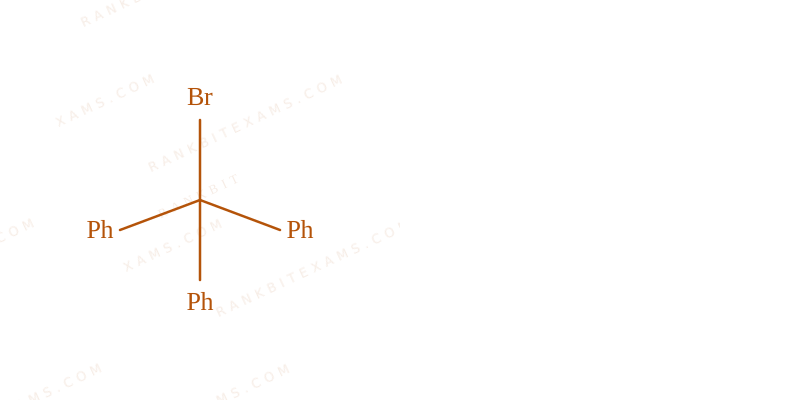
Image depicts four bicyclic and aromatic structures labeled I through IV.
A.IV < III < II < I$IV < III < II < I$
B.III < I < II < IV$III < I < II < IV$
C.II < I < III < IV$II < I < III < IV$
D.I < II < III < IV$I < II < III < IV$
Solution
Related Formula
Rate of SN1 ∝ Stability of intermediate carbocation$$\text{Rate of } S_N1 \propto \text{Stability of intermediate carbocation}$$
Core Logic
Evaluate the stability of the carbocations formed upon dissociation of the bromide ion:
Structure (I) and (II) form carbocations at bridgehead positions of rigid bicyclic systems. According to Bredt's rule, these are highly unstable because they cannot adopt the necessary planar sp²$sp^2$ geometry. Among them, (I) has an additional methyl group which provides slight +I stabilization compared to (II). So, (II) is even less stable than (I).
Structure (III) forms a tertiary carbocation, but it's not a rigid bridgehead preventing planarity, so it's significantly more stable than I and II.
Structure (IV) is a highly stable trityl-like carbocation where the positive charge is stabilized by extensive resonance with the adjacent phenyl ring(s).
Step 1: Final Ordering
Stability order: (II) < (I) < (III) < (IV)$(II) < (I) < (III) < (IV)$. Thus, the SN1$S_{N}1$ rate follows the same order.
Pattern Recognition
Bridgehead halides effectively do not undergo SN1$S_N1$ (or SN2$S_N2$) reactions due to Bredt's rule. Resonance stabilized carbocations always dominate.
Chapter Mix
Class 12 Chemistry: Haloalkanes and Haloarenes
More Haloalkanes and Haloarenes Questions — jee_main_2025_07_april_evening
Practice past-year questions one chapter at a time. Pick an exam → subject → chapter and get every PYQ for that topic — pulled together from all past papers — with the chapter's key formulas alongside.