If A and B are the points of intersection of the circle x^2+y^2-8x=0$x^{2}+y^{2}-8x=0$ and the hyperbola fracx^29-fracy^24=1$\frac{x^{2}}{9}-\frac{y^{2}}{4}=1$ and a point P moves on the line 2x-3y+4=0$2x-3y+4=0$, then the centroid of Delta PAB$\Delta PAB$ lies on the line:
A.4x-9y=12$4x-9y=12$
B.x+9y=36$x+9y=36$
C.9x-9y=32$9x-9y=32$
D.6x-9y=20$6x-9y=20$
Solution & Explanation
### Related Formula
Centroid (h, k)$(h, k)$ of a triangle with vertices (x_1,y_1), (x_2,y_2), (x_3,y_3)$(x_1,y_1), (x_2,y_2), (x_3,y_3)$:
h = fracx_1 + x_2 + x_33, quad k = fracy_1 + y_2 + y_33$$h = \frac{x_1 + x_2 + x_3}{3}, \quad k = \frac{y_1 + y_2 + y_3}{3}$$
### Core Logic
Given equations:
1) Circle: y^2 = 8x - x^2$y^2 = 8x - x^2$
2) Hyperbola: 4x^2 - 9y^2 = 36$4x^2 - 9y^2 = 36$
Substitute circle's y^2$y^2$ into hyperbola equation:
4x^2 - 9(8x - x^2) = 36 implies 4x^2 - 72x + 9x^2 = 36$$4x^2 - 9(8x - x^2) = 36 \implies 4x^2 - 72x + 9x^2 = 36$$13x^2 - 72x - 36 = 0 implies (13x + 6)(x - 6) = 0$$13x^2 - 72x - 36 = 0 \implies (13x + 6)(x - 6) = 0$$
If x = -6/13$x = -6/13$, y^2 < 0$y^2 < 0$ (rejected).
Thus, x = 6$x = 6$.
Substituting x = 6$x = 6$ into circle: y^2 = 8(6) - 6^2 = 48 - 36 = 12 implies y = pm sqrt12$y^2 = 8(6) - 6^2 = 48 - 36 = 12 \implies y = \pm \sqrt{12}$.
The intersection points are A(6, sqrt12)$A(6, \sqrt{12})$ and B(6, -sqrt12)$B(6, -\sqrt{12})$.
### Step 1: Relate Centroid coordinates to P
Let point P$P$ have coordinates (alpha, beta)$(\alpha, \beta)$. Since P$P$ lies on 2x - 3y + 4 = 0$2x - 3y + 4 = 0$:
2alpha - 3beta + 4 = 0 implies beta = frac2alpha + 43$$2\alpha - 3\beta + 4 = 0 \implies \beta = \frac{2\alpha + 4}{3}$$
Let the centroid be (h, k)$(h, k)$:
h = frac6 + 6 + alpha3 = frac12 + alpha3 implies alpha = 3h - 12$$h = \frac{6 + 6 + \alpha}{3} = \frac{12 + \alpha}{3} \implies \alpha = 3h - 12$$k = fracsqrt12 - sqrt12 + beta3 = fracbeta3 implies beta = 3k$$k = \frac{\sqrt{12} - \sqrt{12} + \beta}{3} = \frac{\beta}{3} \implies \beta = 3k$$
### Step 2: Form the Locus Equation
Substitute alpha$\alpha$ and \beta into the line equation of P$P$:
2(3h - 12) - 3(3k) + 4 = 0$$2(3h - 12) - 3(3k) + 4 = 0$$6h - 24 - 9k + 4 = 0$$6h - 24 - 9k + 4 = 0$$6h - 9k = 20$6h - 9k = 20$
Replacing (h, k)$(h, k)$ with general coordinates (x, y)$(x, y)$ gives the locus:
6x - 9y = 20$6x - 9y = 20$
### Pattern Recognition
Notice how the y$y$-coordinates of intersection points A$A$ and B$B$ are symmetric (\,pmsqrt12\,$\,\pm\sqrt{12}\,$), meaning their sum is zero. This simplifies the expression for k$k$ instantly to just beta/3$\beta/3$.
### Evaluation Rubric / Model Answer
null
### Chapter Mix
Class 11 Mathematics: Coordinate Geometry
Class 11 Mathematics: Conic Sections
Keywords:#locus of centroid of triangle formed by curve intersections#JEE Main 2025 Evening Q69#Conic Sections JEE Main 2025#Intersection of Curves and Locus of Centroid JEE Main 2025
More Conic Sections Previous-Year Questions — Page 4
Q59jee_main_2025_29_jan_eveningChord with a Given Midpoint
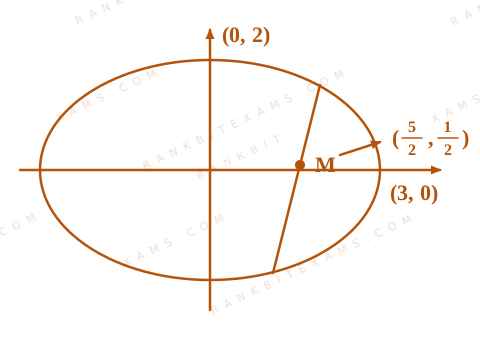
If alpha x + beta y = 109$\alpha x + \beta y = 109$ is the equation of the chord of the ellipse fracx^29 +fracy^24 = 1$\frac{x^2}{9} +\frac{y^2}{4} = 1$, whose mid point is left(frac52,frac12right)$\left(\frac{5}{2},\frac{1}{2}\right)$, then alpha +beta$\alpha +\beta$ is equal to
A.37$37$
B.46$46$
C.58$58$
D.72$72$
Solution
### Related Formula
Equation of a chord of a conic section with a given midpoint (x_1, y_1)$(x_1, y_1)$ is:
T = S_1$T = S_1$
### Core Logic
Given midpoint Mleft(frac52, frac12
ight)$M\left(\frac{5}{2}, \frac{1}{2}
ight)$ and ellipse fracx^29 + fracy^24 = 1$\frac{x^2}{9} + \frac{y^2}{4} = 1$.
Chord with a Given Midpoint diagram for Q59 - JEE Main 2025 Evening
Write T$T$ and S_1$S_1$ terms:
T: fracxleft(frac52right)9 + fracyleft(frac12right)4$$T: \frac{x\left(\frac{5}{2}\right)}{9} + \frac{y\left(\frac{1}{2}\right)}{4}$$S_1: fracleft(frac52right)^29 + fracleft(frac12right)^24$$S_1: \frac{\left(\frac{5}{2}\right)^2}{9} + \frac{\left(\frac{1}{2}\right)^2}{4}$$
Equating both sides:
frac5x18 + fracy8 = frac2536 + frac116$$\frac{5x}{18} + \frac{y}{8} = \frac{25}{36} + \frac{1}{16}$$
### Step 1: Simplify to Standard Form
Multiply the entire equation by 144 to eliminate fractions:
144left(frac5x18right) + 144left(fracy8right) = 144left(frac2536right) + 144left(frac116right)$$144\left(\frac{5x}{18}\right) + 144\left(\frac{y}{8}\right) = 144\left(\frac{25}{36}\right) + 144\left(\frac{1}{16}\right)$$40x + 18y = 4(25) + 9(1)$$40x + 18y = 4(25) + 9(1)$$40x + 18y = 109$40x + 18y = 109$
Comparing this directly with alpha x + beta y = 109$\alpha x + \beta y = 109$ provides:
alpha = 40, quad beta = 18$$\alpha = 40, \quad \beta = 18$$alpha + beta = 40 + 18 = 58$$\alpha + \beta = 40 + 18 = 58$$
### Pattern Recognition
Whenever you see 'chord whose midpoint is given', write T = S_1$T = S_1$ automatically. Match coefficients directly at the final step after equating constant integers.
### Evaluation Rubric / Model Answer
null
### Chapter Mix
Class 11 Mathematics: Conic Sections
Q75jee_main_2025_29_jan_eveningProperties of Focal Chords
Let y^2 = 12x$y^2 = 12x$ the parabola and S$S$ be its focus. Let PQ$PQ$ be a focal chord of the parabola such that (SP) (SQ) = frac1474$(SQ) = \frac{147}{4}$. Let C$C$ be the circle described taking PQ$PQ$ as a diameter. If the equation of a circle C$C$ is 64x^2 + 64y^2 - alpha x - 64sqrt3y = beta$64x^2 + 64y^2 - \alpha x - 64\sqrt{3}y = \beta$, then \beta - \alpha is equal to
Numerical Answer.Answer: 1328 to 1328
Solution
### Related Formula
Properties of focal chord parameter metrics in parabolas y^2 = 4ax$y^2 = 4ax$:
t_1 cdot t_2 = -1$$t_1 \cdot t_2 = -1$$
Distance to the directrix property:
SP = a(1 + t^2), quad SQ = aleft(1 + frac1t^2right)$$SP = a(1 + t^2), \quad SQ = a\left(1 + \frac{1}{t^2}\right)$$
### Core Logic
Given parabola y^2 = 12x implies a = 3$y^2 = 12x \implies a = 3$. Focus S = (3, 0)$S = (3, 0)$.
Set up focal segments product equation:
SP cdot SQ = 3(1+t^2) cdot 3left(1+frac1t^2right) = frac1474$$SP \cdot SQ = 3(1+t^2) \cdot 3\left(1+\frac{1}{t^2}\right) = \frac{147}{4}$$9 cdot frac(1+t^2)^2t^2 = frac1474 implies frac(1+t^2)^2t^2 = frac4912$$9 \cdot \frac{(1+t^2)^2}{t^2} = \frac{147}{4} \implies \frac{(1+t^2)^2}{t^2} = \frac{49}{12}$$
Solving for t^2$t^2$:
12t^4 - 25t^2 + 12 = 0 implies t^2 = frac34 quad textor quad frac43$$12t^4 - 25t^2 + 12 = 0 \implies t^2 = \frac{3}{4} \quad \text{or} \quad \frac{4}{3}$$
### Step 1: Compute Endpoint Coordinate Bounds
Choosing t = -fracsqrt32$t = -\frac{\sqrt{3}}{2}$ allows defining both chord coordinates symmetrically:
P(3t^2, 6t) implies Pleft(frac94, -3sqrt3right)$$P(3t^2, 6t) \implies P\left(\frac{9}{4}, -3\sqrt{3}\right)$$Qleft(frac3t^2, -frac6tright) implies Q(4, 4sqrt3)$$Q\left(\frac{3}{t^2}, -\frac{6}{t}\right) \implies Q(4, 4\sqrt{3})$$
### Step 2: Derive Circle Equation
Write the diameter circle form equation:
(x - 4)left(x - frac94right) + (y - 4sqrt3)(y + 3sqrt3) = 0$$(x - 4)\left(x - \frac{9}{4}\right) + (y - 4\sqrt{3})(y + 3\sqrt{3}) = 0$$x^2 + y^2 - frac254x - sqrt3y - 27 = 0$$x^2 + y^2 - \frac{25}{4}x - \sqrt{3}y - 27 = 0$$
Multiply by 64 to clear the fractions and match the given equation template structure:
64x^2 + 64y^2 - 400x - 64sqrt3y - 1728 = 0$$64x^2 + 64y^2 - 400x - 64\sqrt{3}y - 1728 = 0$$
Comparing directly with 64x^2 + 64y^2 - alpha x - 64sqrt3y = beta$64x^2 + 64y^2 - \alpha x - 64\sqrt{3}y = \beta$ yields:
alpha = 400, quad beta = 1728$$\alpha = 400, \quad \beta = 1728$$beta - alpha = 1728 - 400 = 1328$$\beta - \alpha = 1728 - 400 = 1328$$
### Pattern Recognition
The distance from focal chord endpoints to the focus equals their perpendicular distance to the directrix. This property connects parameter metrics to geometric lengths cleanly.
### Evaluation Rubric / Model Answer
null
### Chapter Mix
Class 11 Mathematics: Conic Sections
Class 11 Mathematics: Circles
Q52jee_main_2025_28_jan_morningParabola and Trapezium Properties
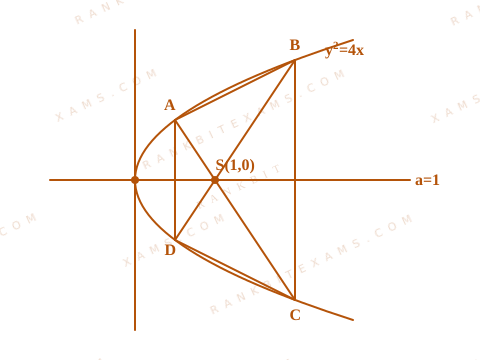
Let ABCD be a trapezium whose vertices lie on the parabolay^2 = 4x$y^2 = 4x$. Let the sides AD and BC of the trapezium be parallel to y-axis. If the diagonal AC is of length frac254$\frac{25}{4}$ and it passes through the point (1,0)$(1,0)$, then the area of ABCD is:
(1) frac754$\frac{75}{4}$
(2) frac252$\frac{25}{2}$
(3) frac1258$\frac{125}{8}$
(4) frac758$\frac{75}{8}$
A.frac754$\frac{75}{4}$
B.frac252$\frac{25}{2}$
C.frac1258$\frac{125}{8}$
D.frac758$\frac{75}{8}$
Solution
### Related Formula
Area of a trapezium is given by:
textArea = frac12 times (textsum of parallel sides) times (textdistance between them)$$\text{Area} = \frac{1}{2} \times (\text{sum of parallel sides}) \times (\text{distance between them})$$
### Core Logic
Let the coordinates of the vertices be parameterized on the parabola y^2 = 4x$y^2 = 4x$. Since AD$AD$ and BC$BC$ are parallel to the y-axis, the coordinates take the form:
A(at_1^2, 2at_1)$A(at_1^2, 2at_1)$ and D(at_1^2, -2at_1)$D(at_1^2, -2at_1)$B(at_2^2, 2at_2)$B(at_2^2, 2at_2)$ and C(at_2^2, -2at_2)$C(at_2^2, -2at_2)$
Given a=1$a=1$, the points simplify accordingly. Parabola and Trapezium Properties diagram for Q52 - JEE Main 2025 Morning
### Step 1: Using Diagonal Properties
The length of diagonal AC$AC$ passing through focal point (1,0)$(1,0)$ implies focal chord properties:
textLength AC = aleft(t_1 + frac1t_1right)^2 = frac254$$\text{Length AC} = a\left(t_1 + \frac{1}{t_1}\right)^2 = \frac{25}{4}$$t_1 + frac1t_1 = pmfrac52 implies t_1 = 2 text or frac12$$t_1 + \frac{1}{t_1} = \pm\frac{5}{2} \implies t_1 = 2 \text{ or } \frac{1}{2}$$
### Step 2: Finding Coordinates and Area
Substituting t_1 = 2$t_1 = 2$, we get:
Aleft(frac12, 1right), Dleft(frac14, -1right), B(4, 4), C(4, -4)$A\left(\frac{1}{2}, 1\right), D\left(\frac{1}{4}, -1\right), B(4, 4), C(4, -4)$
Evaluating the area formula:
textArea = frac12 times (8 + 2) times left(4 - frac14
ight) = frac754$$\text{Area} = \frac{1}{2} \times (8 + 2) \times \left(4 - \frac{1}{4}
ight) = \frac{75}{4}$$
### Pattern Recognition
Focal chords of parabolas always satisfy t_1 t_2 = -1$t_1 t_2 = -1$. Recognizing the passage through (1,0)$(1,0)$ unlocks quick parametric simplifications.
### Evaluation Rubric / Model Answer
null
### Chapter Mix
Class 11 Maths: Conic Sections
Q75jee_main_2025_28_jan_morningInfinite Series of Ellipses
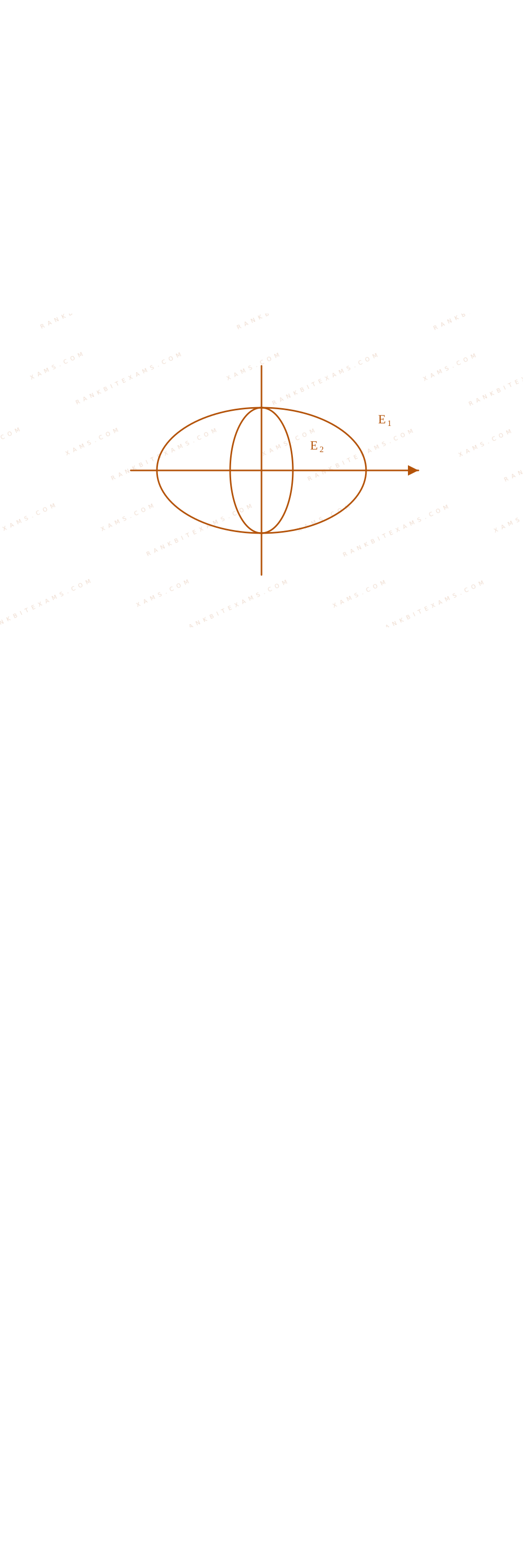
Let E_1: fracx^29 + fracy^24 = 1$E_1: \frac{x^2}{9} + \frac{y^2}{4} = 1$ be an ellipse. Ellipses E_i$E_i$ 's are constructed such that their centres and eccentricities are same as that of E_1$E_1$ , and the length of minor axis of E_i$E_i$ is the length of major axis of E_i+1$E_{i+1}$ ( i ge 1$i \ge 1$ ). If A_i$A_i$ is the area of the ellipse E_i$E_i$ , then frac5pi left( sum_i=1^infty A_i right)$\frac{5}{pi} \left( \sum_{i=1}^{\infty} A_i \right)$ , is equal to ....
Numerical Answer.Answer: 54 to 54
Solution
### Related Formula
Area of an ellipse with semi-axes a$a$ and b$b$:
textArea = pi a b$$\text{Area} = \pi a b$$
### Core Logic
Calculate the constant eccentricity e$e$ from the initial ellipse E_1$E_1$: Infinite Series of Ellipses diagram for Q75 - JEE Main 2025 Morninge = sqrt1 - frac49 = fracsqrt53$$e = \sqrt{1 - \frac{4}{9}} = \frac{\sqrt{5}}{3}$$
For any subsequent ellipse E_2$E_2$, its major axis equals the minor axis of E_1$E_1$ (2b_1 = 4 implies a_2 = 2$2b_1 = 4 \implies a_2 = 2$). Since eccentricity remains constant:
frac59 = 1 - fracb_2^2a_2^2 = 1 - fracb_2^24 implies b_2^2 = frac169 implies b_2 = frac43$$\frac{5}{9} = 1 - \frac{b_2^2}{a_2^2} = 1 - \frac{b_2^2}{4} \implies b_2^2 = \frac{16}{9} \implies b_2 = \frac{4}{3}$$
### Step 1: Finding the Area Sequence Terms
Evaluate the area values for the initial ellipses:
A_1 = pi cdot 3 cdot 2 = 6pi$A_1 = \pi \cdot 3 \cdot 2 = 6\pi$A_2 = pi cdot 2 cdot frac43 = frac8pi3$A_2 = \pi \cdot 2 \cdot \frac{4}{3} = \frac{8\pi}{3}$
The areas form an infinite geometric progression with a common ratio r = frac49$r = \frac{4}{9}$.
### Step 2: Summing the Infinite Geometric Series
sum_i=1^infty A_i = frac6pi1 - frac49 = frac6pifrac59 = frac54pi5$$\sum_{i=1}^{\infty} A_i = \frac{6\pi}{1 - \frac{4}{9}} = \frac{6\pi}{\frac{5}{9}} = \frac{54\pi}{5}$$
Evaluating the final scaling formula:
frac5pi left( frac54pi5 right) = 54$$\frac{5}{\pi} \left( \frac{54\pi}{5} \right) = 54$$
### Pattern Recognition
Iterative dimensional scaling creates geometric progressions where the ratio equals the square of the linear scaling factor.
### Evaluation Rubric / Model Answer
null
### Chapter Mix
Class 11 Maths: Conic Sections
Q56jee_main_2025_03_april_morningEllipse and Line Properties
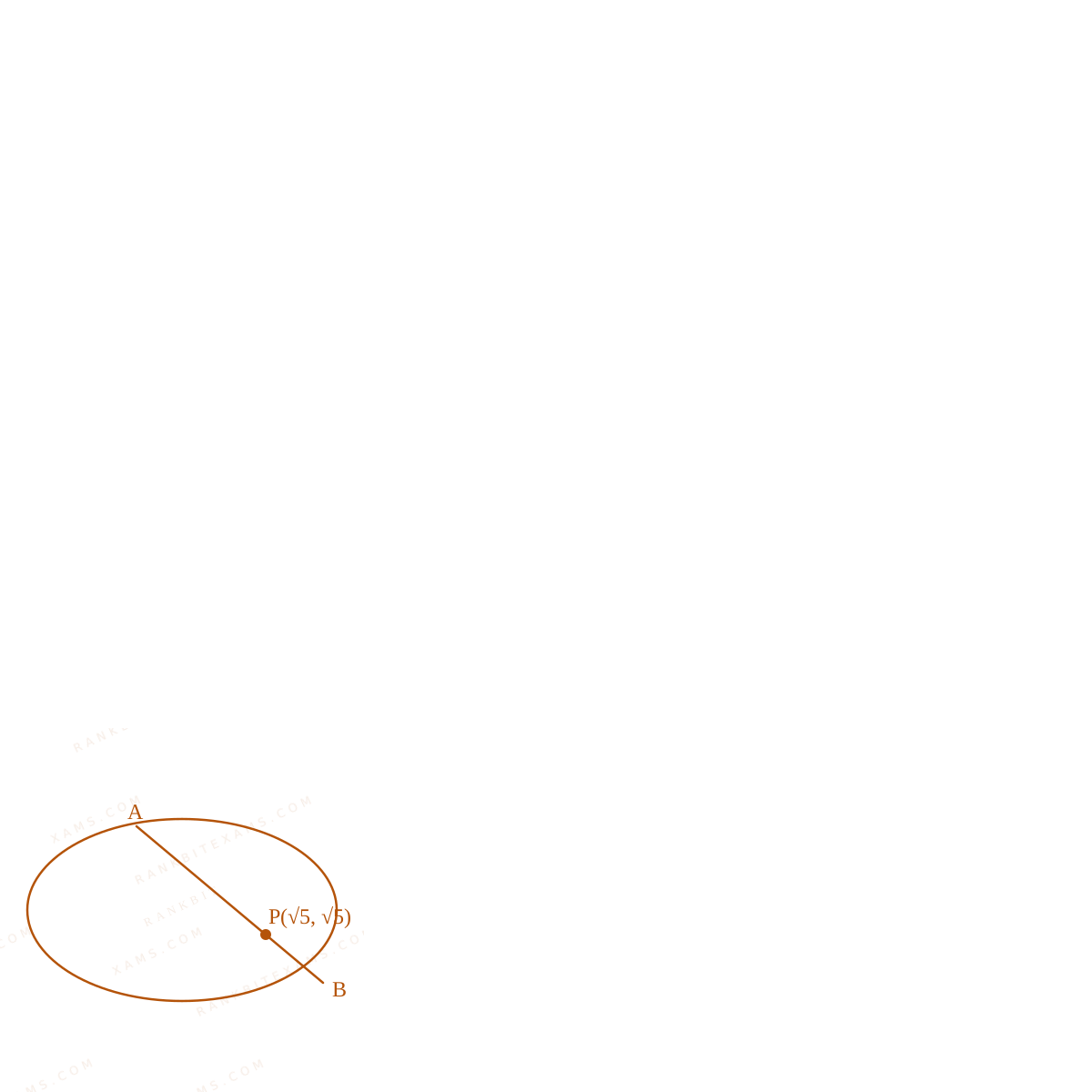
A line passing through the point P(sqrt5, sqrt5)$P(\sqrt{5}, \sqrt{5})$ intersects the ellipse fracx^236 + fracy^225 = 1$\frac{x^2}{36} + \frac{y^2}{25} = 1$ at A$A$ and B$B$ [cite: 567] such that (PA) cdot (PB)$(PA) \cdot (PB)$ is maximum. Then 5(PA^2 + PB^2)$5(PA^{2} + PB^{2})$ is equal to[cite: 570]:
A. 218
B. 377
C. 290
D. 338
Solution
### Related Formula
Parametric line equation relative to an offset point P(x_0, y_0)$P(x_0, y_0)$:
x = x_0 + rcostheta, quad y = y_0 + rsintheta$$x = x_0 + r\cos\theta, \quad y = y_0 + r\sin\theta$$Ellipse and Line Properties diagram for Q56 - JEE Main 2025 Morning
### Core Logic
Assume any line through P$P$ can be represented parametrically by [cite: 1277]:
Q(sqrt5 + rcostheta, sqrt5 + rsintheta)$$Q(\sqrt{5} + r\cos\theta, \sqrt{5} + r\sin\theta)$$ [cite: 1277]
Substitute coordinates into the standard ellipse formula [cite: 1278]:
25(sqrt5 + rcostheta)^2 + 36(sqrt5 + rsintheta)^2 = 900$$25(\sqrt{5} + r\cos\theta)^2 + 36(sqrt{5} + r\sin\theta)^2 = 900$$ [cite: 1278]
Expanding and gathering powers of r$r$ yields [cite: 1280]:
r^2(25cos^2theta + 36sin^2theta) + 2sqrt5r(25costheta + 36sintheta) - 595 = 0$$r^2(25\cos^2\theta + 36\sin^2\theta) + 2\sqrt{5}r(25\cos\theta + 36\sin\theta) - 595 = 0$$ [cite: 1280]
The product of roots corresponds to the distance product value[cite: 1281, 1283]:
PA cdot PB = |r_1 r_2| = frac59525cos^2theta + 36sin^2theta = frac59525 + 11sin^2theta$$PA \cdot PB = |r_1 r_2| = \frac{595}{25\cos^2\theta + 36\sin^2\theta} = \frac{595}{25 + 11\sin^2\theta}$$ [cite: 1283]
### Step 1: Maximization condition
To make PA cdot PB$PA \cdot PB$ maximum, the denominator must be minimized [cite: 1284]:
sin^2theta = 0 implies theta = 0$$\sin^2\theta = 0 \implies \theta = 0$$ [cite: 1284]
This implies the chord line AB$AB$ must run parallel to the x-axis [cite: 1285]:
y_A = y_B = sqrt5$$y_A = y_B = \sqrt{5}$$ [cite: 1285]
Substitute y = sqrt5$y = \sqrt{5}$ back into the ellipse equation to calculate x-coordinates [cite: 1286]:
fracx^236 + frac525 = 1 implies fracx^236 = frac45 implies x^2 = frac1445$$\frac{x^2}{36} + \frac{5}{25} = 1 \implies \frac{x^2}{36} = \frac{4}{5} \implies x^2 = \frac{144}{5}$$ [cite: 1287]
Therefore, the coordinates are x = pm frac12sqrt5$x = \pm \frac{12}{\sqrt{5}}$.
### Step 2: Distance value summation
Compute PA^2 + PB^2$PA^2 + PB^2$ using coordinates directly [cite: 1289]:
PA^2 + PB^2 = left(sqrt5 - frac12sqrt5right)^2 + left(sqrt5 + frac12sqrt5right)^2$$PA^2 + PB^2 = \left(\sqrt{5} - \frac{12}{\sqrt{5}}\right)^2 + \left(\sqrt{5} + \frac{12}{\sqrt{5}}\right)^2$$ [cite: 1289]
= 2left(5 + frac1445right) = frac3385$$= 2\left(5 + \frac{144}{5}\right) = \frac{338}{5}$$ [cite: 1290]
Multiplying by 5 gives the target integer answer [cite: 1290]:
5(PA^2 + PB^2) = 338$$5(PA^2 + PB^2) = 338$$ [cite: 1290]
### Pattern Recognition
Parametric distances from a point intersecting a conic configuration usually form a standard quadratic equation in r$r$. The angle parameter immediately simplifies the boundary constraint optimization.
### Evaluation Rubric / Model Answer
null
### Chapter Mix
Class 11 Mathematics: Conic Sections (Ellipse)
More Conic Sections Questions — jee_main_2025_28_jan_evening
We Map Every Repeating Question in Competitive Exams.
Say goodbye to generic mock test fatigue. RankBit uses smart analysis to group past exam questions into their foundational Repeating Question Types. Find chapter weightage, track repeating questions, and score higher with targeted practice.
Select Your Target Exam
Choose an exam track below to find formulas per chapter and patterns.
Syncing Exam Intelligence
Mapping formulas and patterns across all tracks…
PATH A — FULL LENGTH PRACTICE
Full Mock Test Hub
Simulate real NTA exam conditions with fully tracked mocks. Time yourself against past papers.
Practice past-year questions one chapter at a time. Pick an exam → subject → chapter and get every PYQ for that topic — pulled together from all past papers — with the chapter's key formulas alongside.