JEE Main · Mathematics ↓ Falling

Conic Sections appeared 76 times across 3 years — 8.8% of Mathematics. This question is from Tangent to Parabola and Circle Properties.

Year 2026 2025 2024 Total
Questions 22 38 16 76

Let r be the radius of the circle, which touches x -axis at point (a, 0) , a < 0 and the parabola y² = 9x at the point (4, 6) . Then r is equal to

Numerical Answer Type:
Enter a numerical value Answer: 30 to 30 +4 marks

Solution & Explanation

Related Formula
Tangent line at point (x₁, y₁) yy₁ = 2a(x+x₁)
Core Logic

Establish the tangent vector expression at the parabola intersection mark. Since this path line functions as a shared contact tangent boundaries sheet for the circular arc, impose radius equations.

Step 1: Derive Shared Parabola Tangent Line

Tangent line profile for y² = 9x at coordinate indicator (4,6):

6y = 9 · ( (x+4)/(2) ) 3x - 4y + 12 = 0
Step 2: Build Geometric Metric Connections

Circle touches axis at (a,0), mapping coordinates center directly to C(a,r). Perpendicular boundary constraint steps require:

(3a - 4r + 12)/(5) = ± r 3a + 12 = 4r ± 5r
Step 3: Solve for Radius Matrix Bounds

Enforce circle equation intersection constraint profile (x-a)² + (y-r)² = r² at point (4,6):

a² - 8a - 12r + 52 = 0

Evaluating the target systems from structural logic tracks rejects positive value parameters, providing:

a = -14, r = 30

{{SOL_IMG_75}}

Pattern Recognition

Shared tangent elements connect independent conic fields. Locating circular center boundaries using axial coordinate tracking simplifies secondary equations.

Chapter Mix

Class 11 Mathematics: Conic Sections Class 11 Mathematics: Circles

Tangent to Parabola and Circle Properties diagram for Q75 - JEE Main 2025 Evening

Reference Study Guides

More Conic Sections Previous-Year Questions

Q11 jee_main_2026_21_jan_morning Coinciding Foci of Ellipse and Hyperbola
Let the foci of hyperbola coincide with the foci of the ellipse (x²)/(36) +(y²)/(16) = 1 . If the eccentricity of the hyperbola is 5, then the length of its latus rectum is:
  • A. 12
  • B. 16
  • C. 96√(5)
  • D. 24√(5)

Solution

Related Formula
Eccentricity of ellipse e₁ = √(1 - (b²)/(a²)) Foci = (± ae₁, 0) Length of Latus Rectum of hyperbola = 2bhyp²ahyp
Core Logic

For the given ellipse (x²)/(36) + (y²)/(16) = 1: a² = 36 ⇒ a = 6 b² = 16

e₁ = √(1 - (16)/(36)) = √(1 - (4)/(9)) = √(5)3

Foci of the ellipse are at (± ae₁, 0) = (± 6 · √(5)3, 0) = (± 2√(5), 0).

Step 1: Establish Hyperbola Parameters

Let the hyperbola be (x²)/(p²) - (y²)/(q²) = 1. Its foci coincide with the ellipse, so the foci of hyperbola are also (± 2√(5), 0). Let e be the eccentricity of the hyperbola. We are given e = 5. Focus of hyperbola is pe = 2√(5).

p(5) = 2√(5) ⇒ p = 2√(5)5 = 2√(5)
Step 2: Find the Conjugate Axis (q)

For the hyperbola:

e² = 1 + (q²)/(p²) 25 = 1 + q²( 2√(5))² 24 = (q²)/(4/5) ⇒ 24 = (5q²)/(4) 5q² = 96 ⇒ q² = (96)/(5)
Step 3: Calculate Latus Rectum

Length of Latus Rectum = (2q²)/(p)

= 2 ((96)/(5)) 2√(5) = (96)/(5) × √(5) = 96√(5)
Pattern Recognition

Co-focal conics share the exact mathematical value of their focal length ae (or pe). Instantly extract c = ae from the first shape and map it directly to c = pe for the second.

Chapter Mix

Class 11 Maths: Conic Sections
Q20 jee_main_2026_21_jan_morning Locus of Internal Section Point
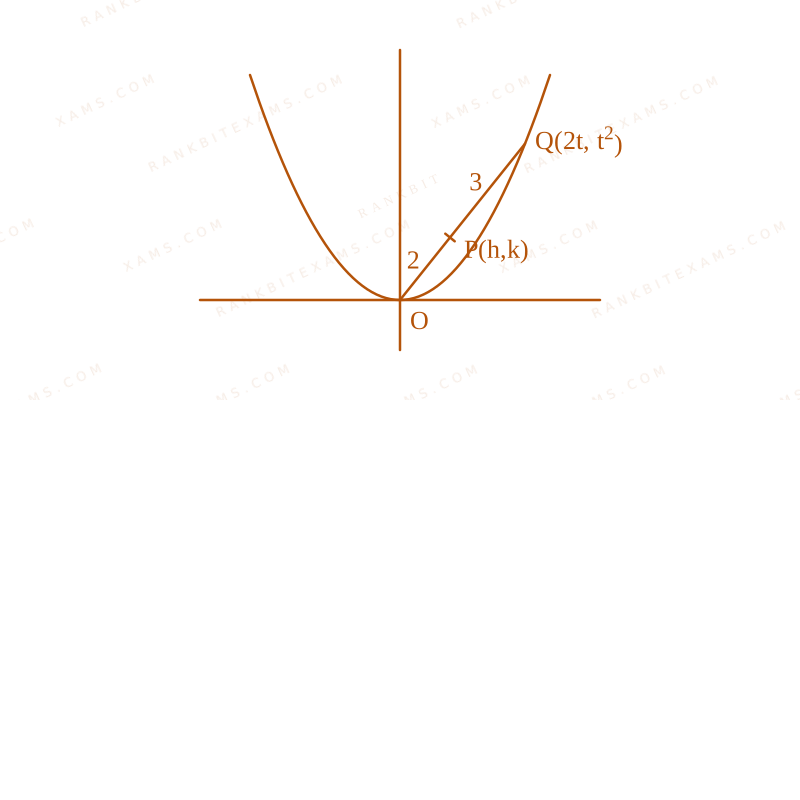
Let O be the vertex of the parabola x²=4y and Q be any point on it. Let the locus of the point P, which divides the line segment OQ internally in the ratio 2: 3 be the conic C. Then the equation of the chord of C, which is bisected at the point (1, 2), is:
  • A. 5x-y-3=0
  • B. 4x-5y+6=0
  • C. x-2y + 3 = 0
  • D. 5x-4y+3=0

Solution

Related Formula
Section Formula: P = (m · Q + n · O)/(m + n) Chord bisected at (x₁, y₁) : T = S₁
Core Logic

Given parabola x² = 4y, its vertex O = (0, 0). A general point Q on x² = 4y is (2t, t²). Let P(h, k) divide OQ in ratio 2:3. By section formula:

h = (2(2t) + 3(0))/(5) = (4t)/(5) k = (2(t²) + 3(0))/(5) = (2t²)/(5)

Locus of point dividing parabolic chord for Q20 - JEE Main 2026 Morning

Step 1: Finding the Locus C

From h = (4t)/(5), we get t = (5h)/(4). Substitute into k:

k = (2)/(5) ((5h)/(4))² = (2)/(5) · (25h²)/(16) = (5h²)/(8) 8k = 5h² ⇒ 5x² = 8y

So the conic C is the parabola 5x² = 8y.

Step 2: Chord bisected at a point

We need the equation of the chord of C: 5x² - 8y = 0 bisected at (x₁, y₁) = (1, 2). Use T = S₁. T = 5xx₁ - 4(y + y₁) = 5x(1) - 4(y + 2) = 5x - 4y - 8 S₁ = 5(1)² - 8(2) = 5 - 16 = -11

Equating T and S₁:

5x - 4y - 8 = -11

5x - 4y + 3 = 0

Pattern Recognition

Internal division locus of a vertex chord on standard conic identically scales the conic. Once the child-conic is found, standard mid-point chord protocol (T=S₁) strictly applies algebraically.

Chapter Mix

Class 11 Maths: Parabola Class 11 Maths: Straight Lines

Q4 jee_main_2026_21_jan_evening Ellipse
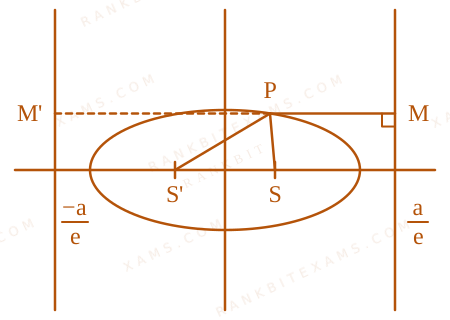
In the line α x + 4y = √(7), where α in R, touches the ellipse 3x² + 4y² = 1 at the point P in the first quadrant, then one of the focal distances of P is:
  • A. 1√(3) - 12√(11)
  • B. 1√(3) + 12√(5)
  • C. 1√(3) - 12√(5)
  • D. 1√(3) + 12√(7)

Solution

Related Formula
Condition of tangency for ellipse (x²)/(a²) + (y²)/(b²) = 1 is c² = a²m² + b² Focal distance SP = a ± ex Eccentricity e = √(1 - (b²)/(a²))
Core Logic

Ellipse diagram for Q4 - JEE Main 2026 Evening
Identify the slope and intercepts of the line to find α. Use the point of contact formula to locate P(x₁, y₁) and apply focal distance definitions.

Step 1: Determine alpha

Rewrite the ellipse: (x²)/(1/3) + (y²)/(1/4) = 1 a² = (1)/(3), b² = (1)/(4). The line is y = -(α)/(4)x + √(7)4. Using c² = a²m² + b²:

( √(7)4)² = (1)/(3) (-(α)/(4))² + (1)/(4) (7)/(16) = (α²)/(48) + (4)/(16) (3)/(16) = (α²)/(48) α² = 9 α = ± 3

Since P is in the first quadrant, coordinates x, y are positive, so we use the tangent 3x + 4y - √(7) = 0.

Step 2: Find Point of Contact P

The tangent at P(x₁, y₁) is 3xx₁ + 4yy₁ = 1. Comparing this with 3x + 4y = √(7) (divided by √(7) to match constant 1): 3x√(7) + 4y√(7) = 1. Comparing coefficients:

3x₁ = 3√(7) x₁ = 1√(7) 4y₁ = 4√(7) y₁ = 1√(7)

So P = ( 1√(7), 1√(7)).

Step 3: Calculate Focal Distance

Find eccentricity:

e = √(1 - (1/4)/(1/3)) = √(1 - (3)/(4)) = (1)/(2)

The focal distances are a - ex and a + ex. Since a² = 1/3 a = 1/√(3).

SP = a - ex₁ = 1√(3) - (1)/(2)( 1√(7)) = 1√(3) - 12√(7) S'P = a + ex₁ = 1√(3) + (1)/(2)( 1√(7)) = 1√(3) + 12√(7)

Matching with the options, the focal distance is 1√(3) + 12√(7).

Pattern Recognition

For tangency lx+my+n=0 to x²/a² + y²/b² = 1, use a² l² + b² m² = n². Points of contact can be quickly evaluated by comparing T=0 to the normalized tangent equation.

Chapter Mix

Class 11 Maths: Conic Sections
Q5 jee_main_2026_21_jan_evening Parabola
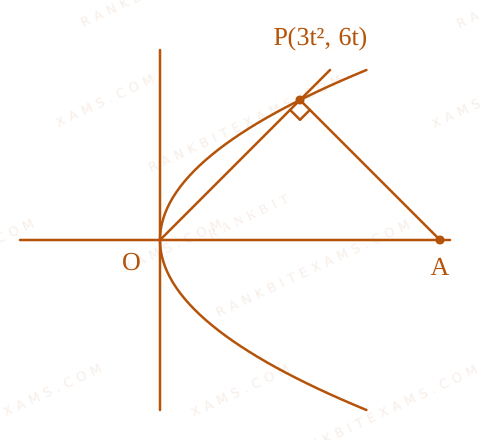
Let y² = 12x be the parabola with its vertex at O. Let P be a point on the parabola and A be a point on the x-axis such that ∠ OPA = 90°. Then the locus of the centroid of such triangles OPA is:
  • A. y² - 6x + 4 = 0
  • B. y² - 9x + 6 = 0
  • C. y² - 2x + 8 = 0
  • D. y² - 4x + 8 = 0

Solution

Related Formula
Centroid G(x,y) = ( (x₁ + x₂ + x₃)/(3), (y₁ + y₂ + y₃)/(3) ) Product of slopes for perpendicular lines m₁ m₂ = -1
Core Logic

Parabola geometry diagram for Q5 - JEE Main 2026 Evening
Define coordinates: O(0,0), P(3t², 6t) (since y² = 12x 4a = 12 a=3). Determine the slope of OP and use perpendicularity to find the equation of PA and locate point A on the x-axis.

Step 1: Locate A via Perpendicularity

Slope of OP is mOP = (6t - 0)/(3t² - 0) = (2)/(t). Since ∠ OPA = 90^°, slope of AP is mAP = -(t)/(2). Equation of AP:

y - 6t = -(t)/(2)(x - 3t²)

To find A on the x-axis, put y = 0:

-6t = -(t)/(2)(x - 3t²) 12 = x - 3t² x = 12 + 3t²

So, A is (12 + 3t², 0).

Step 2: Locus of the Centroid

Let the centroid of OPA be G(h, k).

h = (0 + 3t² + (12 + 3t²))/(3) = (6t² + 12)/(3) = 2t² + 4 k = (0 + 6t + 0)/(3) = 2t

From k = 2t t = (k)/(2). Substitute t into the equation for h:

h = 2((k)/(2))² + 4 = (k²)/(2) + 4 2h = k² + 8 k² = 2h - 8

Replacing (h, k) with (x, y), the locus is y² = 2x - 8 y² - 2x + 8 = 0.

Pattern Recognition

For any right-angled configuration involving the origin and axis on a parabola, parametric geometry simplifies equations significantly. Find coordinates O, P, A, set up the centroid algebraic relations, and eliminate parameter t.

Chapter Mix

Class 11 Maths: Conic Sections Class 11 Maths: Straight Lines
Q6 jee_main_2026_21_jan_evening Parabola
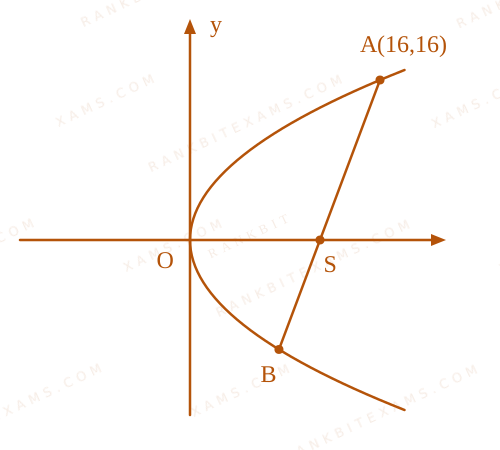
Let one end of a focal chord of the parabola y²=16x be (16, 16). If P(α,β) divides this focal chord internally in the ratio 5:2, then the minimum value of α+β is equal to:
  • A. 22
  • B. 7
  • C. 5
  • D. 16

Solution

Related Formula
For a focal chord with ends (at₁², 2at₁) and (at₂², 2at₂), the relation is t₁t₂ = -1 Section formula: (x, y) = ( (mx₂ + nx₁)/(m+n), (my₂ + ny₁)/(m+n) )
Core Logic

Parabola focal chord division diagram for Q6 - JEE Main 2026 Evening
For y² = 16x, a = 4. The given point A(16, 16) is equivalent to 4t² = 16 and 2(4)t = 16, which gives parameter t₁ = 2. The other end B has parameter t₂ = -(1)/(t₁) = -(1)/(2).

Step 1: Calculate coordinates of B

For t₂ = -1/2, point B is: x = 4(-1/2)² = 1 y = 8(-1/2) = -4 So, B(1, -4).

Step 2: Section formula calculations (Two cases)

Point P(α, β) divides AB in the ratio 5:2. There are two possibilities depending on which end the ratio starts from.

Case 1: Ratio 5 from B to A (i.e. A is x₂ and B is x₁):

α = (5(16) + 2(1))/(7) = (80 + 2)/(7) = (82)/(7) β = (5(16) + 2(-4))/(7) = (80 - 8)/(7) = (72)/(7)

Sum: α + β = (154)/(7) = 22.

Case 2: Ratio 5 from A to B (i.e. B is x₂ and A is x₁):

α = (5(1) + 2(16))/(7) = (5 + 32)/(7) = (37)/(7) β = (5(-4) + 2(16))/(7) = (-20 + 32)/(7) = (12)/(7)

Sum: α + β = (49)/(7) = 7.

Step 3: Minimum Value

Comparing the two possible sums, 7 < 22. Thus, the minimum value is 7.

Pattern Recognition

When a line segment is divided in a given ratio, 'internal division' inherently bears two solutions based on the orientation (from point A or point B). Always evaluate both cases when finding a minimum or maximum.

Chapter Mix

Class 11 Maths: Conic Sections
More Conic Sections Questions — jee_main_2025_08_april_evening

Practice all Conic Sections previous-year questions →

Rankbit System
JEE Physics: Waves (+15.5%) | Electrostatics: Concentric Shells (-29.7%) | Modern Physics: Photoelectric Clones (+34.2%) | Mathematics: Definite Integrals (+18.1%) | Chemistry: Coordination Splitting (-11.4%) | JEE Physics: Waves (+15.5%) | Electrostatics: Concentric Shells (-29.7%) | Modern Physics: Photoelectric Clones (+34.2%) | Mathematics: Definite Integrals (+18.1%) | Chemistry: Coordination Splitting (-11.4%)
