JEE Main · Mathematics → Steady

Conic Sections appeared 94 times across 3 years — 10.9% of Mathematics. This question is from Parabola Equation with Given Vertex and Directrix.

Year 2026 2025 2024 Total
Questions 29 44 21 94

If the equation of the parabola with vertex V((3)/(2),3) and the directrix x+2y=0 is α x²+β y²-γ xy-30x-60y+225=0, then α+β+γ is equal to:

Solution & Explanation

Related Formula

The locus definition of a parabola states that the squared distance from any point P(x,y) to the focus S(x₀, y₀) equals the squared perpendicular distance to the directrix line Ax + By + C = 0:

(x - x₀)² + (y - y₀)² = ((Ax + By + C)²)/(A² + By²)
Step 1: Determine the Focus coordinates

The axis line of the parabola is perpendicular to the directrix x + 2y = 0 and passes through the vertex V(1.5, 3). Slope of directrix = -0.5 ⇒ Slope of axis = 2.

Equation of axis :

y - 3 = 2(x - (3)/(2)) ⇒ y - 2x = 0

The intersection of the axis (y - 2x = 0) and directrix (x + 2y = 0) gives the foot of the directrix, which is (0, 0).

Since the vertex is the midpoint between the focus and the foot of the directrix :

((3)/(2), 3) = ((xf + 0)/(2), (yf + 0)/(2)) ⇒ Focus S = (3, 6)
Step 2: Derive the Parabola Locus Equation

Equate the distance equations from point P(x,y) :

(x - 3)² + (y - 6)² = ((x + 2y)²)/(1² + 2²) 5(x² - 6x + 9 + y² - 12y + 36) = x² + 4xy + 4y² 5x² - 30x + 45 + 5y² - 60y + 180 = x² + 4xy + 4y² 4x² + y² - 4xy - 30x - 60y + 225 = 0
Step 3: Coefficient Extraction

Compare with the equation template α x² + β y² - γ xy - 30x - 60y + 225 = 0 :

α = 4, β = 1, γ = 4 α + β + γ = 4 + 1 + 4 = 9
Pattern Recognition

The vertex is always exactly midway between the focus and the foot of the directrix line along the line of symmetry. Finding the origin (0,0) as the foot quickly reveals the focus coordinates via doubling.

Chapter Mix

Class 11 Mathematics: Conic Sections

Reference Study Guides

More Conic Sections Previous-Year Questions — Page 7

Q67 jee_main_2025_02_april_evening Parabola
Let the point P of the focal chord PQ of the parabola y² = 16x be (1, -4). If the focus of the parabola divides the chord PQ in the ratio m : n, (m, n) = 1, then m² + n² is equal to:
  • A. 17
  • B. 10
  • C. 37
  • D. 26

Solution

Related Formula
Parametric coordinates on y² = 4ax: (at², 2at) Focal Chord relation: t₁ t₂ = -1 Section Formula: (xc, yc) = ( (m x₂ + n x₁)/(m+n), (m y₂ + n y₁)/(m+n) )
Core Logic

We find the parametric parameters of coordinates P and Q, obtain their Cartesian values, and then apply the section formula with the focus S to calculate the splitting ratio.

Step 1: Find coordinates of P and Q

For parabola y² = 16x, the focal parameter is a = 4. Focus is S(4, 0). Let P be (a t₁², 2a t₁) = (1, -4):

2a t₁ = -4 2(4) t₁ = -4 t₁ = -(1)/(2)

Since PQ is a focal chord, the parametric points are coupled:

t₁ t₂ = -1 t₂ = 2

Now, calculate the coordinates of Q:

Q ≡ (a t₂², 2 a t₂) = (4(4), 2(4)(2)) = (16, 16)
Step 2: Solve for the dividing ratio

Let the focus S(4, 0) divide the line segment PQ internally in the ratio λ : 1. Using the y-coordinate of the section formula:

yₛ = (λ yq + 1 yₚ)/(λ + 1) 0 = (λ(16) + 1(-4))/(λ + 1) 16λ - 4 = 0 λ = (1)/(4)

Thus, the focus S divides the chord internally in the ratio 1:4. Since (1, 4) = 1, we have m = 1 and n = 4:

m² + n² = 1² + 4² = 1 + 16 = 17
Pattern Recognition

Harmonic Mean Shortcut: In any parabola, the focus divides a focal chord internally into segments of lengths SP and SQ such that the semi-latus rectum 2a is the harmonic mean of these segments: (1)/(SP) + (1)/(SQ) = (1)/(a).

Chapter Mix

Class 11 Mathematics: Conic Sections
Q jee_main_2025_02_april_morning Properties of Hyperbola
Let one focus of the hyperbola H: (x²)/(a²) - (y²)/(b²) = 1 be at (√(10), 0) and the corresponding directrix be x = 9√(10). If e and l respectively are the eccentricity and the length of the latus rectum of H, then 9(e² + l) is equal to:
  • A. 14
  • B. 15
  • C. 16
  • D. 12

Solution

Related Formula

For a standard hyperbola: Focus: (± ae, 0) Directrix: x = ± (a)/(e) Eccentricity relation: (ae)² = a² + b² Length of latus rectum: l = (2b²)/(a)

Core Logic

Given ae = √(10) and (a)/(e) = 9√(10). Multiplying these gives a², which determines both parameters.

Step 1: Find a and e
a² = (ae) · ((a)/(e)) = √(10) · 9√(10) = 9 a = 3

Substitute a = 3 into ae = √(10):

e = √(10)3 e² = (10)/(9)
Step 2: Find b and l

Using (ae)² = a² + b²:

10 = 9 + b² b² = 1

Then the length of latus rectum l is:

l = (2b²)/(a) = (2(1))/(3) = (2)/(3)
Step 3: Evaluate Final Expression

Calculate 9(e² + l):

9((10)/(9) + (2)/(3)) = 10 + 6 = 16
Pattern Recognition

Multiplying focus location by directrix location immediately eliminates e, giving a² directly. Once a² is known, b² follow seamlessly via (ae)² = a²+b².

Chapter Mix

Class 11 Mathematics: Conic Sections
Q jee_main_2025_02_april_morning Properties of Ellipse
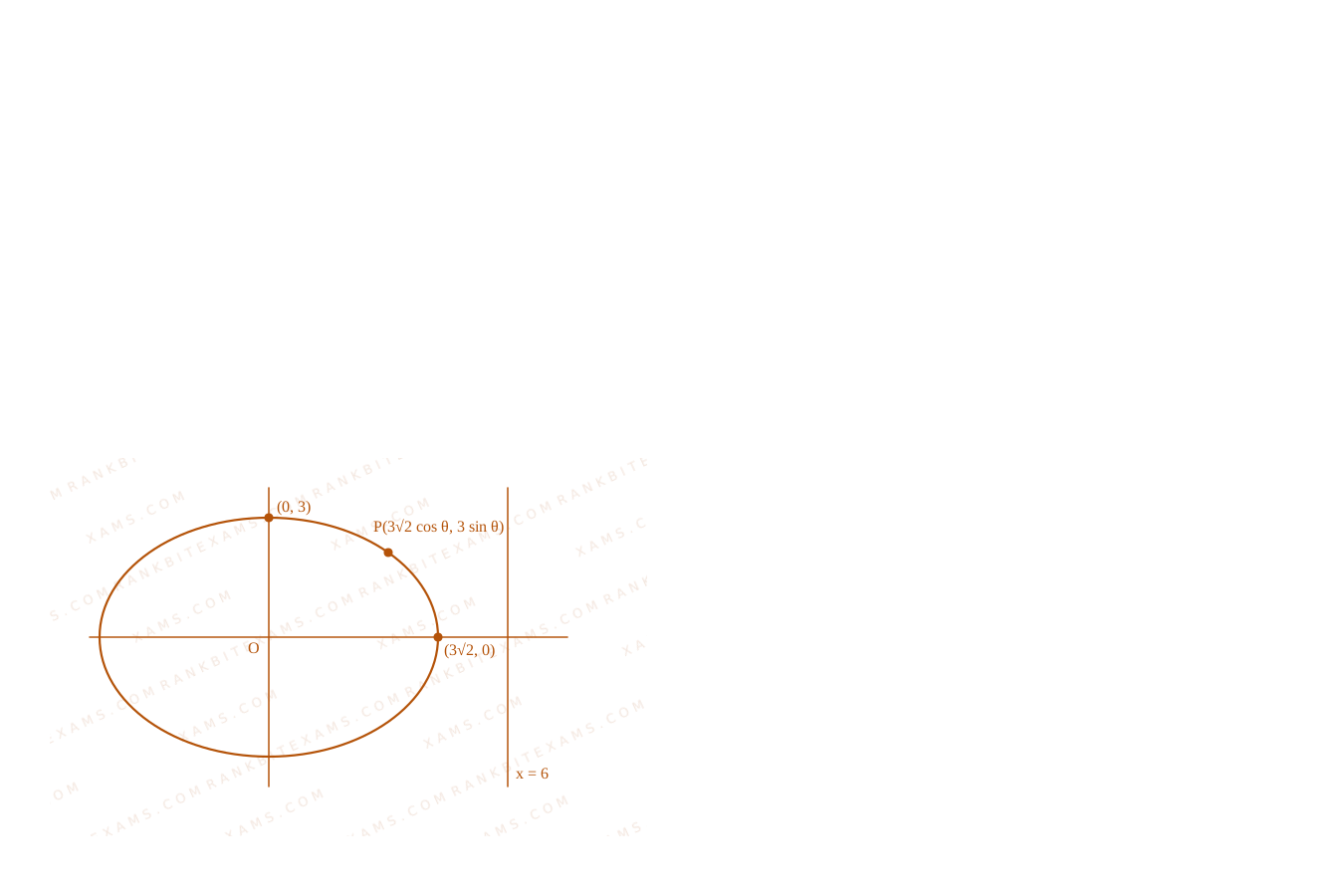
If S and S' are the foci of the ellipse (x²)/(18) + (y²)/(9) = 1 and P be a point on the ellipse, then (SP · S'P) + (SP · S'P) is equal to:
  • A. 3(1+√(2))
  • B. 3(6+√(2))
  • C. 9
  • D. 27

Solution

Related Formula

Focal distances of any point P(a θ, b θ) on an ellipse are given by:

SP = a - exP = a(1 - e θ) S'P = a + exP = a(1 + e θ)

Product of focal distances:

SP · S'P = a²(1 - e² ²θ) = a² - e²xP²
Core Logic

Compute the eccentricity e, express the product SP · S'P in terms of ²θ, and analyze its bounds across the domain to find minimum and maximum limits.

Properties of Ellipse diagram for Q66 - JEE Main 2025 Morning

Step 1: Determine Ellipse Parameters

Given a² = 18 and b² = 9.

b² = a²(1 - e²) 9 = 18(1 - e²) 1 - e² = (1)/(2) e = 1√(10)
Step 2: Express Focal Product

The parametric coordinates are P(3√(2) θ, 3 θ).

SP · S'P = a² - (ae)² ²θ

Since a²=18 and (ae)² = a²-b² = 18-9 = 9:

SP · S'P = 18 - 9 ²θ
Step 3: Evaluate Extrema and Sum

Since 0 ≤ ²θ ≤ 1:

  • Maximum value occurs when ²θ = 0 = 18.
  • Minimum value occurs when ²θ = 1 = 18 - 9 = 9.
Sum = + = 9 + 18 = 27
Pattern Recognition

The product of focal distances can also be written directly as b² at the minor axis vertices (max) and a²(1-e²) varying down to a²-c². Summing them up yields b² + a² = 9 + 18 = 27 instantly.

Chapter Mix

Class 11 Mathematics: Conic Sections
Q jee_main_2025_02_april_morning Properties of Parabola
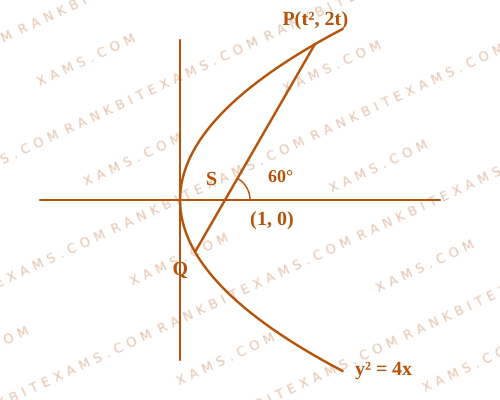
Let the focal chord PQ of the parabola y² = 4x make an angle of 60^° with the positive x-axis, where P lies in the first quadrant. If the circle, whose one diameter is PS, S being the focus of the parabola, touches the y-axis at the point (0, a), then 5a² is equal to:
  • A. 15
  • B. 25
  • C. 30
  • D. 20

Solution

Related Formula

For a standard parabola y² = 4ax: Focus: S(a, 0) Parametric coordinates: (at², 2at) Equation of a circle on diametric endpoints (x₁, y₁) and (x₂, y₂):

(x - x₁)(x - x₂) + (y - y₁)(y - y₂) = 0
Core Logic

Find the point P using the slope of the focal chord, write the equation of the circle with diameter PS, and find its y-intercept.

Properties of Parabola diagram for Q70 - JEE Main 2025 Morning

Step 1: Determine P Coordinates

For y² = 4x, parameter a=1 S(1,0) and P(t², 2t). Slope of focal chord PS:

60^° = (2t - 0)/(t² - 1) = √(3) 2t = √(3)t² - √(3) √(3)t² - 2t - √(3) = 0 (√(3)t + 1)(t - √(3)) = 0

Since P is in the first quadrant, t > 0 t = √(3). Thus, P((√(3))², 2√(3)) = P(3, 2√(3)).

Step 2: Construct the Diametric Circle Equation

Endpoints are S(1,0) and P(3, 2√(3)):

(x - 1)(x - 3) + (y - 0)(y - 2√(3)) = 0
Step 3: Solve for y-intercept

The circle touches/intersects the y-axis at x = 0:

(0 - 1)(0 - 3) + y(y - 2√(3)) = 0 3 + y² - 2√(3)y = 0

This is a perfect square expression (y - √(3))² = 0 y = √(3). Thus, the intercept value is a = √(3).

Step 4: Compute Final Target Value
5a² = 5(√(3))² = 15
Pattern Recognition

A circle whose diameter is a focal radius always touches the tangent at the vertex (y-axis for a standard parabola). The coordinate of the contact point is simply given by a t = 1 · √(3) = √(3), bypasses the full equation construction entirely.

Chapter Mix

Class 11 Mathematics: Conic Sections

Q75 jee_main_2025_02_april_morning Tangent Properties of Circles
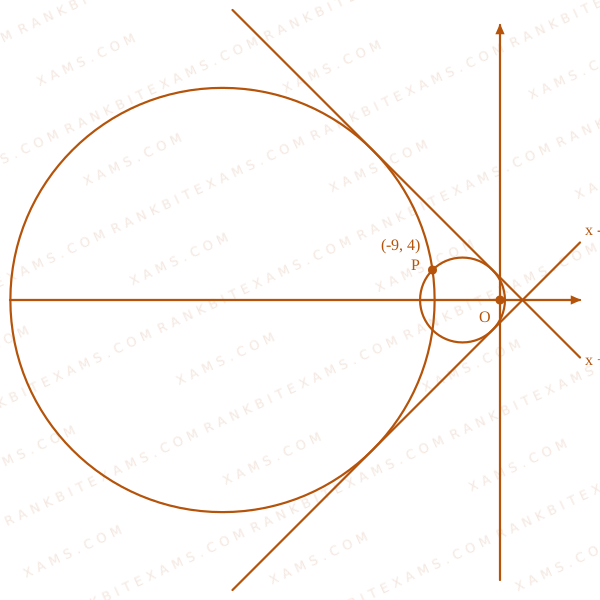
The absolute difference between the squares of the radii of the two circles passing through the point (-9, 4) and touching the lines x + y = 3 and x - y = 3, is equal to ________.
Numerical Answer. Answer: 768 to 768

Solution

Related Formula

Perpendicular distance from point (x₀, y₀) to line Ax + By + C = 0:

d = |Ax₀ + By₀ + C|√(A² + B²)
Core Logic

Since the circle touches two symmetric intersecting lines, its center must lie on their angle bisector (x-axis). Use this property to find the center parameters.

Tangent Properties of Circles diagram for Q75 - JEE Main 2025 Morning

Step 1: Establish Center and Radius Equations

The lines are x+y-3=0 and x-y-3=0. The intersection point is (3,0), and the bisector line is the x-axis. Let the center be C(a, 0). The radius r is the perpendicular distance to either line:

r = |a - 0 - 3|√(1² + 1²) = |a - 3|√(2)
Step 2: Apply Point Passage Constraint

The circle equation is (x - a)² + y² = r². Substitute the given passage point (-9, 4):

(-9 - a)² + 4² = ( a - 3√(2))² 2(a² + 18a + 81 + 16) = a² - 6a + 9 2a² + 36a + 194 = a² - 6a + 9 a² + 42a + 185 = 0
Step 3: Solve for Quadratic Roots

Factor the quadratic equation:

(a + 37)(a + 5) = 0 a₁ = -37, a₂ = -5
Step 4: Compute Radii Squares Difference

Find the corresponding radius value for each root:

r₁ = |-37 - 3|√(2) = 40√(2) = 20√(2) r₁² = 800 r₂ = |-5 - 3|√(2) = 8√(2) = 4√(2) r₂² = 32

The absolute difference between their squares is:

|r₁² - r₂²| = |800 - 32| = 768
Pattern Recognition

Recognizing that the center must lie on the line of symmetry (x-axis) eliminates one variable parameter immediately, reducing a difficult geometric system to a simple single-variable quadratic equation.

Chapter Mix

Class 11 Mathematics: Circles Class 11 Mathematics: Straight Lines

More Conic Sections Questions — jee_main_2025_24_jan_evening

Practice all Conic Sections previous-year questions →

Rankbit System
JEE Physics: Waves (+15.5%) | Electrostatics: Concentric Shells (-29.7%) | Modern Physics: Photoelectric Clones (+34.2%) | Mathematics: Definite Integrals (+18.1%) | Chemistry: Coordination Splitting (-11.4%) | JEE Physics: Waves (+15.5%) | Electrostatics: Concentric Shells (-29.7%) | Modern Physics: Photoelectric Clones (+34.2%) | Mathematics: Definite Integrals (+18.1%) | Chemistry: Coordination Splitting (-11.4%)