If the line alpha x + 2y = 1$\alpha x + 2y = 1$, where alpha in mathbbR$\alpha \in \mathbb{R}$, does not meet the hyperbolax^2 - 9y^2 = 9$x^{2} - 9y^{2} = 9$, then a possible value of alpha$\alpha$ is:
A.0.6$0.6$
B.0.8$0.8$
C.0.5$0.5$
D.0.7$0.7$
Solution & Explanation
### Related Formula
textFor a line y = mx + c text and hyperbola fracx^2a^2 - fracy^2b^2 = 1:$$\text{For a line } y = mx + c \text{ and hyperbola } \frac{x^2}{a^2} - \frac{y^2}{b^2} = 1:$$textIf they do not intersect, the quadratic in x text formed by substituting y text has D < 0.$$\text{If they do not intersect, the quadratic in } x \text{ formed by substituting } y \text{ has } D < 0.$$
### Core Logic
Given line: alpha x + 2y = 1 implies y = frac1 - alpha x2$\alpha x + 2y = 1 \implies y = \frac{1 - \alpha x}{2}$.
Given hyperbola: x^2 - 9y^2 = 9$x^2 - 9y^2 = 9$.
Substitute the expression for y$y$ into the hyperbola's equation:
x^2 - 9left(frac1 - alpha x2right)^2 = 9$$x^2 - 9\left(\frac{1 - \alpha x}{2}\right)^2 = 9$$
### Step 1: Solving for Discriminant
x^2 - frac9(1 - 2alpha x + alpha^2 x^2)4 = 9$$x^2 - \frac{9(1 - 2\alpha x + \alpha^2 x^2)}{4} = 9$$
Multiply by 4:
4x^2 - 9(1 - 2alpha x + alpha^2 x^2) = 36$$4x^2 - 9(1 - 2\alpha x + \alpha^2 x^2) = 36$$4x^2 - 9 + 18alpha x - 9alpha^2 x^2 - 36 = 0$$4x^2 - 9 + 18\alpha x - 9\alpha^2 x^2 - 36 = 0$$(4 - 9alpha^2)x^2 + 18alpha x - 45 = 0$$(4 - 9\alpha^2)x^2 + 18\alpha x - 45 = 0$$
For the line to NOT intersect the hyperbola, the quadratic must yield non-real roots, meaning Discriminant D < 0$D < 0$.
D = (18alpha)^2 - 4(4 - 9alpha^2)(-45) < 0$$D = (18\alpha)^2 - 4(4 - 9\alpha^2)(-45) < 0$$324alpha^2 + 180(4 - 9alpha^2) < 0$$324\alpha^2 + 180(4 - 9\alpha^2) < 0$$324alpha^2 + 720 - 1620alpha^2 < 0$$324\alpha^2 + 720 - 1620\alpha^2 < 0$$-1296alpha^2 + 720 < 0$$-1296\alpha^2 + 720 < 0$$1296alpha^2 > 720 implies alpha^2 > frac7201296 = frac59$$1296\alpha^2 > 720 \implies \alpha^2 > \frac{720}{1296} = \frac{5}{9}$$
### Step 2: Finding Alpha Interval
alpha^2 - frac59 > 0$$\alpha^2 - \frac{5}{9} > 0$$alpha in left(-infty, -fracsqrt53right) cup left(fracsqrt53, inftyright)$$\alpha \in \left(-\infty, -\frac{\sqrt{5}}{3}\right) \cup \left(\frac{\sqrt{5}}{3}, \infty\right)$$
Since sqrt5 approx 2.236$\sqrt{5} \approx 2.236$, we have fracsqrt53 approx 0.745$\frac{\sqrt{5}}{3} \approx 0.745$.
So alpha$\alpha$ must be strictly greater than 0.745$0.745$ (or less than -0.745$-0.745$).
Checking the given options:
(1) 0.6 (No)
(2) 0.8 (Yes, 0.8 > 0.745$0.8 > 0.745$)
(3) 0.5 (No)
(4) 0.7 (No)
### Pattern Recognition
Geometrically, for a line not to meet a hyperbola, its slope must lie within a specific range determined by the asymptotes (m = pm b/a$m = \pm b/a$), and its c^2$c^2$ must satisfy c^2 < a^2m^2 - b^2$c^2 < a^2m^2 - b^2$. Direct substitution to enforce D < 0$D < 0$ is purely mechanical and robust.
### Evaluation Rubric / Model Answer
null
### Chapter Mix
Class 11 Maths: Conic Sections
Keywords:#does not meet the hyperbola#JEE Main 2026 Morning Q10#Conic Sections JEE Main 2026#Hyperbola and Line Intersection JEE Main 2026
More Conic Sections Previous-Year Questions
Q11jee_main_2026_21_jan_morningCoinciding Foci of Ellipse and Hyperbola
Let the foci of hyperbola coincide with the foci of the ellipse fracx^236 +fracy^216 = 1$\frac{x^2}{36} +\frac{y^2}{16} = 1$ . If the eccentricity of the hyperbola is 5, then the length of its latus rectum is:
A. 12
B. 16
C.frac96sqrt5$\frac{96}{\sqrt{5}}$
D.24sqrt5$24\sqrt{5}$
Solution
### Related Formula
textEccentricity of ellipse e_1 = sqrt1 - fracb^2a^2$$\text{Eccentricity of ellipse } e_1 = \sqrt{1 - \frac{b^2}{a^2}}$$textFoci = (pm ae_1, 0)$$\text{Foci} = (\pm ae_1, 0)$$textLength of Latus Rectum of hyperbola = frac2b_hyp^2a_hyp$$\text{Length of Latus Rectum of hyperbola} = \frac{2b_{hyp}^2}{a_{hyp}}$$
### Core Logic
For the given ellipse fracx^236 + fracy^216 = 1$\frac{x^2}{36} + \frac{y^2}{16} = 1$:
a^2 = 36 Rightarrow a = 6$a^2 = 36 \Rightarrow a = 6$b^2 = 16$b^2 = 16$e_1 = sqrt1 - frac1636 = sqrt1 - frac49 = fracsqrt53$$e_1 = \sqrt{1 - \frac{16}{36}} = \sqrt{1 - \frac{4}{9}} = \frac{\sqrt{5}}{3}$$
Foci of the ellipse are at (pm ae_1, 0) = left(pm 6 cdot fracsqrt53, 0right) = (pm 2sqrt5, 0)$(\pm ae_1, 0) = \left(\pm 6 \cdot \frac{\sqrt{5}}{3}, 0\right) = (\pm 2\sqrt{5}, 0)$.
### Step 1: Establish Hyperbola Parameters
Let the hyperbola be fracx^2p^2 - fracy^2q^2 = 1$\frac{x^2}{p^2} - \frac{y^2}{q^2} = 1$.
Its foci coincide with the ellipse, so the foci of hyperbola are also (pm 2sqrt5, 0)$(\pm 2\sqrt{5}, 0)$.
Let e$e$ be the eccentricity of the hyperbola. We are given e = 5$e = 5$.
Focus of hyperbola is pe = 2sqrt5$pe = 2\sqrt{5}$.
p(5) = 2sqrt5 Rightarrow p = frac2sqrt55 = frac2sqrt5$$p(5) = 2\sqrt{5} \Rightarrow p = \frac{2\sqrt{5}}{5} = \frac{2}{\sqrt{5}}$$
### Step 2: Find the Conjugate Axis (q)
For the hyperbola:
e^2 = 1 + fracq^2p^2$$e^2 = 1 + \frac{q^2}{p^2}$$25 = 1 + fracq^2left(frac2sqrt5right)^2$$25 = 1 + \frac{q^2}{\left(\frac{2}{\sqrt{5}}\right)^2}$$24 = fracq^24/5 Rightarrow 24 = frac5q^24$$24 = \frac{q^2}{4/5} \Rightarrow 24 = \frac{5q^2}{4}$$5q^2 = 96 Rightarrow q^2 = frac965$$5q^2 = 96 \Rightarrow q^2 = \frac{96}{5}$$
### Step 3: Calculate Latus Rectum
Length of Latus Rectum = frac2q^2p$\frac{2q^2}{p}$= frac2 left(frac965right)frac2sqrt5 = frac965 times sqrt5 = frac96sqrt5$$= \frac{2 \left(\frac{96}{5}\right)}{\frac{2}{\sqrt{5}}} = \frac{96}{5} \times \sqrt{5} = \frac{96}{\sqrt{5}}$$
### Pattern Recognition
Co-focal conics share the exact mathematical value of their focal length ae$ae$ (or pe$pe$). Instantly extract c = ae$c = ae$ from the first shape and map it directly to c = pe$c = pe$ for the second.
### Evaluation Rubric / Model Answer
null
### Chapter Mix
Class 11 Maths: Conic Sections
Q20jee_main_2026_21_jan_morningLocus of Internal Section Point
Let O be the vertex of the parabola x^2=4y$x^{2}=4y$ and Q be any point on it. Let the locus of the point P, which divides the line segment OQ internally in the ratio 2: 3 be the conic C. Then the equation of the chord of C, which is bisected at the point (1, 2), is:
A. 5x-y-3=0
B. 4x-5y+6=0
C. x-2y + 3 = 0
D. 5x-4y+3=0
Solution
### Related Formula
textSection Formula: quad P = fracm cdot Q + n cdot Om + n$$\text{Section Formula:} \quad P = \frac{m \cdot Q + n \cdot O}{m + n}$$textChord bisected at (x_1, y_1) : quad T = S_1$$\text{Chord bisected at } (x_1, y_1) : \quad T = S_1$$
### Core Logic
Given parabola x^2 = 4y$x^2 = 4y$, its vertex O = (0, 0)$O = (0, 0)$.
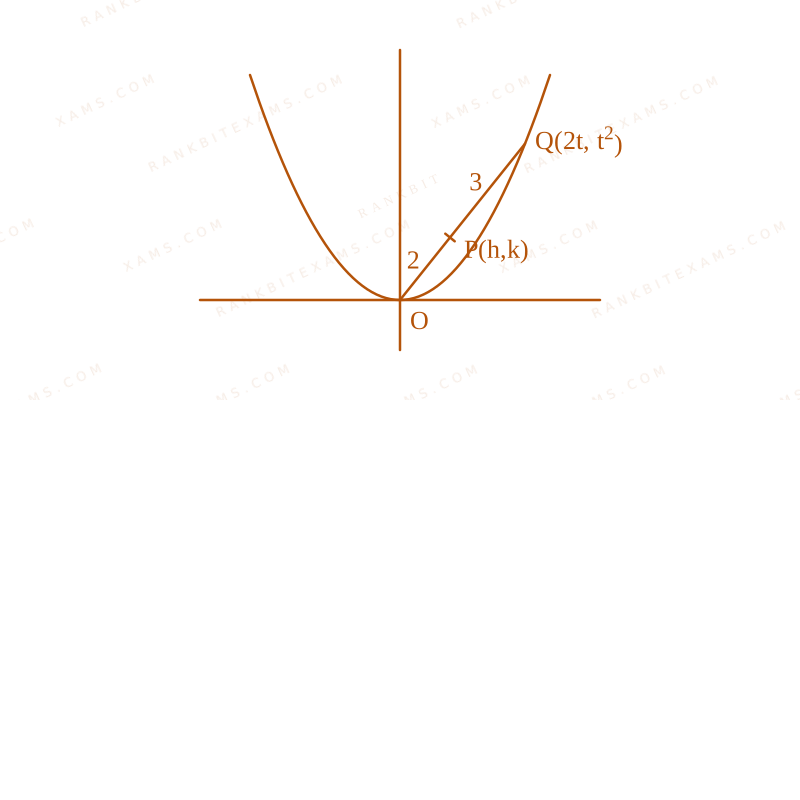
A general point Q$Q$ on x^2 = 4y$x^2 = 4y$ is (2t, t^2)$(2t, t^2)$.
Let P(h, k)$P(h, k)$ divide OQ$OQ$ in ratio 2:3$2:3$.
By section formula:
h = frac2(2t) + 3(0)5 = frac4t5$$h = \frac{2(2t) + 3(0)}{5} = \frac{4t}{5}$$k = frac2(t^2) + 3(0)5 = frac2t^25$$k = \frac{2(t^2) + 3(0)}{5} = \frac{2t^2}{5}$$Locus of point dividing parabolic chord for Q20 - JEE Main 2026 Morning
### Step 1: Finding the Locus C
From h = frac4t5$h = \frac{4t}{5}$, we get t = frac5h4$t = \frac{5h}{4}$.
Substitute into k$k$:
k = frac25 left(frac5h4right)^2 = frac25 cdot frac25h^216 = frac5h^28$$k = \frac{2}{5} \left(\frac{5h}{4}\right)^2 = \frac{2}{5} \cdot \frac{25h^2}{16} = \frac{5h^2}{8}$$8k = 5h^2 Rightarrow 5x^2 = 8y$$8k = 5h^2 \Rightarrow 5x^2 = 8y$$
So the conic C is the parabola 5x^2 = 8y$5x^2 = 8y$.
### Step 2: Chord bisected at a point
We need the equation of the chord of C: 5x^2 - 8y = 0$C: 5x^2 - 8y = 0$ bisected at (x_1, y_1) = (1, 2)$(x_1, y_1) = (1, 2)$.
Use T = S_1$T = S_1$.
T = 5xx_1 - 4(y + y_1) = 5x(1) - 4(y + 2) = 5x - 4y - 8$T = 5xx_1 - 4(y + y_1) = 5x(1) - 4(y + 2) = 5x - 4y - 8$S_1 = 5(1)^2 - 8(2) = 5 - 16 = -11$S_1 = 5(1)^2 - 8(2) = 5 - 16 = -11$
Equating T$T$ and S_1$S_1$:
5x - 4y - 8 = -11$$5x - 4y - 8 = -11$$5x - 4y + 3 = 0$5x - 4y + 3 = 0$
### Pattern Recognition
Internal division locus of a vertex chord on standard conic identically scales the conic. Once the child-conic is found, standard mid-point chord protocol (T=S_1$T=S_1$) strictly applies algebraically.
### Evaluation Rubric / Model Answer
null
### Chapter Mix
Class 11 Maths: Parabola
Class 11 Maths: Straight Lines
Q4jee_main_2026_21_jan_eveningEllipse
In the line alpha x + 4y = sqrt7$\alpha x + 4y = \sqrt{7}$, where alpha in R$\alpha \in R$, touches the ellipse3x^2 + 4y^2 = 1$3x^{2} + 4y^{2} = 1$ at the point P$P$ in the first quadrant, then one of the focal distances of P$P$ is:
### Related Formula
textCondition of tangency for ellipse fracx^2a^2 + fracy^2b^2 = 1 text is c^2 = a^2m^2 + b^2$$\text{Condition of tangency for ellipse } \frac{x^2}{a^2} + \frac{y^2}{b^2} = 1 \text{ is } c^2 = a^2m^2 + b^2$$textFocal distance SP = a pm ex$$\text{Focal distance } SP = a \pm ex$$textEccentricity e = sqrt1 - fracb^2a^2$$\text{Eccentricity } e = \sqrt{1 - \frac{b^2}{a^2}}$$
### Core Logic
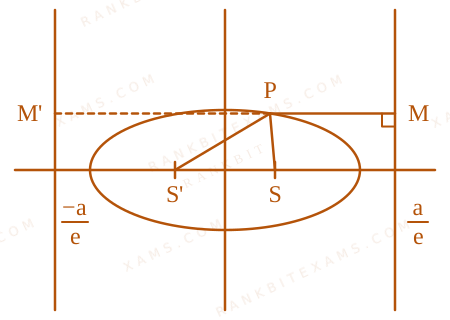
Ellipse diagram for Q4 - JEE Main 2026 Evening
Identify the slope and intercepts of the line to find alpha$\alpha$. Use the point of contact formula to locate P(x_1, y_1)$P(x_1, y_1)$ and apply focal distance definitions.
### Step 1: Determine alpha
Rewrite the ellipse: fracx^21/3 + fracy^21/4 = 1 implies a^2 = frac13, b^2 = frac14$\frac{x^2}{1/3} + \frac{y^2}{1/4} = 1 \implies a^2 = \frac{1}{3}, b^2 = \frac{1}{4}$.
The line is y = -fracalpha4x + fracsqrt74$y = -\frac{\alpha}{4}x + \frac{\sqrt{7}}{4}$.
Using c^2 = a^2m^2 + b^2$c^2 = a^2m^2 + b^2$:
left(fracsqrt74right)^2 = frac13 left(-fracalpha4right)^2 + frac14$$\left(\frac{\sqrt{7}}{4}\right)^2 = \frac{1}{3} \left(-\frac{\alpha}{4}\right)^2 + \frac{1}{4}$$frac716 = fracalpha^248 + frac416 implies frac316 = fracalpha^248 implies alpha^2 = 9 implies alpha = pm 3$$\frac{7}{16} = \frac{\alpha^2}{48} + \frac{4}{16} \implies \frac{3}{16} = \frac{\alpha^2}{48} \implies \alpha^2 = 9 \implies \alpha = \pm 3$$
Since P$P$ is in the first quadrant, coordinates x, y$x, y$ are positive, so we use the tangent 3x + 4y - sqrt7 = 0$3x + 4y - \sqrt{7} = 0$.
### Step 2: Find Point of Contact P
The tangent at P(x_1, y_1)$P(x_1, y_1)$ is 3xx_1 + 4yy_1 = 1$3xx_1 + 4yy_1 = 1$.
Comparing this with 3x + 4y = sqrt7$3x + 4y = \sqrt{7}$ (divided by sqrt7$\sqrt{7}$ to match constant 1$1$): frac3xsqrt7 + frac4ysqrt7 = 1$\frac{3x}{\sqrt{7}} + \frac{4y}{\sqrt{7}} = 1$.
Comparing coefficients:
3x_1 = frac3sqrt7 implies x_1 = frac1sqrt7$$3x_1 = \frac{3}{\sqrt{7}} \implies x_1 = \frac{1}{\sqrt{7}}$$4y_1 = frac4sqrt7 implies y_1 = frac1sqrt7$$4y_1 = \frac{4}{\sqrt{7}} \implies y_1 = \frac{1}{\sqrt{7}}$$
So P = left(frac1sqrt7, frac1sqrt7right)$P = \left(\frac{1}{\sqrt{7}}, \frac{1}{\sqrt{7}}\right)$.
### Step 3: Calculate Focal Distance
Find eccentricity:
e = sqrt1 - frac1/41/3 = sqrt1 - frac34 = frac12$$e = \sqrt{1 - \frac{1/4}{1/3}} = \sqrt{1 - \frac{3}{4}} = \frac{1}{2}$$
The focal distances are a - ex$a - ex$ and a + ex$a + ex$. Since a^2 = 1/3 implies a = 1/sqrt3$a^2 = 1/3 \implies a = 1/\sqrt{3}$.
SP = a - ex_1 = frac1sqrt3 - frac12left(frac1sqrt7right) = frac1sqrt3 - frac12sqrt7$$SP = a - ex_1 = \frac{1}{\sqrt{3}} - \frac{1}{2}\left(\frac{1}{\sqrt{7}}\right) = \frac{1}{\sqrt{3}} - \frac{1}{2\sqrt{7}}$$S'P = a + ex_1 = frac1sqrt3 + frac12left(frac1sqrt7right) = frac1sqrt3 + frac12sqrt7$$S'P = a + ex_1 = \frac{1}{\sqrt{3}} + \frac{1}{2}\left(\frac{1}{\sqrt{7}}\right) = \frac{1}{\sqrt{3}} + \frac{1}{2\sqrt{7}}$$
Matching with the options, the focal distance is frac1sqrt3 + frac12sqrt7$\frac{1}{\sqrt{3}} + \frac{1}{2\sqrt{7}}$.
### Pattern Recognition
For tangency lx+my+n=0$lx+my+n=0$ to x^2/a^2 + y^2/b^2 = 1$x^2/a^2 + y^2/b^2 = 1$, use a^2 l^2 + b^2 m^2 = n^2$a^2 l^2 + b^2 m^2 = n^2$. Points of contact can be quickly evaluated by comparing T=0$T=0$ to the normalized tangent equation.
### Evaluation Rubric / Model Answer
null
### Chapter Mix
Class 11 Maths: Conic Sections
Q5jee_main_2026_21_jan_eveningParabola
Let y^2 = 12x$y^{2} = 12x$ be the parabola with its vertex at O. Let P be a point on the parabola and A be a point on the x-axis such that angle OPA = 90^circ$\angle OPA = 90^{\circ}$. Then the locus of the centroid of such triangles OPA is:
A.y^2 - 6x + 4 = 0$y^{2} - 6x + 4 = 0$
B.y^2 - 9x + 6 = 0$y^{2} - 9x + 6 = 0$
C.y^2 - 2x + 8 = 0$y^{2} - 2x + 8 = 0$
D.y^2 - 4x + 8 = 0$y^{2} - 4x + 8 = 0$
Solution
### Related Formula
textCentroid G(x,y) = left( fracx_1 + x_2 + x_33, fracy_1 + y_2 + y_33 right)$$\text{Centroid } G(x,y) = \left( \frac{x_1 + x_2 + x_3}{3}, \frac{y_1 + y_2 + y_3}{3} \right)$$textProduct of slopes for perpendicular lines m_1 m_2 = -1$$\text{Product of slopes for perpendicular lines } m_1 m_2 = -1$$
### Core Logic
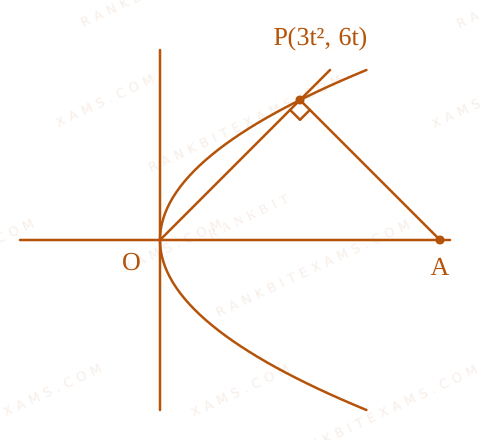
Parabola geometry diagram for Q5 - JEE Main 2026 Evening
Define coordinates: O(0,0)$O(0,0)$, P(3t^2, 6t)$P(3t^2, 6t)$ (since y^2 = 12x implies 4a = 12 implies a=3$y^2 = 12x \implies 4a = 12 \implies a=3$).
Determine the slope of OP$OP$ and use perpendicularity to find the equation of PA$PA$ and locate point A$A$ on the x-axis.
### Step 1: Locate A via Perpendicularity
Slope of OP$OP$ is m_OP = frac6t - 03t^2 - 0 = frac2t$m_{OP} = \frac{6t - 0}{3t^2 - 0} = \frac{2}{t}$.
Since angle OPA = 90^circ$\angle OPA = 90^\circ$, slope of AP$AP$ is m_AP = -fract2$m_{AP} = -\frac{t}{2}$.
Equation of AP$AP$:
y - 6t = -fract2(x - 3t^2)$$y - 6t = -\frac{t}{2}(x - 3t^2)$$
To find A$A$ on the x-axis, put y = 0$y = 0$:
-6t = -fract2(x - 3t^2) implies 12 = x - 3t^2 implies x = 12 + 3t^2$$-6t = -\frac{t}{2}(x - 3t^2) \implies 12 = x - 3t^2 \implies x = 12 + 3t^2$$
So, A$A$ is (12 + 3t^2, 0)$(12 + 3t^2, 0)$.
### Step 2: Locus of the Centroid
Let the centroid of triangle OPA$\triangle OPA$ be G(h, k)$G(h, k)$.
h = frac0 + 3t^2 + (12 + 3t^2)3 = frac6t^2 + 123 = 2t^2 + 4$$h = \frac{0 + 3t^2 + (12 + 3t^2)}{3} = \frac{6t^2 + 12}{3} = 2t^2 + 4$$k = frac0 + 6t + 03 = 2t$$k = \frac{0 + 6t + 0}{3} = 2t$$
From k = 2t implies t = frack2$k = 2t \implies t = \frac{k}{2}$.
Substitute t$t$ into the equation for h$h$:
h = 2left(frack2right)^2 + 4 = frack^22 + 4$$h = 2\left(\frac{k}{2}\right)^2 + 4 = \frac{k^2}{2} + 4$$2h = k^2 + 8 implies k^2 = 2h - 8$$2h = k^2 + 8 \implies k^2 = 2h - 8$$
Replacing (h, k)$(h, k)$ with (x, y)$(x, y)$, the locus is y^2 = 2x - 8 implies y^2 - 2x + 8 = 0$y^2 = 2x - 8 \implies y^2 - 2x + 8 = 0$.
### Pattern Recognition
For any right-angled configuration involving the origin and axis on a parabola, parametric geometry simplifies equations significantly. Find coordinates O, P, A$O, P, A$, set up the centroid algebraic relations, and eliminate parameter t$t$.
### Evaluation Rubric / Model Answer
null
### Chapter Mix
Class 11 Maths: Conic Sections
Class 11 Maths: Straight Lines
Q6jee_main_2026_21_jan_eveningParabola
Let one end of a focal chord of the parabolay^2=16x$y^{2}=16x$ be (16, 16). If P(alpha,beta)$P(\alpha,\beta)$ divides this focal chord internally in the ratio 5:2, then the minimum value of alpha+beta$\alpha+\beta$ is equal to:
A.22$22$
B.7$7$
C.5$5$
D.16$16$
Solution
### Related Formula
textFor a focal chord with ends (at_1^2, 2at_1) text and (at_2^2, 2at_2), text the relation is t_1t_2 = -1$$\text{For a focal chord with ends } (at_1^2, 2at_1) \text{ and } (at_2^2, 2at_2), \text{ the relation is } t_1t_2 = -1$$textSection formula: (x, y) = left( fracmx_2 + nx_1m+n, fracmy_2 + ny_1m+n right)$$\text{Section formula: } (x, y) = \left( \frac{mx_2 + nx_1}{m+n}, \frac{my_2 + ny_1}{m+n} \right)$$
### Core Logic
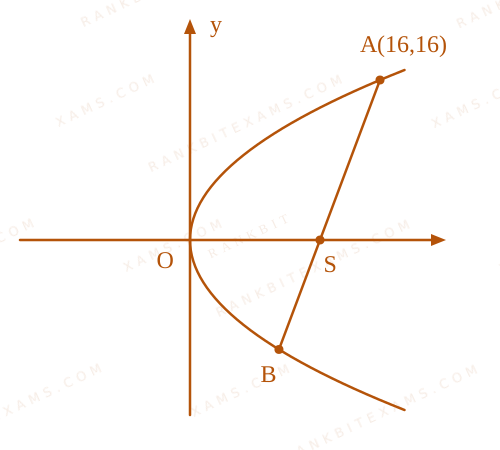
Parabola focal chord division diagram for Q6 - JEE Main 2026 Evening
For y^2 = 16x$y^2 = 16x$, a = 4$a = 4$. The given point A(16, 16)$A(16, 16)$ is equivalent to 4t^2 = 16$4t^2 = 16$ and 2(4)t = 16$2(4)t = 16$, which gives parameter t_1 = 2$t_1 = 2$.
The other end B$B$ has parameter t_2 = -frac1t_1 = -frac12$t_2 = -\frac{1}{t_1} = -\frac{1}{2}$.
### Step 1: Calculate coordinates of B
For t_2 = -1/2$t_2 = -1/2$, point B$B$ is:
x = 4(-1/2)^2 = 1$x = 4(-1/2)^2 = 1$y = 8(-1/2) = -4$y = 8(-1/2) = -4$
So, B(1, -4)$B(1, -4)$.
### Step 2: Section formula calculations (Two cases)
Point P(alpha, beta)$P(\alpha, \beta)$ divides AB$AB$ in the ratio 5:2$5:2$. There are two possibilities depending on which end the ratio starts from.
Case 1: Ratio 5 from B to A (i.e. A is x_2$x_2$ and B is x_1$x_1$):
alpha = frac5(16) + 2(1)7 = frac80 + 27 = frac827$$\alpha = \frac{5(16) + 2(1)}{7} = \frac{80 + 2}{7} = \frac{82}{7}$$beta = frac5(16) + 2(-4)7 = frac80 - 87 = frac727$$\beta = \frac{5(16) + 2(-4)}{7} = \frac{80 - 8}{7} = \frac{72}{7}$$
Sum: alpha + beta = frac1547 = 22$\alpha + \beta = \frac{154}{7} = 22$.
Case 2: Ratio 5 from A to B (i.e. B is x_2$x_2$ and A is x_1$x_1$):
alpha = frac5(1) + 2(16)7 = frac5 + 327 = frac377$$\alpha = \frac{5(1) + 2(16)}{7} = \frac{5 + 32}{7} = \frac{37}{7}$$beta = frac5(-4) + 2(16)7 = frac-20 + 327 = frac127$$\beta = \frac{5(-4) + 2(16)}{7} = \frac{-20 + 32}{7} = \frac{12}{7}$$
Sum: alpha + beta = frac497 = 7$\alpha + \beta = \frac{49}{7} = 7$.
### Step 3: Minimum Value
Comparing the two possible sums, 7 < 22$7 < 22$. Thus, the minimum value is 7$7$.
### Pattern Recognition
When a line segment is divided in a given ratio, 'internal division' inherently bears two solutions based on the orientation (from point A or point B). Always evaluate both cases when finding a minimum or maximum.
### Evaluation Rubric / Model Answer
null
### Chapter Mix
Class 11 Maths: Conic Sections
More Conic Sections Questions — jee_main_2026_22_january_morning
We Map Every Repeating Question in Competitive Exams.
Say goodbye to generic mock test fatigue. RankBit uses smart analysis to group past exam questions into their foundational Repeating Question Types. Find chapter weightage, track repeating questions, and score higher with targeted practice.
Select Your Target Exam
Choose an exam track below to find formulas per chapter and patterns.
Syncing Exam Intelligence
Mapping formulas and patterns across all tracks…
PATH A — FULL LENGTH PRACTICE
Full Mock Test Hub
Simulate real NTA exam conditions with fully tracked mocks. Time yourself against past papers.
Practice past-year questions one chapter at a time. Pick an exam → subject → chapter and get every PYQ for that topic — pulled together from all past papers — with the chapter's key formulas alongside.