JEE Main · Mathematics → Steady

Conic Sections appeared 94 times across 3 years — 10.9% of Mathematics. This question is from Parabola Equation with Given Vertex and Directrix.

Year 2026 2025 2024 Total
Questions 29 44 21 94

If the equation of the parabola with vertex V((3)/(2),3) and the directrix x+2y=0 is α x²+β y²-γ xy-30x-60y+225=0, then α+β+γ is equal to:

Solution & Explanation

Related Formula

The locus definition of a parabola states that the squared distance from any point P(x,y) to the focus S(x₀, y₀) equals the squared perpendicular distance to the directrix line Ax + By + C = 0:

(x - x₀)² + (y - y₀)² = ((Ax + By + C)²)/(A² + By²)
Step 1: Determine the Focus coordinates

The axis line of the parabola is perpendicular to the directrix x + 2y = 0 and passes through the vertex V(1.5, 3). Slope of directrix = -0.5 ⇒ Slope of axis = 2.

Equation of axis :

y - 3 = 2(x - (3)/(2)) ⇒ y - 2x = 0

The intersection of the axis (y - 2x = 0) and directrix (x + 2y = 0) gives the foot of the directrix, which is (0, 0).

Since the vertex is the midpoint between the focus and the foot of the directrix :

((3)/(2), 3) = ((xf + 0)/(2), (yf + 0)/(2)) ⇒ Focus S = (3, 6)
Step 2: Derive the Parabola Locus Equation

Equate the distance equations from point P(x,y) :

(x - 3)² + (y - 6)² = ((x + 2y)²)/(1² + 2²) 5(x² - 6x + 9 + y² - 12y + 36) = x² + 4xy + 4y² 5x² - 30x + 45 + 5y² - 60y + 180 = x² + 4xy + 4y² 4x² + y² - 4xy - 30x - 60y + 225 = 0
Step 3: Coefficient Extraction

Compare with the equation template α x² + β y² - γ xy - 30x - 60y + 225 = 0 :

α = 4, β = 1, γ = 4 α + β + γ = 4 + 1 + 4 = 9
Pattern Recognition

The vertex is always exactly midway between the focus and the foot of the directrix line along the line of symmetry. Finding the origin (0,0) as the foot quickly reveals the focus coordinates via doubling.

Chapter Mix

Class 11 Mathematics: Conic Sections

Reference Study Guides

More Conic Sections Previous-Year Questions — Page 6

Q3 jee_main_2026_28_january_evening Parabola and Triangles
Let A be the focus of the parabola y² = 8x. Let the line y = mx + c intersect the parabola at two distinct points B and C. If the centroid of the triangle ABC is ((7)/(3), (4)/(3)), then (BC)² is equal to :
  • A. 41
  • B. 80
  • C. 89
  • D. 32

Solution

Related Formula
Centroid = ((x₁+x₂+x₃)/(3), (y₁+y₂+y₃)/(3)) D² = (x₂-x₁)² + (y₂-y₁)²
Core Logic

Focus of y² = 8x is A(2, 0) since 4a = 8 ⇒ a=2. Let points on parabola be B(2t₁², 4t₁) and C(2t₂², 4t₂). The centroid of Δ ABC is given as ((7)/(3), (4)/(3)). Equating coordinates:

(2 + 2t₁² + 2t₂²)/(3) = (7)/(3) ⇒ t₁² + t₂² = (5)/(2) (0 + 4t₁ + 4t₂)/(3) = (4)/(3) ⇒ t₁ + t₂ = 1
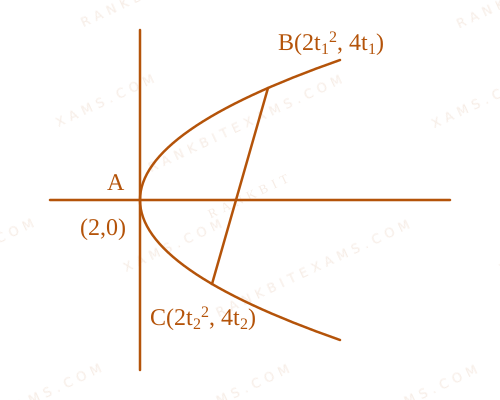
Parabola points and centroid configuration

Execution

Square the sum equation:

(t₁ + t₂)² = t₁² + t₂² + 2t₁t₂ 1 = (5)/(2) + 2t₁t₂ ⇒ 2t₁t₂ = -(3)/(2) ⇒ t₁t₂ = -(3)/(4)

Find (t₁ - t₂)²:

(t₁ - t₂)² = (t₁ + t₂)² - 4t₁t₂ = 1 - 4(-(3)/(4)) = 4

Calculate distance squared for BC:

(BC)² = (2t₁² - 2t₂²)² + (4t₁ - 4t₂)² (BC)² = 4(t₁ - t₂)²(t₁ + t₂)² + 16(t₁ - t₂)² (BC)² = 4(4)(1) + 16(4) = 16 + 64 = 80
Pattern Recognition

Using parametric coordinates (at², 2at) systematically reduces algebraic complexity when determining intersections or triangle properties on a parabola.

Chapter Mix

Class 11 Maths: Conic Sections
Q9 jee_main_2026_28_january_evening Ellipse Parameters and Latus Rectum
An ellipse has its center at (1,-2), one focus at (3,-2) and one vertex at (5, - 2). Then the length of its latus rectum is :
  • A. 16√(3)
  • B. 6
  • C. 4√(3)
  • D. 6√(3)

Solution

Related Formula
Latus Rectum (LR) = (2b²)/(a) = 2a(1-e²)
Core Logic

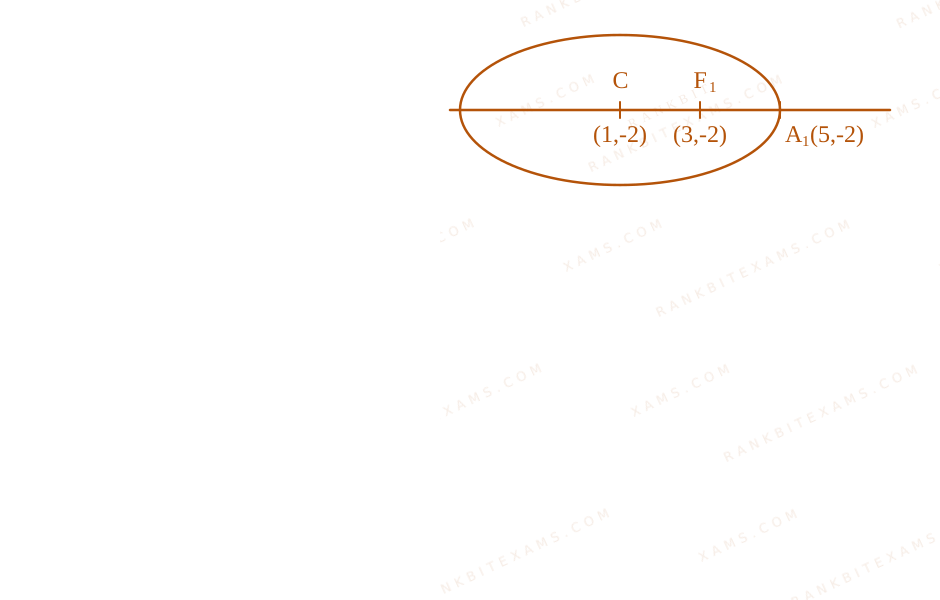
From the given coordinates on the major axis (y = -2): Center C(1, -2), Focus F₁(3, -2), Vertex A₁(5, -2). Distance from center to vertex, CA₁ = a = 5 - 1 = 4. Distance from center to focus, CF₁ = ae = 3 - 1 = 2.

Ellipse dimensions mapped to coordinates

Execution

Calculate eccentricity e:

ae = 2 ⇒ 4e = 2 ⇒ e = (1)/(2)

Use alternate formula for Latus Rectum:

LR = 2e((a)/(e) - ae) or directly 2a(1-e²) LR = 2(4)(1 - (1)/(4)) = 8 × (3)/(4) = 6
Pattern Recognition

Aligning focus, center, and vertex along a constant y-axis implies a standard shifted ellipse where absolute differences in x-coordinates yield standard parameters (a and ae) directly.

Chapter Mix

Class 11 Maths: Conic Sections

Q10 jee_main_2026_28_january_evening Confocal Ellipse and Hyperbola
Let the ellipse E: x²144 + y²169 = 1 and the hyperbola H: x²16 - y²λ² = -1 have the same foci. If e and L respectively denote the eccentricity and the length of the latus rectum of H, then the value of 24(e + L) is:
  • A. 296
  • B. 126
  • C. 148
  • D. 67

Solution

Related Formula
e = √(1 - (a²)/(b²)) (for vertical ellipse) e = √(1 + (a²)/(b²)) (for conjugate hyperbola)
Core Logic

For Ellipse E: (x²)/(144) + (y²)/(169) = 1 a² = 144, b² = 169. Since b > a, the major axis is along the y-axis. Eccentricity e' = √(1 - (144)/(169)) = √((25)/(169)) = (5)/(13). Foci of ellipse = (0, ± be') = (0, ± 13 × (5)/(13)) = (0, ± 5).

Execution

For Hyperbola H: (y²)/(λ²) - (x²)/(16) = 1 Foci of conjugate hyperbola are (0, ± λ e). Equating foci: λ e = 5.

e = √(1 + (16)/(λ²)) λ √(1 + (16)/(λ²)) = 5 ⇒ λ² + 16 = 25 ⇒ λ² = 9 ⇒ λ = 3

Eccentricity of hyperbola, e = (5)/(3). Length of latus rectum of hyperbola, L = (2(16))/(λ) = (32)/(3).

Calculate 24(e + L):

24(e + L) = 24[(5)/(3) + (32)/(3)] = 24((37)/(3)) = 8 × 37 = 296
Pattern Recognition

Confocal conics usually align along the same major axis. Notice the -1 on the RHS of the hyperbola equation indicates a conjugate hyperbola orienting it vertically to match the b>a ellipse.

Chapter Mix

Class 11 Maths: Conic Sections

Q12 jee_main_2026_28_january_evening Parametric Form and Chord Intersections
Let the circle x² + y² = 4 intersect x-axis at the points A(a, 0), a > 0 and B(b, 0). Let P(2 α, 2 α), 0 < α < (π)/(2) and Q(2 β, 2 β) be two points such that (α - β) = (π)/(2). Then the point of intersection of AQ and BP lies on:
  • A. x² + y² - 4y - 4 = 0
  • B. x² + y² - 4x - 4 = 0
  • C. x² + y² - 4x - 4y = 0
  • D. x² + y² - 4x - 4y - 4 = 0

Solution

Core Logic

Intersection of circle with x-axis provides A(2,0) and B(-2,0). Let the point of intersection of AQ and BP be R(h, k). Since R lies on BP, the slope mBR = mBP:

(k)/(h + 2) = (2 α)/(2 α + 2) = (α)/(2)

Since R lies on AQ, the slope mAR = mAQ:

(k)/(h - 2) = (2 β)/(2 β - 2) = ( β)/( β - 1) = - (β)/(2)
Execution

We are given α - β = (π)/(2) ⇒ (α)/(2) - (β)/(2) = (π)/(4). Applying the (A-B) formula:

((α)/(2) - (β)/(2)) = ( (α)/(2) - (β)/(2))/(1 + (α)/(2) (β)/(2)) = 1

Substitute the slope relations: (α)/(2) = (k)/(h+2) (β)/(2) = -(h-2)/(k) (since - (β)/(2) = (k)/(h-2))

1 = ((k)/(h+2) + (h-2)/(k))/(1 + ((k)/(h+2))((2-h)/(k))) 1 = k² + h² - 4(k(h+2))/(k) · (k(h+2) - k(2-h))/(k(h+2)) wait, clear denominator 1 = (k² + h² - 4)/(k(h+2) + k(2-h)) × k(h+2) The denominator simplifies to:

1 + (2-h)/(h+2) = (h+2+2-h)/(h+2) = (4)/(h+2)

Numerator is (k² + h² - 4)/(k(h+2)). So the expression simplifies to:

1 = (k² + h² - 4)/(4k) h² + k² - 4k - 4 = 0

Locus of R is x² + y² - 4y - 4 = 0.

Pattern Recognition

Connecting chords from extreme diameter vertices to points whose parametric angles differ by π/2 reliably generates perpendicular-like slope products or standard tangent angle identities, mapping directly to a circular locus.

Chapter Mix

Class 11 Maths: Circles

Q55 jee_main_2025_02_april_evening Ellipse
If the length of the minor axis of an ellipse is equal to one fourth of the distance between the foci, then the eccentricity of the ellipse is :
  • A. 4√(17)
  • B. √(3)16
  • C. 3√(19)
  • D. √(5)7

Solution

Related Formula
Length of minor axis = 2b Distance between foci = 2ae Eccentricity: e = √(1 - (b²)/(a²))
Core Logic

We set up an algebraic equation relating b, a, and e from the given geometric condition, then substitute it into the eccentricity identity.

Step 1: Set up the geometric relation

Given that 2b = (1)/(4) (2ae):

b = (ae)/(4) (b)/(a) = (e)/(4)

Square both sides:

(b²)/(a²) = (e²)/(16)
Step 2: Solve for eccentricity

Using the eccentricity relation:

e² = 1 - (b²)/(a²) e² = 1 - (e²)/(16) e² (1 + (1)/(16)) = 1 (17)/(16) e² = 1 e² = (16)/(17) e = 4√(17)
Pattern Recognition

Standard Ellipse relations: For standard ellipses, the ratio of axes and the eccentricity are coupled quadratic equations. Expressing b/a as a function of e allows direct solving of the eccentricity.

Chapter Mix

Class 11 Mathematics: Conic Sections

More Conic Sections Questions — jee_main_2025_24_jan_evening

Practice all Conic Sections previous-year questions →

Rankbit System
JEE Physics: Waves (+15.5%) | Electrostatics: Concentric Shells (-29.7%) | Modern Physics: Photoelectric Clones (+34.2%) | Mathematics: Definite Integrals (+18.1%) | Chemistry: Coordination Splitting (-11.4%) | JEE Physics: Waves (+15.5%) | Electrostatics: Concentric Shells (-29.7%) | Modern Physics: Photoelectric Clones (+34.2%) | Mathematics: Definite Integrals (+18.1%) | Chemistry: Coordination Splitting (-11.4%)