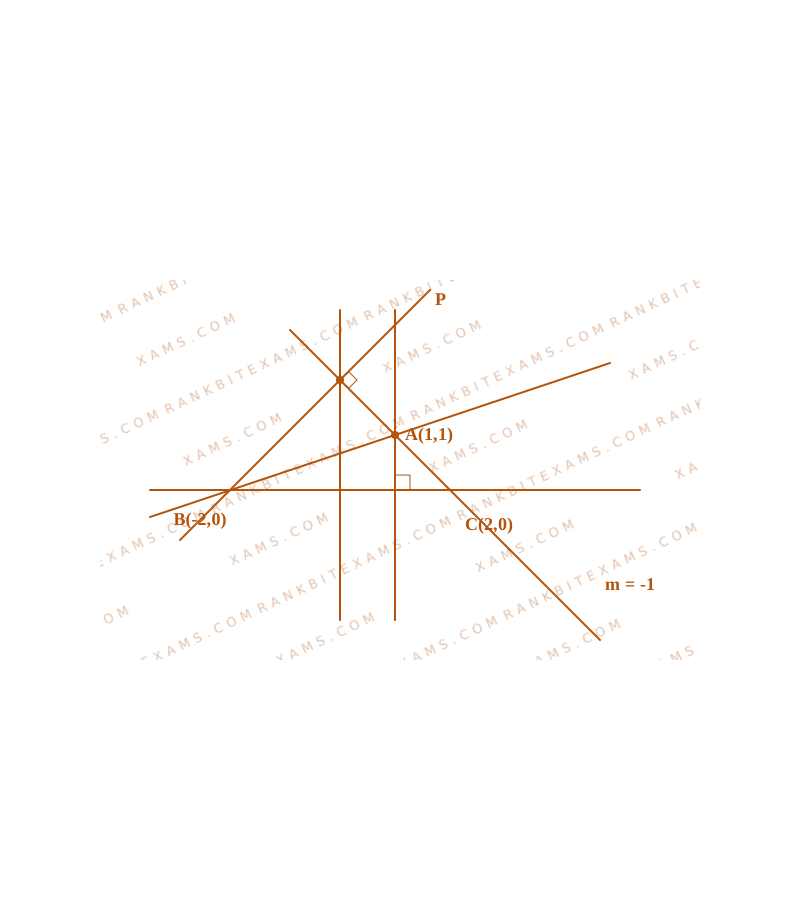
Let ABC be the triangle such that the equations of lines AB and AC be 3y - x = 2$3y - x = 2$ and x + y = 2$x + y = 2$ , respectively, and the points B and C lie on x-axis. If P is the orthocentre of the triangle ABC, then the area of the triangle PBC is equal to
A.4$4$
B.10$10$
C.8$8$
D.6$6$
Solution & Explanation
Related Formula
The orthocentre P$P$ of a triangle is the point of intersection of its altitudes.
Area of a triangle with a horizontal base lying on the x-axis is:
Find vertex A$A$ by solving the line equations AB$AB$ and AC$AC$:
3y - x = 2 x = 3y - 2$$3y - x = 2 \implies x = 3y - 2$$
Substitute into x + y = 2 (3y - 2) + y = 2 4y = 4 y = 1$x + y = 2 \implies (3y - 2) + y = 2 \implies 4y = 4 \implies y = 1$.
Then x = 3(1) - 2 = 1$x = 3(1) - 2 = 1$. So vertex A$A$ is (1, 1)$(1, 1)$.
Find vertices B$B$ and C$C$ where the lines cross the x-axis (y = 0$y = 0$):
For B$B$ (on line AB$AB$): 3(0) - x = 2 x = -2 B(-2, 0)$3(0) - x = 2 \implies x = -2 \implies B(-2, 0)$
For C$C$ (on line AC$AC$): x + 0 = 2 x = 2 C(2, 0)$x + 0 = 2 \implies x = 2 \implies C(2, 0)$
Base length BC = |2 - (-2)| = 4$BC = |2 - (-2)| = 4$.
Step 1: Find Equations of Altitudes
Orthocentre of a Triangle diagram for Q70 - JEE Main 2025 Morning
Altitude from A to BC:
Since BC$BC$ lies along the x-axis, the altitude from A(1, 1)$A(1, 1)$ must be a vertical line:
Equation of Altitude 1: x = 1$$\text{Equation of Altitude 1}: x = 1$$
Altitude from B to AC:
Slope of line AC$AC$ (x + y = 2$x + y = 2$) is mAC = -1$m_{AC} = -1$.
Therefore, the slope of the altitude perpendicular to AC$AC$ is m₂ = -(1)/(-1) = 1$m_2 = -\frac{1}{-1} = 1$.
Passing through B(-2, 0)$B(-2, 0)$:
y - 0 = 1(x - (-2)) y = x + 2 x - y + 2 = 0$$y - 0 = 1(x - (-2)) \implies y = x + 2 \implies x - y + 2 = 0$$
Step 2: Solve for Orthocentre coordinates P
Intersect the altitude equations: x = 1$x = 1$ and y = x + 2$y = x + 2$:
y = 1 + 2 = 3$y = 1 + 2 = 3$
Hence, the orthocentre is P(1, 3)$P(1, 3)$.
Step 3: Compute Area of Triangle PBC
Triangle PBC$PBC$ has base BC = 4$BC = 4$ on the x-axis, and vertex P(1, 3)$P(1, 3)$ gives a height of 3$3$.
When a triangle has its base sitting entirely on the coordinate axis, the altitude dropped from the opposite vertex is simplified to a pure horizontal or vertical line path, heavily reducing your linear derivation equation workload.
Keywords:#triangle orthocentre calculation#area of triangle coordinate geometry#JEE Main 2025 Morning Q70#Straight Lines equations list
More Straight Lines Previous-Year Questions — Page 5
Qjee_main_2024_29_january_eveningDistance of a Point From a Line
The distance of the point (2, 3) from the line 2x - 3y + 28 = 0$2x - 3y + 28 = 0$, measured parallel to the line √(3) x - y + 1 = 0$\sqrt{3} x - y + 1 = 0$, is equal to
A.4√(2)$4\sqrt{2}$
B.6√(3)$6\sqrt{3}$
C.3 + 4√(2)$3 + 4\sqrt{2}$
D.4 + 6√(3)$4 + 6\sqrt{3}$
Solution
Related Formula
x = x₁ + r θ, y = y₁ + r θ$$x = x_1 + r \cos \theta, \quad y = y_1 + r \sin \theta$$
Core Logic
The line is measured parallel to √(3)x - y + 1 = 0$\sqrt{3}x - y + 1 = 0$, which has a slope θ = √(3) θ = 60^°$\tan \theta = \sqrt{3} \implies \theta = 60^\circ$.
Thus, θ = (1)/(2)$\cos \theta = \frac{1}{2}$ and θ = √(3)2$\sin \theta = \frac{\sqrt{3}}{2}$.
Writing any point P$P$ along this direction passing through (2,3)$(2,3)$ in parametric coordinates:
P = (2 + r 60^°, 3 + r 60^°) = (2 + (r)/(2), 3 + √(3)r2)$$P = \left(2 + r \cos 60^\circ, 3 + r \sin 60^\circ\right) = \left(2 + \frac{r}{2}, 3 + \frac{\sqrt{3}r}{2}\right)$$
Step 1: Finding Intersection Point
Since P$P$ must lie on the given line 2x - 3y + 28 = 0$2x - 3y + 28 = 0$:
Distance measured parallel to a given direction is always resolved most efficiently using parametric equations of lines rather than perpendicular metrics.
Chapter Mix
Class 11 Mathematics: Straight Lines
Qjee_main_2024_29_january_eveningIntersection of Lines and Distance
Let A$A$ be the point of intersection of the lines 3x + 2y = 14, 5x - y = 6$3x + 2y = 14, 5x - y = 6$ and B$B$ be the point of intersection of the lines 4x + 3y = 8, 6x + y = 5$4x + 3y = 8, 6x + y = 5$. The distance of the point P(5, -2)$P(5, -2)$ from the line AB is
Verify calculation metrics step-by-step. Finding straight intersections correctly upfront avoids scaling mistakes down the track.
Chapter Mix
Class 11 Mathematics: Straight Lines
Qjee_main_2024_27_jan_morningAngle Between Two Lines
The portion of the line 4x+5y=20$4x+5y=20$ in the first quadrant is trisected by the lines L₁$L_{1}$ and L₂$L_{2}$ passing through the origin. The tangent of an angle between the lines L₁$L_{1}$ and L₂$L_{2}$ is:
Find the intercepts of the line 4x + 5y = 20$4x + 5y = 20$ in the first quadrant.
Put y=0 ⇒ x=5$y=0 \Rightarrow x=5$. Point X(5, 0)$X(5, 0)$.
Put x=0 ⇒ y=4$x=0 \Rightarrow y=4$. Point Y(0, 4)$Y(0, 4)$.
The line segment XY$XY$ is trisected by two points, say A$A$ and B$B$.
Point A$A$ divides YX$YX$ in the ratio 2:1$2:1$, and B$B$ divides it in 1:2$1:2$.
Step 1: Trisection Points Calculation
Using the section formula for A$A$ (closer to Y-axis, ratio 1:2 from Y to X):
For trisection or specific division of an intercepted segment, identify the axis intercepts first, rapidly apply the internal section formula, compute origin-centered slopes (which equal just the y/x ratio of the points), and pass them into the tan formula.
Chapter Mix
Class 11 Maths: Straight Lines
Q7jee_main_2024_29_jan_morningAngle Bisector and Reflection
In a Δ ABC$\Delta ABC$, suppose y=x$y=x$ is the equation of the bisector of the angle B and the equation of the side AC is 2x-y=2$2x-y=2$. If 2AB=BC$2AB=BC$ and the point A and B are respectively (4,6)$(4,6)$ and (α,β)$(\alpha,\beta)$, then α+2β$\alpha+2\beta$ is equal to
A.42$42$
B.39$39$
C.48$48$
D.45$45$
Solution
Related Formula
Image of a point (x₁, y₁)$(x_1, y_1)$ across line y=x$y=x$ is (y₁, x₁)$(y_1, x_1)$.
Angle Bisector Theorem: The angle bisector of a triangle divides the opposite side into segments proportional to the lengths of the adjacent sides:
Given A(4,6)$A(4,6)$ and Angle bisector of B is y=x$y=x$.
Because y=x$y=x$ bisects angle B, the geometric reflection of vertex A across the bisector line y=x$y=x$ must lie exactly on the line containing the side BC$BC$.
Let the reflection of A(4,6)$A(4,6)$ be A'$A'$. Across y=x$y=x$, the coordinates swap:
A' = (6,4)$A' = (6,4)$
Next, find the intersection point D$D$ of the bisector y=x$y=x$ and side AC$AC$ (2x-y=2$2x-y=2$).
Substitute y=x$y=x$ into 2x-y=2$2x-y=2$:
2x - x = 2 ⇒ x = 2 ⇒ y = 2$$2x - x = 2 \Rightarrow x = 2 \Rightarrow y = 2$$
Given 2AB = BC$2AB = BC$, so (AB)/(BC) = (1)/(2)$\frac{AB}{BC} = \frac{1}{2}$.
This means point D(2,2)$D(2,2)$ divides the segment AC$AC$ in the ratio 1:2$1:2$.
Let C$C$ have coordinates (xc, yc)$(x_c, y_c)$.
Applying the section formula for D(2,2)$D(2,2)$ dividing A(4,6)$A(4,6)$ and C(xc, yc)$C(x_c, y_c)$ in ratio 1:2$1:2$:
Vertex B(α, β)$B(\alpha, \beta)$ is the intersection of line BC$BC$ and the angle bisector y=x$y=x$.
Substitute y=x$y=x$ into 5x - 4y - 14 = 0$5x - 4y - 14 = 0$:
Reflection properties drastically simplify angle bisector questions. If you know the bisector equation, reflecting one vertex over it gives a coordinate on the opposing extended ray. This paired with the angle bisector proportion theorem locks the entire geometric frame.
Chapter Mix
Class 11 Mathematics: Straight Lines
Q7jee_main_2024_30_january_eveningAngle Bisectors
If x² - y² + 2hxy + 2gx + 2fy + c = 0$x^2 - y^2 + 2hxy + 2gx + 2fy + c = 0$ is the locus of a point, which moves such that it is always equidistant from the lines x + 2y + 7 = 0$x + 2y + 7 = 0$ and 2x - y + 8 = 0$2x - y + 8 = 0$ , then the value of g + c + h - f$g + c + h - f$ equals
A.14$14$
B.6$6$
C.8$8$
D.29$29$
Solution
Related Formula
Distance of (x, y) from ax+by+c=0 is d = |ax + by + c|√(a² + b²)$$\text{Distance of } (x, y) \text{ from } ax+by+c=0 \text{ is } d = \frac{|ax + by + c|}{\sqrt{a^2 + b^2}}$$
Core Logic
The locus of a point P(x, y)$P(x, y)$ equidistant from lines x + 2y + 7 = 0$x + 2y + 7 = 0$ and 2x - y + 8 = 0$2x - y + 8 = 0$ is the pair of angle bisectors:
The standard form given is x² - y² + 2hxy + 2gx + 2fy + c = 0$x^2 - y^2 + 2hxy + 2gx + 2fy + c = 0$.
Divide our derived equation by 3 to match the leading coefficients:
Locus of equidistant points from two lines is their pair of angle bisectors. Equating squares d₁² = d₂²$d_1^2 = d_2^2$ directly yields the joint equation of bisectors without needing explicit line separation.
Chapter Mix
Class 11 Maths: Straight Lines
More Straight Lines Questions — jee_main_2025_07_april_morning
Practice past-year questions one chapter at a time. Pick an exam → subject → chapter and get every PYQ for that topic — pulled together from all past papers — with the chapter's key formulas alongside.