JEE Main · Mathematics ↓ Falling

Straight Lines appeared 29 times across 3 years — 3.4% of Mathematics. This question is from Orthocentre of a Triangle.

Year 2026 2025 2024 Total
Questions 7 13 9 29

Let ABC be the triangle such that the equations of lines AB and AC be 3y - x = 2 and x + y = 2 , respectively, and the points B and C lie on x-axis. If P is the orthocentre of the triangle ABC, then the area of the triangle PBC is equal to

Solution & Explanation

Related Formula

The orthocentre P of a triangle is the point of intersection of its altitudes. Area of a triangle with a horizontal base lying on the x-axis is:

Area = (1)/(2) × base × height = (1)/(2) × |xC - xB| × |yP|
Core Logic

Find vertex A by solving the line equations AB and AC:

3y - x = 2 x = 3y - 2

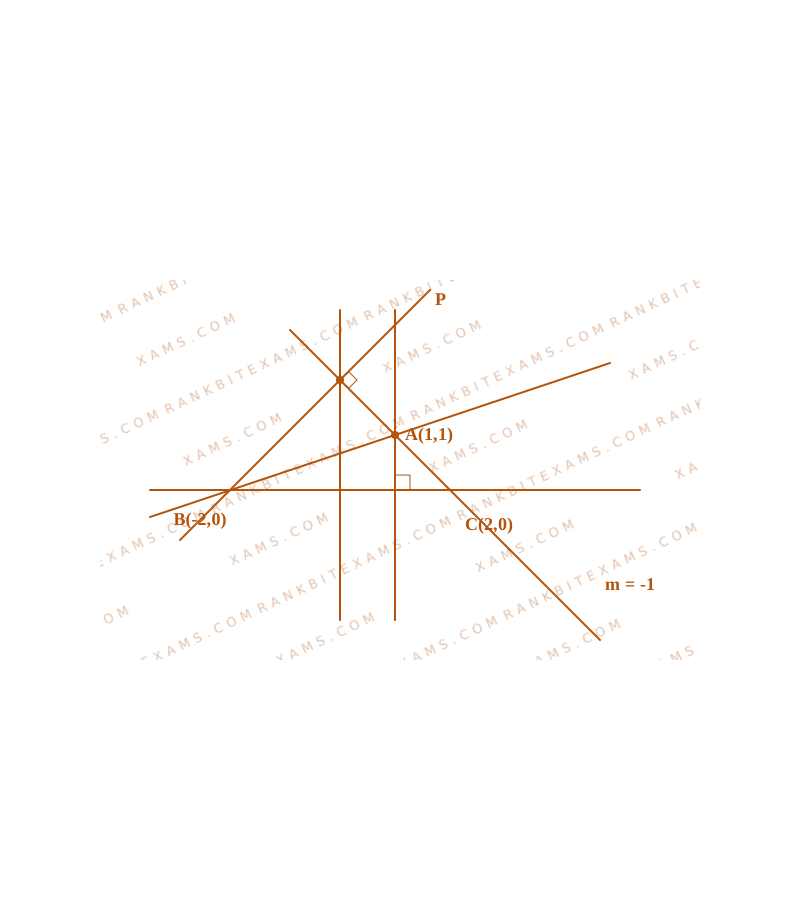
Substitute into x + y = 2 (3y - 2) + y = 2 4y = 4 y = 1. Then x = 3(1) - 2 = 1. So vertex A is (1, 1).

Find vertices B and C where the lines cross the x-axis (y = 0):

  • For B (on line AB): 3(0) - x = 2 x = -2 B(-2, 0)
  • For C (on line AC): x + 0 = 2 x = 2 C(2, 0)
  • Base length BC = |2 - (-2)| = 4.

Step 1: Find Equations of Altitudes

Orthocentre of a Triangle diagram for Q70 - JEE Main 2025 Morning

  • Altitude from A to BC:
  • Since BC lies along the x-axis, the altitude from A(1, 1) must be a vertical line:

Equation of Altitude 1: x = 1
  • Altitude from B to AC:
  • Slope of line AC (x + y = 2) is mAC = -1. Therefore, the slope of the altitude perpendicular to AC is m₂ = -(1)/(-1) = 1. Passing through B(-2, 0):

y - 0 = 1(x - (-2)) y = x + 2 x - y + 2 = 0
Step 2: Solve for Orthocentre coordinates P

Intersect the altitude equations: x = 1 and y = x + 2: y = 1 + 2 = 3

Hence, the orthocentre is P(1, 3).

Step 3: Compute Area of Triangle PBC

Triangle PBC has base BC = 4 on the x-axis, and vertex P(1, 3) gives a height of 3.

Area = (1)/(2) × 4 × 3 = 6
Pattern Recognition

When a triangle has its base sitting entirely on the coordinate axis, the altitude dropped from the opposite vertex is simplified to a pure horizontal or vertical line path, heavily reducing your linear derivation equation workload.

Chapter Mix

Class 11 Mathematics: Straight Lines

Reference Study Guides

More Straight Lines Previous-Year Questions — Page 4

Q65 jee_main_2025_04_april_morning Orthocentre of a Triangle
Let the three sides of a triangle be on the lines 4x - 7y + 10 = 0, x + y = 5 and 7x + 4y = 15. Then the distance of its orthocentre from the orthocentre of the triangle formed by the lines x = 0, y = 0 and x + y = 1 is
  • A. 5
  • B. √(5)
  • C. √(20)
  • D. 20

Solution

Related Formula

For any right-angled triangle, the orthocentre lies exactly at the vertex containing the 90° right angle. Distance formula:

d = √((x₂ - x₁)² + (y₂ - y₁)²)
Core Logic

Analyze slopes of lines forming Triangle 1: L₁: 4x - 7y + 10 = 0 m₁ = (4)/(7) L₂: 7x + 4y - 15 = 0 m₂ = -(7)/(4) Notice m₁ · m₂ = ((4)/(7))(-(7)/(4)) = -1.

Thus, Triangle 1 is a right-angled triangle. Its orthocentre B is the intersection point of L₁ and L₂: Solving 4x - 7y = -10 and 7x + 4y = 15: Multiplying first by 4, second by 7, and adding yields x = 1, y = 2 B(1, 2).
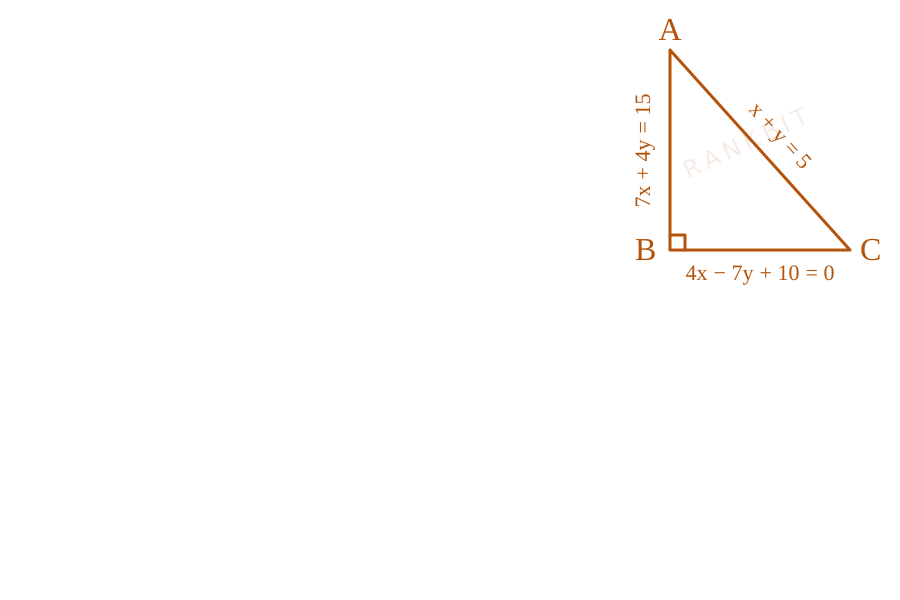
Orthocentre of a Triangle diagram for Q65 - JEE Main 2025 Morning

Step 1: Locate Second Orthocentre

Triangle 2 is formed by x = 0, y = 0, and x + y = 1. This is a right triangle with vertices at (0,0), (1,0), (0,1). The right-angled vertex is at the origin P(0, 0). Thus, its orthocentre is P(0, 0).
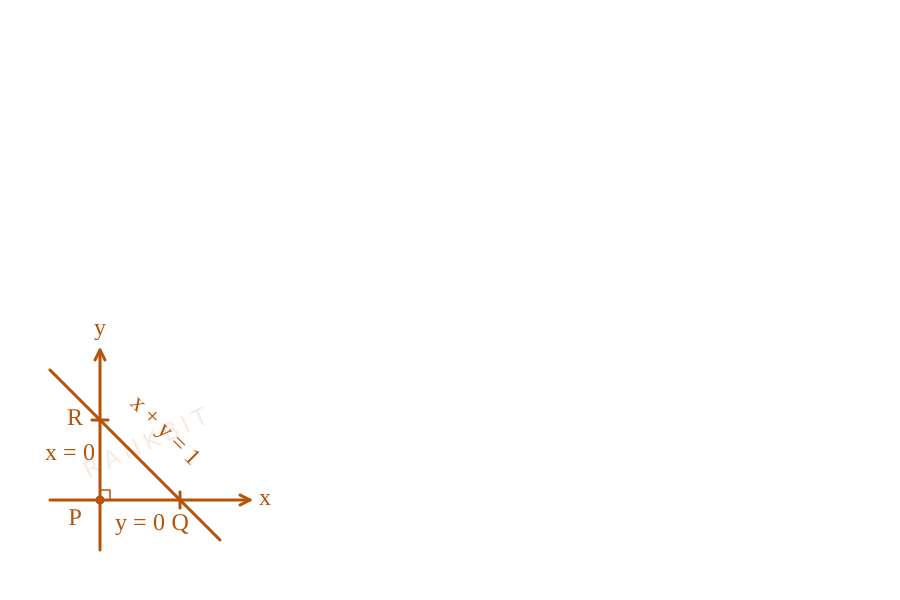
Orthocentre of a Triangle diagram for Q65 - JEE Main 2025 Morning

Step 2: Distance Computation

Find the distance between B(1,2) and P(0,0):

d = √((1 - 0)² + (2 - 0)²) = √(1 + 4) = √(5)
Pattern Recognition

Always check for mutually perpendicular side orientations (m₁ · m₂ = -1) when finding orthocentres in competitive math papers. This completely cuts out lengthy altitude equation derivation tracks.

Chapter Mix

Class 11 Mathematics: Straight Lines
Q51 jee_main_2025_07_april_evening Orthocentre of a Triangle
If the orthocentre of the triangle formed by the lines y = x + 1, y = 4x - 8 and y = mx + c is at (3, -1), then m - c is:
  • A. 0
  • B. -2
  • C. 4
  • D. 2

Solution

Related Formula

The product of slopes of two mutually perpendicular lines is always equal to -1:

m₁ · m₂ = -1
Core Logic

Let the vertices of the triangle be P, Q, and R. The lines given are:

  • y = x + 1
  • y = 4x - 8
  • y = mx + c
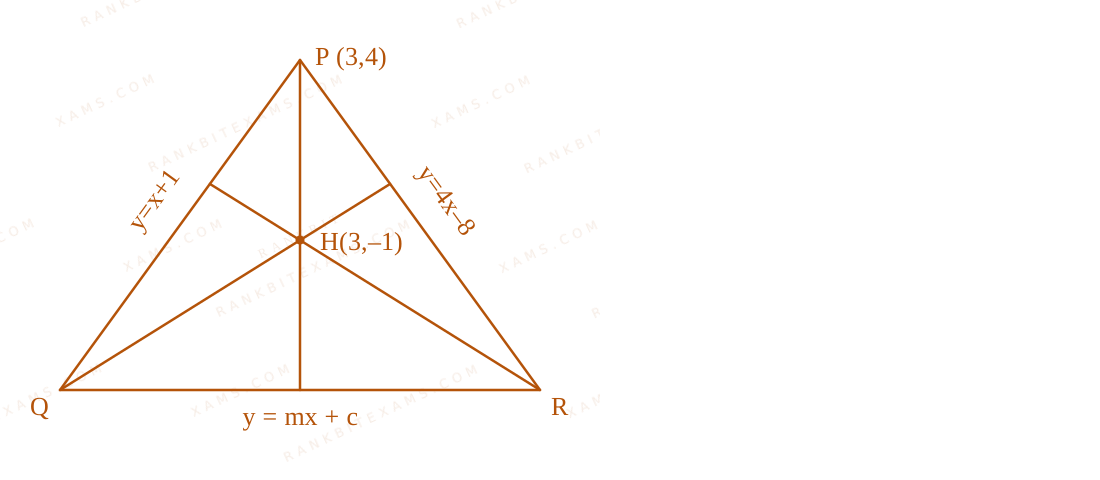
  • Solving lines y = x + 1 and y = 4x - 8 gives the vertex P(3, 4).

    The orthocentre is given as H(3, -1). Notice that the x-coordinate of P and H are identical (x = 3). This implies that the altitude from vertex P to the base line y = mx + c is a vertical line along x = 3.

    Orthocentre of a Triangle diagram for Q51 - JEE Main 2025 Evening
    Orthocentre of a Triangle diagram for Q51 - JEE Main 2025 Evening

Step 1: Determine the Slopes

Since the altitude from P is vertical, the side opposite to it (which lies on y = mx + c) must be a horizontal line.

Therefore, the slope of the line y = mx + c must be zero:

m = 0

Step 2: Solve for c

Let's find point Q by intersecting y = x + 1 and y = mx + c. Since m = 0, y = c, we get Q(c-1, c).

Using the property that the line segment connecting Q to the opposite side's altitude is perpendicular to line PR (y = 4x - 8):

Slope of QH · Slope of PR = -1 (-1 - c)/(3 - (c - 1)) · 4 = -1 (-4(c + 1))/(4 - c) = -1 4c + 4 = 4 - c 5c = 0 c = 0
Step 3: Evaluate m - c

Substituting the values of m and c:

m - c = 0 - 0 = 0
Pattern Recognition

When the x-coordinate of a vertex matches the x-coordinate of the orthocentre, the altitude is vertical, forcing the opposite base to be purely horizontal (m=0). This observation cuts down calculation time completely.

Chapter Mix

Class 11 Mathematics: Straight Lines
Q jee_main_2025_24_jan_morning Concurrency of Straight Lines
Let the lines 3x - 4y - α = 0, 8x - 11y - 33 = 0, and 2x - 3y + λ = 0 be concurrent. If the image of the point (1, 2) in the line 2x - 3y + λ = 0 is ((57)/(13),(-40)/(13)) , then |α λ| is equal to :
  • A. 84
  • B. 91
  • C. 113
  • D. 101

Solution

Related Formula

The midpoint between a point and its reflection image must lie exactly on the line mirror equation.

Core Logic

Find the midpoint M between point P(1, 2) and its given reflection image Q((57)/(13), (-40)/(13)):

M = ( (1 + (57)/(13))/(2), (2 - (40)/(13))/(2) ) = ( (70)/(26), (-14)/(26) ) = ( (35)/(13), (-7)/(13) )

Since M lies on the reflecting line 2x - 3y + λ = 0:

2((35)/(13)) - 3((-7)/(13)) + λ = 0 (70)/(13) + (21)/(13) + λ = 0 (91)/(13) + λ = 0 7 + λ = 0 λ = -7
Step 1: Apply Concurrency Determinant

For three straight lines to intersect at a single concurrent point, the determinant of their linear coefficients must equal zero:

| matrix 3 & -4 & -α 8 & -11 & -33 2 & -3 & -7 matrix | = 0

Expand the determinant along the first row:

3[ (-11)(-7) - (-33)(-3) ] - (-4)[ (8)(-7) - (-33)(2) ] - α [ (8)(-3) - (-11)(2) ] = 0 3[77 - 99] + 4[-56 + 66] - α[-24 + 22] = 0 3[-22] + 4[10] - α[-2] = 0 -66 + 40 + 2α = 0 2α = 26 α = 13
Step 2: Compute Final Product Target

Multiply the absolute values of the determined parameters together:

|α λ| = |13 · (-7)| = |-91| = 91
Pattern Recognition

Using the midpoint property to evaluate unknown line parameters from reflection images is often much faster than using full distance formulas.

Chapter Mix

Class 11 Mathematics: Straight Lines
Q67 jee_main_2025_28_jan_evening Angle Between Lines
Two equal sides of an isosceles triangle are along -x+2y=4 and x+y=4. If m is the slope of its third side, then the sum, of all possible distinct values of m, is:
  • A. -6
  • B. 12
  • C. 6
  • D. -2√(10)

Solution

Related Formula

Angle θ between two lines with slopes m₁ and m₂:

θ = | (m₁ - m₂)/(1 + m₁ m₂) |
Core Logic

Given lines for the equal sides:

  • -x + 2y = 4 y = (1)/(2)x + 2 m₁ = (1)/(2)
  • x + y = 4 y = -x + 4 m₂ = -1
  • In an isosceles triangle, the third side makes equal angles θ with both equal sides. Let the slope of the third side be m:

| (m - 1/2)/(1 + m/2) | = | (m - (-1))/(1 + m(-1)) | | (2m - 1)/(2 + m) | = | (m + 1)/(1 - m) |
Step 1: Solve the Slope Equation

Case 1 (Same sign):

(2m - 1)/(2 + m) = (m + 1)/(1 - m) (2m - 1)(1 - m) = (m + 1)(2 + m) 2m - 2m² - 1 + m = m² + 3m + 2 -2m² + 3m - 1 = m² + 3m + 2 3m² + 3 = 0 m² = -1 (No real roots)

Case 2 (Opposite sign):

(2m - 1)/(2 + m) = -(m + 1)/(1 - m) = (m + 1)/(m - 1) (2m - 1)(m - 1) = (2 + m)(m + 1) 2m² - 3m + 1 = m² + 3m + 2 m² - 6m - 1 = 0
Step 2: Sum of Roots

The quadratic equation for m is m² - 6m - 1 = 0. The sum of possible distinct values of m is given by the sum of roots of this quadratic:

Sum of roots = -(-6)/(1) = 6
Pattern Recognition

Instead of solving for the explicit values of the slopes (which involve radicals), using Vieta's relations directly on the quadratic equation m² - 6m - 1 = 0 gives the final answer instantly.

Chapter Mix

Class 11 Mathematics: Straight Lines

Q54 jee_main_2025_29_jan_morning Centroid and Image of a Point
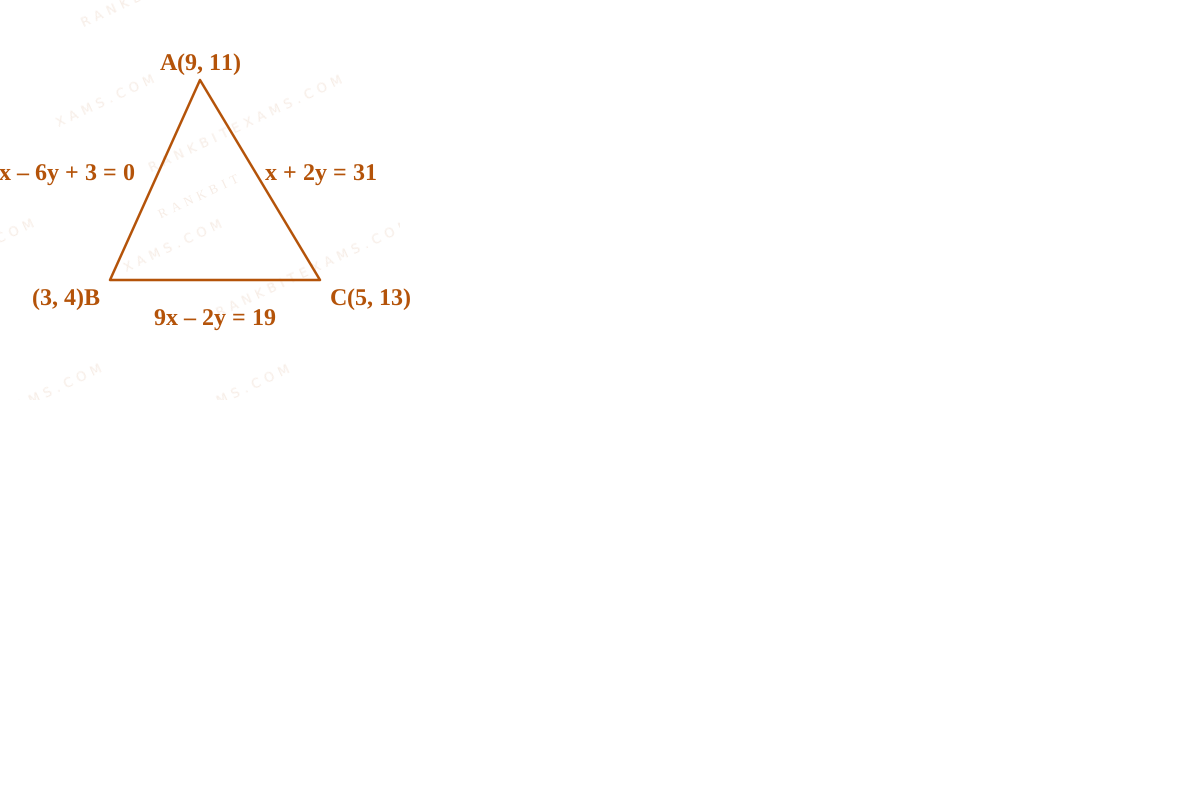
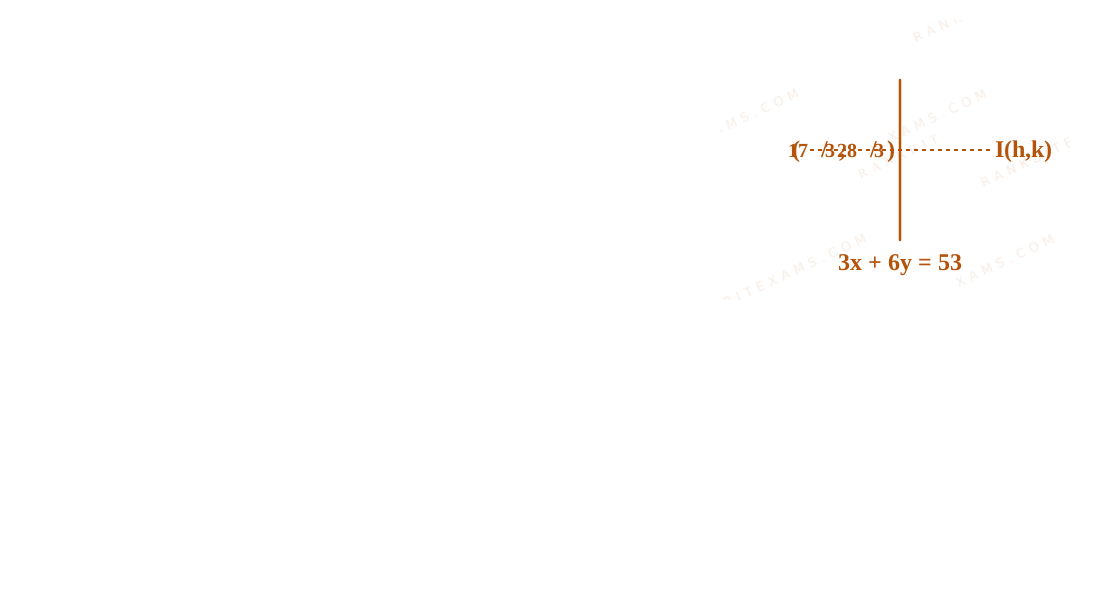
Let ABC be a triangle formed by the lines 7x - 6y + 3 = 0, x + 2y - 31 = 0 and 9x - 2y - 19 = 0 . Let the point (h,k) be the image of the centroid of Δ ABC in the line 3x + 6y - 53 = 0 . Then \mathrm{h}^2 + \mathrm{k}^2 + \mathrm{hk} is equal to
  • A. 37
  • B. 47
  • C. 40
  • D. 36

Solution

Related Formula
Centroid G = ((x₁+x₂+x₃)/(3), (y₁+y₂+y₃)/(3)) Image of (x₁, y₁) in line ax+by+c=0: (x-x₁)/(a) = (y-y₁)/(b) = -2(ax₁+by₁+c)/(a²+b²)
Core Logic

First, find the vertices A, B, C by solving the lines pairwise. Solving 7x - 6y + 3 = 0 and x + 2y - 31 = 0 gives A(9,11). Solving 7x - 6y + 3 = 0 and 9x - 2y - 19 = 0 gives B(3,4). Solving x + 2y - 31 = 0 and 9x - 2y - 19 = 0 gives C(5,13).

Centroid diagram for Q54 - JEE Main 2025 Morning

Step 1: Determine the Centroid
G = ((9 + 3 + 5)/(3), (11 + 4 + 13)/(3)) = ((17)/(3), (28)/(3))
Step 2: Find the Image (h, k)

Using the line 3x + 6y - 53 = 0:

(h - (17)/(3))/(3) = (k - (28)/(3))/(6) = -2 (3((17)/(3)) + 6((28)/(3)) - 53)/(3² + 6²) (h - (17)/(3))/(3) = (k - (28)/(3))/(6) = -2 (17 + 56 - 53)/(45) = -2 (20)/(45) = -(8)/(9)

Solving for h and k yields:

h = 3, k = 4

Centroid diagram for Q54 - JEE Main 2025 Morning

Step 3: Compute final algebraic target
h² + k² + hk = 3² + 4² + (3)(4) = 9 + 16 + 12 = 37
Pattern Recognition

Instead of solving fractions endlessly, substitute potential integer coordinates early into the slope relationship (k - yG)/(h - xG) = -1/m to accelerate competitive solving time.

Chapter Mix

Class 11 Mathematics: Straight Lines

More Straight Lines Questions — jee_main_2025_07_april_morning

Practice all Straight Lines previous-year questions →

Rankbit System
JEE Physics: Waves (+15.5%) | Electrostatics: Concentric Shells (-29.7%) | Modern Physics: Photoelectric Clones (+34.2%) | Mathematics: Definite Integrals (+18.1%) | Chemistry: Coordination Splitting (-11.4%) | JEE Physics: Waves (+15.5%) | Electrostatics: Concentric Shells (-29.7%) | Modern Physics: Photoelectric Clones (+34.2%) | Mathematics: Definite Integrals (+18.1%) | Chemistry: Coordination Splitting (-11.4%)