In a Delta ABC, suppose y=x is the equation of the bisector of the angle B and the equation of the side AC is 2x-y=2. If 2AB=BC and the point A and B are respectively (4,6) and (alpha,beta), then alpha+2beta is equal to

Solution & Explanation

### Related Formula Image of a point (x_1, y_1) across line y=x is (y_1, x_1). **Angle Bisector Theorem:** The angle bisector of a triangle divides the opposite side into segments proportional to the lengths of the adjacent sides: fracABBC = fracADDC ### Core Logic Given A(4,6) and Angle bisector of B is y=x. Because y=x bisects angle B, the geometric reflection of vertex A across the bisector line y=x must lie exactly on the line containing the side BC. Let the reflection of A(4,6) be A'. Across y=x, the coordinates swap: A' = (6,4) Next, find the intersection point D of the bisector y=x and side AC (2x-y=2). Substitute y=x into 2x-y=2: 2x - x = 2 Rightarrow x = 2 Rightarrow y = 2 So, point D is (2,2).
Angle Bisector and Reflection
### Step 1: Utilize Section Formula By the internal angle bisector theorem: fracADDC = fracABBC Given 2AB = BC, so fracABBC = frac12. This means point D(2,2) divides the segment AC in the ratio 1:2. Let C have coordinates (x_c, y_c). Applying the section formula for D(2,2) dividing A(4,6) and C(x_c, y_c) in ratio 1:2: 2 = frac1 cdot x_c + 2 cdot 41 + 2 Rightarrow 6 = x_c + 8 Rightarrow x_c = -2 2 = frac1 cdot y_c + 2 cdot 61 + 2 Rightarrow 6 = y_c + 12 Rightarrow y_c = -6 So, C is (-2,-6). ### Step 2: Find Equation of BC The line BC passes through point C(-2,-6) and the reflection point A'(6,4). Find the slope of BC: m_BC = frac4 - (-6)6 - (-2) = frac108 = frac54 Equation of BC: y - 4 = frac54(x - 6) 4y - 16 = 5x - 30 5x - 4y - 14 = 0 ### Step 3: Solve for Vertex B Vertex B(alpha, beta) is the intersection of line BC and the angle bisector y=x. Substitute y=x into 5x - 4y - 14 = 0: 5x - 4x - 14 = 0 Rightarrow x = 14 Thus, y = 14. Therefore, B is (14, 14), implying alpha = 14 and beta = 14. Calculate alpha + 2beta: alpha + 2beta = 14 + 2(14) = 42 ### Pattern Recognition Reflection properties drastically simplify angle bisector questions. If you know the bisector equation, reflecting one vertex over it gives a coordinate on the opposing extended ray. This paired with the angle bisector proportion theorem locks the entire geometric frame. ### Evaluation Rubric / Model Answer null ### Chapter Mix Class 11 Mathematics: Straight Lines

Reference Study Guides

More Straight Lines Previous-Year Questions

Q4 jee_main_2026_21_jan_morning Equilateral Triangle Between Parallel Lines
Let a point A lie between the parallel lines L_1 and L_2 such that its distances from L_1 and L_2 are 6 and 3 units, respectively. Then the area (in sq. units) of the equilateral triangle ABC, where the points B and C lie on the lines L_1 and L_2 respectively, is:
  • A. 15sqrt6
  • B. 27
  • C. 21sqrt3
  • D. 12sqrt2

Solution

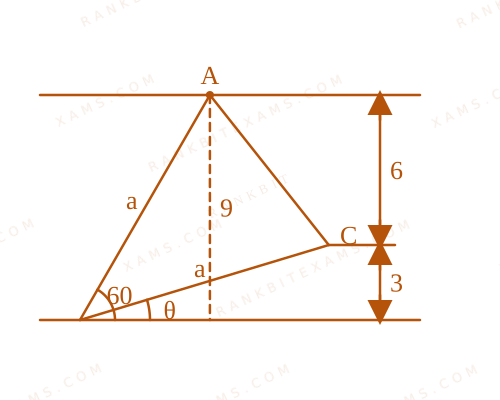
### Related Formula textArea of Equilateral Triangle = fracsqrt34 a^2 Where a is the side length. ### Core Logic Let the side of the equilateral triangle be a. Let theta be the angle between the side AC and the parallel line L_2. Then, the angle between the side AB and the parallel line L_1 can be expressed via alternate geometry. Given distances from A to the lines form right-angled triangles. ### Step 1: Set up geometric projections
Equilateral triangle between parallel lines diagram for Q4 - JEE Main 2026 Morning
From vertex C to line passing through A parallel to L_1, L_2, the perpendicular distance is 3. In the right triangle formed, we have: sin theta = frac3a Similarly, point B lies on L_1. The perpendicular distance from A to L_1 is 6. However, combining the overall heights between the parallel lines, the total distance between L_1 and L_2 is 6 + 3 = 9. The projection of side BC (which connects L_1 and L_2) vertically is 9. sin(60^circ + theta) = frac9a ### Step 2: Solve the trigonometric system Expand sin(60^circ + theta): fracsqrt32 cos theta + frac12 sin theta = frac9a Substitute sin theta = frac3a and cos theta = sqrt1 - sin^2 theta = sqrt1 - frac9a^2: fracsqrt32 sqrt1 - frac9a^2 + frac12 left(frac3aright) = frac9a sqrt3 sqrt1 - frac9a^2 + frac3a = frac18a sqrt3 sqrt1 - frac9a^2 = frac15a Squaring both sides: 3 left(1 - frac9a^2right) = frac225a^2 3 - frac27a^2 = frac225a^2 3 = frac252a^2 Rightarrow a^2 = 84 ### Step 3: Calculate Area textArea of Delta ABC = fracsqrt34 a^2 = fracsqrt34 times 84 = 21sqrt3 ### Pattern Recognition When a rigid polygon (like an equilateral triangle or square) is wedged between parallel lines, set a base orientation angle theta for one edge and use rotational shifts (e.g., 60^circ + theta) to project heights. Expanding the sine addition formula instantly yields the side length. ### Evaluation Rubric / Model Answer null ### Chapter Mix Class 11 Maths: Straight Lines Class 11 Maths: Trigonometric Functions
Q69 jee_main_2025_02_april_evening Equation of a Straight Line
Let the area of the triangle formed by a straight Line L: x + by + c = 0 with co-ordinate axes be 48 square units. If the perpendicular drawn from the origin to the line L makes an angle of 45^circ with the positive x-axis, then the value of b^2 + c^2 is:
  • A. 90
  • B. 93
  • C. 97
  • D. 83

Solution

### Related Formula textNormal form of a straight line: x cos alpha + y sin alpha = p textArea of right-angled triangle formed with axes: A = frac12 left| x_textintercept cdot y_textintercept right| ### Core Logic We write down the normal equation of the straight line using the given polar normal angle alpha = 45^circ, find its intercept coordinates, and use the area constraint to solve for the coefficients. ### Step 1: Write down normal form The perpendicular drawn from the origin makes an angle of 45^circ with the positive x-axis, so alpha = 45^circ. The line equation is: x cos 45^circ + y sin 45^circ = p implies fracxsqrt2 + fracysqrt2 = p x + y = psqrt2 implies x + y - psqrt2 = 0 Comparing this with the given format x + by + c = 0, we find: b = 1 quad textand quad c = -psqrt2 ### Step 2: Solve for the parameters using the area constraint The line equation is x + y = psqrt2. The intercepts are: - x_textintercept = psqrt2 - y_textintercept = psqrt2 The area of the right-angled triangle formed with the axes is: textArea = frac12 left| psqrt2 cdot psqrt2 right| = p^2 Since the area is given as 48 square units: p^2 = 48 ### Step 3: Calculate the requested value We have: b^2 = 1^2 = 1 c^2 = (-psqrt2)^2 = 2p^2 = 2(48) = 96 Therefore, we find: b^2 + c^2 = 1 + 96 = 97 ### Pattern Recognition Normal equation coupling: Normal equations of lines xcosalpha+ysinalpha = p are extremely powerful when normal angles are specified. For alpha=45^circ, the coordinate intercepts are identical, making the area relation A=p^2 exceptionally simple. ### Evaluation Rubric / Model Answer null ### Chapter Mix Class 11 Mathematics: Straight Lines
Q55 jee_main_2025_03_april_evening Family of Lines
Consider the lines x(3lambda + 1) + y(7lambda + 2) = 17lambda + 5, lambda being a parameter, all passing through a point P. One of these lines (say L) is farthest from the origin. If the distance of L from the point (3, 6) is d, then the value of d^2 is
  • A. 20
  • B. 30
  • C. 10
  • D. 15

Solution

### Related Formula A family of lines passing through the intersection of L_1 = 0 and L_2 = 0 is expressed as: L_1 + lambda L_2 = 0 For a point P through which a family of lines passes, the line in the family that is at the maximum distance from origin O is the line perpendicular to OP passing through P. ### Core Logic Rearranging the equation of the given lines in terms of lambda: (x + 2y - 5) + lambda(3x + 7y - 17) = 0 To find point P, solve the system: 1. x + 2y = 5 implies x = 5 - 2y 2. 3x + 7y = 17 ### Step 1: Finding P and Line L Substitute x = 5-2y into the second equation: 3(5 - 2y) + 7y = 17 implies 15 + y = 17 implies y = 2 x = 5 - 2(2) = 1 Thus, the common intersection point is P(1, 2). The line farthest from the origin is perpendicular to the segment OP joining the origin O(0,0) to P(1,2). - Slope of OP = frac2 - 01 - 0 = 2 - Slope of L (m) = -frac12 Equation of line L passing through P(1,2): y - 2 = -frac12(x - 1) implies 2y - 4 = -x + 1 implies x + 2y - 5 = 0 ### Step 2: Distance calculation from (3,6) The distance d of point Q(3,6) from line x + 2y - 5 = 0 is: d = left| frac3 + 2(6) - 5sqrt1^2 + 2^2 right| = left| frac10sqrt5 right| = 2sqrt5 Calculating d^2: d^2 = (2sqrt5)^2 = 20 ### Pattern Recognition Short Shortcut: The maximum distance of a family of lines passing through P from the origin is simply the length OP. The line perpendicular to OP at P is the unique farthest line. ### Evaluation Rubric / Model Answer null ### Chapter Mix Class 11 Mathematics: Straight Lines
Q70 jee_main_2025_07_april_morning Orthocentre of a Triangle
Let ABC be the triangle such that the equations of lines AB and AC be 3y - x = 2 and x + y = 2 , respectively, and the points B and C lie on x-axis. If P is the orthocentre of the triangle ABC, then the area of the triangle PBC is equal to
  • A. 4
  • B. 10
  • C. 8
  • D. 6

Solution

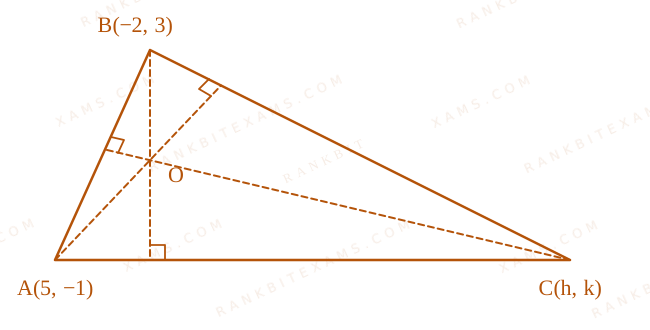
### Related Formula The orthocentre P of a triangle is the point of intersection of its altitudes. Area of a triangle with a horizontal base lying on the x-axis is: textArea = frac12 times textbase times textheight = frac12 times |x_C - x_B| times |y_P| ### Core Logic Find vertex A by solving the line equations AB and AC: 3y - x = 2 implies x = 3y - 2 Substitute into x + y = 2 implies (3y - 2) + y = 2 implies 4y = 4 implies y = 1. Then x = 3(1) - 2 = 1. So vertex A is (1, 1). Find vertices B and C where the lines cross the x-axis (y = 0): - For B (on line AB): 3(0) - x = 2 implies x = -2 implies B(-2, 0) - For C (on line AC): x + 0 = 2 implies x = 2 implies C(2, 0) Base length BC = |2 - (-2)| = 4. ### Step 1: Find Equations of Altitudes
Orthocentre of a Triangle diagram for Q70 - JEE Main 2025 Morning
1. **Altitude from A to BC**: Since BC lies along the x-axis, the altitude from A(1, 1) must be a vertical line: textEquation of Altitude 1: x = 1 2. **Altitude from B to AC**: Slope of line AC (x + y = 2) is m_AC = -1. Therefore, the slope of the altitude perpendicular to AC is m_2 = -frac1-1 = 1. Passing through B(-2, 0): y - 0 = 1(x - (-2)) implies y = x + 2 implies x - y + 2 = 0 ### Step 2: Solve for Orthocentre coordinates P Intersect the altitude equations: x = 1 and y = x + 2: y = 1 + 2 = 3 Hence, the orthocentre is P(1, 3). ### Step 3: Compute Area of Triangle PBC Triangle PBC has base BC = 4 on the x-axis, and vertex P(1, 3) gives a height of 3. textArea = frac12 times 4 times 3 = 6 ### Pattern Recognition When a triangle has its base sitting entirely on the coordinate axis, the altitude dropped from the opposite vertex is simplified to a pure horizontal or vertical line path, heavily reducing your linear derivation equation workload. ### Evaluation Rubric / Model Answer null ### Chapter Mix Class 11 Mathematics: Straight Lines
Q jee_main_2025_08_april_evening Rotation of Coordinate Axes / Distance from Origin
A line passing through the point P(a, 0) makes an acute angle alpha with the positive x-axis. Let this line be rotated about the point mathrmP through an angle fracalpha2 in the clock-wise direction. If in the new position, the slope of the line is 2 - sqrt3 and its distance from the origin is frac1sqrt2, then the value of 3mathrma^2tan^2alpha - 2sqrt3 is
  • A. 4
  • B. 6
  • C. 5
  • D. 8

Solution

### Related Formula textDistance from origin d = frac|C|sqrtA^2+B^2 ### Core Logic Decode slope angle fields to define vector shifts. Match variables to isolate focal root segments accurately as provided in the reference layout steps. ### Step 1: Identify Phase Shift Angles Given final tracking position slope component is: m = 2 - sqrt3 = tan 15^circ Because clockwise translation turns angular coordinates down by half increments: alpha - fracalpha2 = 15^circ implies alpha = 30^circ ### Step 2: Construct Rotated Vector Path Line The line equation through point (a,0) with final angle scaling is: y = (2-sqrt3)(x-a) implies (2-sqrt3)x - y - a(2-sqrt3) = 0 ### Step 3: Solve Origin Geometric Profiles Impose perpendicular bounds tracking distance rule: left| fracsqrt3a - 2asqrt4+3-4sqrt3+1 right| = frac1sqrt2 implies a^2 = 2(2+sqrt3) Target formulation output text string solution: 3a^2 tan^2 30^circ - 2sqrt3 = 3 times 2(2+sqrt3) times frac13 - 2sqrt3 = 4 {{SOL_IMG_62}} ### Pattern Recognition Recognizing standard trigonometric slopes (tan 15^circ = 2-sqrt3) bypasses computational bottlenecks instantly when working with line updates. ### Evaluation Rubric / Model Answer null ### Chapter Mix Class 11 Mathematics: Straight Lines

More Straight Lines Questions — jee_main_2024_29_jan_morning

Practice all Straight Lines previous-year questions →

Rankbit System
JEE Physics: Waves (+15.5%) | Electrostatics: Concentric Shells (-29.7%) | Modern Physics: Photoelectric Clones (+34.2%) | Mathematics: Definite Integrals (+18.1%) | Chemistry: Coordination Splitting (-11.4%) | JEE Physics: Waves (+15.5%) | Electrostatics: Concentric Shells (-29.7%) | Modern Physics: Photoelectric Clones (+34.2%) | Mathematics: Definite Integrals (+18.1%) | Chemistry: Coordination Splitting (-11.4%)