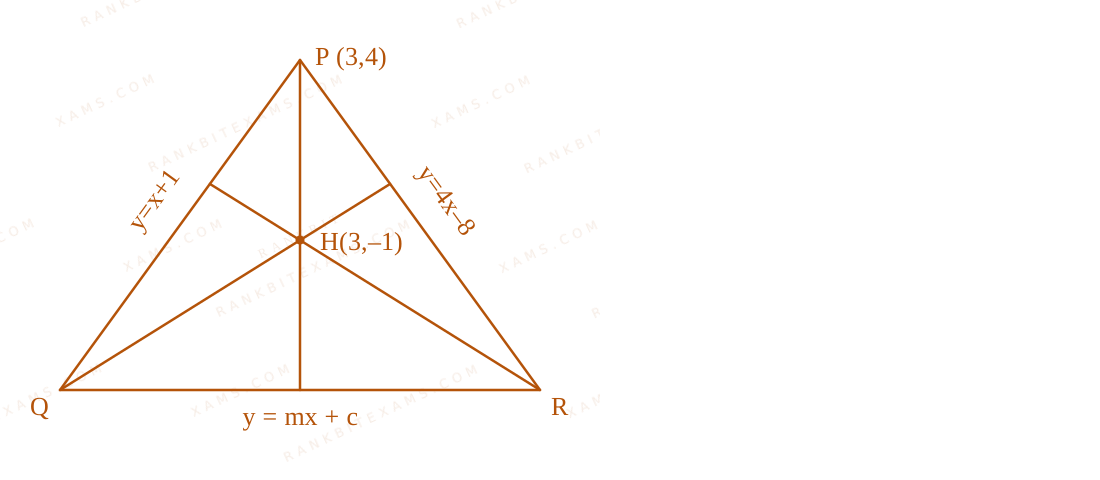
If the orthocentre of the triangle formed by the lines y = x + 1$y = x + 1$, y = 4x - 8$y = 4x - 8$ and y = mx + c$y = mx + c$ is at (3, -1)$(3, -1)$, then m - c$m - c$ is:
A.0$0$
B.-2$-2$
C.4$4$
D.2$2$
Solution & Explanation
### Related Formula
The product of slopes of two mutually perpendicular lines is always equal to -1$-1$:
m_1 cdot m_2 = -1$m_1 \cdot m_2 = -1$
### Core Logic
Let the vertices of the triangle be P$P$, Q$Q$, and R$R$. The lines given are:
1) y = x + 1$y = x + 1$
2) y = 4x - 8$y = 4x - 8$
3) y = mx + c$y = mx + c$
Solving lines y = x + 1$y = x + 1$ and y = 4x - 8$y = 4x - 8$ gives the vertex P(3, 4)$P(3, 4)$.
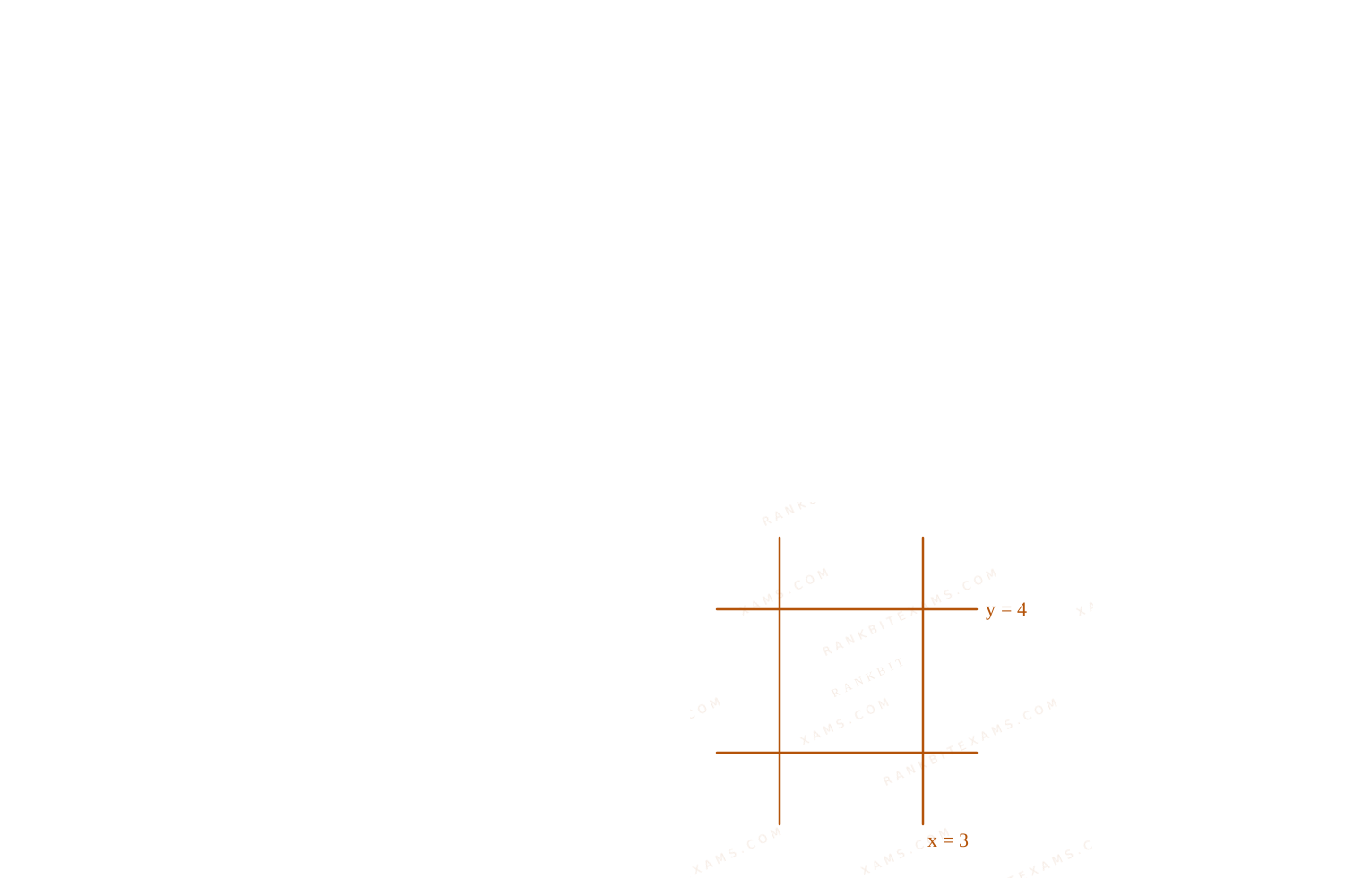
The orthocentre is given as H(3, -1)$H(3, -1)$. Notice that the x$x$-coordinate of P$P$ and H$H$ are identical (x = 3$x = 3$). This implies that the altitude from vertex P$P$ to the base line y = mx + c$y = mx + c$ is a vertical line along x = 3$x = 3$.
Orthocentre of a Triangle diagram for Q51 - JEE Main 2025 Evening
### Step 1: Determine the Slopes
Since the altitude from P$P$ is vertical, the side opposite to it (which lies on y = mx + c$y = mx + c$) must be a horizontal line.
Therefore, the slope of the line y = mx + c$y = mx + c$ must be zero:
m = 0$m = 0$
### Step 2: Solve for c
Let's find point Q$Q$ by intersecting y = x + 1$y = x + 1$ and y = mx + c$y = mx + c$. Since m = 0$m = 0$, y = c$y = c$, we get Q(c-1, c)$Q(c-1, c)$.
Using the property that the line segment connecting Q$Q$ to the opposite side's altitude is perpendicular to line PR$PR$ (y = 4x - 8$y = 4x - 8$):
textSlope of QH cdot textSlope of PR = -1$\text{Slope of } QH \cdot \text{Slope of } PR = -1$frac-1 - c3 - (c - 1) cdot 4 = -1$\frac{-1 - c}{3 - (c - 1)} \cdot 4 = -1$frac-4(c + 1)4 - c = -1 implies 4c + 4 = 4 - c implies 5c = 0 implies c = 0$\frac{-4(c + 1)}{4 - c} = -1 \implies 4c + 4 = 4 - c \implies 5c = 0 \implies c = 0$
### Step 3: Evaluate m - c
Substituting the values of m$m$ and c$c$:
m - c = 0 - 0 = 0$m - c = 0 - 0 = 0$
### Pattern Recognition
When the x$x$-coordinate of a vertex matches the x$x$-coordinate of the orthocentre, the altitude is vertical, forcing the opposite base to be purely horizontal (m=0$m=0$). This observation cuts down calculation time completely.
### Evaluation Rubric / Model Answer
null
### Chapter Mix
Class 11 Mathematics: Straight Lines
Keywords:#orthocentre of the triangle formed by lines#JEE Main 2025 Evening Q51#Straight Lines JEE Main 2025#Orthocentre of a Triangle JEE Main 2025
More Straight Lines Previous-Year Questions
Q692025Equation of a Straight Line
Let the area of the triangle formed by a straight Line L: x + by + c = 0$L: x + by + c = 0$ with co-ordinate axes be 48 square units. If the perpendicular drawn from the origin to the line L$L$ makes an angle of 45^circ$45^\circ$ with the positive x$x$-axis, then the value of b^2 + c^2$b^2 + c^2$ is:
A. 90
B. 93
C. 97
D. 83
Solution
### Related Formula
textNormal form of a straight line: x cos alpha + y sin alpha = p$\text{Normal form of a straight line: } x \cos \alpha + y \sin \alpha = p$textArea of right-angled triangle formed with axes: A = frac12 left| x_textintercept cdot y_textintercept right|$\text{Area of right-angled triangle formed with axes: } A = \frac{1}{2} \left| x_{\text{intercept}} \cdot y_{\text{intercept}} \right|$
### Core Logic
We write down the normal equation of the straight line using the given polar normal angle alpha = 45^circ$\alpha = 45^\circ$, find its intercept coordinates, and use the area constraint to solve for the coefficients.
### Step 1: Write down normal form
The perpendicular drawn from the origin makes an angle of 45^circ$45^\circ$ with the positive x$x$-axis, so alpha = 45^circ$\alpha = 45^\circ$. The line equation is:
x cos 45^circ + y sin 45^circ = p implies fracxsqrt2 + fracysqrt2 = p$x \cos 45^\circ + y \sin 45^\circ = p \implies \frac{x}{\sqrt{2}} + \frac{y}{\sqrt{2}} = p$x + y = psqrt2 implies x + y - psqrt2 = 0$x + y = p\sqrt{2} \implies x + y - p\sqrt{2} = 0$
Comparing this with the given format x + by + c = 0$x + by + c = 0$, we find:
b = 1 quad textand quad c = -psqrt2$b = 1 \quad \text{and} \quad c = -p\sqrt{2}$
### Step 2: Solve for the parameters using the area constraint
The line equation is x + y = psqrt2$x + y = p\sqrt{2}$. The intercepts are:
- x_textintercept = psqrt2$x_{\text{intercept}} = p\sqrt{2}$
- y_textintercept = psqrt2$y_{\text{intercept}} = p\sqrt{2}$
The area of the right-angled triangle formed with the axes is:
textArea = frac12 left| psqrt2 cdot psqrt2 right| = p^2$\text{Area} = \frac{1}{2} \left| p\sqrt{2} \cdot p\sqrt{2} \right| = p^2$
Since the area is given as 48 square units:
p^2 = 48$p^2 = 48$
### Step 3: Calculate the requested value
We have:
b^2 = 1^2 = 1$b^2 = 1^2 = 1$c^2 = (-psqrt2)^2 = 2p^2 = 2(48) = 96$c^2 = (-p\sqrt{2})^2 = 2p^2 = 2(48) = 96$
Therefore, we find:
b^2 + c^2 = 1 + 96 = 97$b^2 + c^2 = 1 + 96 = 97$
### Pattern Recognition
Normal equation coupling: Normal equations of lines xcosalpha+ysinalpha = p$x\cos\alpha+y\sin\alpha = p$ are extremely powerful when normal angles are specified. For alpha=45^circ$\alpha=45^\circ$, the coordinate intercepts are identical, making the area relation A=p^2$A=p^2$ exceptionally simple.
### Evaluation Rubric / Model Answer
null
### Chapter Mix
Class 11 Mathematics: Straight Lines
Q552025Family of Lines
Consider the lines x(3lambda + 1) + y(7lambda + 2) = 17lambda + 5$x(3\lambda + 1) + y(7\lambda + 2) = 17\lambda + 5$, lambda$\lambda$ being a parameter, all passing through a point P$P$. One of these lines (say L$L$) is farthest from the origin. If the distance of L$L$ from the point (3, 6)$(3, 6)$ is d$d$, then the value of d^2$d^2$ is
A.20$20$
B.30$30$
C.10$10$
D.15$15$
Solution
### Related Formula
A family of lines passing through the intersection of L_1 = 0$L_1 = 0$ and L_2 = 0$L_2 = 0$ is expressed as:
L_1 + lambda L_2 = 0$L_1 + \lambda L_2 = 0$
For a point P$P$ through which a family of lines passes, the line in the family that is at the maximum distance from origin O$O$ is the line perpendicular to OP$OP$ passing through P$P$.
### Core Logic
Rearranging the equation of the given lines in terms of lambda$\lambda$:
(x + 2y - 5) + lambda(3x + 7y - 17) = 0$(x + 2y - 5) + \lambda(3x + 7y - 17) = 0$
To find point P$P$, solve the system:
1. x + 2y = 5 implies x = 5 - 2y$x + 2y = 5 \implies x = 5 - 2y$
2. 3x + 7y = 17$3x + 7y = 17$
### Step 1: Finding P$P$ and Line L$L$
Substitute x = 5-2y$x = 5-2y$ into the second equation:
3(5 - 2y) + 7y = 17 implies 15 + y = 17 implies y = 2$3(5 - 2y) + 7y = 17 \implies 15 + y = 17 \implies y = 2$x = 5 - 2(2) = 1$x = 5 - 2(2) = 1$
Thus, the common intersection point is P(1, 2)$P(1, 2)$.
The line farthest from the origin is perpendicular to the segment OP$OP$ joining the origin O(0,0)$O(0,0)$ to P(1,2)$P(1,2)$.
- Slope of OP = frac2 - 01 - 0 = 2$OP = \frac{2 - 0}{1 - 0} = 2$
- Slope of L$L$ (m$m$) = -frac12$= -\frac{1}{2}$
Equation of line L$L$ passing through P(1,2)$P(1,2)$:
y - 2 = -frac12(x - 1) implies 2y - 4 = -x + 1 implies x + 2y - 5 = 0$y - 2 = -\frac{1}{2}(x - 1) \implies 2y - 4 = -x + 1 \implies x + 2y - 5 = 0$
### Step 2: Distance calculation from (3,6)$(3,6)$
The distance d$d$ of point Q(3,6)$Q(3,6)$ from line x + 2y - 5 = 0$x + 2y - 5 = 0$ is:
d = left| frac3 + 2(6) - 5sqrt1^2 + 2^2 right| = left| frac10sqrt5 right| = 2sqrt5$d = \left| \frac{3 + 2(6) - 5}{\sqrt{1^2 + 2^2}} \right| = \left| \frac{10}{\sqrt{5}} \right| = 2\sqrt{5}$
Calculating d^2$d^2$:
d^2 = (2sqrt5)^2 = 20$d^2 = (2\sqrt{5})^2 = 20$
### Pattern Recognition
Short Shortcut: The maximum distance of a family of lines passing through P$P$ from the origin is simply the length OP$OP$. The line perpendicular to OP$OP$ at P$P$ is the unique farthest line.
### Evaluation Rubric / Model Answer
null
### Chapter Mix
Class 11 Mathematics: Straight Lines
Q702025Orthocentre of a Triangle
Let ABC be the triangle such that the equations of lines AB and AC be 3y - x = 2$3y - x = 2$ and x + y = 2$x + y = 2$ , respectively, and the points B and C lie on x-axis. If P is the orthocentre of the triangle ABC, then the area of the triangle PBC is equal to
A.4$4$
B.10$10$
C.8$8$
D.6$6$
Solution
### Related Formula
The orthocentre P$P$ of a triangle is the point of intersection of its altitudes.
Area of a triangle with a horizontal base lying on the x-axis is:
textArea = frac12 times textbase times textheight = frac12 times |x_C - x_B| times |y_P|$\text{Area} = \frac{1}{2} \times \text{base} \times \text{height} = \frac{1}{2} \times |x_C - x_B| \times |y_P|$
### Core Logic
Find vertex A$A$ by solving the line equations AB$AB$ and AC$AC$:
3y - x = 2 implies x = 3y - 2$3y - x = 2 \implies x = 3y - 2$
Substitute into x + y = 2 implies (3y - 2) + y = 2 implies 4y = 4 implies y = 1$x + y = 2 \implies (3y - 2) + y = 2 \implies 4y = 4 \implies y = 1$.
Then x = 3(1) - 2 = 1$x = 3(1) - 2 = 1$. So vertex A$A$ is (1, 1)$(1, 1)$.
Find vertices B$B$ and C$C$ where the lines cross the x-axis (y = 0$y = 0$):
- For B$B$ (on line AB$AB$): 3(0) - x = 2 implies x = -2 implies B(-2, 0)$3(0) - x = 2 \implies x = -2 \implies B(-2, 0)$
- For C$C$ (on line AC$AC$): x + 0 = 2 implies x = 2 implies C(2, 0)$x + 0 = 2 \implies x = 2 \implies C(2, 0)$
Base length BC = |2 - (-2)| = 4$BC = |2 - (-2)| = 4$.
### Step 1: Find Equations of Altitudes
Orthocentre of a Triangle diagram for Q70 - JEE Main 2025 Morning
1. **Altitude from A to BC**:
Since BC$BC$ lies along the x-axis, the altitude from A(1, 1)$A(1, 1)$ must be a vertical line:
textEquation of Altitude 1: x = 1$\text{Equation of Altitude 1}: x = 1$
2. **Altitude from B to AC**:
Slope of line AC$AC$ (x + y = 2$x + y = 2$) is m_AC = -1$m_{AC} = -1$.
Therefore, the slope of the altitude perpendicular to AC$AC$ is m_2 = -frac1-1 = 1$m_2 = -\frac{1}{-1} = 1$.
Passing through B(-2, 0)$B(-2, 0)$:
y - 0 = 1(x - (-2)) implies y = x + 2 implies x - y + 2 = 0$y - 0 = 1(x - (-2)) \implies y = x + 2 \implies x - y + 2 = 0$
### Step 2: Solve for Orthocentre coordinates P
Intersect the altitude equations: x = 1$x = 1$ and y = x + 2$y = x + 2$:
y = 1 + 2 = 3$y = 1 + 2 = 3$
Hence, the orthocentre is P(1, 3)$P(1, 3)$.
### Step 3: Compute Area of Triangle PBC
Triangle PBC$PBC$ has base BC = 4$BC = 4$ on the x-axis, and vertex P(1, 3)$P(1, 3)$ gives a height of 3$3$.
textArea = frac12 times 4 times 3 = 6$\text{Area} = \frac{1}{2} \times 4 \times 3 = 6$
### Pattern Recognition
When a triangle has its base sitting entirely on the coordinate axis, the altitude dropped from the opposite vertex is simplified to a pure horizontal or vertical line path, heavily reducing your linear derivation equation workload.
### Evaluation Rubric / Model Answer
null
### Chapter Mix
Class 11 Mathematics: Straight Lines
Q572025Properties of Square and Diagonals
Let a$a$ be the length of a side of a square OABC with O$O$ being the origin. Its side OA$OA$ makes an acute angle alpha$\alpha$ with the positive x-axis and the equations of its diagonals are
(sqrt3 + 1)x + (sqrt3 - 1)y = 0 quad textand$(\sqrt{3} + 1)x + (\sqrt{3} - 1)y = 0 \quad \text{and}$(sqrt3 - 1)x - (sqrt3 + 1)y + 8sqrt3 = 0.$(\sqrt{3} - 1)x - (\sqrt{3} + 1)y + 8\sqrt{3} = 0.$
Then a^2$a^2$ is equal to
A.48$48$
B.32$32$
C.16$16$
D.24$24$
Solution
### Related Formula
textSlope m = -fracAB$\text{Slope } m = -\frac{A}{B}$
### Core Logic
Identify which diagonal passes through the origin. Use its directional configuration slope to determine the exact angle orientation layout map of the geometric system elements.
### Step 1: Determine Diagonal Orientation
The line passing through the origin is diagonal OB$OB$:
m_OB = -fracsqrt3+1sqrt3-1 = tan 105^circ$m_{OB} = -\frac{\sqrt{3}+1}{\sqrt{3}-1} = \tan 105^\circ$
Since diagonals of a square split the vertex paths evenly at 45^circ$45^\circ$, the side OA$OA$ makes an angle:
alpha = 105^circ - 45^circ = 60^circ$\alpha = 105^\circ - 45^\circ = 60^\circ$
### Step 2: Coordinate Vector Definition
Coordinates of vertex A$A$ matching side value a$a$ are:
A(acos 60^circ, asin 60^circ) = left( fraca2, fracsqrt3a2 right)$A(a\cos 60^\circ, a\sin 60^\circ) = \left( \frac{a}{2}, \frac{\sqrt{3}a}{2} \right)$
### Step 3: Diagonal Intersection Point Solver
Vertex A$A$ lies upon the alternative structural path line:
(sqrt3-1)fraca2 - (sqrt3+1)fracsqrt3a2 + 8sqrt3 = 0$(\sqrt{3}-1)\frac{a}{2} - (\sqrt{3}+1)\frac{\sqrt{3}a}{2} + 8\sqrt{3} = 0$a left[ fracsqrt3 - 1 - 3 - sqrt32 right] = -8sqrt3 implies -2a = -8sqrt3 implies a = 4sqrt3$a \left[ \frac{\sqrt{3} - 1 - 3 - \sqrt{3}}{2} \right] = -8\sqrt{3} \implies -2a = -8\sqrt{3} \implies a = 4\sqrt{3}$a^2 = 48$a^2 = 48$
{{SOL_IMG_57}}
### Pattern Recognition
Slopes involving sqrt3 pm 1$\sqrt{3} \pm 1$ explicitly alert you to geometric orientations built on multiples of 15^circ$15^circ$ or 75^circ$75^circ$ configurations.
### Evaluation Rubric / Model Answer
null
### Chapter Mix
Class 11 Mathematics: Straight Lines
Q622025Rotation of Coordinate Axes / Distance from Origin
A line passing through the point P(a, 0)$P(a, 0)$ makes an acute angle alpha$\alpha$ with the positive x-axis. Let this line be rotated about the point mathrmP$\mathrm{P}$ through an angle fracalpha2$\frac{\alpha}{2}$ in the clock-wise direction. If in the new position, the slope of the line is 2 - sqrt3$2 - \sqrt{3}$ and its distance from the origin is frac1sqrt2$\frac{1}{\sqrt{2}}$, then the value of 3mathrma^2tan^2alpha - 2sqrt3$3\mathrm{a}^2\tan^2\alpha - 2\sqrt{3}$ is
A.4$4$
B.6$6$
C.5$5$
D.8$8$
Solution
### Related Formula
textDistance from origin d = frac|C|sqrtA^2+B^2$\text{Distance from origin } d = \frac{|C|}{\sqrt{A^2+B^2}}$
### Core Logic
Decode slope angle fields to define vector shifts. Match variables to isolate focal root segments accurately as provided in the reference layout steps.
### Step 1: Identify Phase Shift Angles
Given final tracking position slope component is:
m = 2 - sqrt3 = tan 15^circ$m = 2 - \sqrt{3} = \tan 15^circ$
Because clockwise translation turns angular coordinates down by half increments:
alpha - fracalpha2 = 15^circ implies alpha = 30^circ$\alpha - \frac{\alpha}{2} = 15^\circ \implies \alpha = 30^\circ$
### Step 2: Construct Rotated Vector Path Line
The line equation through point (a,0)$(a,0)$ with final angle scaling is:
y = (2-sqrt3)(x-a) implies (2-sqrt3)x - y - a(2-sqrt3) = 0$y = (2-\sqrt{3})(x-a) \implies (2-\sqrt{3})x - y - a(2-\sqrt{3}) = 0$
### Step 3: Solve Origin Geometric Profiles
Impose perpendicular bounds tracking distance rule:
left| fracsqrt3a - 2asqrt4+3-4sqrt3+1 right| = frac1sqrt2 implies a^2 = 2(2+sqrt3)$\left| \frac{\sqrt{3}a - 2a}{\sqrt{4+3-4\sqrt{3}+1}} \right| = \frac{1}{\sqrt{2}} \implies a^2 = 2(2+\sqrt{3})$
Target formulation output text string solution:
3a^2 tan^2 30^circ - 2sqrt3 = 3 times 2(2+sqrt3) times frac13 - 2sqrt3 = 4$3a^2 \tan^2 30^\circ - 2\sqrt{3} = 3 \times 2(2+\sqrt{3}) \times \frac{1}{3} - 2\sqrt{3} = 4$
{{SOL_IMG_62}}
### Pattern Recognition
Recognizing standard trigonometric slopes (\tan 15^\circ = 2-\sqrt3$\\tan 15^\\circ = 2-\\sqrt{3}$) bypasses computational bottlenecks instantly when working with line updates.
### Evaluation Rubric / Model Answer
null
### Chapter Mix
Class 11 Mathematics: Straight Lines
More Straight Lines Questions — jee_main_2025_07_april_evening
We Map Every Repeating Question in Competitive Exams.
Say goodbye to generic mock test fatigue. RankBit uses smart analysis to group past exam questions into their foundational Repeating Question Types. Find chapter weightage, track repeating questions, and score higher with targeted practice.
Select Your Target Exam
Choose an exam track below to find formulas per chapter and patterns.
Syncing Exam Intelligence
Mapping formulas and patterns across all tracks…
PATH A — FULL LENGTH PRACTICE
Full Mock Test Hub
Simulate real NTA exam conditions with fully tracked mocks. Time yourself against past papers.
Under Development
PATH B — TARGETED PRACTICE
Topic-wise Practice Hub
Practice past-year questions one chapter at a time. Pick an exam → subject → chapter and get every PYQ for that topic — pulled together from all past papers — with the chapter's key formulas alongside.