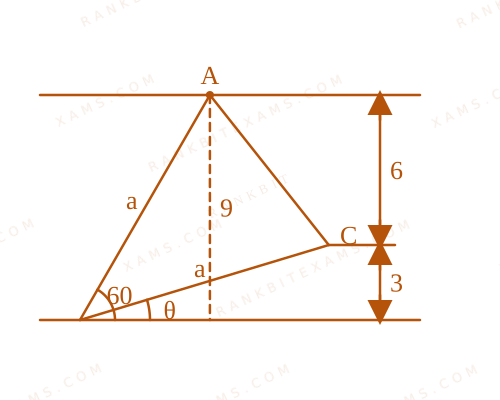
Let a point A lie between the parallel lines L_1 and L_2 such that its distances from L_1 and L_2 are 6 and 3 units, respectively. Then the area (in sq. units) of the equilateral triangle ABC, where the points B and C lie on the lines L_1 and L_2 respectively, is:

Solution & Explanation

### Related Formula textArea of Equilateral Triangle = fracsqrt34 a^2 Where a is the side length. ### Core Logic Let the side of the equilateral triangle be a. Let theta be the angle between the side AC and the parallel line L_2. Then, the angle between the side AB and the parallel line L_1 can be expressed via alternate geometry. Given distances from A to the lines form right-angled triangles. ### Step 1: Set up geometric projections
Equilateral triangle between parallel lines diagram for Q4 - JEE Main 2026 Morning
From vertex C to line passing through A parallel to L_1, L_2, the perpendicular distance is 3. In the right triangle formed, we have: sin theta = frac3a Similarly, point B lies on L_1. The perpendicular distance from A to L_1 is 6. However, combining the overall heights between the parallel lines, the total distance between L_1 and L_2 is 6 + 3 = 9. The projection of side BC (which connects L_1 and L_2) vertically is 9. sin(60^circ + theta) = frac9a ### Step 2: Solve the trigonometric system Expand sin(60^circ + theta): fracsqrt32 cos theta + frac12 sin theta = frac9a Substitute sin theta = frac3a and cos theta = sqrt1 - sin^2 theta = sqrt1 - frac9a^2: fracsqrt32 sqrt1 - frac9a^2 + frac12 left(frac3aright) = frac9a sqrt3 sqrt1 - frac9a^2 + frac3a = frac18a sqrt3 sqrt1 - frac9a^2 = frac15a Squaring both sides: 3 left(1 - frac9a^2right) = frac225a^2 3 - frac27a^2 = frac225a^2 3 = frac252a^2 Rightarrow a^2 = 84 ### Step 3: Calculate Area textArea of Delta ABC = fracsqrt34 a^2 = fracsqrt34 times 84 = 21sqrt3 ### Pattern Recognition When a rigid polygon (like an equilateral triangle or square) is wedged between parallel lines, set a base orientation angle theta for one edge and use rotational shifts (e.g., 60^circ + theta) to project heights. Expanding the sine addition formula instantly yields the side length. ### Evaluation Rubric / Model Answer null ### Chapter Mix Class 11 Maths: Straight Lines Class 11 Maths: Trigonometric Functions
Reference Study Guides

More Straight Lines Previous-Year Questions

Q69 jee_main_2025_02_april_evening Equation of a Straight Line
Let the area of the triangle formed by a straight Line L: x + by + c = 0 with co-ordinate axes be 48 square units. If the perpendicular drawn from the origin to the line L makes an angle of 45^circ with the positive x-axis, then the value of b^2 + c^2 is:
  • A. 90
  • B. 93
  • C. 97
  • D. 83

Solution

### Related Formula textNormal form of a straight line: x cos alpha + y sin alpha = p textArea of right-angled triangle formed with axes: A = frac12 left| x_textintercept cdot y_textintercept right| ### Core Logic We write down the normal equation of the straight line using the given polar normal angle alpha = 45^circ, find its intercept coordinates, and use the area constraint to solve for the coefficients. ### Step 1: Write down normal form The perpendicular drawn from the origin makes an angle of 45^circ with the positive x-axis, so alpha = 45^circ. The line equation is: x cos 45^circ + y sin 45^circ = p implies fracxsqrt2 + fracysqrt2 = p x + y = psqrt2 implies x + y - psqrt2 = 0 Comparing this with the given format x + by + c = 0, we find: b = 1 quad textand quad c = -psqrt2 ### Step 2: Solve for the parameters using the area constraint The line equation is x + y = psqrt2. The intercepts are: - x_textintercept = psqrt2 - y_textintercept = psqrt2 The area of the right-angled triangle formed with the axes is: textArea = frac12 left| psqrt2 cdot psqrt2 right| = p^2 Since the area is given as 48 square units: p^2 = 48 ### Step 3: Calculate the requested value We have: b^2 = 1^2 = 1 c^2 = (-psqrt2)^2 = 2p^2 = 2(48) = 96 Therefore, we find: b^2 + c^2 = 1 + 96 = 97 ### Pattern Recognition Normal equation coupling: Normal equations of lines xcosalpha+ysinalpha = p are extremely powerful when normal angles are specified. For alpha=45^circ, the coordinate intercepts are identical, making the area relation A=p^2 exceptionally simple. ### Evaluation Rubric / Model Answer null ### Chapter Mix Class 11 Mathematics: Straight Lines
Q55 jee_main_2025_03_april_evening Family of Lines
Consider the lines x(3lambda + 1) + y(7lambda + 2) = 17lambda + 5, lambda being a parameter, all passing through a point P. One of these lines (say L) is farthest from the origin. If the distance of L from the point (3, 6) is d, then the value of d^2 is
  • A. 20
  • B. 30
  • C. 10
  • D. 15

Solution

### Related Formula A family of lines passing through the intersection of L_1 = 0 and L_2 = 0 is expressed as: L_1 + lambda L_2 = 0 For a point P through which a family of lines passes, the line in the family that is at the maximum distance from origin O is the line perpendicular to OP passing through P. ### Core Logic Rearranging the equation of the given lines in terms of lambda: (x + 2y - 5) + lambda(3x + 7y - 17) = 0 To find point P, solve the system: 1. x + 2y = 5 implies x = 5 - 2y 2. 3x + 7y = 17 ### Step 1: Finding P and Line L Substitute x = 5-2y into the second equation: 3(5 - 2y) + 7y = 17 implies 15 + y = 17 implies y = 2 x = 5 - 2(2) = 1 Thus, the common intersection point is P(1, 2). The line farthest from the origin is perpendicular to the segment OP joining the origin O(0,0) to P(1,2). - Slope of OP = frac2 - 01 - 0 = 2 - Slope of L (m) = -frac12 Equation of line L passing through P(1,2): y - 2 = -frac12(x - 1) implies 2y - 4 = -x + 1 implies x + 2y - 5 = 0 ### Step 2: Distance calculation from (3,6) The distance d of point Q(3,6) from line x + 2y - 5 = 0 is: d = left| frac3 + 2(6) - 5sqrt1^2 + 2^2 right| = left| frac10sqrt5 right| = 2sqrt5 Calculating d^2: d^2 = (2sqrt5)^2 = 20 ### Pattern Recognition Short Shortcut: The maximum distance of a family of lines passing through P from the origin is simply the length OP. The line perpendicular to OP at P is the unique farthest line. ### Evaluation Rubric / Model Answer null ### Chapter Mix Class 11 Mathematics: Straight Lines
Q70 jee_main_2025_07_april_morning Orthocentre of a Triangle
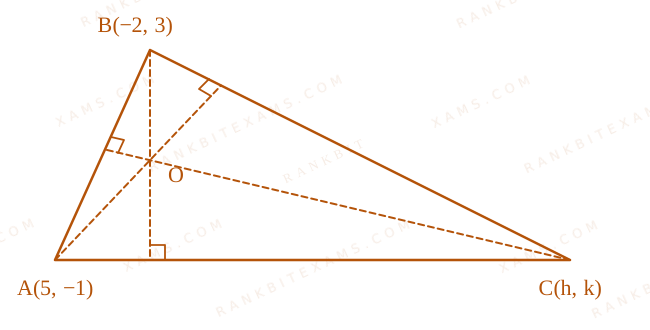
Let ABC be the triangle such that the equations of lines AB and AC be 3y - x = 2 and x + y = 2 , respectively, and the points B and C lie on x-axis. If P is the orthocentre of the triangle ABC, then the area of the triangle PBC is equal to
  • A. 4
  • B. 10
  • C. 8
  • D. 6

Solution

### Related Formula The orthocentre P of a triangle is the point of intersection of its altitudes. Area of a triangle with a horizontal base lying on the x-axis is: textArea = frac12 times textbase times textheight = frac12 times |x_C - x_B| times |y_P| ### Core Logic Find vertex A by solving the line equations AB and AC: 3y - x = 2 implies x = 3y - 2 Substitute into x + y = 2 implies (3y - 2) + y = 2 implies 4y = 4 implies y = 1. Then x = 3(1) - 2 = 1. So vertex A is (1, 1). Find vertices B and C where the lines cross the x-axis (y = 0): - For B (on line AB): 3(0) - x = 2 implies x = -2 implies B(-2, 0) - For C (on line AC): x + 0 = 2 implies x = 2 implies C(2, 0) Base length BC = |2 - (-2)| = 4. ### Step 1: Find Equations of Altitudes
Orthocentre of a Triangle diagram for Q70 - JEE Main 2025 Morning
1. **Altitude from A to BC**: Since BC lies along the x-axis, the altitude from A(1, 1) must be a vertical line: textEquation of Altitude 1: x = 1 2. **Altitude from B to AC**: Slope of line AC (x + y = 2) is m_AC = -1. Therefore, the slope of the altitude perpendicular to AC is m_2 = -frac1-1 = 1. Passing through B(-2, 0): y - 0 = 1(x - (-2)) implies y = x + 2 implies x - y + 2 = 0 ### Step 2: Solve for Orthocentre coordinates P Intersect the altitude equations: x = 1 and y = x + 2: y = 1 + 2 = 3 Hence, the orthocentre is P(1, 3). ### Step 3: Compute Area of Triangle PBC Triangle PBC has base BC = 4 on the x-axis, and vertex P(1, 3) gives a height of 3. textArea = frac12 times 4 times 3 = 6 ### Pattern Recognition When a triangle has its base sitting entirely on the coordinate axis, the altitude dropped from the opposite vertex is simplified to a pure horizontal or vertical line path, heavily reducing your linear derivation equation workload. ### Evaluation Rubric / Model Answer null ### Chapter Mix Class 11 Mathematics: Straight Lines
Q57 jee_main_2025_08_april_evening Properties of Square and Diagonals
Let a be the length of a side of a square OABC with O being the origin. Its side OA makes an acute angle alpha with the positive x-axis and the equations of its diagonals are (sqrt3 + 1)x + (sqrt3 - 1)y = 0 quad textand (sqrt3 - 1)x - (sqrt3 + 1)y + 8sqrt3 = 0. Then a^2 is equal to
  • A. 48
  • B. 32
  • C. 16
  • D. 24

Solution

### Related Formula textSlope m = -fracAB ### Core Logic Identify which diagonal passes through the origin. Use its directional configuration slope to determine the exact angle orientation layout map of the geometric system elements. ### Step 1: Determine Diagonal Orientation The line passing through the origin is diagonal OB: m_OB = -fracsqrt3+1sqrt3-1 = tan 105^circ Since diagonals of a square split the vertex paths evenly at 45^circ, the side OA makes an angle: alpha = 105^circ - 45^circ = 60^circ ### Step 2: Coordinate Vector Definition Coordinates of vertex A matching side value a are: A(acos 60^circ, asin 60^circ) = left( fraca2, fracsqrt3a2 right) ### Step 3: Diagonal Intersection Point Solver Vertex A lies upon the alternative structural path line: (sqrt3-1)fraca2 - (sqrt3+1)fracsqrt3a2 + 8sqrt3 = 0 a left[ fracsqrt3 - 1 - 3 - sqrt32 right] = -8sqrt3 implies -2a = -8sqrt3 implies a = 4sqrt3 a^2 = 48 {{SOL_IMG_57}} ### Pattern Recognition Slopes involving sqrt3 pm 1 explicitly alert you to geometric orientations built on multiples of 15^circ or 75^circ configurations. ### Evaluation Rubric / Model Answer null ### Chapter Mix Class 11 Mathematics: Straight Lines

More Straight Lines Questions — jee_main_2026_21_jan_morning

Practice all Straight Lines previous-year questions →

Rankbit System
JEE Physics: Waves (+15.5%) | Electrostatics: Concentric Shells (-29.7%) | Modern Physics: Photoelectric Clones (+34.2%) | Mathematics: Definite Integrals (+18.1%) | Chemistry: Coordination Splitting (-11.4%) | JEE Physics: Waves (+15.5%) | Electrostatics: Concentric Shells (-29.7%) | Modern Physics: Photoelectric Clones (+34.2%) | Mathematics: Definite Integrals (+18.1%) | Chemistry: Coordination Splitting (-11.4%)
YOUR FIRST PREP STEP STARTS HERE

We Map Every Repeating Question in Competitive Exams.

Say goodbye to generic mock test fatigue. RankBit uses smart analysis to group past exam questions into their foundational Repeating Question Types. Find chapter weightage, track repeating questions, and score higher with targeted practice.

Select Your Target Exam

Choose an exam track below to find formulas per chapter and patterns.

Syncing Exam Intelligence

Mapping formulas and patterns across all tracks…

PATH A — FULL LENGTH PRACTICE

Full Mock Test Hub

Simulate real NTA exam conditions with fully tracked mocks. Time yourself against past papers.

Now Live Open
PATH B — TARGETED PRACTICE

Topic-wise Practice Hub

Practice past-year questions one chapter at a time. Pick an exam → subject → chapter and get every PYQ for that topic — pulled together from all past papers — with the chapter's key formulas alongside.

Loading Questions... Browse Topics
Latest from the Blog
View all →

Loading articles...