Let C$C$ be the circle of minimum area enclosing the ellipse E: fracx^2a^2 + fracy^2b^2 = 1$E: \frac{x^2}{a^2} + \frac{y^2}{b^2} = 1$ with eccentricity frac12$\frac{1}{2}$ and foci (pm 2, 0)$(pm 2, 0)$. Let PQR$PQR$ be a variable triangle, whose vertex P$P$ is on the circle C$C$ and the side QR$QR$ of length 8$8$ is parallel to the major axis of E$E$ and contains the point of intersection of E$E$ with the negative y$y$-axis. Then the maximum area of the triangle PQR$PQR$ is:
A.6(3 + sqrt2)$6(3 + \sqrt{2})$
B.8(3 + sqrt2)$8(3 + \sqrt{2})$
C.6(2 + sqrt3)$6(2 + \sqrt{3})$
D.8(2 + sqrt3)$8(2 + \sqrt{3})$
Solution & Explanation
### Related Formula
For an ellipse E$E$:
- Foci: (pm ae, 0)$(\pm ae, 0)$
- Eccentricity: b^2 = a^2(1 - e^2)$b^2 = a^2(1 - e^2)$
- The circle of minimum area enclosing a centered ellipse has diameter equal to the major axis of the ellipse (R = a$R = a$).
- Area of triangle: textArea = frac12 cdot textbase cdot textheight$\text{Area} = \frac{1}{2} \cdot \text{base} \cdot \text{height}$
### Core Logic
Let's first find coordinates a$a$ and b$b$:
- ae = 2$ae = 2$
- e = frac12 implies aleft(frac12right) = 2 implies a = 4$e = \frac{1}{2} \implies a\left(\frac{1}{2}\right) = 2 \implies a = 4$
- b^2 = a^2(1 - e^2) = 16left(1 - frac14right) = 12 implies b = 2sqrt3$b^2 = a^2(1 - e^2) = 16\left(1 - \frac{1}{4}\right) = 12 \implies b = 2\sqrt{3}$
### Step 1: Setting Circle and Triangle geometry
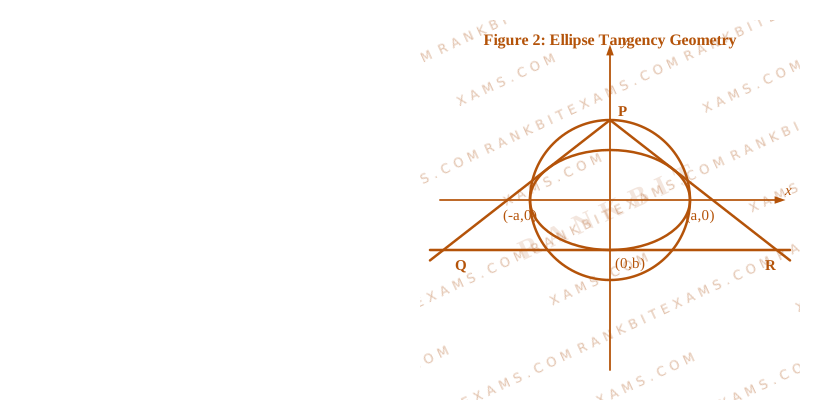
The enclosing circle C$C$ has radius R = a = 4$R = a = 4$, centered at (0,0)$(0,0)$. Thus, its equation is:
x^2 + y^2 = 16 implies P = (4costheta, 4sintheta)$$x^2 + y^2 = 16 \implies P = (4\cos\theta, 4\sin\theta)$$
The intersection of the ellipse with the negative y$y$-axis is (0, -b) = (0, -2sqrt3)$(0, -b) = (0, -2\sqrt{3})$.
Since side QR$QR$ (length = 8$= 8$) is parallel to the major axis (x$x$-axis) and contains (0, -2sqrt3)$(0, -2\sqrt{3})$, the equation of the line containing QR$QR$ is:
y = -2sqrt3$y = -2\sqrt{3}$Enclosing circle diagram for Q67 - JEE Main 2025 Evening Shift
### Step 2: Maximizing Area of Delta PQR$\Delta PQR$
The perpendicular height of vertex P(4costheta, 4sintheta)$P(4\cos\theta, 4\sin\theta)$ from the base line y = -2sqrt3$y = -2\sqrt{3}$ is:
H = 4sintheta - (-2sqrt3) = 4sintheta + 2sqrt3$$H = 4\sin\theta - (-2\sqrt{3}) = 4\sin\theta + 2\sqrt{3}$$
To maximize the area, we maximize height H$H$ by choosing sintheta = 1$\sin\theta = 1$:
H_max = 4 + 2sqrt3$$H_{max} = 4 + 2\sqrt{3}$$textMaximum Area = frac12 cdot textbase QR cdot H_max$$\text{Maximum Area} = \frac{1}{2} \cdot \text{base } QR \cdot H_{max}$$textMaximum Area = frac12 cdot 8 cdot (4 + 2sqrt3) = 4(4 + 2sqrt3) = 8(2 + sqrt3)$$\text{Maximum Area} = \frac{1}{2} \cdot 8 \cdot (4 + 2\sqrt{3}) = 4(4 + 2\sqrt{3}) = 8(2 + \sqrt{3})$$
### Pattern Recognition
The enclosing circle with minimum area is called the auxiliary circle. Its radius is equal to the semi-major axis a$a$. Max height of a triangle with a base fixed at line y=-k$y=-k$ and vertex on the circle is R + k$R + k$. This directly gives textArea = frac12 cdot textbase cdot (a+b)$\text{Area} = \frac{1}{2} \cdot \text{base} \cdot (a+b)$.
### Evaluation Rubric / Model Answer
null
### Chapter Mix
Class 11 Mathematics: Conic Sections
Keywords:#minimum area enclosing circle ellipse#JEE Main 2025 Evening Q67#Conic Sections JEE Main 2025#auxiliary circle elliptical geometry
More Conic Sections Previous-Year Questions — Page 3
Q75jee_main_2025_03_april_eveningHyperbola
If the equation of the hyperbola with foci (4, 2)$(4, 2)$ and (8, 2)$(8, 2)$ is 3x^2 - y^2 - alpha x + beta y + gamma = 0$3x^2 - y^2 - \alpha x + \beta y + \gamma = 0$, then alpha + beta + gamma$\alpha + \beta + \gamma$ is equal to
Numerical Answer.Answer: 141 to 141
Solution
### Related Formula
For a horizontal hyperbola centered at (h,k)$(h,k)$:
frac(x-h)^2a^2 - frac(y-k)^2b^2 = 1$$\frac{(x-h)^2}{a^2} - \frac{(y-k)^2}{b^2} = 1$$
- Foci: (h pm ae, k)$(h \pm ae, k)$
- Eccentricity relation: b^2 = a^2(e^2 - 1) = a^2 e^2 - a^2$b^2 = a^2(e^2 - 1) = a^2 e^2 - a^2$
### Core Logic
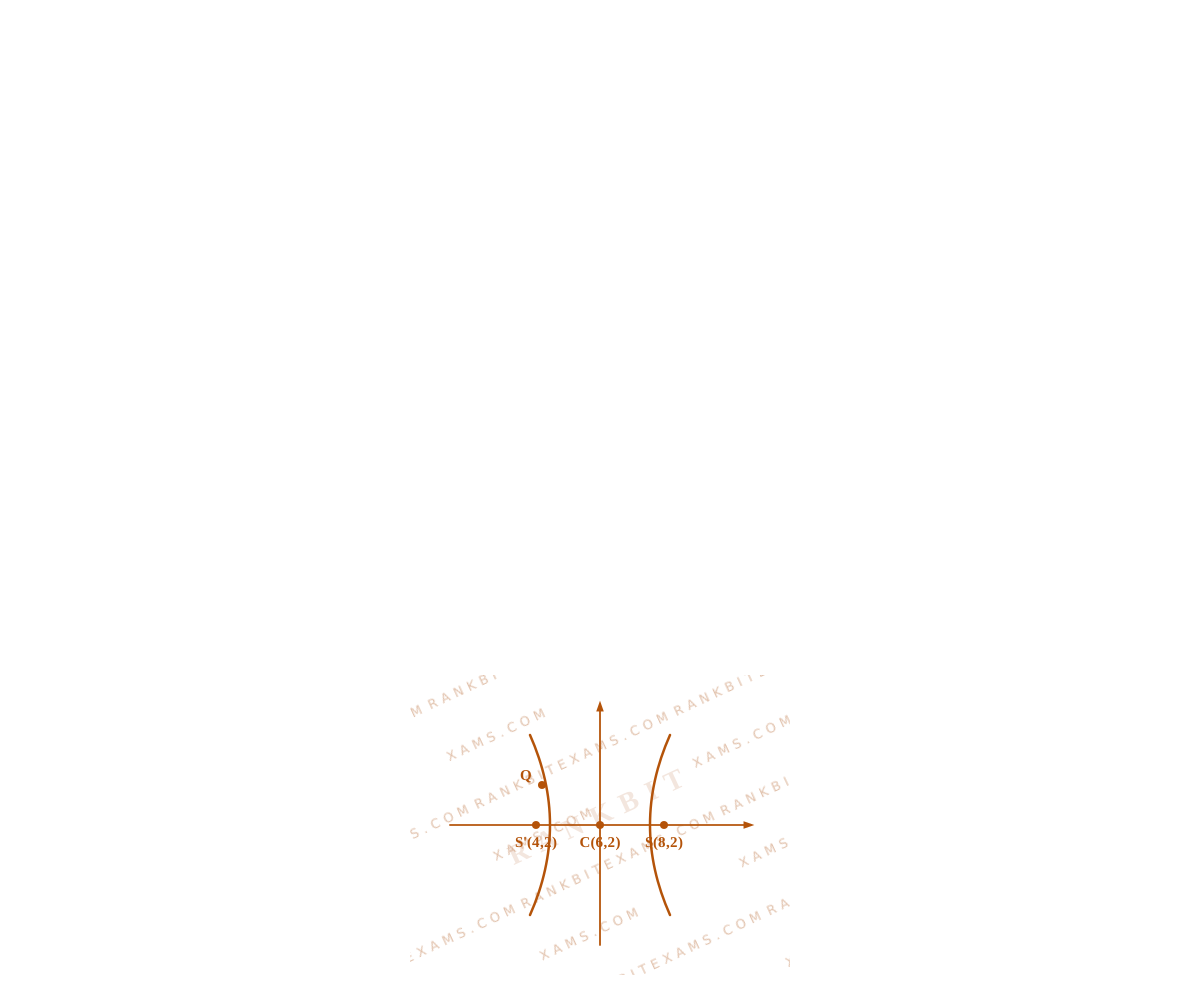
Foci are S_1 = (4,2)$S_1 = (4,2)$ and S_2 = (8,2)$S_2 = (8,2)$.
- Center C(h,k)$C(h,k)$ is the midpoint:
h = frac4 + 82 = 6, quad k = 2 implies C = (6, 2)$$h = \frac{4 + 8}{2} = 6, \quad k = 2 \implies C = (6, 2)$$
- Distance between foci:
2ae = 8 - 4 = 4 implies ae = 2$$2ae = 8 - 4 = 4 \implies ae = 2$$
Thus, b^2 = 4 - a^2$b^2 = 4 - a^2$.
### Step 1: Expanding standard equation
The equation is:
frac(x-6)^2a^2 - frac(y-2)^24-a^2 = 1$$\frac{(x-6)^2}{a^2} - \frac{(y-2)^2}{4-a^2} = 1$$(4-a^2)(x-6)^2 - a^2(y-2)^2 = a^2(4-a^2)$$(4-a^2)(x-6)^2 - a^2(y-2)^2 = a^2(4-a^2)$$
Comparing with 3x^2 - y^2 - alpha x + beta y + gamma = 0$3x^2 - y^2 - \alpha x + \beta y + \gamma = 0$, the ratio of coefficients of x^2$x^2$ and y^2$y^2$ is frac3-1 = -3$\frac{3}{-1} = -3$:
frac4 - a^2-a^2 = -3 implies 4 - a^2 = 3a^2 implies 4a^2 = 4 implies a^2 = 1$$\frac{4 - a^2}{-a^2} = -3 \implies 4 - a^2 = 3a^2 \implies 4a^2 = 4 \implies a^2 = 1$$
Thus, b^2 = 4 - 1 = 3$b^2 = 4 - 1 = 3$.
### Step 2: Finding values of coefficients alpha, beta, gamma$\alpha, \beta, \gamma$
Substituting a^2 = 1$a^2 = 1$ back into standard form equation:
3(x-6)^2 - (y-2)^2 = 3$$3(x-6)^2 - (y-2)^2 = 3$$3(x^2 - 12x + 36) - (y^2 - 4y + 4) = 3$$3(x^2 - 12x + 36) - (y^2 - 4y + 4) = 3$$3x^2 - 36x + 108 - y^2 + 4y - 4 = 3$$3x^2 - 36x + 108 - y^2 + 4y - 4 = 3$$3x^2 - y^2 - 36x + 4y + 101 = 0$$3x^2 - y^2 - 36x + 4y + 101 = 0$$
Comparing coefficients:
- alpha = 36$\alpha = 36$
- beta = 4$\beta = 4$
- gamma = 101$\gamma = 101$alpha + beta + gamma = 36 + 4 + 101 = 141$$\alpha + \beta + \gamma = 36 + 4 + 101 = 141$$Hyperbola diagram for Q75 - JEE Main 2025 Evening Shift
### Pattern Recognition
Symmetric focal coordinates (y=2$y=2$) indicate the hyperbola is horizontal. Identifying coordinates of the center (6,2)$(6,2)$ quickly and using coefficient ratio comparison restricts parameters immediately without requiring complex algebraic systems.
### Evaluation Rubric / Model Answer
null
### Chapter Mix
Class 11 Conic Sections
Qjee_main_2025_07_april_morningParabola
Let mathrmP$\mathrm{P}$ be the parabola, whose focus is (-2, 1)$(-2, 1)$ and directrix is 2mathrmx + mathrmy + 2 = 0$2\mathrm{x} + \mathrm{y} + 2 = 0$ . Then the sum of the ordinates of the points on mathrmP$\mathrm{P}$ , whose abscissa is -2$-2$ , is
A.frac32$\frac{3}{2}$
B.frac52$\frac{5}{2}$
C.frac14$\frac{1}{4}$
D.frac34$\frac{3}{4}$
Solution
### Related Formula
By the definition of a parabola, the distance from any point (x, y)$(x, y)$ on the curve to the focus (x_f, y_f)$(x_f, y_f)$ equals its perpendicular distance to the directrix line Ax + By + C = 0$Ax + By + C = 0$:
(x - x_f)^2 + (y - y_f)^2 = frac(Ax + By + C)^2A^2 + B^2$$(x - x_f)^2 + (y - y_f)^2 = \frac{(Ax + By + C)^2}{A^2 + B^2}$$
### Core Logic
Substituting the focus (-2, 1)$(-2, 1)$ and directrix 2x + y + 2 = 0$2x + y + 2 = 0$ into the definition equation:
(x + 2)^2 + (y - 1)^2 = frac(2x + y + 2)^22^2 + 1^2$$(x + 2)^2 + (y - 1)^2 = \frac{(2x + y + 2)^2}{2^2 + 1^2}$$5left[(x + 2)^2 + (y - 1)^2right] = (2x + y + 2)^2$$5\left[(x + 2)^2 + (y - 1)^2\right] = (2x + y + 2)^2$$
### Step 1: Substitute the Given Abscissa
Parabola diagram for Q55 - JEE Main 2025 Morning
We need the points whose abscissa (x-coordinate) is x = -2$x = -2$. Substitute x = -2$x = -2$ into the general equation:
5left[(-2 + 2)^2 + (y - 1)^2right] = (2(-2) + y + 2)^2$$5\left[(-2 + 2)^2 + (y - 1)^2\right] = (2(-2) + y + 2)^2$$5left[0 + (y - 1)^2right] = (-4 + y + 2)^2$$5\left[0 + (y - 1)^2\right] = (-4 + y + 2)^2$$5(y - 1)^2 = (y - 2)^2$$5(y - 1)^2 = (y - 2)^2$$5(y^2 - 2y + 1) = y^2 - 4y + 4$$5(y^2 - 2y + 1) = y^2 - 4y + 4$$5y^2 - 10y + 5 = y^2 - 4y + 4$$5y^2 - 10y + 5 = y^2 - 4y + 4$$4y^2 - 6y + 1 = 0$$4y^2 - 6y + 1 = 0$$
### Step 2: Find the Sum of Ordinates
The ordinates y_1$y_1$ and y_2$y_2$ are the roots of the quadratic equation 4y^2 - 6y + 1 = 0$4y^2 - 6y + 1 = 0$.
The sum of the ordinates is:
y_1 + y_2 = -frac-64 = frac64 = frac32$$y_1 + y_2 = -\frac{-6}{4} = \frac{6}{4} = \frac{3}{2}$$
### Pattern Recognition
Notice how evaluating the intersection layout directly simplifies when the substitution value matches the coordinate of the focus, converting the entire quadratic horizontal layout component to 0 immediately.
### Evaluation Rubric / Model Answer
null
### Chapter Mix
Class 11 Mathematics: Conic Sections
Q73jee_main_2025_07_april_morningHyperbola
Consider the hyperbola fracx^2a^2 -fracy^2b^2 = 1$\frac{x^2}{a^2} -\frac{y^2}{b^2} = 1$ having one of its focus at mathrmP(-3,0)$\mathrm{P(-3,0)}$ . If the latus rectum through its other focus subtends a right angle at mathrmP$\mathrm{P}$ and a^2 b^2 = alpha sqrt2 -beta ,alpha ,beta in mathbbN$a^2 b^2 = \alpha \sqrt{2} -\beta ,\alpha ,\beta \in \mathbb{N}$ , calculate alpha + beta$\alpha + \beta$.
Numerical Answer.Answer: 1944 to 1944
Solution
### Related Formula
For a standard hyperbola:
- Focus positions are (pm ae, 0)$(\pm ae, 0)$.
- Length of semi-latus rectum is fracb^2a$\frac{b^2}{a}$.
- Eccentricity identity linkage: b^2 = a^2(e^2 - 1) implies a^2e^2 = a^2 + b^2$b^2 = a^2(e^2 - 1) \implies a^2e^2 = a^2 + b^2$.
### Core Logic
Given focus F_1 equiv (-ae, 0) equiv P(-3, 0)$F_1 \equiv (-ae, 0) \equiv P(-3, 0)$, so ae = 3$ae = 3$.
The other focus is F_2 equiv (ae, 0) equiv (3, 0)$F_2 \equiv (ae, 0) \equiv (3, 0)$.
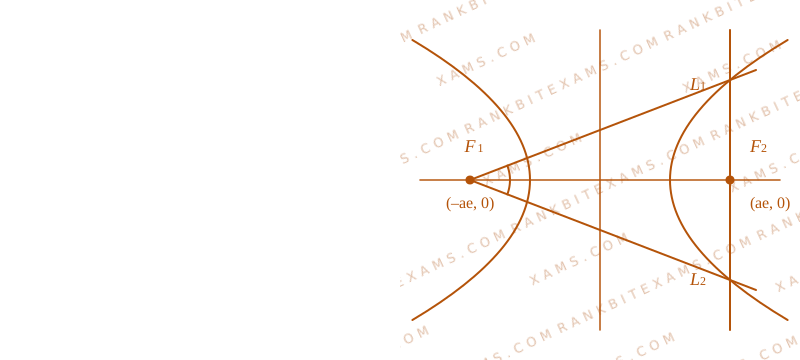
The latus rectum passes vertically through F_2$F_2$, with endpoints L_1left(ae, fracb^2aright)$L_1\left(ae, \frac{b^2}{a}\right)$ and L_2left(ae, -fracb^2aright)$L_2\left(ae, -\frac{b^2}{a}\right)$.
This segment subtends a right angle at P(-ae, 0)$P(-ae, 0)$. By symmetry, the top half angle at P$P$ must be exactly 45^circ$45^\circ$.
### Step 1: Set Up Slope Relationship
Hyperbola diagram for Q73 - JEE Main 2025 Morning
Using the geometric slope relationship:
tan 45^circ = fractextheighttextbase = fracb^2/a2ae$$\tan 45^\circ = \frac{\text{height}}{\text{base}} = \frac{b^2/a}{2ae}$$1 = fracb^22a^2e implies 2a^2e = b^2 implies b^2 = 6a quad (textsince ae = 3)$$1 = \frac{b^2}{2a^2e} \implies 2a^2e = b^2 \implies b^2 = 6a \quad (\text{since } ae = 3)$$
### Step 2: Solve the Quadratic Excentricity Equation
Substitute ae = 3$ae = 3$ and b^2 = 6a$b^2 = 6a$ into the eccentricity identity a^2e^2 = a^2 + b^2$a^2e^2 = a^2 + b^2$:
9 = a^2 + 6a implies a^2 + 6a - 9 = 0$$9 = a^2 + 6a \implies a^2 + 6a - 9 = 0$$
Solving for a$a$ using the quadratic formula (taking the positive root since a > 0$a > 0$):
a = frac-6 pm sqrt36 - 4(1)(-9)2 = frac-6 + sqrt722 = -3 + 3sqrt2 = 3(sqrt2 - 1)$$a = \frac{-6 \pm \sqrt{36 - 4(1)(-9)}}{2} = \frac{-6 + \sqrt{72}}{2} = -3 + 3\sqrt{2} = 3(\sqrt{2} - 1)$$
### Step 3: Evaluate product and sum coefficients
Now compute a^2b^2$a^2b^2$:
a^2b^2 = a^2(6a) = 6a^3$$a^2b^2 = a^2(6a) = 6a^3$$6a^3 = 6left[3(sqrt2 - 1)right]^3 = 6 times 27 times (sqrt2 - 1)^3$$6a^3 = 6\left[3(\sqrt{2} - 1)\right]^3 = 6 \times 27 \times (\sqrt{2} - 1)^3$$6a^3 = 162 times (2sqrt2 - 6 + 3sqrt2 - 1) = 162 times (5sqrt2 - 7)$$6a^3 = 162 \times (2\sqrt{2} - 6 + 3\sqrt{2} - 1) = 162 \times (5\sqrt{2} - 7)$$6a^3 = 810sqrt2 - 1134$$6a^3 = 810\sqrt{2} - 1134$$
Matching with alphasqrt2 - beta$\alpha\sqrt{2} - \beta$ gives:
alpha = 810 quad textand quad beta = 1134$$\alpha = 810 \quad \text{and} \quad \beta = 1134$$
Calculate the final required sum:
alpha + beta = 810 + 1134 = 1944$$\alpha + \beta = 810 + 1134 = 1944$$
### Pattern Recognition
Recognizing that the right angle subtended at the opposite focus implies a perfect tan(45^circ)$\tan(45^\circ)$ right triangle instantly yields the key linear constraint b^2 = 2a(ae)$b^2 = 2a(ae)$, avoiding the need for lengthy distance-formula tracking.
### Evaluation Rubric / Model Answer
null
### Chapter Mix
Class 11 Mathematics: Conic Sections
Q60jee_main_2025_08_april_eveningEllipse and Focal Distances
Let the ellipse 3x^2 + py^2 = 4$3x^{2} + py^{2} = 4$ pass through the centre C of the circle x^2 + y^2 - 2x - 4y - 11 = 0$x^{2} + y^{2} - 2x - 4y - 11 = 0$ of radius r. Let f_1, f_2$f_{1}, f_{2}$ be the focal distances of the point C on the ellipse. Then 6f_1f_2 - r$6f_{1}f_{2} - r$ is equal to
A.74$74$
B.68$68$
C.70$70$
D.78$78$
Solution
### Related Formula
textFocal Distance Product on Vertical Ellipse = b^2 - e^2 k^2$$\text{Focal Distance Product on Vertical Ellipse} = b^2 - e^2 k^2$$
### Core Logic
Extract the coordinate center of the target circle, substitute it directly to locate the missing parameter p$p$, and resolve eccentricity metrics.
### Step 1: Extract Circle Metric Values
For circle x^2 + y^2 - 2x - 4y - 11 = 0$x^{2} + y^{2} - 2x - 4y - 11 = 0$:
textCentre C(1, 2), quad textRadius r = sqrt1 + 4 + 11 = 4$$\text{Centre } C(1, 2), \quad \text{Radius } r = \sqrt{1 + 4 + 11} = 4$$
### Step 2: Standardize Ellipse Formulation
Ellipse passes through point C(1,2)$C(1,2)$:
3(1)^2 + p(2)^2 = 4 implies 3 + 4p = 4 implies p = frac14$$3(1)^2 + p(2)^2 = 4 \implies 3 + 4p = 4 \implies p = \frac{1}{4}$$
Standard model form: fracx^24/3 + fracy^216 = 1$\frac{x^2}{4/3} + \frac{y^2}{16} = 1$ (b > a$b > a$, vertical configuration axis).
e = sqrt1 - frac4/316 = sqrt1 - frac112 = sqrtfrac1112$$e = \sqrt{1 - \frac{4/3}{16}} = \sqrt{1 - \frac{1}{12}} = \sqrt{\frac{11}{12}}$$
### Step 3: Evaluate Product Chain
Focal distance elements at ordinate coordinate height k=2$k=2$ are bounded by b pm ek$b \pm ek$:
f_1 f_2 = b^2 - e^2 k^2 = 16 - left(frac1112right) times 4 = 16 - frac113 = frac373$$f_1 f_2 = b^2 - e^2 k^2 = 16 - \left(\frac{11}{12}\right) \times 4 = 16 - \frac{11}{3} = \frac{37}{3}$$
Target evaluation expression response string:
6f_1 f_2 - r = 6 left(frac373right) - 4 = 74 - 4 = 70$$6f_1 f_2 - r = 6 \left(\frac{37}{3}\right) - 4 = 74 - 4 = 70$$
### Pattern Recognition
Pay attention to whether b > a$b > a$ or a > b$a > b$ when analyzing ellipse forms. Focal distance definitions swap directions immediately across major horizontal/vertical configurations.
### Evaluation Rubric / Model Answer
null
### Chapter Mix
Class 11 Mathematics: Conic Sections
Class 11 Mathematics: Circles
Q75jee_main_2025_08_april_eveningTangent to Parabola and Circle Properties
Let r$r$ be the radius of the circle, which touches x$x$ -axis at point (a, 0)$(a, 0)$ , a < 0$a < 0$ and the parabola y^2 = 9x$y^2 = 9x$ at the point (4, 6)$(4, 6)$ . Then r$r$ is equal to
Numerical Answer.Answer: 30 to 30
Solution
### Related Formula
textTangent line at point (x_1, y_1) implies yy_1 = 2a(x+x_1)$$\text{Tangent line at point } (x_1, y_1) \implies yy_1 = 2a(x+x_1)$$
### Core Logic
Establish the tangent vector expression at the parabola intersection mark. Since this path line functions as a shared contact tangent boundaries sheet for the circular arc, impose radius equations.
### Step 1: Derive Shared Parabola Tangent Line
Tangent line profile for y^2 = 9x$y^2 = 9x$ at coordinate indicator (4,6)$(4,6)$:
6y = 9 cdot left( fracx+42 right) implies 3x - 4y + 12 = 0$$6y = 9 \cdot \left( \frac{x+4}{2} \right) \implies 3x - 4y + 12 = 0$$
### Step 2: Build Geometric Metric Connections
Circle touches axis at (a,0)$(a,0)$, mapping coordinates center directly to C(a,r)$C(a,r)$. Perpendicular boundary constraint steps require:
frac3a - 4r + 125 = pm r implies 3a + 12 = 4r pm 5r$$\frac{3a - 4r + 12}{5} = \pm r \implies 3a + 12 = 4r \pm 5r$$
### Step 3: Solve for Radius Matrix Bounds
Enforce circle equation intersection constraint profile (x-a)^2 + (y-r)^2 = r^2$(x-a)^2 + (y-r)^2 = r^2$ at point (4,6)$(4,6)$:
a^2 - 8a - 12r + 52 = 0$$a^2 - 8a - 12r + 52 = 0$$
Evaluating the target systems from structural logic tracks rejects positive value parameters, providing:
a = -14, quad r = 30$$a = -14, \quad r = 30$$
{{SOL_IMG_75}}
### Pattern Recognition
Shared tangent elements connect independent conic fields. Locating circular center boundaries using axial coordinate tracking simplifies secondary equations.
### Evaluation Rubric / Model Answer
null
### Chapter Mix
Class 11 Mathematics: Conic Sections
Class 11 Mathematics: Circles
More Conic Sections Questions — jee_main_2025_03_april_evening
We Map Every Repeating Question in Competitive Exams.
Say goodbye to generic mock test fatigue. RankBit uses smart analysis to group past exam questions into their foundational Repeating Question Types. Find chapter weightage, track repeating questions, and score higher with targeted practice.
Select Your Target Exam
Choose an exam track below to find formulas per chapter and patterns.
Syncing Exam Intelligence
Mapping formulas and patterns across all tracks…
PATH A — FULL LENGTH PRACTICE
Full Mock Test Hub
Simulate real NTA exam conditions with fully tracked mocks. Time yourself against past papers.
Practice past-year questions one chapter at a time. Pick an exam → subject → chapter and get every PYQ for that topic — pulled together from all past papers — with the chapter's key formulas alongside.
.svg)