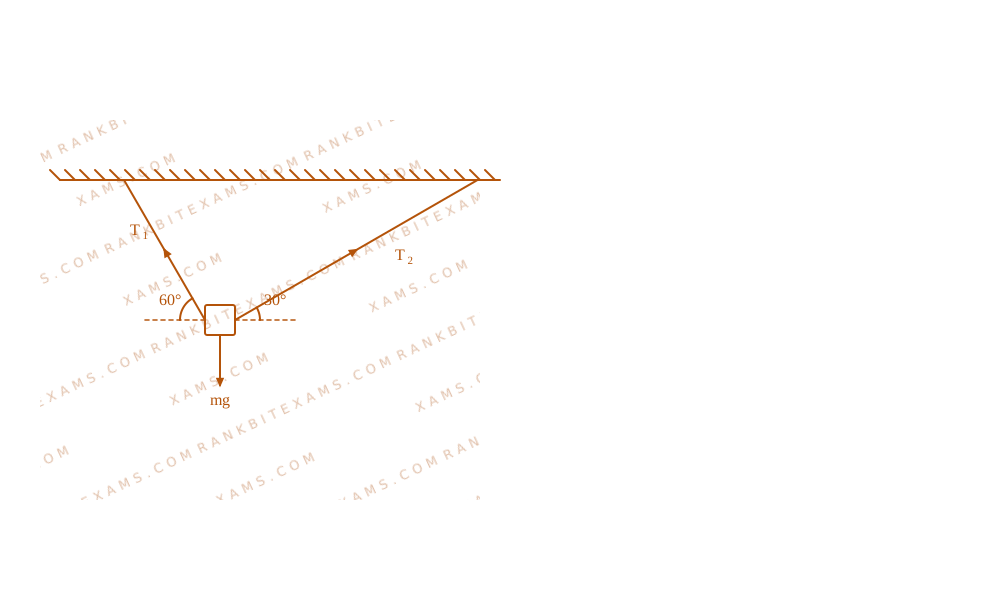
A body of mass 1mathrmkg$1\mathrm{kg}$ is suspended with the help of two strings making angles as shown in figure. Magnitude of tensions mathbfT_1$\mathbf{T}_1$ and mathbfT_2$\mathbf{T}_2$ , respectively, are (in N):
The diagram shows a suspended mass of 1 kg held by two strings making angles of 60 and 30 degrees with the horizontal.
A.5, 5sqrt3$5, 5\sqrt{3}$
B.5sqrt3, 5$5\sqrt{3}, 5$
C.5sqrt3, 5sqrt3$5\sqrt{3}, 5\sqrt{3}$
D.5, 5$5, 5$
Solution & Explanation
### Related Formula
For a system in static equilibrium:
sum F_x = 0 quad textand quad sum F_y = 0$$\sum F_x = 0 \quad \text{and} \quad \sum F_y = 0$$
### Core Logic
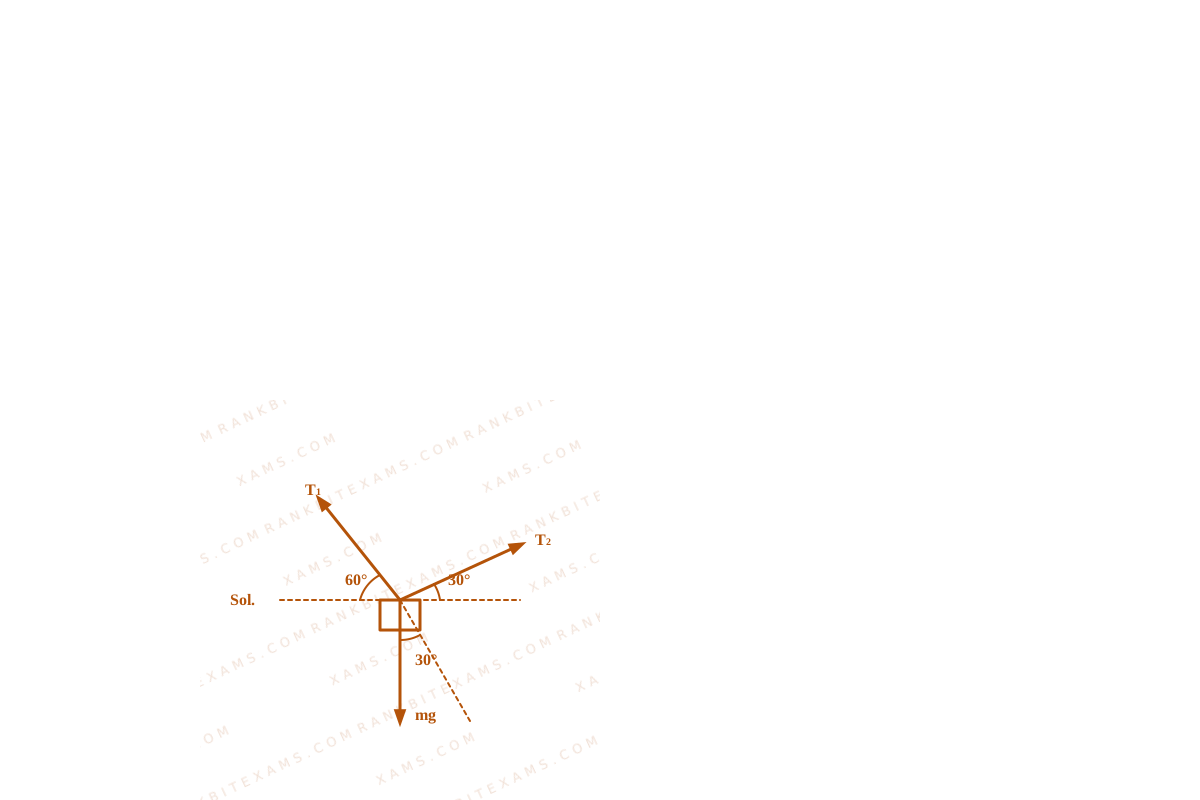
Let's resolve the tension forces vecT_1$\vec{T}_1$ and vecT_2$\vec{T}_2$ into horizontal and vertical components:
- T_1$T_1$ makes 60^circ$60^\circ$ with the horizontal.
- T_2$T_2$ makes 30^circ$30^\circ$ with the horizontal.
- Downward gravitational force: W = m g = 1 times 10 = 10 \ mathrmN$W = m g = 1 \times 10 = 10 \ \mathrm{N}$.
1. **Horizontal Equilibrium (sum F_x = 0$\sum F_x = 0$):**
T_1 cos 60^circ = T_2 cos 30^circ$$T_1 \cos 60^\circ = T_2 \cos 30^\circ$$T_1 cdot frac12 = T_2 cdot fracsqrt32 implies T_1 = T_2 sqrt3$$T_1 \cdot \frac{1}{2} = T_2 \cdot \frac{\sqrt{3}}{2} \implies T_1 = T_2 \sqrt{3}$$
2. **Vertical Equilibrium (sum F_y = 0$\sum F_y = 0$):**
T_1 sin 60^circ + T_2 sin 30^circ = m g = 10$$T_1 \sin 60^\circ + T_2 \sin 30^\circ = m g = 10$$T_1 cdot fracsqrt32 + T_2 cdot frac12 = 10$$T_1 \cdot \frac{\sqrt{3}}{2} + T_2 \cdot \frac{1}{2} = 10$$
### Step 1: Solve for Tensions
Substitute T_1 = T_2 sqrt3$T_1 = T_2 \sqrt{3}$ into the vertical equilibrium equation:
(T_2 sqrt3) fracsqrt32 + fracT_22 = 10$$(T_2 \sqrt{3}) \frac{\sqrt{3}}{2} + \frac{T_2}{2} = 10$$frac3 T_22 + fracT_22 = 10 implies 2 T_2 = 10 implies T_2 = 5 \ mathrmN$$\frac{3 T_2}{2} + \frac{T_2}{2} = 10 \implies 2 T_2 = 10 \implies T_2 = 5 \ \mathrm{N}$$
Substitute T_2$T_2$ back to obtain T_1$T_1$:
T_1 = 5 sqrt3 \ mathrmN$$T_1 = 5 \sqrt{3} \ \mathrm{N}$$
Thus, the tension magnitudes are T_1 = 5sqrt3 \ mathrmN$T_1 = 5\sqrt{3} \ \mathrm{N}$ and T_2 = 5 \ mathrmN$T_2 = 5 \ \mathrm{N}$.
### Pattern Recognition
Sees: Suspending particle static equilibrium with asymmetric strings.
Trap: Associating components with incorrect trigonometry axes or swapping T_1$T_1$ and T_2$T_2$ in options.
Shortcut: Since the incline of T_1$T_1$ (60^circ$60^\circ$) is steeper than that of T_2$T_2$ (30^circ$30^\circ$), T_1$T_1$ must carry a larger portion of the load, meaning T_1 > T_2$T_1 > T_2$. From the choices, only (2) satisfies this hierarchy.
### Evaluation Rubric / Model Answer
null
### Chapter Mix
Class 11 Physics: Laws of Motion
The diagram shows a suspended mass of 1 kg held by two strings making angles of 60 and 30 degrees with the horizontal.
A coin is placed on a disc. The coefficient of friction between the coin and the disc is mu$\mu$. If the distance of the coin from the center of the disc is r$r$, the maximum angular velocity which can be given to the disc, so that the coin does not slip away, is:
A.fracmu gr$\frac{\mu g}{r}$
B.sqrtfracrmu g$\sqrt{\frac{r}{\mu g}}$
C.sqrtfracmu gr$\sqrt{\frac{\mu g}{r}}$
D.fracmusqrtrg$\frac{\mu}{\sqrt{rg}}$
Solution
### Related Formula
f_s leq mu_s N$$f_s \leq \mu_s N$$F_c = mromega^2$$F_c = mr\omega^2$$
### Core Logic
Circular Motion Friction diagram for Q47 - JEE Main 2024 MorningCircular Motion Friction diagram for Q47 - JEE Main 2024 Morning
To prevent the coin from slipping, the static friction must provide the necessary centripetal force for circular motion.
f = momega^2 r$f = m\omega^2 r$
The normal force on the flat disc is N = mg$N = mg$.
The maximum static friction is f_textmax = mu N = mu mg$f_{\text{max}} = \mu N = \mu mg$.
For no slipping:
m r omega^2 leq mu mg$$m r \omega^2 \leq \mu mg$$omega^2 leq fracmu gr$$\omega^2 \leq \frac{\mu g}{r}$$omega_textmax = sqrtfracmu gr$$\omega_{\text{max}} = \sqrt{\frac{\mu g}{r}}$$
### Evaluation Rubric / Model Answer
null
### Chapter Mix
Class 11 Physics: Laws Of Motion
More Laws of Motion Questions — jee_main_2025_02_april_evening
We Map Every Repeating Question in Competitive Exams.
Say goodbye to generic mock test fatigue. RankBit uses smart analysis to group past exam questions into their foundational Repeating Question Types. Find chapter weightage, track repeating questions, and score higher with targeted practice.
Select Your Target Exam
Choose an exam track below to find formulas per chapter and patterns.
Syncing Exam Intelligence
Mapping formulas and patterns across all tracks…
PATH A — FULL LENGTH PRACTICE
Full Mock Test Hub
Simulate real NTA exam conditions with fully tracked mocks. Time yourself against past papers.
Practice past-year questions one chapter at a time. Pick an exam → subject → chapter and get every PYQ for that topic — pulled together from all past papers — with the chapter's key formulas alongside.