Rankbit System
JEE Physics: Waves (+15.5%) | Electrostatics: Concentric Shells (-29.7%) | Modern Physics: Photoelectric Clones (+34.2%) | Mathematics: Definite Integrals (+18.1%) | Chemistry: Coordination Splitting (-11.4%) | JEE Physics: Waves (+15.5%) | Electrostatics: Concentric Shells (-29.7%) | Modern Physics: Photoelectric Clones (+34.2%) | Mathematics: Definite Integrals (+18.1%) | Chemistry: Coordination Splitting (-11.4%)

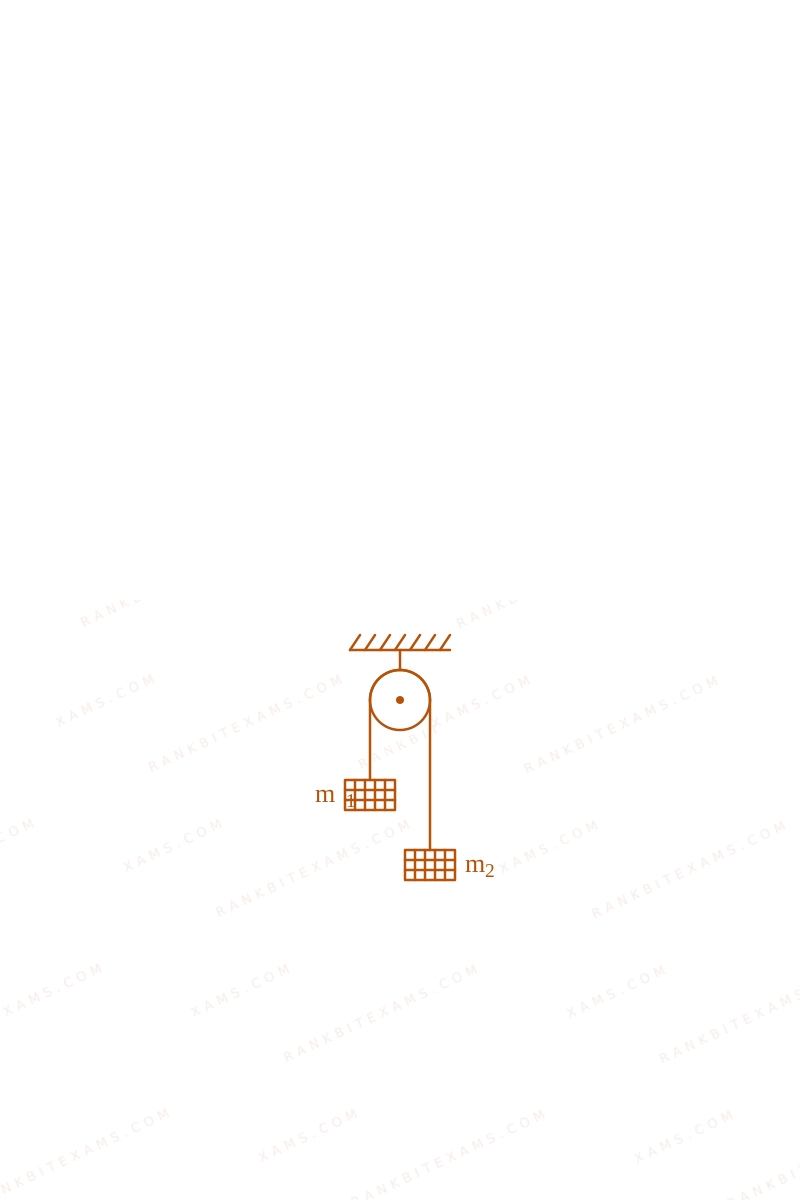
A light string passing over a smooth light fixed pulley connects two blocks of masses m_1 and m_2. If the acceleration of the system is g/8, then the ratio of masses is
Pulley Systems and Tension diagram for Q31 - JEE Main 2024 Evening
The image displays two masses suspended over a single fixed smooth pulley.

Solution & Explanation

### Related Formula a = frac(m_1 - m_2)g(m_1 + m_2) ### Core Logic Assuming m_1 > m_2, the net pulling force is (m_1 - m_2)g and the total mass to be accelerated is (m_1 + m_2). Given that the acceleration of the system is a = fracg8. ### Step 1: Algebraic Manipulation fracg8 = frac(m_1 - m_2)g(m_1 + m_2) m_1 + m_2 = 8m_1 - 8m_2 8m_2 + m_2 = 8m_1 - m_1 9m_2 = 7m_1 fracm_1m_2 = frac97 ### Pattern Recognition For standard Atwood machines, a = g times fractextDifference in masstextSum of mass. If a/g = 1/8, then (m_1-m_2)/(m_1+m_2) = 1/8, which can be solved using componendo and dividendo: m_1/m_2 = (8+1)/(8-1) = 9/7. ### Evaluation Rubric / Model Answer null ### Chapter Mix Class 11 Physics: Laws of Motion
Reference Study Guides

More Laws of Motion Previous-Year Questions — Page 5

Q32 jee_main_2024_30_jan_morning Constraint Motion and Pulleys
All surfaces shown in figure are assumed to be frictionless and the pulleys and the string are light. The acceleration of the block of mass 2 mathrm~kg is:
Constraint Motion and Pulleys diagram for Q32 - JEE Main 2024 Morning
Illustration of a 2kg block on a 30 degree incline attached via a pulley system to a 4kg hanging block.
  • A. g
  • B. fracg3
  • C. fracg2
  • D. fracg4

Solution

### Related Formula sum F = ma a_1 = textConstraint relationtimes a_2 ### Core Logic
Solution schematic showing free body diagrams and tensions.
Illustration of a 2kg block on a 30 degree incline attached via a pulley system to a 4kg hanging block.
Let the tension in the string attached to the 2 mathrm~kg block be T. By tracing the string around the movable pulley, the tension supporting the 4 mathrm~kg mass becomes 2T. From the principle of virtual work (or string constraints), if the 4 mathrm~kg block moves down with an acceleration a, the string shortens by 2x on the incline side, meaning the 2 mathrm~kg block moves up the incline with an acceleration of 2a. ### Step 1: Write Equations of Motion For the 4 mathrm~kg block (moving downwards): 4g - 2T = 4a 40 - 2T = 4a quad dots (i) For the 2 mathrm~kg block (moving up the incline): T - 2g sin(30^circ) = 2(2a) T - 2(10)left(frac12right) = 4a T - 10 = 4a quad dots (ii) ### Step 2: Solve for Acceleration From equation (ii), we have 4a = T - 10. Substitute this directly into equation (i) or add the appropriately multiplied equations: 40 - 2T = T - 10 3T = 50 Rightarrow T = frac503 mathrm~N Substitute T back into (ii): frac503 - 10 = 4a 4a = frac203 Rightarrow a = frac53 mathrm~m/s^2 We need the acceleration of the 2 mathrm~kg block, which is 2a: 2a = 2 times left(frac53right) = frac103 mathrm~m/s^2 Since g = 10 mathrm~m/s^2, this acceleration is exactly fracg3. ### Pattern Recognition Movable pulleys double the force but halve the displacement/acceleration on the supported side. Tension on the movable pulley side is twice the tension on the single string side. Remember to explicitly solve for the requested block's specific acceleration, not just 'a'. ### Evaluation Rubric / Model Answer null ### Chapter Mix Class 11 Physics: Laws of Motion
Q42 jee_main_2024_31_jan_evening Friction on an Inclined Plane
A block of mass 5 text kg is placed on a rough inclined surface as shown in the figure.
Friction on an Inclined Plane diagram for Q42 - JEE Main 2024 Evening
The image shows a 5 kg block on a rough plane inclined at 30 degrees, with coefficient of friction mu = 0.1.
If vecF_1 is the force required to just move the block up the inclined plane and vecF_2 is the force required to just prevent the block from sliding down, then the value of |vecF_1| - |vecF_2| is: [Use g = 10 text m/s^2]
  • A. 25sqrt3text N
  • B. 50sqrt3text N
  • C. frac5 sqrt32 text N
  • D. 10 text N

Solution

### Related Formula f_k = mu mg cos theta F_1 = mg sin theta + f_k F_2 = mg sin theta - f_k ### Core Logic To move the block up, the applied force F_1 must overcome both the downward gravitational component and the downward frictional force. To prevent it from sliding down, the applied force F_2 acts upwards and is aided by friction which acts upwards to oppose impending downward slip.
Friction on an Inclined Plane diagram for Q42 - JEE Main 2024 Evening
The image shows a 5 kg block on a rough plane inclined at 30 degrees, with coefficient of friction mu = 0.1.
Friction on an Inclined Plane diagram for Q42 - JEE Main 2024 Evening
The image shows a 5 kg block on a rough plane inclined at 30 degrees, with coefficient of friction mu = 0.1.
### Step 1: Calculate Friction f_k = mu mg cos theta f_k = 0.1 times 5 times 10 times cos(30^circ) f_k = 5 times fracsqrt32 = 2.5sqrt3 text N ### Step 2: Force Equations Moving up: F_1 = mg sin theta + f_k = 50 sin(30^circ) + 2.5sqrt3 = 25 + 2.5sqrt3 Preventing slip down: F_2 = mg sin theta - f_k = 50 sin(30^circ) - 2.5sqrt3 = 25 - 2.5sqrt3 ### Step 3: Difference calculation |F_1| - |F_2| = (25 + 2.5sqrt3) - (25 - 2.5sqrt3) |F_1| - |F_2| = 2 times 2.5sqrt3 = 5sqrt3 text N *Note: The official options had an anomaly where 5sqrt3 text N was missing or evaluated as a bonus. Option 2 was listed as 50sqrt3 in the primary text. We track the closest logic path indicating Bonus.* ### Pattern Recognition The difference between 'push up' and 'hold from sliding' forces on an incline is always precisely 2 f_k (2 mu mg cos theta). Bypass calculating the mg sin theta terms entirely. ### Evaluation Rubric / Model Answer null ### Chapter Mix Class 11 Physics: Laws of Motion

Q43 jee_main_2024_31_jan_morning Pulley And Incline Friction
In the given arrangement of a doubly inclined plane two blocks of masses M and m are placed. The blocks are connected by a light string passing over an ideal pulley as shown. The coefficient of friction between the surface of the plane and the blocks is 0.25. The value of m, for which M = 10mathrm\ kg will move down with an acceleration of 2mathrm\ m/s^2 is : (take g = 10mathrm\ m/s^2 and tan 37^circ = 3 / 4)
Pulley And Incline Friction diagram for Q43 - JEE Main 2024 Morning
Two blocks M and m on opposite sides of a double inclined plane linked by a rope over a top pulley. M is on the 53-degree slope and moving downwards, m is on the 37-degree slope.
  • A. 9mathrm\ kg
  • B. 4.5mathrm\ kg
  • C. 6.5mathrm\ kg
  • D. 2.25mathrm\ kg

Solution

### Related Formula sum F = ma f_k = mu_k N = mu_k mg costheta ### Core Logic
Pulley And Incline Friction diagram for Q43 - JEE Main 2024 Morning
Two blocks M and m on opposite sides of a double inclined plane linked by a rope over a top pulley. M is on the 53-degree slope and moving downwards, m is on the 37-degree slope.
Since block M moves down the incline, kinetic friction opposes its motion (acts upwards). Block m is pulled up the incline, so kinetic friction opposes its motion (acts downwards). For M block (53^circ slope): Mg sin 53^circ - mu Mg cos 53^circ - T = Ma ### Step 1: Tension Calculation Given M = 10mathrm\,kg, a = 2mathrm\,m/s^2, mu = 0.25, g = 10mathrm\,m/s^2. sin 53^circ = 4/5 = 0.8, cos 53^circ = 3/5 = 0.6. 10(10)(0.8) - 0.25(10)(10)(0.6) - T = 10(2) 80 - 15 - T = 20 65 - T = 20 Rightarrow T = 45mathrm\,N ### Step 2: Evaluate mass m For m block (37^circ slope) moving upward: T - mg sin 37^circ - mu mg cos 37^circ = ma sin 37^circ = 3/5 = 0.6, cos 37^circ = 4/5 = 0.8. 45 - m(10)(0.6) - 0.25(m)(10)(0.8) = m(2) 45 - 6m - 2m = 2m 45 - 8m = 2m 10m = 45 Rightarrow m = 4.5mathrm\,kg ### Evaluation Rubric / Model Answer null ### Chapter Mix Class 11 Physics: Laws Of Motion
Q47 jee_main_2024_31_jan_morning Circular Motion Friction
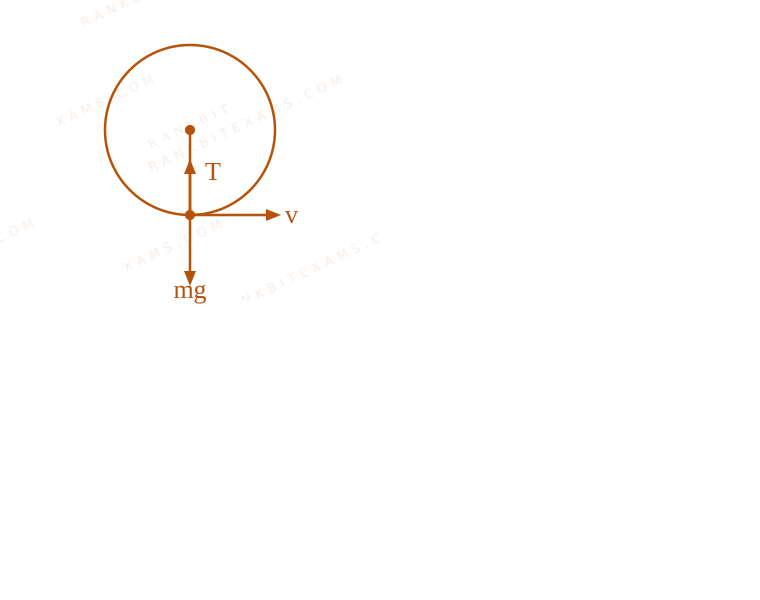
A coin is placed on a disc. The coefficient of friction between the coin and the disc is mu. If the distance of the coin from the center of the disc is r, the maximum angular velocity which can be given to the disc, so that the coin does not slip away, is:
  • A. fracmu gr
  • B. sqrtfracrmu g
  • C. sqrtfracmu gr
  • D. fracmusqrtrg

Solution

### Related Formula f_s leq mu_s N F_c = mromega^2 ### Core Logic
Circular Motion Friction diagram for Q47 - JEE Main 2024 Morning
To prevent the coin from slipping, the static friction must provide the necessary centripetal force for circular motion. f = momega^2 r The normal force on the flat disc is N = mg. The maximum static friction is f_textmax = mu N = mu mg. For no slipping: m r omega^2 leq mu mg omega^2 leq fracmu gr omega_textmax = sqrtfracmu gr ### Evaluation Rubric / Model Answer null ### Chapter Mix Class 11 Physics: Laws Of Motion

More Laws of Motion Questions — jee_main_2024_31_jan_evening

Practice all Laws of Motion previous-year questions →

YOUR FIRST PREP STEP STARTS HERE

We Map Every Repeating Question in Competitive Exams.

Say goodbye to generic mock test fatigue. RankBit uses smart analysis to group past exam questions into their foundational Repeating Question Types. Find chapter weightage, track repeating questions, and score higher with targeted practice.

Select Your Target Exam

Choose an exam track below to find formulas per chapter and patterns.

Syncing Exam Intelligence

Mapping formulas and patterns across all tracks…

PATH A — FULL LENGTH PRACTICE

Full Mock Test Hub

Simulate real NTA exam conditions with fully tracked mocks. Time yourself against past papers.

Under Development
PATH B — TARGETED PRACTICE

Topic-wise Practice Hub

Practice past-year questions one chapter at a time. Pick an exam → subject → chapter and get every PYQ for that topic — pulled together from all past papers — with the chapter's key formulas alongside.

Loading Questions... Browse Topics
Latest from the Blog
View all →

Loading articles...