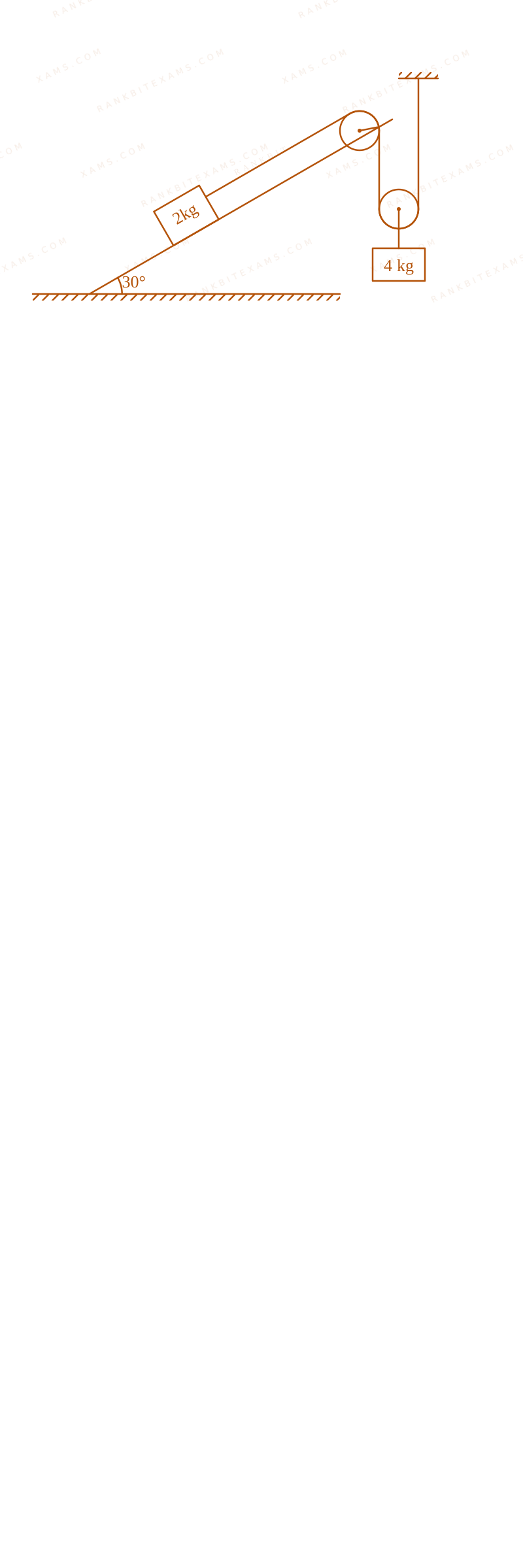
All surfaces shown in figure are assumed to be frictionless and the pulleys and the string are light. The acceleration of the block of mass 2 mathrm~kg$2 \mathrm{~kg}$ is:
Illustration of a 2kg block on a 30 degree incline attached via a pulley system to a 4kg hanging block.
A.g$g$
B.fracg3$\frac{g}{3}$
C.fracg2$\frac{g}{2}$
D.fracg4$\frac{g}{4}$
Solution & Explanation
### Related Formula
sum F = ma$\sum F = ma$a_1 = textConstraint relationtimes a_2$a_1 = \text{Constraint relation}\times a_2$
### Core Logic
Illustration of a 2kg block on a 30 degree incline attached via a pulley system to a 4kg hanging block.
Let the tension in the string attached to the 2 mathrm~kg$2 \mathrm{~kg}$ block be T$T$. By tracing the string around the movable pulley, the tension supporting the 4 mathrm~kg$4 \mathrm{~kg}$ mass becomes 2T$2T$.
From the principle of virtual work (or string constraints), if the 4 mathrm~kg$4 \mathrm{~kg}$ block moves down with an acceleration a$a$, the string shortens by 2x$2x$ on the incline side, meaning the 2 mathrm~kg$2 \mathrm{~kg}$ block moves up the incline with an acceleration of 2a$2a$.
### Step 1: Write Equations of Motion
For the 4 mathrm~kg$4 \mathrm{~kg}$ block (moving downwards):
4g - 2T = 4a$4g - 2T = 4a$40 - 2T = 4a quad dots (i)$40 - 2T = 4a \quad \dots (i)$
For the 2 mathrm~kg$2 \mathrm{~kg}$ block (moving up the incline):
T - 2g sin(30^circ) = 2(2a)$T - 2g \sin(30^\circ) = 2(2a)$T - 2(10)left(frac12right) = 4a$T - 2(10)\left(\frac{1}{2}\right) = 4a$T - 10 = 4a quad dots (ii)$T - 10 = 4a \quad \dots (ii)$
### Step 2: Solve for Acceleration
From equation (ii), we have 4a = T - 10$4a = T - 10$. Substitute this directly into equation (i) or add the appropriately multiplied equations:
40 - 2T = T - 10$40 - 2T = T - 10$3T = 50 Rightarrow T = frac503 mathrm~N$3T = 50 \Rightarrow T = \frac{50}{3} \mathrm{~N}$
Substitute T$T$ back into (ii):
frac503 - 10 = 4a$\frac{50}{3} - 10 = 4a$4a = frac203 Rightarrow a = frac53 mathrm~m/s^2$4a = \frac{20}{3} \Rightarrow a = \frac{5}{3} \mathrm{~m/s^2}$
We need the acceleration of the 2 mathrm~kg$2 \mathrm{~kg}$ block, which is 2a$2a$:
2a = 2 times left(frac53right) = frac103 mathrm~m/s^2$2a = 2 \times \left(\frac{5}{3}\right) = \frac{10}{3} \mathrm{~m/s^2}$
Since g = 10 mathrm~m/s^2$g = 10 \mathrm{~m/s^2}$, this acceleration is exactly fracg3$\frac{g}{3}$.
### Pattern Recognition
Movable pulleys double the force but halve the displacement/acceleration on the supported side. Tension on the movable pulley side is twice the tension on the single string side. Remember to explicitly solve for the requested block's specific acceleration, not just 'a'.
### Evaluation Rubric / Model Answer
null
### Chapter Mix
Class 11 Physics: Laws of Motion
Keywords:#Constraint Motion and Pulleys#JEE Main 2024 Morning Q32#Laws of Motion JEE Main 2024#Pulley acceleration#Pulley system#Inclined plane#Mass blocks#String tension
More Laws of Motion Previous-Year Questions — Page 3
A ball of mass 0.5mathrm~kg$0.5\mathrm{~kg}$ is attached to a string of length 50mathrm~cm$50\mathrm{~cm}$. The ball is rotated on a horizontal circular path about its vertical axis. The maximum tension that the string can bear is 400mathrm~N$400\mathrm{~N}$. The maximum possible value of angular velocity of the ball in mathrmrad/s$\mathrm{rad/s}$ is:
A. 1600
B. 40
C. 1000
D. 20
Solution
### Related Formula
Centripetal force configuration for simplified horizontal rotation layout:
T = momega^2 l$T = m\omega^2 l$
### Core Logic
Given values:
m = 0.5mathrm~kg$m = 0.5\mathrm{~kg}$, l = 50mathrm~cm = 0.5mathrm~m$l = 50\mathrm{~cm} = 0.5\mathrm{~m}$, T_textmax = 400mathrm~N$T_{\text{max}} = 400\mathrm{~N}$.
Equating max tension to centripetal requirement:
400 = 0.5 times omega^2 times 0.5$400 = 0.5 \times \omega^2 \times 0.5$
### Step 1: Compute Angular Velocity
400 = 0.25 omega^2$400 = 0.25 \omega^2$omega^2 = frac4000.25 = 1600$\omega^2 = \frac{400}{0.25} = 1600$omega = sqrt1600 = 40mathrm~rad/s$\omega = \sqrt{1600} = 40\mathrm{~rad/s}$
### Pattern Recognition
Ensure units are metric (50mathrm~cm to 0.5mathrm~m$50\mathrm{~cm} \to 0.5\mathrm{~m}$). Direct mapping to horizontal string projection metrics.
### Evaluation Rubric / Model Answer
null
### Chapter Mix
Class 11 Physics: Laws of Motion
Q48jee_main_2024_01_february_morningFriction
Consider a block and trolley system as shown in figure. If the coefficient of kinetic friction between the trolley and the surface is 0.04, the acceleration of the system in mathrmms^-2$\mathrm{ms}^{-2}$ is (Consider that the string is massless and unstretchable and the pulley is also massless and frictionless):
A block and trolley mass arrangement demonstrating a horizontal kinetic interface connected over a corner pulley driven by an explicit 60N forcing function loop.
A. 3
B. 4
C. 2
D. 1.2
Solution
### Related Formula
Kinetic friction force:
f_k = mu_k N = mu_k m_1 g$f_k = \mu_k N = \mu_k m_1 g$
System acceleration:
a = fracF_textpull - f_km_texttotal$a = \frac{F_{\text{pull}} - f_k}{m_{\text{total}}}$
### Core Logic
Given values:
Trolley mass m_1 = 20mathrm~kg$m_1 = 20\mathrm{~kg}$, total system mass component in frame m_texttotal = 26mathrm~kg$m_{\text{total}} = 26\mathrm{~kg}$ (from solution fraction frac60-826$\frac{60-8}{26}$).
Applied pulling force F = 60mathrm~N$F = 60\mathrm{~N}$.
mu_k = 0.04$\mu_k = 0.04$.
Calculate the kinetic friction resisting the trolley:
f_k = 0.04 times 20 times 10 = 8mathrm~N$f_k = 0.04 \times 20 \times 10 = 8\mathrm{~N}$
### Step 1: Calculate Acceleration
Using the dynamic equation for connected translation systems:
a = frac60 - 826 = frac5226 = 2mathrm~ms^-2$a = \frac{60 - 8}{26} = \frac{52}{26} = 2\mathrm{~ms}^{-2}$
### Pattern Recognition
Treat connected inline systems as a single collective mass block, balancing external driving forces against collective internal friction resistance.
### Evaluation Rubric / Model Answer
null
### Chapter Mix
Class 11 Physics: Laws of Motion
Q36jee_main_2024_29_january_eveningCircular Motion and Tension
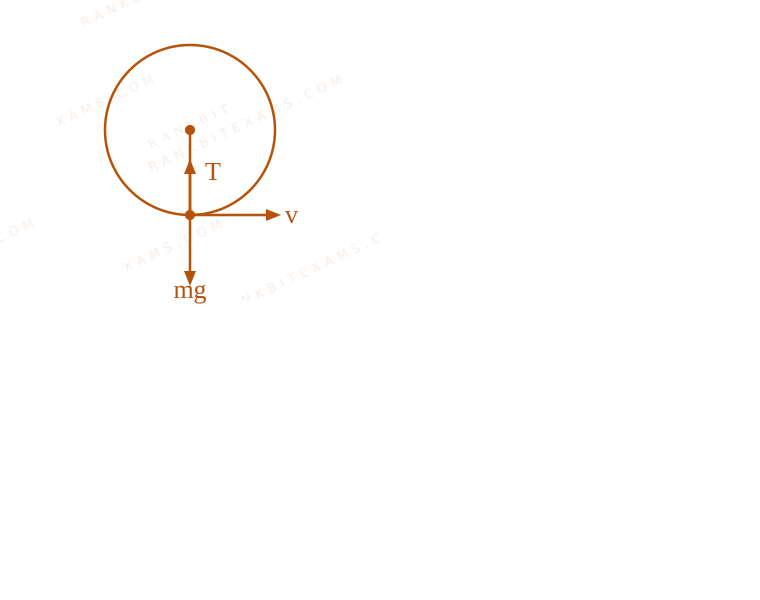
A stone of mass 900text g$900\text{ g}$ is tied to a string and moved in a vertical circle of radius 1text m$1\text{ m}$ making 10text rpm$10\text{ rpm}$. The tension in the string, when the stone is at the lowest point is (if pi^2 = 9.8$\pi^2 = 9.8$ and g = 9.8text m/s^2$g = 9.8\text{ m/s}^2$):
A.97text N$97\text{ N}$
B.9.8text N$9.8\text{ N}$
C.8.82text N$8.82\text{ N}$
D.17.8text N$17.8\text{ N}$
Solution
### Related Formula
At the lowest point of a vertical circle, the equation of motion for a mass m$m$ is:
T - mg = m r omega^2$T - mg = m r \omega^2$
Rearranging to solve for tension T$T$:
T = mg + m r omega^2$T = mg + m r \omega^2$
### Core Logic
Given data:
* Mass, m = 900text g = 0.9text kg$m = 900\text{ g} = 0.9\text{ kg}$
* Radius, r = 1text m$r = 1\text{ m}$
* Frequency, N = 10text rpm = frac1060text rps = frac16text rps$N = 10\text{ rpm} = \frac{10}{60}\text{ rps} = \frac{1}{6}\text{ rps}$
* Angular velocity, omega = 2pi N = 2pi left(frac16right) = fracpi3text rad/s$\omega = 2\pi N = 2\pi \left(\frac{1}{6}\right) = \frac{\pi}{3}\text{ rad/s}$
### Step 1: Calculate Force Values
Now we substitute our parameters into the tension equation:
T = (0.9)(9.8) + (0.9)(1)left(fracpi3right)^2$T = (0.9)(9.8) + (0.9)(1)\left(\frac{\pi}{3}\right)^2$T = 8.82 + 0.9 times fracpi^29$T = 8.82 + 0.9 \times \frac{\pi^2}{9}$
Since pi^2 = 9.8$\pi^2 = 9.8$:
T = 8.82 + 0.1 times 9.8$T = 8.82 + 0.1 \times 9.8$T = 8.82 + 0.98 = 9.80text N$T = 8.82 + 0.98 = 9.80\text{ N}$Free-body diagram of stone at lowest point in vertical circle for Q36
### Pattern Recognition
Always convert Mass to textkg$\text{kg}$ and rotational speed to textrad/s$\text{rad/s}$ first. Using the prompt constraint pi^2 = 9.8$\pi^2 = 9.8$ yields a perfect decimal addition match.
### Evaluation Rubric / Model Answer
null
### Chapter Mix
Class 11 Physics: Laws of Motion
A particle is moving in a circle of radius 50text cm$50\text{ cm}$ in such a way that at any instant the normal and tangential components of its acceleration are equal. If its speed at t = 0$t = 0$ is 4text m/s$4\text{ m/s}$, the time taken to complete the first revolution will be frac1alphaleft[ 1 - e^-2pi right]text s$\frac{1}{\alpha}\left[ 1 - e^{-2\pi} \right]\text{ s}$, where alpha =$\alpha =$ ________.
Numerical Answer.Answer: 8 to 8
Solution
### Related Formula
For a particle in circular motion:
* Normal (centripetal) acceleration: a_c = fracv^2r$a_c = \frac{v^2}{r}$
* Tangential acceleration: a_t = fracdvdt$a_t = \frac{dv}{dt}$
### Core Logic
Given a_c = a_t$a_c = a_t$:
fracv^2r = fracdvdt$\frac{v^2}{r} = \frac{dv}{dt}$int_v_0^v fracdvv^2 = int_0^t fracdtr$\int_{v_0}^{v} \frac{dv}{v^2} = \int_{0}^{t} \frac{dt}{r}$left[ -frac1v right]_v_0^v = fractr$\left[ -\frac{1}{v} \right]_{v_0}^{v} = \frac{t}{r}$-frac1v + frac1v_0 = fractr implies frac1v = frac1v_0 - fractr$-\frac{1}{v} + \frac{1}{v_0} = \frac{t}{r} \implies \frac{1}{v} = \frac{1}{v_0} - \frac{t}{r}$v = fracv_01 - fracv_0 tr$v = \frac{v_0}{1 - \frac{v_0 t}{r}}$
### Step 1: Relate Velocity to Position and Integrate
Substitute the parameters v_0 = 4text m/s$v_0 = 4\text{ m/s}$ and r = 50text cm = 0.5text m$r = 50\text{ cm} = 0.5\text{ m}$:
v = frac41 - 8t = fracdsdt$v = \frac{4}{1 - 8t} = \frac{ds}{dt}$
Integrating this to find the position s(t)$s(t)$:
int_0^s ds = int_0^t frac41 - 8t dt$\int_{0}^{s} ds = \int_{0}^{t} \frac{4}{1 - 8t} dt$s = 4 left[ fracln(1 - 8t)-8 right]_0^t = -frac12 ln(1 - 8t)$s = 4 \left[ \frac{\ln(1 - 8t)}{-8} \right]_0^t = -\frac{1}{2} \ln(1 - 8t)$
### Step 2: Solve for Time of First Revolution
To complete the first revolution, the distance covered is:
s = 2pi r = 2pi (0.5) = pitext m$s = 2\pi r = 2\pi (0.5) = \pi\text{ m}$
Equating the distance:
pi = -frac12 ln(1 - 8t)$\pi = -\frac{1}{2} \ln(1 - 8t)$-2pi = ln(1 - 8t)$-2\pi = \ln(1 - 8t)$1 - 8t = e^-2pi$1 - 8t = e^{-2\pi}$8t = 1 - e^-2pi implies t = frac18 left[ 1 - e^-2pi right]text s$8t = 1 - e^{-2\pi} \implies t = \frac{1}{8} \left[ 1 - e^{-2\pi} \right]\text{ s}$
Comparing this to frac1alphaleft[ 1 - e^-2pi right]text s$\frac{1}{\alpha}\left[ 1 - e^{-2\pi} \right]\text{ s}$, we get:
alpha = 8$\alpha = 8$
### Pattern Recognition
The condition a_t = a_c implies v fracdvds = fracv^2r implies fracdvv = fracdsr$a_t = a_c \implies v \frac{dv}{ds} = \frac{v^2}{r} \implies \frac{dv}{v} = \frac{ds}{r}$. Integrating directly gives v = v_0 e^s/r$v = v_0 e^{s/r}$. Substituting this back into v = ds/dt$v = ds/dt$ makes the final time integral much more intuitive.
### Evaluation Rubric / Model Answer
null
### Chapter Mix
Class 11 Physics: Laws of Motion
Q36jee_main_2024_27_jan_morningBanking of Tracks
A train is moving with a speed of 12text m/s$12\text{ m/s}$ on rails which are 1.5text m$1.5\text{ m}$ apart. To negotiate a curve of radius 400text m$400\text{ m}$, the height by which the outer rail should be raised with respect to the inner rail is (Given, g = 10text m/s^2$g = 10\text{ m/s}^{2}$):
A.6.0text cm$6.0\text{ cm}$
B.5.4text cm$5.4\text{ cm}$
C.4.8text cm$4.8\text{ cm}$
D.4.2text cm$4.2\text{ cm}$
Solution
### Related Formula
tantheta = fracv^2Rg$\tan\theta = \frac{v^2}{Rg}$
For small angles, tantheta approx sintheta = frachd$\tan\theta \approx \sin\theta = \frac{h}{d}$, where h$h$ is the raised height and d$d$ is the separation between the tracks.
### Core Logic
Equating the two relationships:
frachd = fracv^2Rg$\frac{h}{d} = \frac{v^2}{Rg}$frach1.5 = frac12 times 12400 times 10$\frac{h}{1.5} = \frac{12 \times 12}{400 \times 10}$
### Step 1: Compute height value
h = 1.5 times frac1444000 = 1.5 times 0.036 = 0.054text m$h = 1.5 \times \frac{144}{4000} = 1.5 \times 0.036 = 0.054\text{ m}$
Converting to centimeters:
h = 0.054 times 100 = 5.4text cm$h = 0.054 \times 100 = 5.4\text{ cm}$
### Pattern Recognition
Whenever theta$\theta$ is small, geometry permits approximating tantheta$\tan\theta$ with frachtextwidth$\frac{h}{\text{width}}$, vastly reducing computational transcendental overhead.
### Evaluation Rubric / Model Answer
null
### Chapter Mix
Class 11 Physics: Laws of Motion
More Laws of Motion Questions — jee_main_2024_30_jan_morning
We Map Every Repeating Question in Competitive Exams.
Say goodbye to generic mock test fatigue. RankBit uses smart analysis to group past exam questions into their foundational Repeating Question Types. Find chapter weightage, track repeating questions, and score higher with targeted practice.
Select Your Target Exam
Choose an exam track below to find formulas per chapter and patterns.
Syncing Exam Intelligence
Mapping formulas and patterns across all tracks…
PATH A — FULL LENGTH PRACTICE
Full Mock Test Hub
Simulate real NTA exam conditions with fully tracked mocks. Time yourself against past papers.
Under Development
PATH B — TARGETED PRACTICE
Topic-wise Practice Hub
Practice past-year questions one chapter at a time. Pick an exam → subject → chapter and get every PYQ for that topic — pulled together from all past papers — with the chapter's key formulas alongside.