JEE Main · Mathematics → Steady

Vector Algebra appeared 46 times across 3 years — 5.3% of Mathematics. This question is from Vector Angle Bisector.

Year 2026 2025 2024 Total
Questions 15 17 14 46

Let O be the origin and the position vector of A and B be 2 i+2 j+ k and 2 i+4 j+4 k respectively. If the internal bisector of ∠ AOB meets the line AB at C, then the length of OC is

Solution & Explanation

Related Formula
Internal Angle Bisector Theorem: (AC)/(CB) = | OA|| OB| Section Formula: OC = m OB + n OAm+n
Core Logic

Find the magnitudes of the position vectors OA and OB:

| OA| = √(2² + 2² + 1²) = √(4+4+1) = √(9) = 3 | OB| = √(2² + 4² + 4²) = √(4+16+16) = √(36) = 6

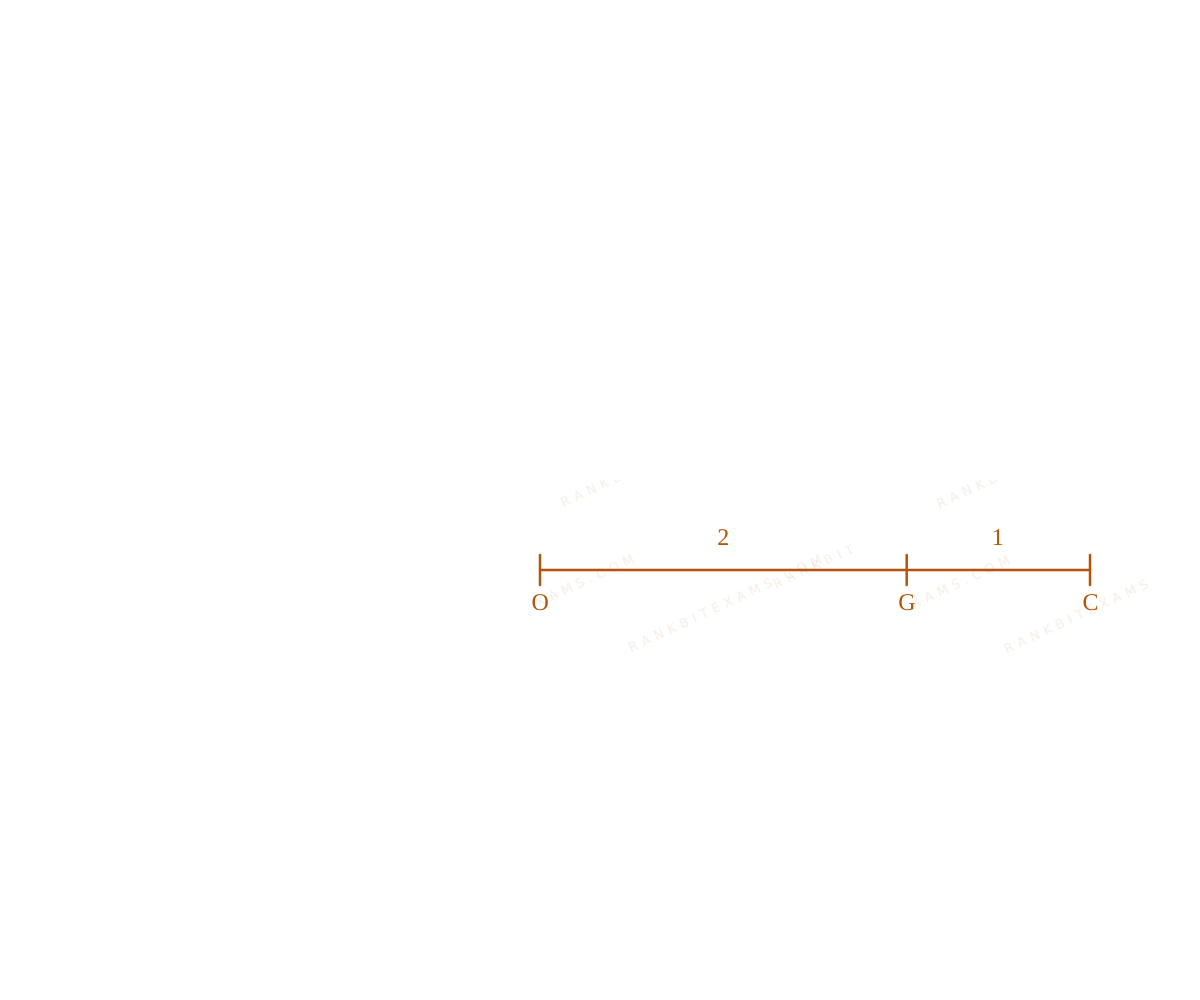
According to the internal angle bisector theorem in Δ AOB, the point C divides the segment AB in the ratio of the adjacent sides:

(AC)/(CB) = | OA|| OB| = (3)/(6) = (1)/(2)

Vector Angle Bisector

Step 1: Apply Section Formula

Using the section formula to find the position vector of C, dividing AB internally in ratio m:n = 1:2:

OC = 1( OB) + 2( OA)1 + 2 OC = 1(2 i+4 j+4 k) + 2(2 i+2 j+ k)3 OC = (2+4) i + (4+4) j + (4+2) k3 OC = 6 i + 8 j + 6 k3 = 2 i + (8)/(3) j + 2 k
Step 2: Compute Length of OC

Now, find the magnitude (length) of the vector OC:

| OC| = √(2² + ((8)/(3))² + 2²) = √(4 + (64)/(9) + 4) = √(8 + (64)/(9)) = √((72 + 64)/(9)) = √((136)/(9)) = √(4 × 34)3 = 2√(34)3
Pattern Recognition

Vector angle bisector questions invariably test the geometric property that the bisector divides the opposite side in the ratio of the side lengths. Combine this directly with the 3D coordinate section formula.

Chapter Mix

Class 12 Mathematics: Vector Algebra

Reference Study Guides

More Vector Algebra Previous-Year Questions — Page 6

Q52 jee_main_2025_07_april_evening Vector Magnitude and Operations
Let a and b be the vectors of the same magnitude such that | a + b| + | a - b|| a + b| - | a - b| = √(2) + 1. Then | a + b|²| a|² is:
  • A. 2 + 4√(2)
  • B. 1 + √(2)
  • C. 2 + √(2)
  • D. 4 + 2√(2)

Solution

Related Formula

Componendo and Dividendo rule states that if (x)/(y) = (p)/(q), then:

(x+y)/(x-y) = (p+q)/(p-q)
Core Logic

Given expression:

| a + b| + | a - b|| a + b| - | a - b| = √(2) + 11

Applying Componendo and Dividendo:

2| a + b|2| a - b| = (√(2) + 1) + 1(√(2) + 1) - 1 = √(2) + 2√(2) = 1 + √(2)

Squaring both sides:

| a + b|² = (1 + √(2))² | a - b|² | a + b|² = (3 + 2√(2)) | a - b|²
Step 1: Vector Expansion

Expanding using dot products, keeping in mind that | a| = | b|:

| a|² + | b|² + 2 a· b = (3 + 2√(2))(| a|² + | b|² - 2 a· b) 2| a|² + 2 a· b = (3 + 2√(2))(2| a|² - 2 a· b) 2| a|² (1 - (3 + 2√(2))) = -2 a· b (1 + 3 + 2√(2))

Simplifying directly leads to:

a· b| a|² = 2 + 2√(2)4 + 2√(2) = 1√(2)
Step 2: Final Calculation

We need to find | a + b|²| a|²:

| a + b|²| a|² = | a|² + | b|² + 2 a· b| a|² = 1 + 1 + 2 a· b| a|² = 2 + 2( 1√(2)) = 2 + √(2)
Pattern Recognition

Whenever symmetric sums and differences like | x|+| y| and | x|-| y| occur in ratios, Componendo-Dividendo should be applied immediately to isolate the ratio of the individual magnitudes.

Chapter Mix

Class 12 Physics: Vector Algebra Class 12 Mathematics: Vector Algebra

Q56 jee_main_2025_24_jan_evening Centroid, Orthocenter, and Circumcenter
Let the position vectors of three vertices of a $$$be4\vec{p}+\vec{q}-3\vec{r},-5\vec{p}+\vec{q}+2\vec{r}and2\vec{p}-\vec{q}+2\vec{r}If the position vectors of the orthocenter and the circumcenter of the\triangleare\frac{\vec{p}+\vec{q}+\vec{r}}{4}and\alpha\vec{p}+\beta\vec{q}+\gamma\vec{r}respectively, then\alpha+2\beta+5\gamma$ is equal to:
  • A. 3
  • B. 1
  • C. 6
  • D. 4

Solution

Related Formula
  • Centroid (G) of a $$with vertices $A, B, C$ is given by:
\vec{G} = \frac{\vec{A} + \vec{B} + \vec{C}}{3}
  • Euler's line property: The orthocenter ($O$), centroid ($G$), and circumcenter ($C$) are collinear, and $G$ divides the segment $OC$ internally in the ratio $2:1$.
Step 1: Compute the Centroid Vector

Sum the vectors of the three given vertices:

\vec{A} = 4\vec{p}+\vec{q}-3\vec{r}\vec{B} = -5\vec{p}+\vec{q}+2\vec{r}\vec{C} = 2\vec{p}-\vec{q}+2\vec{r}\vec{G} = \frac{(4 - 5 + 2)\vec{p} + (1 + 1 - 1)\vec{q} + (-3 + 2 + 2)\vec{r}}{3} = \frac{\vec{p} + \vec{q} + \vec{r}}{3}
Step 2: Apply Euler Line Section Ratio

Using the section formula ratio $O-G-C$ as $2:1$:

Euler Line section diagram for Q56 - JEE Main 2025 Evening

\vec{G} = \frac{2\vec{C} + \vec{O}}{3} \Rightarrow 3\vec{G} = 2\vec{C} + \vec{O}2\vec{C} = 3\vec{G} - \vec{O} = 3\left(\frac{\vec{p} + \vec{q} + \vec{r}}{3}\right) - \frac{\vec{p} + \vec{q} + \vec{r}}{4}2\vec{C} = (\vec{p} + \vec{q} + \vec{r}) - \frac{1}{4}(\vec{p} + \vec{q} + \vec{r}) = \frac{3}{4}(\vec{p} + \vec{q} + \vec{r})\vec{C} = \frac{3}{8}\vec{p} + \frac{3}{8}\vec{q} + \frac{3}{8}\vec{r}
Step 3: Coefficient Matching

Compare with the given circumcenter format $α p + β q + γ r$:

\alpha = \frac{3}{8}, \quad \beta = \frac{3}{8}, \quad \gamma = \frac{3}{8}

Calculate $α + 2β + 5γ$:

\frac{3}{8} + 2\left(\frac{3}{8}\right) + 5\left(\frac{3}{8}\right) = \frac{3 + 6 + 15}{8} = \frac{24}{8} = 3$
Pattern Recognition

Euler line configuration is universally

Pattern Recognition

Euler line configuration is universally $O-G-Cin2:1. Remember the mnemonic 'Oil-Gas-Company' or simply3G = 2C + O$ to prevent swapping structural coefficients under exam stress.

Chapter Mix

Class 12 Mathematics: Vector Algebra Class 11 Mathematics: Properties of Triangles

Q64 jee_main_2025_24_jan_evening Vector Triple Product and Projection
Let a=3 i- j+2 k, b= a×( i-2 k) and c= b× k. Then the projection of c-2 j on a is:
  • A. 3√(7)
  • B. √(14)
  • C. 2√(14)
  • D. 2√(7)

Solution

Related Formula

The scalar projection of vector v onto vector w is calculated as:

Projection = v · w| w|
Step 1: Calculate b

Compute the cross product using standard matrix expansion:

b = a × ( i - 2 k) = vmatrix i & j & k 3 & -1 & 2 1 & 0 & -2 vmatrix b = i(2 - 0) - j(-6 - 2) + k(0 - (-1)) = 2 i + 8 j + k
Step 2: Calculate c and c - 2 j

Perform the second cross product with unit vector k:

c = b × k = (2 i + 8 j + k) × k = 2( i × k) + 8( j × k) + 0 c = 2(- j) + 8( i) = 8 i - 2 j

Subtract 2 j:

c - 2 j = (8 i - 2 j) - 2 j = 8 i - 4 j
Step 3: Compute the projection onto a

Using the dot product formula :

Projection = ( c - 2 j) · a| a| = 8, -4, 0 · 3, -1, 2 √(3² + (-1)² + 2²) Projection = 24 + 4 + 0√(9 + 1 + 4) = 28√(14) = 2√(14)
Pattern Recognition

Keep cyclic unit cross products clear: i × k = - j and j × k = i. Missing a negative sign during basic cross multiplications ruins multi-step vector projections easily.

Chapter Mix

Class 12 Mathematics: Vector Algebra

Q51 jee_main_2025_24_jan_morning Coplanar Vectors and Vector Products
Let a = i + 2 j + 3 k , b = 3 i + j - k and \|\vec{\mathbf{c}}\| be three vectors such that c is coplanar with a and b . If the vector c is perpendicular to b and a · c = 5 , then | c| is equal to :
  • A. 13√(2)
  • B. 18
  • C. 16
  • D. √((11)/(6))

Solution

Related Formula

A vector c coplanar with a and b and perpendicular to b can be expressed using the vector triple product command template:

c = λ ( b × ( a × b)) = λ [( b · b) a - ( a · b) b]
Core Logic

First, find the dot products of the given vectors:

b · b = 3² + 1² + (-1)² = 9 + 1 + 1 = 11 a · b = (1)(3) + (2)(1) + (3)(-1) = 3 + 2 - 3 = 2

Substituting these values into the expression for c:

c = λ [11 a - 2 b] c = λ [11( i + 2 j + 3 k) - 2(3 i + j - k)] c = λ (5 i + 20 j + 35 k) = 5λ ( i + 4 j + 7 k)
Step 1: Determine Lambda

Using the given condition a · c = 5:

a · [5λ ( i + 4 j + 7 k)] = 5 5λ (1 · 1 + 2 · 4 + 3 · 7) = 5 5λ (1 + 8 + 21) = 5 30λ = 1 λ = (1)/(30)

Thus, the vector c is:

c = (5)/(30)( i + 4 j + 7 k) = (1)/(6)( i + 4 j + 7 k)
Step 2: Calculate Magnitude

The magnitude of c is evaluated as:

| c| = √(1² + 4² + 7²)6 = √(1 + 16 + 49)6 = √(66)6 = √((66)/(36)) = √((11)/(6))
Pattern Recognition

Whenever a vector is specified to be coplanar with a, b and perpendicular to b, direct setup with the cross-product template b × ( a × b) circumvents solving cumbersome linear systems of scalar variables.

Chapter Mix

Class 12 Mathematics: Vector Algebra

Q52 jee_main_2025_28_jan_evening Vector Operations and Components
Let A, B, C be three points in xy-plane, whose position vector are given by √(3) i+ j, i+√(3) j and a i+(1-a) j respectively with respect to the origin O. If the distance of the point C from the line bisecting the angle between the vectors OA and OB is 9√(2) then the sum of all the possible values of a is:
  • A. 1
  • B. 9/2
  • C. 0
  • D. 2

Solution

Related Formula

The line bisecting the angle between two symmetric vectors passing through the origin in the first quadrant is given by y = x or x - y = 0.

Distance from point (x₁, y₁) to line Ax + By + C = 0 is:

d = |Ax₁ + By₁ + C|√(A² + B²)
Core Logic

Vectors OA = √(3) i+ j and OB = i+√(3) j are symmetric about the line y = x. Therefore, the angle bisector of OA and OB is the line x - y = 0.

Point C has coordinates (a, 1 - a).

Step 1: Calculate Distance and Solve for a

The perpendicular distance from C(a, 1 - a) to x - y = 0 is:

d = |a - (1 - a)|√(1² + (-1)²) = |2a - 1|√(2)

Given that this distance is 9√(2):

|2a - 1|√(2) = 9√(2) |2a - 1| = 9

This gives two solutions:

  • 2a - 1 = 9 2a = 10 a = 5
  • 2a - 1 = -9 2a = -8 a = -4
Step 2: Find the Sum of Values

Sum of all possible values of a:

Sum = 5 + (-4) = 1
Pattern Recognition

Notice that OA and OB have swapped coordinates, meaning they are symmetric with respect to y=x. Thus, the angle bisector equation is immediate (x-y=0), simplifying the problem to a standard point-to-line distance calculation.

Chapter Mix

Class 11 Mathematics: Straight Lines Class 12 Mathematics: Vector Algebra

More Vector Algebra Questions — jee_main_2024_29_jan_morning

Practice all Vector Algebra previous-year questions →

Rankbit System
JEE Physics: Waves (+15.5%) | Electrostatics: Concentric Shells (-29.7%) | Modern Physics: Photoelectric Clones (+34.2%) | Mathematics: Definite Integrals (+18.1%) | Chemistry: Coordination Splitting (-11.4%) | JEE Physics: Waves (+15.5%) | Electrostatics: Concentric Shells (-29.7%) | Modern Physics: Photoelectric Clones (+34.2%) | Mathematics: Definite Integrals (+18.1%) | Chemistry: Coordination Splitting (-11.4%)