JEE Main · Mathematics → Steady

Vector Algebra appeared 46 times across 3 years — 5.3% of Mathematics. This question is from Vector Angle Bisector.

Year 2026 2025 2024 Total
Questions 15 17 14 46

Let O be the origin and the position vector of A and B be 2 i+2 j+ k and 2 i+4 j+4 k respectively. If the internal bisector of ∠ AOB meets the line AB at C, then the length of OC is

Solution & Explanation

Related Formula
Internal Angle Bisector Theorem: (AC)/(CB) = | OA|| OB| Section Formula: OC = m OB + n OAm+n
Core Logic

Find the magnitudes of the position vectors OA and OB:

| OA| = √(2² + 2² + 1²) = √(4+4+1) = √(9) = 3 | OB| = √(2² + 4² + 4²) = √(4+16+16) = √(36) = 6

According to the internal angle bisector theorem in Δ AOB, the point C divides the segment AB in the ratio of the adjacent sides:

(AC)/(CB) = | OA|| OB| = (3)/(6) = (1)/(2)

Vector Angle Bisector

Step 1: Apply Section Formula

Using the section formula to find the position vector of C, dividing AB internally in ratio m:n = 1:2:

OC = 1( OB) + 2( OA)1 + 2 OC = 1(2 i+4 j+4 k) + 2(2 i+2 j+ k)3 OC = (2+4) i + (4+4) j + (4+2) k3 OC = 6 i + 8 j + 6 k3 = 2 i + (8)/(3) j + 2 k
Step 2: Compute Length of OC

Now, find the magnitude (length) of the vector OC:

| OC| = √(2² + ((8)/(3))² + 2²) = √(4 + (64)/(9) + 4) = √(8 + (64)/(9)) = √((72 + 64)/(9)) = √((136)/(9)) = √(4 × 34)3 = 2√(34)3
Pattern Recognition

Vector angle bisector questions invariably test the geometric property that the bisector divides the opposite side in the ratio of the side lengths. Combine this directly with the 3D coordinate section formula.

Chapter Mix

Class 12 Mathematics: Vector Algebra

Reference Study Guides

More Vector Algebra Previous-Year Questions — Page 7

Q53 jee_main_2025_28_jan_evening Components of Vectors
If the components of a=α i+β j+γ k along and perpendicular to b=3 i+ j- k respectively, are (16)/(11)(3 i+ j- k) and (1)/(11)(-4 i-5 j-17 k), then α²+β²+γ² is equal to:
  • A. 23
  • B. 18
  • C. 16
  • D. 26

Solution

Related Formula

Any vector a can be written as the sum of its component parallel to b (along b) and its component perpendicular to b:

a = a∥ + a⊥

Magnitude squared:

| a|² = α² + β² + γ²
Core Logic

Given:

a∥ = (16)/(11)(3 i+ j- k) a⊥ = (1)/(11)(-4 i-5 j-17 k)
Step 1: Reconstruct Vector a

Add both components to find a:

a = (16)/(11)(3 i+ j- k) + (1)/(11)(-4 i-5 j-17 k) a = (1)/(11) [ (48 - 4) i + (16 - 5) j + (-16 - 17) k ] a = (1)/(11) [ 44 i + 11 j - 33 k ] = 4 i + j - 3 k

Therefore, α = 4, β = 1, γ = -3.

Step 2: Calculate Sum of Squares
α² + β² + γ² = 4² + 1² + (-3)² = 16 + 1 + 9 = 26
Pattern Recognition

Since parallel and perpendicular components are orthogonal vectors, you can also use directly | a|² = | a∥|² + | a⊥|² to save algebra step: | a∥|² = (16²)/(11²)(9+1+1) = (256)/(11), | a⊥|² = (1)/(11²)(16+25+289) = (330)/(121) = (30)/(11). Total = (286)/(11) = 26.

Chapter Mix

Class 12 Mathematics: Vector Algebra

Q55 jee_main_2025_29_jan_morning Vector Cross Product and Dot Product
Let a = 2 i - j + 3 k , b = 3 i - 5 j + k and c be a vector such that a × c = c × b and ( a + c) . ( b + c) = 168. Then the maximum value of | c|² is:
  • A. 77
  • B. 462
  • C. 308
  • D. 154

Solution

Related Formula
u × v = - v × u If u × v = 0 u ∥ v u = λ v
Core Logic

Given a × c = c × b a × c + b × c = 0

( a + b) × c = 0 c = λ( a + b)
Step 1: Compute a + b
a + b = (2+3) i + (-1-5) j + (3+1) k = 5 i - 6 j + 4 k c = λ(5 i - 6 j + 4 k) | c|² = λ²(25 + 36 + 16) = 77λ²
Step 2: Expand the Dot Product Condition
( a + c) · ( b + c) = 168 a · b + c · ( a + b) + | c|² = 168

Evaluate a · b = (2)(3) + (-1)(-5) + (3)(1) = 6 + 5 + 3 = 14. Substitute c · ( a + b) = λ | a + b|² = 77λ:

14 + 77λ + 77λ² = 168 77λ² + 77λ - 154 = 0 λ² + λ - 2 = 0 λ = 1 or λ = -2
Step 3: Maximize | c|²

Maximum value occurs when λ = -2:

| c|² = 77(-2)² = 77 × 4 = 308
Pattern Recognition

Recognize the cross-product rule inversion immediately: x × y = y × z ( x+ z) ∥ y. This linear reduction circumvents solving complex linear systems.

Chapter Mix

Class 12 Mathematics: Vector Algebra

Q8 jee_main_2024_01_february_morning Vector Triple Product
Let a=-5 i+ j-3 k, b= i+2 j-4 k and c=((( a× b)× i)× i)× i. Then c·(- i+ j+ k) is equal to:
  • A. -12
  • B. -10
  • C. -13
  • D. -15

Solution

Related Formula

Vector Triple Product Identity:

( u × v) × w = ( u · w) v - ( v · w) a
Core Logic

Given vectors a and b: First, let's find the inner vector triple product ( a × b) × i:

( a × b) × i = ( a · i) b - ( b · i) a

From the given components:

  • a · i = -5
  • b · i = 1
( a × b) × i = -5 b - a
Step 1: Substitute Vector Coordinates

Substitute coordinates of a and b into the expression:

-5 b - a = -5( i + 2 j - 4 k) - (-5 i + j - 3 k) = -5 i - 10 j + 20 k + 5 i - j + 3 k = -11 j + 23 k

Now, perform successive cross products with i:

Next Step = (-11 j + 23 k) × i = -11( j × i) + 23( k × i) = 11 k + 23 j Final Vector c = (23 j + 11 k) × i = 23( j × i) + 11( k × i) = -23 k + 11 j
Step 2: Calculate Dot Product

Now evaluate c · (- i + j + k):

c = 11 j - 23 k c · (- i + j + k) = (0)( -1) + (11)(1) + (-23)(1) = 11 - 23 = -12
Pattern Recognition

Sees: Repeated vector cross products with standard unit vectors. Shortcut: Observe that crossing a vector in the y-z plane with i rotates its components by 90° in that plane. Doing it twice returns it to the original plane with flipped coefficients and signs (v × i × i = - v).

Chapter Mix

Class 12 Mathematics: Vector Algebra

Q jee_main_2024_29_january_evening Area of Quadrilateral and Parallelogram
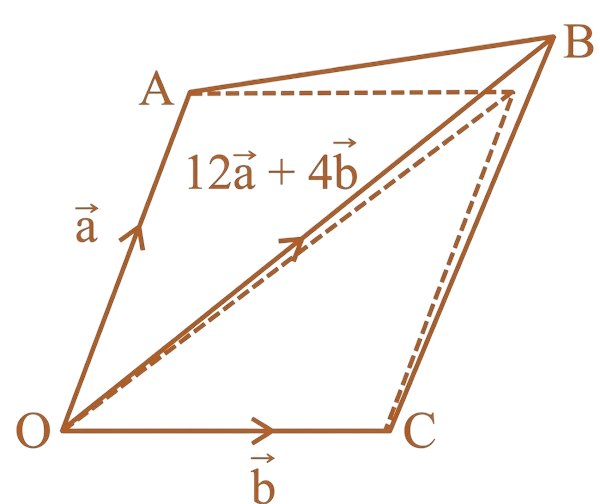
Let OA = a, OB = 12 a + 4 b and OC = b, where O is the origin. If S is the parallelogram with adjacent sides OA and OC, then the ratio of the area of the quadrilateral OABC to the area of S is equal to
  • A. 6
  • B. 10
  • C. 7
  • D. 8

Solution

Related Formula
Area of Parallelogram S = | a × b| Area of Quadrilateral OABC = Area(Δ OAB) + Area(Δ OBC)
Core Logic

Let us compute the component areas using vector cross products:

Area(Δ OAB) = (1)/(2) | OA × OB| = (1)/(2) | a × (12 a + 4 b)| = (1)/(2) |4( a × b)| = 2| a × b| Area(Δ OBC) = (1)/(2) | OB × OC| = (1)/(2) |(12 a + 4 b) × b| = (1)/(2) |12( a × b)| = 6| a × b|
Step 1: Finding Total Ratio

Adding both triangles to find the total area of the quadrilateral OABC:

Area(OABC) = 2| a × b| + 6| a × b| = 8| a × b|

Area of Quadrilateral and Parallelogram diagram for Q8 - JEE Main 2024 Evening

Dividing this total by the area of the baseline parallelogram S = | a × b|:

Ratio = 8| a × b|| a × b| = 8
Pattern Recognition

Since a × a = 0 and b × b = 0, cross product distributions yield terms with purely a × b, ensuring absolute scalability independent of vectors chosen.

Chapter Mix

Class 12 Mathematics: Vector Algebra

Q jee_main_2024_29_january_evening Vector Operations and Angles
Let a unit vector u = x i + y j + z k make angles (π)/(2), (π)/(3), and (2π)/(3) with the vectors 1√(2) i + 1√(2) k, 1√(2) j + 1√(2) k, and 1√(2) i + 1√(2) j respectively. If v = 1√(2) i + 1√(2) j + 1√(2) k, then | u - v|² is equal to
  • A. (11)/(2)
  • B. (5)/(2)
  • C. 9
  • D. 7

Solution

Related Formula
A · B = | A| | B| φ
Core Logic

Let the given baseline vectors be p₁, p₂, p₃. Note that | p₁| = | p₂| = | p₃| = 1.

  • Angle with p₁ is (π)/(2):
u · p₁ = 0 x√(2) + z√(2) = 0 x + z = 0 (i)
  • Angle with p₂ is (π)/(3):
u · p₂ = (π)/(3) y√(2) + z√(2) = (1)/(2) y + z = 1√(2) (ii)
  • Angle with p₃ is (2π)/(3):
u · p₃ = (2π)/(3) x√(2) + y√(2) = -(1)/(2) x + y = - 1√(2) (iii)
Step 1: Finding Vector Coordinates

Subtracting (ii) from (iii):

(x + y) - (y + z) = - 1√(2) - 1√(2) x - z = -√(2) (iv)

Solving (i) and (iv):

2x = -√(2) x = - 1√(2) z = 1√(2)

From (ii): y = 1√(2) - 1√(2) = 0. So, u = - 1√(2) i + 0 j + 1√(2) k.

Step 2: Evaluating the Norm Difference

Given v = 1√(2) i + 1√(2) j + 1√(2) k:

u - v = (- 1√(2) - 1√(2)) i + (0 - 1√(2)) j + ( 1√(2) - 1√(2)) k u - v = -√(2) i - 1√(2) j + 0 k

Evaluating the squared magnitude:

| u - v|² = (-√(2))² + (- 1√(2))² = 2 + (1)/(2) = (5)/(2)
Pattern Recognition

Setting up dot products systematically transforms descriptive geometric angles into solvable sets of linear equations.

Chapter Mix

Class 12 Mathematics: Vector Algebra

More Vector Algebra Questions — jee_main_2024_29_jan_morning

Practice all Vector Algebra previous-year questions →

Rankbit System
JEE Physics: Waves (+15.5%) | Electrostatics: Concentric Shells (-29.7%) | Modern Physics: Photoelectric Clones (+34.2%) | Mathematics: Definite Integrals (+18.1%) | Chemistry: Coordination Splitting (-11.4%) | JEE Physics: Waves (+15.5%) | Electrostatics: Concentric Shells (-29.7%) | Modern Physics: Photoelectric Clones (+34.2%) | Mathematics: Definite Integrals (+18.1%) | Chemistry: Coordination Splitting (-11.4%)