JEE Main · Mathematics → Steady

Vector Algebra appeared 46 times across 3 years — 5.3% of Mathematics. This question is from Vector Angle Bisector.

Year 2026 2025 2024 Total
Questions 15 17 14 46

Let O be the origin and the position vector of A and B be 2 i+2 j+ k and 2 i+4 j+4 k respectively. If the internal bisector of ∠ AOB meets the line AB at C, then the length of OC is

Solution & Explanation

Related Formula
Internal Angle Bisector Theorem: (AC)/(CB) = | OA|| OB| Section Formula: OC = m OB + n OAm+n
Core Logic

Find the magnitudes of the position vectors OA and OB:

| OA| = √(2² + 2² + 1²) = √(4+4+1) = √(9) = 3 | OB| = √(2² + 4² + 4²) = √(4+16+16) = √(36) = 6

According to the internal angle bisector theorem in Δ AOB, the point C divides the segment AB in the ratio of the adjacent sides:

(AC)/(CB) = | OA|| OB| = (3)/(6) = (1)/(2)

Vector Angle Bisector

Step 1: Apply Section Formula

Using the section formula to find the position vector of C, dividing AB internally in ratio m:n = 1:2:

OC = 1( OB) + 2( OA)1 + 2 OC = 1(2 i+4 j+4 k) + 2(2 i+2 j+ k)3 OC = (2+4) i + (4+4) j + (4+2) k3 OC = 6 i + 8 j + 6 k3 = 2 i + (8)/(3) j + 2 k
Step 2: Compute Length of OC

Now, find the magnitude (length) of the vector OC:

| OC| = √(2² + ((8)/(3))² + 2²) = √(4 + (64)/(9) + 4) = √(8 + (64)/(9)) = √((72 + 64)/(9)) = √((136)/(9)) = √(4 × 34)3 = 2√(34)3
Pattern Recognition

Vector angle bisector questions invariably test the geometric property that the bisector divides the opposite side in the ratio of the side lengths. Combine this directly with the 3D coordinate section formula.

Chapter Mix

Class 12 Mathematics: Vector Algebra

Reference Study Guides

More Vector Algebra Previous-Year Questions — Page 5

Q69 jee_main_2025_29_jan_evening Vector Products and Angles
Let a be a unit vector perpendicular to the vectors b = i -2 j +3 k and c = 2 i +3 j - k, and makes an angle of ⁻¹(-(1)/(3)) with the vector i + j + k. If a makes an angle of (π)/(3) with the vector i +α j + k, then the value of α is :
  • A. -√(3)
  • B. √(6)
  • C. -√(6)
  • D. √(3)

Solution

Related Formula

Cross product for vector perpendicular direction alignment:

u = b × c

Angle projection formula:

θ = a · v| a|| v|
Core Logic

Compute cross product of b and c:

b × c = vmatrix i & j & k 1 & -2 & 3 2 & 3 & -1 vmatrix = -7 i + 7 j + 7 k = -7( i - j - k)

Hence, unit vector a matches form:

a = ± i - j - k√(3)
Step 1: Isolate Core Angle Direction

Check conditions against vector v = i + j + k: Using a = i - j - k√(3):

θ = 1 - 1 - 1√(3)√(3) = -(1)/(3)

This confirms the direction for a.

Step 2: Solve for Unknown Scalar Variable

Now compute angle with vector i + α j + k for θ = (π)/(3):

(π)/(3) = 1√(3) · 1 - α - 1√(2 + α²) (1)/(2) = -α√(3)√(α² + 2)

Since left hand side is positive, α must be strictly negative. Squaring both sides:

(1)/(4) = (α²)/(3(α² + 2)) 3α² + 6 = 4α² α² = 6

Since α < 0, α = -√(6).

Pattern Recognition

Keep strict track of signs when dealing with algebra containing square roots. Checking value constraints early on allows you to drop phantom positive/negative branches seamlessly.

Chapter Mix

Class 12 Mathematics: Vector Algebra
Q jee_main_2025_28_jan_morning Vector Dot and Cross Products
Let a = i + j + k, b = 2 i +2 j + k and d = a× b. If c is a vector such that a. c = | c |, | c -2 a|² = 8 and the angle between d and vecc is (π)/(4), then |10 - 3 b. c| + |vecd× vecc|² is equal to ....
Numerical Answer. Answer: 6 to 6

Solution

Related Formula

Vector magnitude expansion identity:

| u - v|² = | u|² + | v|² - 2( u · v)
Core Logic

Calculate the reference vector values: a = i + j + k | a|² = 3 b = 2 i + 2 j + k d = a × b = - i + j | d|² = 2

Expanding | c - 2 a|² = 8:

| c|² + 4| a|² - 4( a · c) = 8

Substituting | a|² = 3 and a · c = | c|:

| c|² - 4| c| + 4 = 0 (| c| - 2)² = 0 | c| = 2
Step 1: Evaluating the Cross Product Vector Component

Using the given angle (π)/(4) between d and c:

| d × c|² = (| d|| c| (π)/(4))² = (√(2) · 2 · 1√(2))² = 4
Step 2: Solving for the Vector Dot Product

Expanding using standard vector identities yields b · c = (8)/(3).

Substituting this back into the target expression:

Value = |10 - 3((8)/(3))| + 4 = |10 - 8| + 4 = 6
Pattern Recognition

Recognizing a perfect square trinomial (x² - 4x + 4 = 0) instantly isolates the unknown vector magnitude.

Chapter Mix

Class 12 Maths: Vectors

Q73 jee_main_2025_03_april_morning Vector Triple Products and Vector Equations
Let a = i + j + k, b = 3 i + 2 j - k, c = λ j + μ k and d be a unit vector such that a × d = b × d and c · d = 1. If c is perpendicular to a, then |3λ d + μ c|² is equal to:
Numerical Answer. Answer: 5 to 5

Solution

Related Formula

Vector cross distribution property:

( a - b) × d = 0 d ∥ ( a - b)
Core Logic

Gather cross products to solve for collineation lines:

( a - b) × d = 0 d = t( a - b)

Compute the baseline difference vector:

a - b = (1-3) i + (1-2) j + (1 - (-1)) k = -2 i - j + 2 k d = t(-2 i - j + 2 k)

Since d is a unit vector:

|t| · √((-2)² + (-1)² + 2²) = 1 3|t| = 1 |t| = (1)/(3)
Step 1: Applying orthogonality constraints

Using orthogonal information given for vectors c and a:

c · a = 0 (0)(1) + λ(1) + μ(1) = 0 μ = -λ c = λ( j - k) | c|² = 2λ²

Use product condition c · d = 1 to isolate scalar values:

t(-2 i - j + 2 k) · λ( j - k) = 1 tλ(-1 - 2) = 1 -3tλ = 1 tλ = -(1)/(3)

Since |t|² = (1)/(9), squaring components yields: λ² = 1

Step 2: Vector magnitude resolution

Expand target expression using standard inner dot product expansions:

|3λ d + μ c|² = 9λ²| d|² + μ²| c|² + 6λμ( d · c)

Substitute values evaluated throughout sections:

= 9(1)(1) + (λ)²(2λ²) + 6λ(-λ)(1) = 9 + 2λ⁴ - 6λ² = 9 + 2(1) - 6(1) = 5
Pattern Recognition

Translating vector cross equalities directly into linear scale parameter multipliers prevents manual determinant expansions, leaving clean system variables behind.

Chapter Mix

Class 12 Mathematics: Vector Algebra

Q jee_main_2025_04_april_evening Properties of Vectors in Triangles
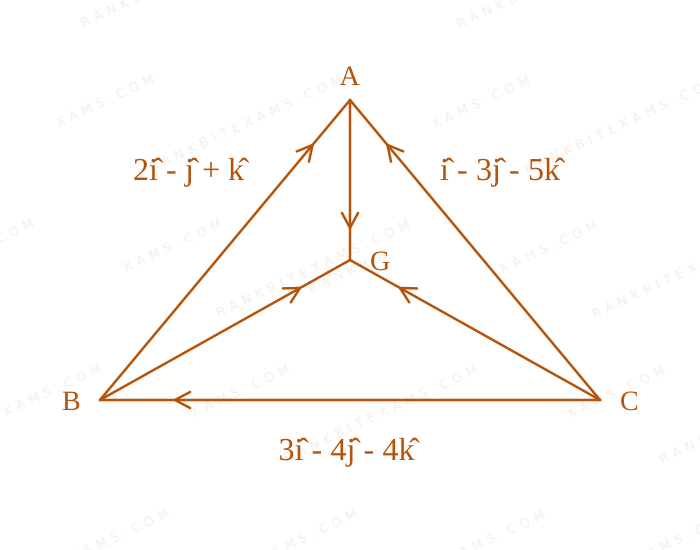
Let the three sides of a triangle ABC be given by the vectors 2 i - j + k, i - 3 j - 5 k, and 3 i - 4 j - 4 k. Let G be the centroid of the triangle ABC. Then 6(| AG|² + | BG|² + | CG|²) is equal to
Numerical Answer. Answer: 164 to 164

Solution

Core Logic

Let the vertices of the triangle be A, B, and C. The vectors representing the side paths are:

AB = 2 i - j + k CA = i - 3 j - 5 k CB = 3 i - 4 j - 4 k

Notice that AB + CA = (2+1) i + (-1-3) j + (1-5) k = 3 i - 4 j - 4 k = CB. This structurally validates vector addition rules.

Vector algebra diagram for Q75 - JEE Main 2025 Evening

Step 1: Finding Position Vectors relative to A

Let's set vertex A as the origin origin point (Position vector A = 0):

  • Position vector of B: B = 2 i - j + k
  • Position vector of C: Since CA = A - C = - C C = - i + 3 j + 5hatk
  • Now, calculate the position vector of the centroid G:

G = A + B + C3 = 0 + (2 i - j + k) + (- i + 3 j + 5 k)3 = (1)/(3)( i + 2 j + 6 k)
Step 2: Calculating Squared Lengths to the Centroid

Let's find each individual vector distance block:

  • AG = G - A = (1)/(3)( i + 2 j + 6 k) | AG|² = (1)/(9)(1² + 2² + 6²) = (41)/(9)
  • BG = G - B = ((1)/(3)-2) i + ((2)/(3)+1) j + (2-1) k = -(5)/(3) i + (5)/(3) j + 1 k
| BG|² = (-(5)/(3))² + ((5)/(3))² + 1² = (25)/(9) + (25)/(9) + 1 = (59)/(9)
  • CG = G - C = ((1)/(3)+1) i + ((2)/(3)-3) j + (2-5) k = (4)/(3) i - (7)/(3) j - 3 k
| CG|² = ((4)/(3))² + (-(7)/(3))² + (-3)² = (16)/(9) + (49)/(9) + 9 = (146)/(9)
Step 3: Final Targeted Evaluation

Summing the squared values and multiplying by 6:

Value = 6 [ | AG|² + | BG|² + | CG|² ] = 6 [ (41)/(9) + (59)/(9) + (146)/(9) ] Value = 6 × (246)/(9) = 2 × (246)/(3) = 2 × 82 = 164
Pattern Recognition

Setting one vector node as the origin point (A = 0) heavily dampens intermediate coordinate math steps, avoiding dealing with an absolute baseline origin orientation.

Chapter Mix

Class 12 Mathematics: Vector Algebra

Q64 jee_main_2025_04_april_morning Components of Vectors
Consider two vectors u = 3 i - j and v = 2 i + j - λ k, where λ > 0. The angle between them is given by ⁻¹( √(5)2sqrt7). Let v = v₁ + v₂, where v₁ is parallel to u and v₂ is perpendicular to u. Then the value | v₁|² + | v₂|² is equal to
  • A. (23)/(2)
  • B. 14
  • C. (25)/(2)
  • D. 10

Solution

Related Formula

By orthogonal vector decomposition (Pythagorean property):

| v|² = | v₁|² + | v₂|² when v₁ · v₂ = 0
Core Logic

Compute λ using dot product formula:

θ = u · v| u|| v| √(5)2√(7) = 3(2) + (-1)(1)√(3² + (-1)²) √(2² + 1² + (-λ)²) √(5)2√(7) = 5√(10)√(5 + λ²) 12√(7) = √(5)√(10)√(5 + λ²) = 1√(2)√(5 + λ²)
Step 1: Solve for lambda

Square both sides of equation:

(1)/(28) = (1)/(2(5 + λ²)) 2(5 + λ²) = 28 5 + λ² = 14 λ² = 9 λ = 3

Since v = 2 i + j - 3 k.

Step 2: Apply Identity

Since components are orthogonal, direct magnitude squared holds:

| v₁|² + | v₂|² = | v|² = 2² + 1² + (-3)² = 4 + 1 + 9 = 14
Pattern Recognition

Do not waste time explicitly projecting components v₁ and v₂ if only the sum of their squared magnitudes is requested. The scalar length matches the total vector length invariant under any orthogonal basis change.

Chapter Mix

Class 12 Mathematics: Vector Algebra

More Vector Algebra Questions — jee_main_2024_29_jan_morning

Practice all Vector Algebra previous-year questions →

Rankbit System
JEE Physics: Waves (+15.5%) | Electrostatics: Concentric Shells (-29.7%) | Modern Physics: Photoelectric Clones (+34.2%) | Mathematics: Definite Integrals (+18.1%) | Chemistry: Coordination Splitting (-11.4%) | JEE Physics: Waves (+15.5%) | Electrostatics: Concentric Shells (-29.7%) | Modern Physics: Photoelectric Clones (+34.2%) | Mathematics: Definite Integrals (+18.1%) | Chemistry: Coordination Splitting (-11.4%)