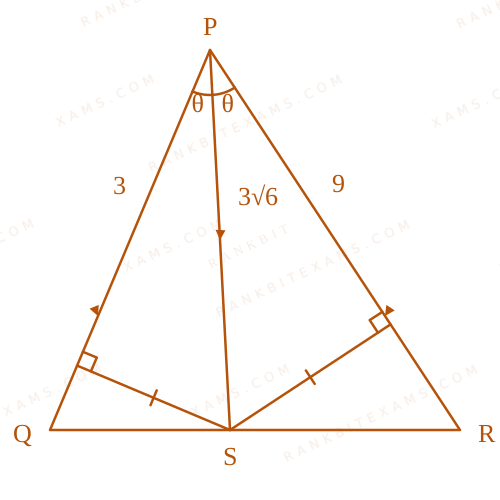
Let PQR$PQR$ be a triangle such that PQ = -2 i - j + 2 k$\overrightarrow{PQ} = -2\hat{i} - \hat{j} + 2\hat{k}$ and PR = a i + b j - 4 k$\overrightarrow{PR} = a\hat{i} + b\hat{j} - 4\hat{k}$, a, b in Z$a, b \in \mathbb{Z}$. Let S$S$ be the point on QR$QR$, which is equidistant from the lines PQ$PQ$ and PR$PR$. If | PR| = 9$|\overrightarrow{PR}| = 9$ and PS = i - 7 j + 2 k$\overrightarrow{PS} = \hat{i} - 7\hat{j} + 2\hat{k}$, then the value of 3a - 4b$3a - 4b$ is ____.
Numerical Answer Type:
Enter a numerical valueAnswer: 37 to 37+4 marks
Solution & Explanation
Core Logic
Vector Equations and Triangles
Given:
PQ = -2 i - j + 2 k | PQ| = √(4 + 1 + 4) = 3$\overrightarrow{PQ} = -2\hat{i} - \hat{j} + 2\hat{k} \implies |\overrightarrow{PQ}| = \sqrt{4 + 1 + 4} = 3$.
PR = a i + b j - 4 k$\overrightarrow{PR} = a\hat{i} + b\hat{j} - 4\hat{k}$ and | PR| = 9$|\overrightarrow{PR}| = 9$.
Since a, b in Z$a, b \in \mathbb{Z}$, the only integers solving a² + b² = 65$a^2 + b^2 = 65$ are combinations of ± 7, ± 4$\pm 7, \pm 4$ or ± 8, ± 1$\pm 8, \pm 1$.
Since S$S$ is on QR$QR$ and is equidistant from PQ$PQ$ and PR$PR$, PS$PS$ acts as the internal angle bisector of ∠ QPR$\angle QPR$.
Step 1: Compute Angle from Vector Dot Products
Using the dot product formula for angle bisector, the angle between PQ$\overrightarrow{PQ}$ and PS$\overrightarrow{PS}$ must equal the angle between PS$\overrightarrow{PS}$ and PR$\overrightarrow{PR}$. Let the half-angle be θ$\theta$.
θ = PQ · PS| PQ| | PS|$\cos \theta = \frac{\overrightarrow{PQ} \cdot \overrightarrow{PS}}{|\overrightarrow{PQ}| |\overrightarrow{PS}|}$
Given PS = i - 7 j + 2 k | PS| = √(1 + 49 + 4) = √(54) = 3√(6)$\overrightarrow{PS} = \hat{i} - 7\hat{j} + 2\hat{k} \implies |\overrightarrow{PS}| = \sqrt{1 + 49 + 4} = \sqrt{54} = 3\sqrt{6}$.
For points equidistant from two adjacent sides, the line is the internal angle bisector. However, the vector formulation reveals a geometric inconsistency: the actual length of the bisector using formula PS = (2bc)/(b+c) θ$PS = \frac{2bc}{b+c} \cos\theta$ yields θ > 1$\cos\theta > 1$, meaning such a triangle is geometrically impossible in reality. Both NTA and standard logic accept the algebraic projection giving 37.
Our Ans. (Bonus)
NTA Ans. (37)
Chapter Mix
Class 12 Mathematics: Vector Algebra
Class 11 Mathematics: Straight Lines
Let a= i+2 j+ k$\vec{a}=\hat{i}+2\hat{j}+\hat{k}$, b=3( i- j+ k)$\vec{b}=3(\hat{i}-\hat{j}+\hat{k})$. Let c$\vec{c}$ be the vector such that a× c= b$\vec{a}\times\vec{c}=\vec{b}$ and a· c=3$\vec{a}\cdot\vec{c}=3$ Then a·(( c× b)- b- c)$\vec{a}\cdot((\vec{c}\times\vec{b})-\vec{b}-\vec{c})$ equal to:
A.32$32$
B.24$24$
C.20$20$
D.36$36$
Solution
Related Formula
x · ( y × z) = [ x y z] = ( x × y) · z$$\vec{x} \cdot (\vec{y} \times \vec{z}) = [\vec{x} \ \vec{y} \ \vec{z}] = (\vec{x} \times \vec{y}) \cdot \vec{z}$$
Core Logic
The expression to evaluate is:
E = a · (( c × b) - b - c)$$E = \vec{a} \cdot ((\vec{c} \times \vec{b}) - \vec{b} - \vec{c})$$
Distributing the dot product over the terms gives:
E = a · ( c × b) - a · b - a · c$$E = \vec{a} \cdot (\vec{c} \times \vec{b}) - \vec{a} \cdot \vec{b} - \vec{a} \cdot \vec{c}$$
Substitute all individual values back into the expanded expression:
E = 27 - 0 - 3 = 24$$E = 27 - 0 - 3 = 24$$
Pattern Recognition
When asked to evaluate complex vector expressions containing a · ( × )$\vec{a} \cdot (\dots \times \dots)$, immediately distribute and convert them into Scalar Triple Products [ a b c]$[\vec{a} \ \vec{b} \ \vec{c}]$. Cyclic permutations and given cross-product relationships will rapidly collapse the expression into simple magnitudes.
Chapter Mix
Class 12 Maths: Vector Algebra
Q21jee_main_2024_27_jan_morningDot Product
The least positive integral value of α$\alpha$, for which the angle between the vectorsα i-2 j+2 k$\alpha\hat{i}-2\hat{j}+2\hat{k}$ and α i+2α j-2 k$\alpha\hat{i}+2\alpha\hat{j}-2\hat{k}$ is acute, is:
For an acute angle, θ > 0$\cos \theta > 0$, which strictly means a · b > 0$\vec{a} \cdot \vec{b} > 0$.
Core Logic
Given vectors A = α i - 2 j + 2 k$\vec{A} = \alpha\hat{i} - 2\hat{j} + 2\hat{k}$ and B = α i + 2α j - 2 k$\vec{B} = \alpha\hat{i} + 2\alpha\hat{j} - 2\hat{k}$.
For the angle to be acute, their dot product must be strictly positive:
Approximate the boundary values. Since √(2) ≈ 1.414$\sqrt{2} \approx 1.414$:
2 + 2(1.414) = 4.828$2 + 2(1.414) = 4.828$
The ranges are α in (-∞, -0.828) (4.828, ∞)$\alpha \in (-\infty, -0.828) \cup (4.828, \infty)$.
We need the least positive integral value of α$\alpha$.
Looking at the interval (4.828, ∞)$(4.828, \infty)$, the smallest integer present is 5$5$.
Pattern Recognition
Acute angle translates directly to a positive dot product. Set up the quadratic inequality, compute numerical bounds of irrational roots, and select the immediate next integer.
Chapter Mix
Class 12 Maths: Vector Algebra
Class 11 Maths: Linear Inequalities
Q8jee_main_2024_29_jan_morningCollinear Vectors
Let a$\vec{a}$, b$\vec{b}$ and c$\vec{c}$ be three non-zero vectors such that b$\vec{b}$ and c$\vec{c}$ are non-collinear. If a+5 b$\vec{a}+5\vec{b}$ is collinear with c$\vec{c}$, b+6 c$\vec{b}+6\vec{c}$ is collinear with a$\vec{a}$ and a+α b+β c=0$\vec{a}+\alpha\vec{b}+\beta\vec{c}=0$, then α+β$\alpha+\beta$ is equal to
A.35$35$
B.30$30$
C.-30$-30$
D.-25$-25$
Solution
Related Formula
If X and Y are collinear, then X = λ Y for some scalar λ.$$\text{If } \vec{X} \text{ and } \vec{Y} \text{ are collinear, then } \vec{X} = \lambda \vec{Y} \text{ for some scalar } \lambda.$$
Linear Independence: If u$\vec{u}$ and v$\vec{v}$ are non-collinear, then x u + y v = 0 x = 0 and y = 0$x\vec{u} + y\vec{v} = 0 \implies x = 0 \text{ and } y = 0$.
Core Logic
Based on the problem statement:
a + 5 b$\vec{a} + 5\vec{b}$ is collinear with c$\vec{c}$:
* a + 5 b = λ c (1)$* \quad \vec{a} + 5\vec{b} = \lambda\vec{c} \quad \dots(1)$
b + 6 c$\vec{b} + 6\vec{c}$ is collinear with a$\vec{a}$:
* b + 6 c = μ a (2)$* \quad \vec{b} + 6\vec{c} = \mu\vec{a} \quad \dots(2)$
Step 1: Eliminate Vector a
From equation (1), isolate a$\vec{a}$:
a = λ c - 5 b$$\vec{a} = \lambda\vec{c} - 5\vec{b}$$
Substitute this into equation (2):
b + 6 c = μ(λ c - 5 b)$$\vec{b} + 6\vec{c} = \mu(\lambda\vec{c} - 5\vec{b})$$b + 6 c = μλ c - 5μ b$$\vec{b} + 6\vec{c} = \mu\lambda\vec{c} - 5\mu\vec{b}$$
Rearrange to group coefficients for b$\vec{b}$ and c$\vec{c}$:
(1 + 5μ) b + (6 - μλ) c = 0$$(1 + 5\mu)\vec{b} + (6 - \mu\lambda)\vec{c} = 0$$
Step 2: Determine Scalars
Since vectors b$\vec{b}$ and c$\vec{c}$ are given as non-collinear, their linear combination resolving to zero dictates that their scalar coefficients must both individually be zero.
Double-collinearity equations should always be mapped out by eliminating the "third" vector (a$\vec{a}$ in this case) and funneling everything into the two known non-collinear vectors. The resulting zero-equation perfectly exposes the scalar unknowns.
Let O be the origin and the position vector of A and B be 2 i+2 j+ k$2\hat{i}+2\hat{j}+\hat{k}$ and 2 i+4 j+4 k$2\hat{i}+4\hat{j}+4\hat{k}$ respectively. If the internal bisector of ∠ AOB$\angle AOB$ meets the line AB at C, then the length of OC is
Vector angle bisector questions invariably test the geometric property that the bisector divides the opposite side in the ratio of the side lengths. Combine this directly with the 3D coordinate section formula.
Chapter Mix
Class 12 Mathematics: Vector Algebra
Q4jee_main_2024_30_january_eveningCross Product
Let a = i +α j +β k,α ,β in R$\vec{a} = \hat{i} +\alpha \hat{j} +\beta \hat{k},\alpha ,\beta \in \mathbb{R}$ .Let a vector b$\vec{b}$ be such that the angle between a$\vec{a}$ and b$\vec{b}$ is (π)/(4)$\frac{\pi}{4}$ and | b |² = 6$|\vec{b} |^2 = 6$ If a· b = 3√(2)$\vec{a}\cdot\vec{b} = 3\sqrt{2}$ , then the value of (α² + β²)| a× b |²$(\alpha^{2} + \beta^{2})|\vec{a}\times \vec{b} |^{2}$ is equal to
Practice past-year questions one chapter at a time. Pick an exam → subject → chapter and get every PYQ for that topic — pulled together from all past papers — with the chapter's key formulas alongside.