Core Logic
For the hyperbola (x²)/(8) - (y²)/(8 ²θ) = 1$\frac{x^2}{8} - \frac{y^2}{8\cos^2\theta} = 1$:
a² = 8, b² = 8 ²θ$a^2 = 8, b^2 = 8\cos^2\theta$
Eccentricity e₁ = √(1 + (b²)/(a²)) = √(1 + (8 ²θ)/(8)) = √(1 + ²θ)$e_1 = \sqrt{1 + \frac{b^2}{a^2}} = \sqrt{1 + \frac{8\cos^2\theta}{8}} = \sqrt{1 + \cos^2\theta}$.
Latus rectum ₁ = (2b²)/(a) = 2(8 ²θ)2√(2) = 4√(2) ²θ$\ell_1 = \frac{2b^2}{a} = \frac{2(8\cos^2\theta)}{2\sqrt{2}} = 4\sqrt{2}\cos^2\theta$.
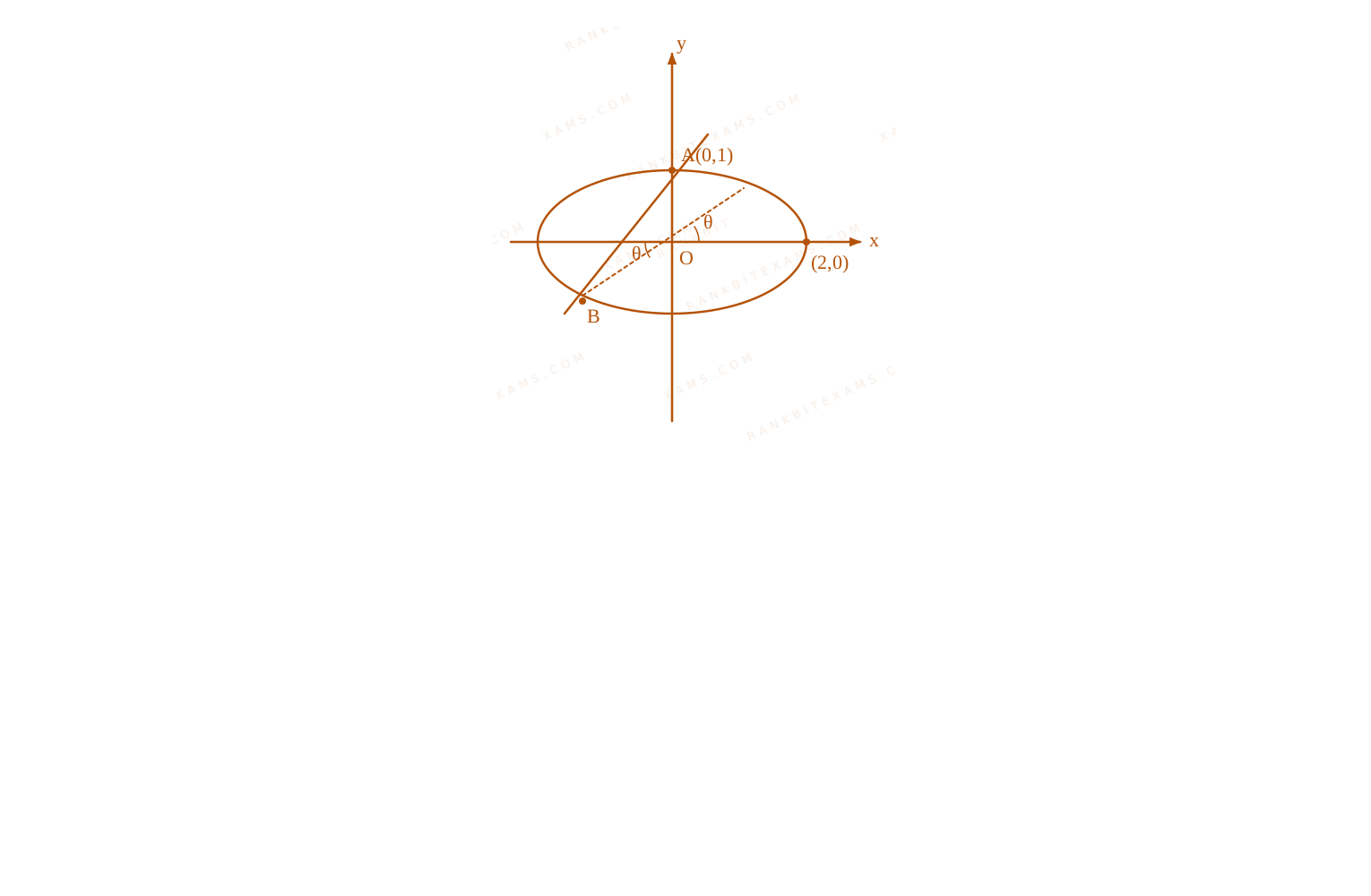
For the ellipse (x²)/(6 ²θ) + (y²)/(6) = 1$\frac{x^2}{6\cos^2\theta} + \frac{y^2}{6} = 1$:
Here a² = 6 ²θ, b² = 6$a^2 = 6\cos^2\theta, b^2 = 6$. Since θ in (0, π/2)$\theta \in (0, \pi/2)$, 6 > 6 ²θ$6 > 6\cos^2\theta$, so the major axis is along the y-axis.
Eccentricity e₂ = √(1 - (a²)/(b²)) = √(1 - (6 ²θ)/(6)) = √(1 - ²θ) = θ$e_2 = \sqrt{1 - \frac{a^2}{b^2}} = \sqrt{1 - \frac{6\cos^2\theta}{6}} = \sqrt{1 - \cos^2\theta} = \sin\theta$.
Latus rectum ₂ = (2a²)/(b) = 2(6 ²θ)√(6) = 2√(6) ²θ$\ell_2 = \frac{2a^2}{b} = \frac{2(6\cos^2\theta)}{\sqrt{6}} = 2\sqrt{6}\cos^2\theta$.
Step 1: Solve for Theta
Given relation: e₁² = e₂² ( ²θ + 1)$e_1^2 = e_2^2 (\sec^2\theta + 1)$
1 + ²θ = ²θ (1 + (1)/( ²θ))$$ 1 + \cos^2\theta = \sin^2\theta \left(1 + \frac{1}{\cos^2\theta}\right) $$
1 + ²θ = ²θ + ²θ$$ 1 + \cos^2\theta = \sin^2\theta + \tan^2\theta $$
Replace ²θ$\sin^2\theta$ with 1 - ²θ$1 - \cos^2\theta$:
1 + ²θ = 1 - ²θ + ²θ$$ 1 + \cos^2\theta = 1 - \cos^2\theta + \tan^2\theta $$
2 ²θ = ²θ = ( ²θ)/( ²θ)$$ 2\cos^2\theta = \tan^2\theta = \frac{\sin^2\theta}{\cos^2\theta} $$
2 ⁴θ = 1 - ²θ 2 ⁴θ + ²θ - 1 = 0$$ 2\cos^4\theta = 1 - \cos^2\theta \implies 2\cos^4\theta + \cos^2\theta - 1 = 0 $$
Factorizing:
(2 ²θ - 1)( ²θ + 1) = 0$$ (2\cos^2\theta - 1)(\cos^2\theta + 1) = 0 $$
Since ²θ + 1 ≠ 0$\cos^2\theta + 1 \neq 0$, we have 2 ²θ = 1 ²θ = (1)/(2)$2\cos^2\theta = 1 \implies \cos^2\theta = \frac{1}{2}$.
Since θ in (0, π/2)$\theta \in (0, \pi/2)$, θ = (π)/(4)$\theta = \frac{\pi}{4}$.
Step 2: Evaluate All Variables
For θ = π/4$\theta = \pi/4$:
e₁ = √(1 + 1/2) = √(3/2)$e_1 = \sqrt{1 + 1/2} = \sqrt{3/2}$
e₂ = (π/4) = 1/√(2)$e_2 = \sin(\pi/4) = 1/\sqrt{2}$
₁ = 4√(2)(1/2) = 2√(2)$\ell_1 = 4\sqrt{2}(1/2) = 2\sqrt{2}$
₂ = 2√(6)(1/2) = √(6)$\ell_2 = 2\sqrt{6}(1/2) = \sqrt{6}$
²θ = 1$\tan^2\theta = 1$
Step 3: Final Calculation
Evaluate the target expression:
(( ₁ ₂)/(e₁ e₂)) ² θ = 2√(2) · √(6)√(3/2) · 1/√(2) · 1$$ \left(\frac{\ell_1 \ell_2}{e_1 e_2}\right) \tan^2 \theta = \frac{2\sqrt{2} \cdot \sqrt{6}}{\sqrt{3/2} \cdot 1/\sqrt{2}} \cdot 1 $$
Numerator: 2√(12) = 4√(3)$2\sqrt{12} = 4\sqrt{3}$
Denominator: √(3/4) = √(3)2$\sqrt{3/4} = \frac{\sqrt{3}}{2}$
Result = 4√(3) √(3)2 = 8$\frac{4\sqrt{3}}{\frac{\sqrt{3}}{2}} = 8$
Chapter Mix
Class 11 Mathematics: Conic Sections