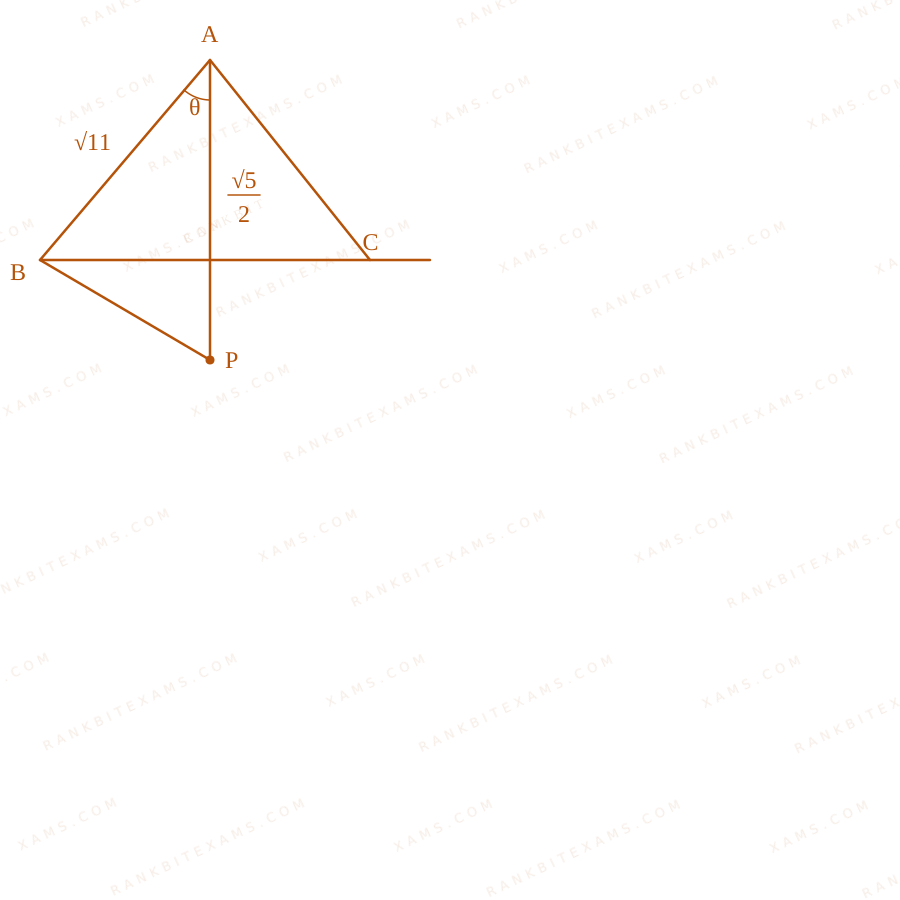
Let P$P$ be a point in the plane of the vector AB = 3 i + j - k$\overrightarrow{AB} = 3\hat{i} + \hat{j} - \hat{k}$ and AC = i - j + 3 k$\overrightarrow{AC} = \hat{i} - \hat{j} + 3\hat{k}$ such that P$P$ is equidistant from the linesAB$AB$ and AC$AC$. If | AP| = √(5)2$|\overrightarrow{AP}| = \frac{\sqrt{5}}{2}$, then the area of the triangle ABP$ABP$ is:
A.2$2$
B.(3)/(2)$\frac{3}{2}$
C.√(30)4$\frac{\sqrt{30}}{4}$
D.√(26)4$\frac{\sqrt{26}}{4}$
Solution & Explanation
Core Logic
Since P$P$ is equidistant from AB$AB$ and AC$AC$, AP$AP$ must lie on the angle bisector of ∠ BAC$\angle BAC$.
Let the angle between vectors AB$\overrightarrow{AB}$ and AC$\overrightarrow{AC}$ be 2θ$2\theta$.
We need θ$\sin \theta$ to find the perpendicular distance from P$P$ to AB$AB$ (which acts as the height of Δ ABP$\Delta ABP$).
Using half-angle formula 1 - 2 ²θ = 2θ$1 - 2\sin^2\theta = \cos 2\theta$:
The phrase "equidistant from two lines" defines the angle bisector. Instantly calculate half-angle trigonometric ratios from the standard dot-product full angle to unlock perpendicular triangle heights.
Let a$\vec{a}$ and b$\vec{b}$ be two vectors such that | a| = 1, | b| = 4$|\vec{a}| = 1, |\vec{b}| = 4$ and a · b = 2$\vec{a} \cdot \vec{b} = 2$. If c = (2 a × b) - 3 b$\vec{c} = (2\vec{a} \times \vec{b}) - 3\vec{b}$ and the angle between b$\vec{b}$ and c$\vec{c}$ is α$\alpha$, then 192 ²α$192\sin^2\alpha$ is equal to
Numerical Answer.Answer: 48 to 48
Solution
Core Logic
b · c = b · ((2 a × b) - 3 b)$$\vec{b} \cdot \vec{c} = \vec{b} \cdot ((2\vec{a} \times \vec{b}) - 3\vec{b})$$|b||c| α = 2( b · ( a × b)) - 3|b|²$$|b||c|\cos\alpha = 2(\vec{b} \cdot (\vec{a} \times \vec{b})) - 3|b|^2$$
Since b · ( a × b) = 0$\vec{b} \cdot (\vec{a} \times \vec{b}) = 0$, we have |b||c| α = -3|b|²$|b||c|\cos\alpha = -3|b|^2$.
Practice past-year questions one chapter at a time. Pick an exam → subject → chapter and get every PYQ for that topic — pulled together from all past papers — with the chapter's key formulas alongside.