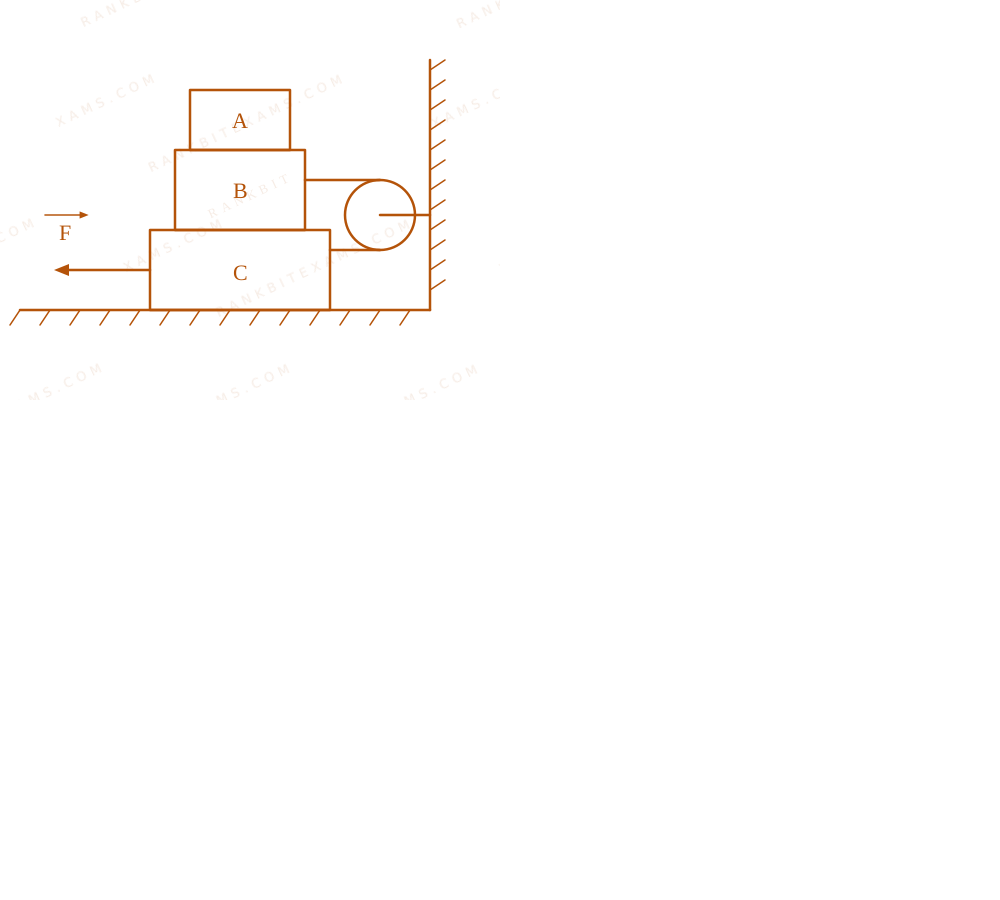
In the given figure the blocks A, B and C weigh 4 kg, 6 kg and 8 kg respectively. The co-efficient of sliding friction between any two surfaces is 0.5. The force F$\vec{\mathrm{F}}$ required to slide the block C with constant speed is ____ N. (Used g = 10 m/s²$g = 10 \text{ m/s}^{2}$)
Three stacked blocks A, B, C with an external pulling force F applied to C.
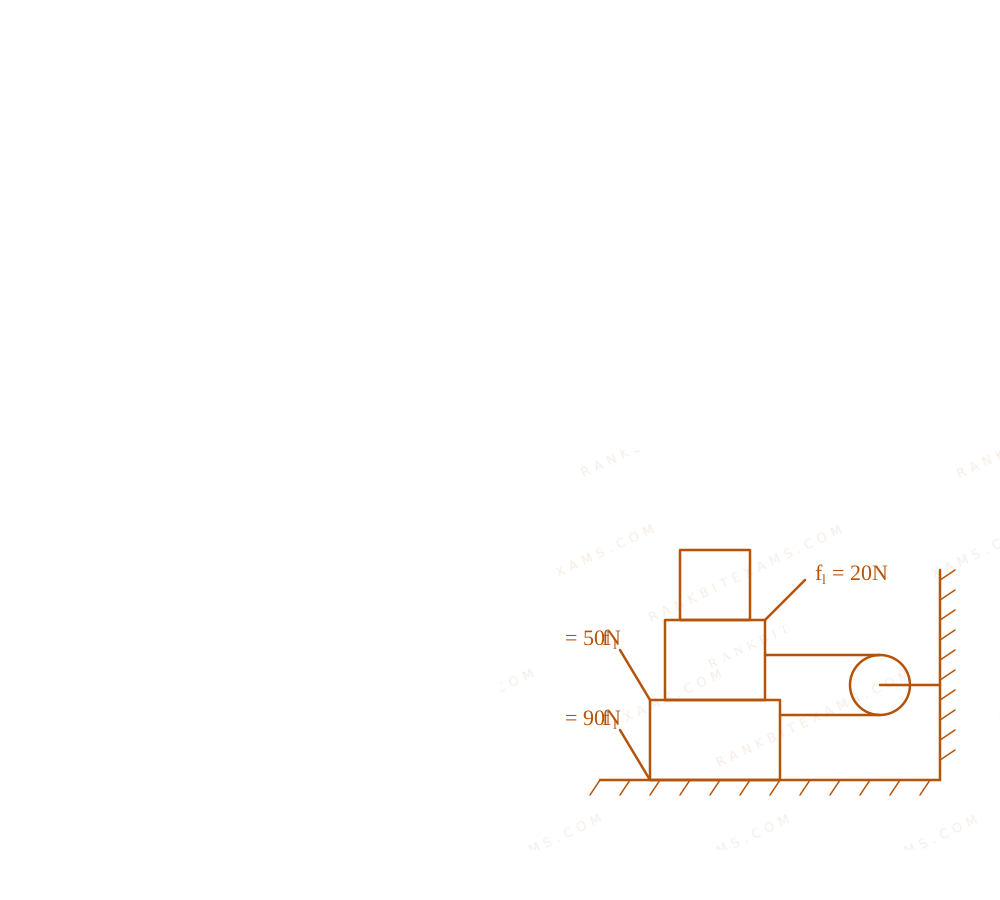
Three stacked blocks A, B, C with an external pulling force F applied to C.
Since C moves with constant speed, a=0$a=0$, meaning net force is zero.
For block A (4 kg$4\text{ kg}$) over B, sliding friction fA = μ (mA)g = 0.5 × 4 × 10 = 20 N$f_A = \mu (m_A)g = 0.5 \times 4 \times 10 = 20\text{ N}$.
For block B (6 kg$6\text{ kg}$) over C, the normal force includes block A. NB = (mA + mB)g = 100 N$N_B = (m_A + m_B)g = 100\text{ N}$.
Friction on B from C is fB = 0.5 × 100 = 50 N$f_B = 0.5 \times 100 = 50\text{ N}$.
For block C (8 kg$8\text{ kg}$) over ground, normal force is total weight NC = (mA + mB + mC)g = 180 N$N_C = (m_A + m_B + m_C)g = 180\text{ N}$.
Friction on C from ground is fC = 0.5 × 180 = 90 N$f_C = 0.5 \times 180 = 90\text{ N}$.
Step 1: Force Balance Equations
For block B to move relative to A and C (assuming standard string configuration where pulling C left causes B to be dragged right relative to C via pulley):
The tension T$T$ on B balances friction from A and C:
For block C moving left, the force F$F$ must overcome friction from ground, friction from B, and the tension T$T$ attached to it (depending on pulley setup. If pulley is on wall, string pulls C right):
Assuming standard setup where string connects B and C around wall pulley:
In multi-block pulley systems, pulling the bottom block accumulates all nested friction forces. The bottom block fights the ground, the block above it, AND the tension of the string anchoring the block above it.
Keywords:#stacked blocks friction force#JEE Main 2026 Morning Q49#Laws of Motion JEE Main 2026#Friction JEE Main 2026#stacked blocks#pulley string#sliding friction#external force
More Laws of Motion Previous-Year Questions — Page 5
A ball of mass 0.5~kg$0.5\mathrm{~kg}$ is attached to a string of length 50~cm$50\mathrm{~cm}$. The ball is rotated on a horizontal circular path about its vertical axis. The maximum tension that the string can bear is 400~N$400\mathrm{~N}$. The maximum possible value of angular velocity of the ball in rad/s$\mathrm{rad/s}$ is:
A. 1600
B. 40
C. 1000
D. 20
Solution
Related Formula
Centripetal force configuration for simplified horizontal rotation layout:
T = mω² l$T = m\omega^2 l$
Core Logic
Given values:
m = 0.5~kg$m = 0.5\mathrm{~kg}$, l = 50~cm = 0.5~m$l = 50\mathrm{~cm} = 0.5\mathrm{~m}$, Tmax = 400~N$T_{\text{max}} = 400\mathrm{~N}$.
Ensure units are metric (50~cm → 0.5~m$50\mathrm{~cm} \to 0.5\mathrm{~m}$). Direct mapping to horizontal string projection metrics.
Chapter Mix
Class 11 Physics: Laws of Motion
Q36jee_main_2024_29_january_eveningCircular Motion and Tension
A stone of mass 900 g$900\text{ g}$ is tied to a string and moved in a vertical circle of radius 1 m$1\text{ m}$ making 10 rpm$10\text{ rpm}$. The tension in the string, when the stone is at the lowest point is (if π² = 9.8$\pi^2 = 9.8$ and g = 9.8 m/s²$g = 9.8\text{ m/s}^2$):
A.97 N$97\text{ N}$
B.9.8 N$9.8\text{ N}$
C.8.82 N$8.82\text{ N}$
D.17.8 N$17.8\text{ N}$
Solution
Related Formula
At the lowest point of a vertical circle, the equation of motion for a mass m$m$ is:
T - mg = m r ω²$$T - mg = m r \omega^2$$
Rearranging to solve for tension T$T$:
T = mg + m r ω²$$T = mg + m r \omega^2$$
Core Logic
Given data:
Mass, m = 900 g = 0.9 kg$m = 900\text{ g} = 0.9\text{ kg}$
Free-body diagram of stone at lowest point in vertical circle for Q36
Pattern Recognition
Always convert Mass to kg$\text{kg}$ and rotational speed to rad/s$\text{rad/s}$ first. Using the prompt constraint π² = 9.8$\pi^2 = 9.8$ yields a perfect decimal addition match.
A particle is moving in a circle of radius 50 cm$50\text{ cm}$ in such a way that at any instant the normal and tangential components of its acceleration are equal. If its speed at t = 0$t = 0$ is 4 m/s$4\text{ m/s}$, the time taken to complete the first revolution will be (1)/(α)[ 1 - e-2π ] s$\frac{1}{\alpha}\left[ 1 - e^{-2\pi} \right]\text{ s}$, where α =$\alpha =$ ________.
Numerical Answer.Answer: 8 to 8
Solution
Related Formula
For a particle in circular motion:
Normal (centripetal) acceleration: ac = (v²)/(r)$a_c = \frac{v^2}{r}$
Comparing this to (1)/(α)[ 1 - e-2π ] s$\frac{1}{\alpha}\left[ 1 - e^{-2\pi} \right]\text{ s}$, we get:
α = 8$\alpha = 8$
Pattern Recognition
The condition aₜ = ac v (dv)/(ds) = (v²)/(r) (dv)/(v) = (ds)/(r)$a_t = a_c \implies v \frac{dv}{ds} = \frac{v^2}{r} \implies \frac{dv}{v} = \frac{ds}{r}$. Integrating directly gives v = v₀ es/r$v = v_0 e^{s/r}$. Substituting this back into v = ds/dt$v = ds/dt$ makes the final time integral much more intuitive.
Chapter Mix
Class 11 Physics: Laws of Motion
Q36jee_main_2024_27_jan_morningBanking of Tracks
A train is moving with a speed of 12 m/s$12\text{ m/s}$ on rails which are 1.5 m$1.5\text{ m}$ apart. To negotiate a curve of radius 400 m$400\text{ m}$, the height by which the outer rail should be raised with respect to the inner rail is (Given, g = 10 m/s²$g = 10\text{ m/s}^{2}$):
A.6.0 cm$6.0\text{ cm}$
B.5.4 cm$5.4\text{ cm}$
C.4.8 cm$4.8\text{ cm}$
D.4.2 cm$4.2\text{ cm}$
Solution
Related Formula
θ = (v²)/(Rg)$$\tan\theta = \frac{v^2}{Rg}$$
For small angles, θ ≈ θ = (h)/(d)$\tan\theta \approx \sin\theta = \frac{h}{d}$, where h$h$ is the raised height and d$d$ is the separation between the tracks.
Whenever θ$\theta$ is small, geometry permits approximating θ$\tan\theta$ with hwidth$\frac{h}{\text{width}}$, vastly reducing computational transcendental overhead.
Chapter Mix
Class 11 Physics: Laws of Motion
Q45jee_main_2024_27_jan_morningConservation of Linear Momentum
A body of mass 1000 kg$1000\text{ kg}$ is moving horizontally with a velocity 6 m/s$6\text{ m/s}$. If 200 kg$200\text{ kg}$ extra mass is added, the final velocity (in m/s) is:
A.6$6$
B.2$2$
C.3$3$
D.5$5$
Solution
Related Formula
m₁ v₁ = m₂ v₂$$m_1 v_1 = m_2 v_2$$
Core Logic
Since there is no external horizontal force acting on the body, linear momentum along the horizontal axis is conserved.
Practice past-year questions one chapter at a time. Pick an exam → subject → chapter and get every PYQ for that topic — pulled together from all past papers — with the chapter's key formulas alongside.