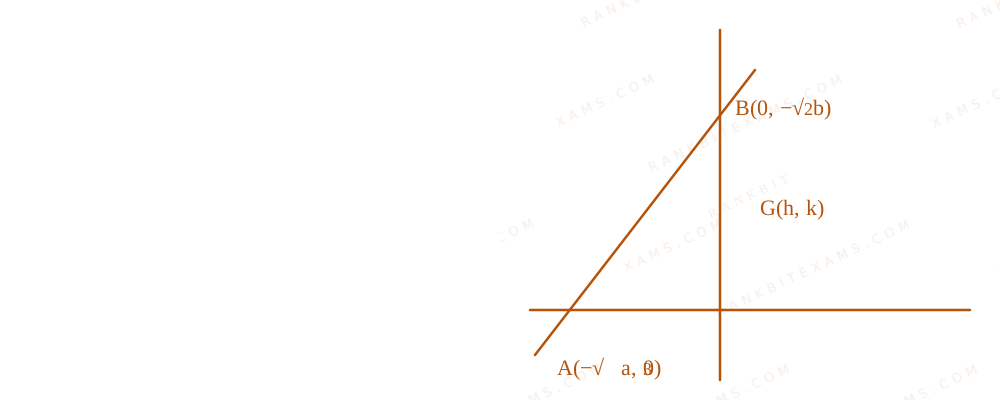
Let a circle of radius 4$4$ pass through the origin O$O$, the points A(-√(3)a, 0)$A(-\sqrt{3}a, 0)$ and B(0, -√(2)b)$B(0, -\sqrt{2}b)$, where a$a$ and b$b$ are real parameters and ab ≠ 0$ab \neq 0$. Then the locus of the centroid of Δ OAB$\Delta OAB$ is a circle of radius Graphical representation of the triangle OAB mapped on the Cartesian plane.
Graphical representation of the triangle OAB mapped on the Cartesian plane.
Since ∠ AOB = 90^°$\angle AOB = 90^\circ$, AB$AB$ is the diameter of the circle passing through O, A, B$O, A, B$.
Therefore, the diameter AB = 2r = 8$AB = 2r = 8$.
This is a circle with r² = (64)/(9)$r^2 = \frac{64}{9}$, so r = (8)/(3)$r = \frac{8}{3}$.
Pattern Recognition
Whenever a circle passes through the origin and points on the axes, the segment joining the axes points is always the diameter. Centroid coordinates easily scale the locus.
Chapter Mix
Class 11 Maths: Conic Sections
Class 11 Maths: Straight Lines
Keywords:#locus of the centroid#JEE Main 2026 Morning Q2#Conic Sections JEE Main 2026#Circles and Centroid Locus JEE Main 2026#Circle#Triangle OAB#Centroid Locus#Axes
More Conic Sections Previous-Year Questions — Page 2
Q6jee_main_2026_21_jan_eveningParabola
Let one end of a focal chord of the parabolay²=16x$y^{2}=16x$ be (16, 16). If P(α,β)$P(\alpha,\beta)$ divides this focal chord internally in the ratio 5:2, then the minimum value of α+β$\alpha+\beta$ is equal to:
A.22$22$
B.7$7$
C.5$5$
D.16$16$
Solution
Related Formula
For a focal chord with ends (at₁², 2at₁) and (at₂², 2at₂), the relation is t₁t₂ = -1$$\text{For a focal chord with ends } (at_1^2, 2at_1) \text{ and } (at_2^2, 2at_2), \text{ the relation is } t_1t_2 = -1$$Section formula: (x, y) = ( (mx₂ + nx₁)/(m+n), (my₂ + ny₁)/(m+n) )$$\text{Section formula: } (x, y) = \left( \frac{mx_2 + nx_1}{m+n}, \frac{my_2 + ny_1}{m+n} \right)$$
Core Logic
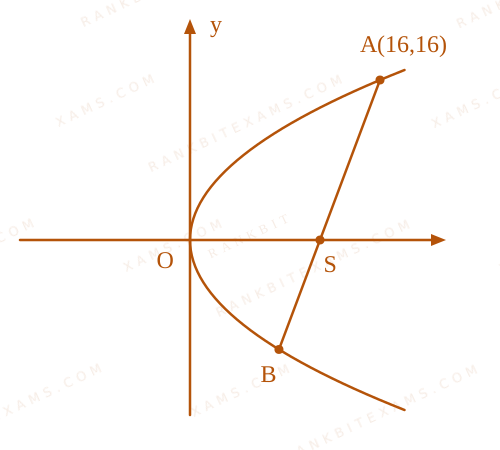
Parabola focal chord division diagram for Q6 - JEE Main 2026 Evening
For y² = 16x$y^2 = 16x$, a = 4$a = 4$. The given point A(16, 16)$A(16, 16)$ is equivalent to 4t² = 16$4t^2 = 16$ and 2(4)t = 16$2(4)t = 16$, which gives parameter t₁ = 2$t_1 = 2$.
The other end B$B$ has parameter t₂ = -(1)/(t₁) = -(1)/(2)$t_2 = -\frac{1}{t_1} = -\frac{1}{2}$.
Step 1: Calculate coordinates of B
For t₂ = -1/2$t_2 = -1/2$, point B$B$ is:
x = 4(-1/2)² = 1$x = 4(-1/2)^2 = 1$y = 8(-1/2) = -4$y = 8(-1/2) = -4$
So, B(1, -4)$B(1, -4)$.
Step 2: Section formula calculations (Two cases)
Point P(α, β)$P(\alpha, \beta)$ divides AB$AB$ in the ratio 5:2$5:2$. There are two possibilities depending on which end the ratio starts from.
Case 1: Ratio 5 from B to A (i.e. A is x₂$x_2$ and B is x₁$x_1$):
Comparing the two possible sums, 7 < 22$7 < 22$. Thus, the minimum value is 7$7$.
Pattern Recognition
When a line segment is divided in a given ratio, 'internal division' inherently bears two solutions based on the orientation (from point A or point B). Always evaluate both cases when finding a minimum or maximum.
Chapter Mix
Class 11 Maths: Conic Sections
Q25jee_main_2026_21_jan_eveningLocus
If P$P$ is a point on the circlex² + y² = 4$x^{2} + y^{2} = 4$, Q$Q$ is a point on the straight line 5x + y + 2 = 0$5x + y + 2 = 0$ and x - y + 1 = 0$x - y + 1 = 0$ is the perpendicular bisector of PQ$PQ$, then 13 times the sum of abscissa of all such point P$P$ is ____.
Numerical Answer.Answer: 2 to 2
Solution
Related Formula
Perpendicular bisector properties: m₁m₂ = -1 and mid-point lies on the line.$$\text{Perpendicular bisector properties: } m_1m_2 = -1 \text{ and mid-point lies on the line.}$$Parametric point on circle x²+y²=r² is (r θ, r θ)$$\text{Parametric point on circle } x^2+y^2=r^2 \text{ is } (r\cos\theta, r\sin\theta)$$
Core Logic
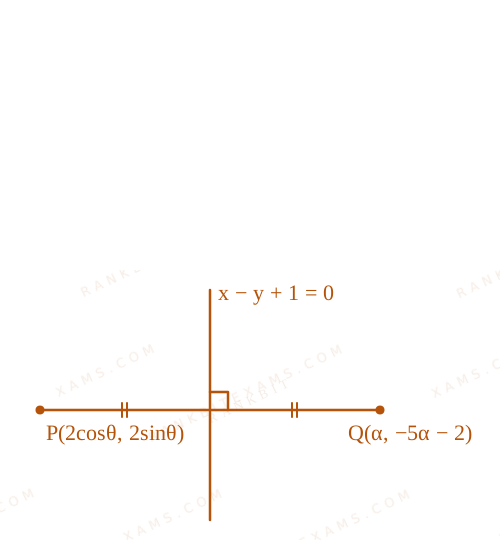
Circle locus perpendicular bisector diagram for Q25 - JEE Main 2026 Evening
Let P = (2 θ, 2 θ)$P = (2\cos\theta, 2\sin\theta)$.
Let Q$Q$ on the line 5x + y + 2 = 0$5x + y + 2 = 0$ be Q(α, -5α-2)$Q(\alpha, -5\alpha-2)$.
The line x - y + 1 = 0$x - y + 1 = 0$ is the perpendicular bisector of PQ$PQ$. This gives two conditions: slope of PQ$PQ$ is -1$-1$, and mid-point of PQ$PQ$ satisfies the bisector equation.
Step 1: Apply Slope Condition
Slope of bisector is 1$1$, so slope of PQ$PQ$ must be -1$-1$.
The abscissa of P$P$ is 2 θ$2\cos\theta$.
Values of abscissa are 2(1) = 2$2(1) = 2$ and 2(-(12)/(13)) = -(24)/(13)$2\left(-\frac{12}{13}\right) = -\frac{24}{13}$.
Sum of abscissa values = 2 - (24)/(13) = (26 - 24)/(13) = (2)/(13)$= 2 - \frac{24}{13} = \frac{26 - 24}{13} = \frac{2}{13}$.
We need 13 × (Sum) = 13 × (2)/(13) = 2$13 \times (\text{Sum}) = 13 \times \frac{2}{13} = 2$.
Pattern Recognition
Instead of finding the image of a generic circle point in a line, construct the reflection point Q$Q$ parameter, use slope logic (m₁m₂=-1$m_1m_2=-1$) and midpoint logic simultaneously to create a trigonometric linear equation.
Chapter Mix
Class 11 Maths: Circles
Class 11 Maths: Straight Lines
Q10jee_main_2026_22_january_morningHyperbola and Line Intersection
If the line α x + 2y = 1$\alpha x + 2y = 1$, where α in R$\alpha \in \mathbb{R}$, does not meet the hyperbolax² - 9y² = 9$x^{2} - 9y^{2} = 9$, then a possible value of α$\alpha$ is:
A.0.6$0.6$
B.0.8$0.8$
C.0.5$0.5$
D.0.7$0.7$
Solution
Related Formula
For a line y = mx + c and hyperbola (x²)/(a²) - (y²)/(b²) = 1:$$\text{For a line } y = mx + c \text{ and hyperbola } \frac{x^2}{a^2} - \frac{y^2}{b^2} = 1:$$If they do not intersect, the quadratic in x formed by substituting y has D < 0.$$\text{If they do not intersect, the quadratic in } x \text{ formed by substituting } y \text{ has } D < 0.$$
Core Logic
Given line: α x + 2y = 1 y = (1 - α x)/(2)$\alpha x + 2y = 1 \implies y = \frac{1 - \alpha x}{2}$.
Given hyperbola: x² - 9y² = 9$x^2 - 9y^2 = 9$.
Substitute the expression for y$y$ into the hyperbola's equation:
Since √(5) ≈ 2.236$\sqrt{5} \approx 2.236$, we have √(5)3 ≈ 0.745$\frac{\sqrt{5}}{3} \approx 0.745$.
So α$\alpha$ must be strictly greater than 0.745$0.745$ (or less than -0.745$-0.745$).
Geometrically, for a line not to meet a hyperbola, its slope must lie within a specific range determined by the asymptotes (m = ± b/a$m = \pm b/a$), and its c²$c^2$ must satisfy c² < a²m² - b²$c^2 < a^2m^2 - b^2$. Direct substitution to enforce D < 0$D < 0$ is purely mechanical and robust.
Chapter Mix
Class 11 Maths: Conic Sections
Q12jee_main_2026_22_january_morningIntersection of Two Circles
Let the set of all values of r$r$, for which the circles (x + 1)² + (y + 4)² = r²$(x + 1)^2 + (y + 4)^2 = r^2$ and x² + y² - 4x - 2y - 4 = 0$x^2 + y^2 - 4x - 2y - 4 = 0$ intersect at two distinct points be the interval (α, β)$(\alpha, \beta)$. Then αβ$\alpha\beta$ is equal to
A.25$25$
B.20$20$
C.21$21$
D.24$24$
Solution
Related Formula
Two circles intersect at distinct points if |r₁ - r₂| < d < r₁ + r₂$$\text{Two circles intersect at distinct points if } |r_1 - r_2| < d < r_1 + r_2$$
Intersection of two circles boils down to the fundamental triangle inequality relating the radii to the center distance: |r₁ - r₂| < d < r₁ + r₂$|r_1 - r_2| < d < r_1 + r_2$. Solving this naturally yields an interval (α, β)$(\alpha, \beta)$ formatted as a difference of squares upon multiplication.
Chapter Mix
Class 11 Maths: Circles
Q17jee_main_2026_22_january_morningProperties of Parabola
If the chord joining the points P₁(x₁, y₁)$P_{1}(x_{1}, y_{1})$ and P₂(x₂, y₂)$P_{2}(x_{2}, y_{2})$ on the parabola y² = 12x$y^{2} = 12x$subtends a right angle at the vertex of the parabola, then x₁x₂ - y₁y₂$x_{1}x_{2} - y_{1}y_{2}$ is equal to
A.288$288$
B.280$280$
C.284$284$
D.292$292$
Solution
Related Formula
If a chord joining t₁ and t₂ subtends a right angle at the vertex (0,0), then t₁ t₂ = -4.$$\text{If a chord joining } t_1 \text{ and } t_2 \text{ subtends a right angle at the vertex } (0,0), \text{ then } t_1 t_2 = -4.$$Parametric coordinates for y² = 4ax: (at², 2at)$$\text{Parametric coordinates for } y^2 = 4ax: (at^2, 2at)$$
Core Logic
Given parabola y² = 12x 4a = 12 a = 3$y^2 = 12x \implies 4a = 12 \implies a = 3$.
Let the points be P₁(x₁, y₁) = (3t₁², 6t₁)$P_1(x_1, y_1) = (3t_1^2, 6t_1)$ and P₂(x₂, y₂) = (3t₂², 6t₂)$P_2(x_2, y_2) = (3t_2^2, 6t_2)$.
Right angles subtended at the vertex by a chord on y² = 4ax$y^2 = 4ax$ instantly lock the parameter product to t₁ t₂ = -4$t_1 t_2 = -4$. Substitute this directly into any coordinate products required by the problem.
Chapter Mix
Class 11 Maths: Conic Sections
More Conic Sections Questions — jee_main_2026_24_january_morning
Practice past-year questions one chapter at a time. Pick an exam → subject → chapter and get every PYQ for that topic — pulled together from all past papers — with the chapter's key formulas alongside.