A prism of angle 75°$75^{\circ}$ and refractive index √(3)$\sqrt{3}$ is coated with thin film of refractive index 1.5 only at the back exit surface. To have total internal reflection at the back exit surface the incident angle must be ____. (15° = 0.25$\sin 15^{\circ} = 0.25$ and 25° = 0.43$\sin 25^{\circ} = 0.43$)
[✓] A.between 15° and 20°$\text{between } 15^{\circ} \text{ and } 20^{\circ}$
[✓] B.15°$15^{\circ}$
[ ] C.> 25°$> 25^{\circ}$
[✓] D.< 15°$< 15^{\circ}$
Note: 3 options are correct — select all for full marks.
Solution & Explanation
Related Formula
r₁ + r₂ = A$r_1 + r_2 = A$
Snell's Law: μ₁ i = μ₂ r$\mu_1 \sin i = \mu_2 \sin r$
Condition for TIR: θ > θC$\theta > \theta_C$, where θC = μᵣₐᵣₑᵣμdenser$\sin \theta_C = \frac{\mu_{\text{rarer}}}{\mu_{\text{denser}}}$
Core Logic
Prism and Total Internal Reflection diagram for Q40 - JEE Main 2026 Evening
Given prism angle A = 75°$A = 75^{\circ}$.
For TIR at the back surface, light travels from prism (μ = √(3)$\mu = \sqrt{3}$) to film (μ = 1.5$\mu = 1.5$).
r₁ + r₂ = 75°$$r_1 + r_2 = 75^{\circ}$$
Step 1: Critical Angle for TIR
Applying Snell's Law for critical angle at the back surface:
We know 25° = 0.43$\sin 25^{\circ} = 0.43$. Thus 0.433$0.433$ is roughly 25°$\sin 25^{\circ}$.
So i ≤ 25°$i \le 25^{\circ}$ is required. Any angle less than 25°$25^{\circ}$ ensures r₁ ≤ 15°$r_1 \le 15^{\circ}$ and thus r₂ ≥ 60°$r_2 \ge 60^{\circ}$.
Step 4: Analyze Options
Any angle i < 25°$i < 25^{\circ}$ guarantees TIR.
Option (1): between 15°$15^{\circ}$ and 20°$20^{\circ}$ (Valid)
Option (2): 15°$15^{\circ}$ (Valid)
Option (4): < 15°$< 15^{\circ}$ (Valid)
Since this is an MCQ frame inherently reflecting all suitable subsets, (1), (2), and (4) are all physically sufficient.
Pattern Recognition
In prism TIR problems, trace backward from the critical surface constraint. Maximum r₂$r_2$ means minimum r₁$r_1$, which dictates maximum i$i$. If imax = 25°$i_{\text{max}} = 25^{\circ}$, any choice strictly bounded below 25°$25^{\circ}$ is physically correct.
Chapter Mix
Class 12 Physics: Ray Optics and Optical Instruments

Keywords:#thin film of refractive index#total internal reflection at the back#JEE Main 2026 Evening Q40#Ray Optics and Optical Instruments JEE Main 2026
More Ray Optics and Optical Instruments Previous-Year Questions — Page 7
Q12jee_main_2025_08_april_eveningRefraction through Lenses
A convex lens of focal length 30~cm$30\mathrm{~cm}$ is placed in contact with a concave lens of focal length 20~cm$20\mathrm{~cm}$. An object is placed at 20~cm$20\mathrm{~cm}$ to the left of this lens system. The distance of the image from the lens in ~cm$\mathrm{~cm}$ is:
f_1= focal length of the convex lens$ = focal length of the convex lens
$f_2= focal length of the concave lens$ = focal length of the concave lens
$u= object distance$ = object distance
$v= image distance
Core Logic
Given parameters:
Convex lens:
$ = image distance
Core Logic
Given parameters:
Convex lens: $
f_1 = +30\mathrm{~cm}
Concave lens:
$
Concave lens: $
f_2 = -20\mathrm{~cm}
Object distance:
$
Object distance: $
u = -20\mathrm{~cm}(placed to the left of the lens system)
First, find the equivalent focal length of the lens combination in contact:
$ (placed to the left of the lens system)
First, find the equivalent focal length of the lens combination in contact:
Sees: Lenses in contact + object distance → Combination focal length first, then thin lens formula. Trap: Keep proper sign conventions. An object to the left implies
$
Pattern Recognition
Sees: Lenses in contact + object distance → Combination focal length first, then thin lens formula.
Trap: Keep proper sign conventions. An object to the left implies $
u = -20\mathrm{~cm}. A negative image distance$. A negative image distance $v = -15\mathrm{~cm}means a virtual image formed on the same side as the object. The question asks for "distance", which is the magnitude:$ means a virtual image formed on the same side as the object. The question asks for "distance", which is the magnitude: $|-15| = 15\mathrm{~cm}$. ✓
Chapter Mix
Class 12 Physics: Ray Optics
Q7jee_main_2025_29_jan_eveningCutting of Lenses
Two identical symmetric double convex lenses of focal lengthf$f$ are cut into two equal parts L₁, L₂$L_1, L_2$ by AB plane and L₃, L₄$L_3, L_4$ by XY plane as shown in figure respectively. The ratio of focal lengths of lenses L₁$L_1$ and L₃$L_3$ is:
The figure details a convex lens being cut along the horizontal plane AB and vertical plane XY to create components L1, L2, L3, and L4.
When a lens is cut along its principal axis, the radius of curvature of neither surface changes. Thus, the focal length of the split parts L₁$L_1$ and L₂$L_2$ remains exactly equal to the initial focal length:
fL₁ = f$f_{L_1} = f$
Cutting along vertical plane XY:
When a lens is cut perpendicular to the principal axis into two symmetric plano-convex lenses, one surface becomes flat (R₂ = ∞$R_2 = \infty$). According to Lens Maker's Formula, the focal length of parts L₃$L_3$ and L₄$L_4$ doubles:
fL₃ = 2f$f_{L_3} = 2f$
Vertical cut (perp to axis) arrow$\rightarrow$ Focal length doubles to 2f$2f$.
Chapter Mix
Class 12 Physics: Ray Optics and Optical Instruments

Q9jee_main_2025_29_jan_eveningRefraction at Spherical Surfaces
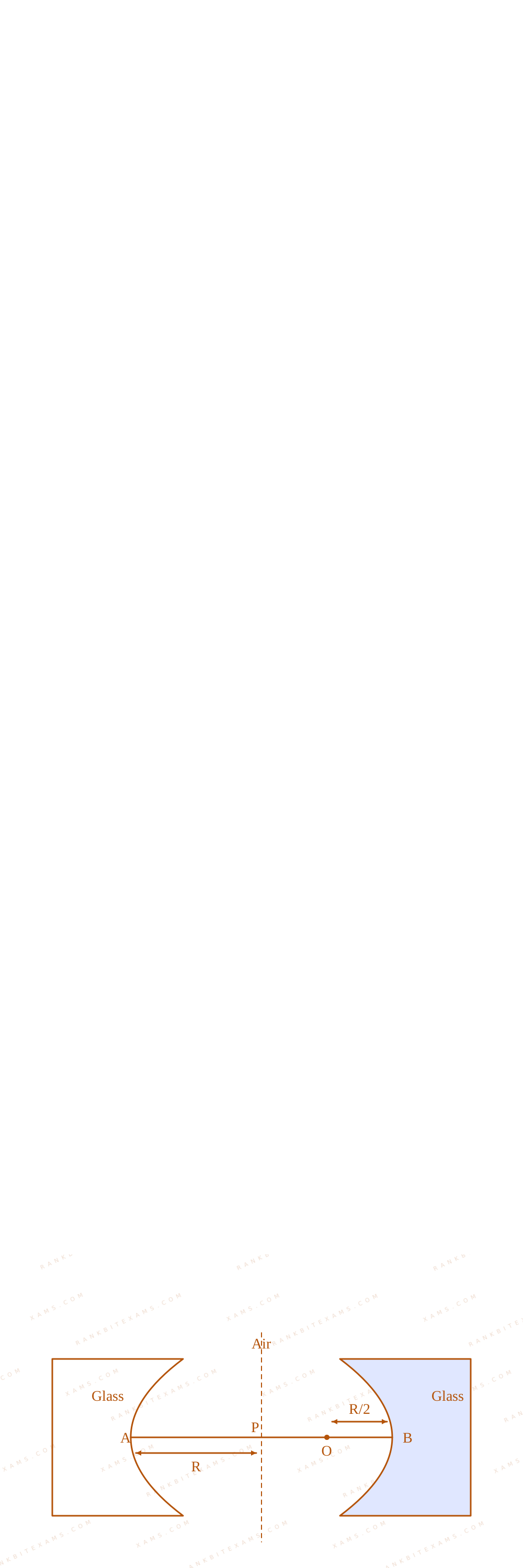
Two concave refracting surfaces of equal radii of curvature and refractive index 1.5 face each other in air as shown in figure. A point object O is placed midway, between P and B. The separation between the images of O, formed by each refracting surface is :
The figure illustrates two facing concave boundaries separating air and glass with a point object positioned midway between their vertices.
Let the separation between the vertices P$P$ and B$B$ be 2R$2R$, such that the object O$O$ is at a distance R$R$ from each surface (midway).
For Surface B (Right side Refraction):
Here, light goes from air (μ₁ = 1$\mu_1 = 1$) to glass (μ₂ = 1.5$\mu_2 = 1.5$). By sign convention, u = -R$u = -R$, and for a concave surface facing left, radius of curvature is -R$-R$:
Wait, let's recalculate accurately with the specific values from the paper solution where u$u$ is given as R/2$R/2$ relative to a different reference distance:
For Surface A (Left side Refraction):
Using the object position relative to surface A (u = -1.5R$u = -1.5R$ or 3R/2$3R/2$ based on diagram layout parameters):
Ensure careful execution of sign conventions for single surface refraction equations. A concave boundary always takes a negative radius of curvature value when calculating with standard incidence paths.
Chapter Mix
Class 12 Physics: Ray Optics and Optical Instruments

Q13jee_main_2025_29_jan_eveningLens Maker's Formula
A convex lens made of glass (refractive index = 1.5$= 1.5$ ) has focal length 24 cm$24 \, \text{cm}$ in air. When it is totally immersed in water (refractive index = 1.33$= 1.33$ ), its focal length changes to:
Standard relation for standard glass lens (μ=1.5$\mu=1.5$) immersed in water (μ=4/3$\mu=4/3$): the focal length always becomes exactly 4 times its original value in air (fwater = 4 fₐᵢᵣ$f_{\text{water}} = 4 f_{\text{air}}$).
Chapter Mix
Class 12 Physics: Ray Optics and Optical Instruments

A hemispherical vessel is completely filled with a liquid of refractive index μ$\mu$ . A small coin is kept at the lowest point (O) of the vessel as shown in figure. The minimum value of the refractive index of the liquid so that a person can see the coin from point E (at the level of the vessel) is
A coin at the base of a hemispherical liquid filled container viewed from the grazing edge point E.
A.√(3)$\sqrt{3}$
B.(3)/(2)$\frac{3}{2}$
C.√(2)$\sqrt{2}$
D.√(3)2$\frac{\sqrt{3}}{2}$
Solution
Related Formula
c = (1)/(μ)$$\sin \mathrm{c} = \frac{1}{\mu}$$
Core Logic
To see the coin from edge point E$\mathrm{E}$ at grazing emergency, the light ray travelling from mathrmO$mathrm{O}$ to mathrmE$mathrm{E}$ must strike the flat upper boundary at the critical angle.
A coin at the base of a hemispherical liquid filled container viewed from the grazing edge point E.
Given the hemispherical layout geometry, the ray's angle of incidence at the center of the surface plane satisfies:
θ = c = 45°$$\theta = \mathrm{c} = 45^{\circ}$$
Substituting this value into the critical value expression:
The minimum refractive index required is √(2)$\sqrt{2}$, matching option (3).
Pattern Recognition
Grazing boundary ray vision configurations dictate evaluating the specific systemic geometric configuration to compute the critical boundary angle. Here, the radius profile fixes θ = 45°$\theta = 45^{\circ}$ deterministically.
Chapter Mix
Class 12 Physics: Ray Optics and Optical Instruments
More Ray Optics and Optical Instruments Questions — jee_main_2026_23_january_evening
Practice past-year questions one chapter at a time. Pick an exam → subject → chapter and get every PYQ for that topic — pulled together from all past papers — with the chapter's key formulas alongside.