A prism of angle 75°$75^{\circ}$ and refractive index √(3)$\sqrt{3}$ is coated with thin film of refractive index 1.5 only at the back exit surface. To have total internal reflection at the back exit surface the incident angle must be ____. (15° = 0.25$\sin 15^{\circ} = 0.25$ and 25° = 0.43$\sin 25^{\circ} = 0.43$)
[✓] A.between 15° and 20°$\text{between } 15^{\circ} \text{ and } 20^{\circ}$
[✓] B.15°$15^{\circ}$
[ ] C.> 25°$> 25^{\circ}$
[✓] D.< 15°$< 15^{\circ}$
Note: 3 options are correct — select all for full marks.
Solution & Explanation
Related Formula
r₁ + r₂ = A$r_1 + r_2 = A$
Snell's Law: μ₁ i = μ₂ r$\mu_1 \sin i = \mu_2 \sin r$
Condition for TIR: θ > θC$\theta > \theta_C$, where θC = μᵣₐᵣₑᵣμdenser$\sin \theta_C = \frac{\mu_{\text{rarer}}}{\mu_{\text{denser}}}$
Core Logic
Prism and Total Internal Reflection diagram for Q40 - JEE Main 2026 Evening
Given prism angle A = 75°$A = 75^{\circ}$.
For TIR at the back surface, light travels from prism (μ = √(3)$\mu = \sqrt{3}$) to film (μ = 1.5$\mu = 1.5$).
r₁ + r₂ = 75°$$r_1 + r_2 = 75^{\circ}$$
Step 1: Critical Angle for TIR
Applying Snell's Law for critical angle at the back surface:
We know 25° = 0.43$\sin 25^{\circ} = 0.43$. Thus 0.433$0.433$ is roughly 25°$\sin 25^{\circ}$.
So i ≤ 25°$i \le 25^{\circ}$ is required. Any angle less than 25°$25^{\circ}$ ensures r₁ ≤ 15°$r_1 \le 15^{\circ}$ and thus r₂ ≥ 60°$r_2 \ge 60^{\circ}$.
Step 4: Analyze Options
Any angle i < 25°$i < 25^{\circ}$ guarantees TIR.
Option (1): between 15°$15^{\circ}$ and 20°$20^{\circ}$ (Valid)
Option (2): 15°$15^{\circ}$ (Valid)
Option (4): < 15°$< 15^{\circ}$ (Valid)
Since this is an MCQ frame inherently reflecting all suitable subsets, (1), (2), and (4) are all physically sufficient.
Pattern Recognition
In prism TIR problems, trace backward from the critical surface constraint. Maximum r₂$r_2$ means minimum r₁$r_1$, which dictates maximum i$i$. If imax = 25°$i_{\text{max}} = 25^{\circ}$, any choice strictly bounded below 25°$25^{\circ}$ is physically correct.
Chapter Mix
Class 12 Physics: Ray Optics and Optical Instruments
Keywords:#thin film of refractive index#total internal reflection at the back#JEE Main 2026 Evening Q40#Ray Optics and Optical Instruments JEE Main 2026
More Ray Optics and Optical Instruments Previous-Year Questions — Page 6
Q9jee_main_2025_03_april_eveningRefraction of Light and Refractive Index
A monochromatic light of frequency 5×10¹⁴~Hz$5\times10^{14}\mathrm{~Hz}$ travelling through air, is incident on a medium of refractive index '2'. Wavelength of the refracted light will be :
A. 300 nm
B. 600 nm
C. 400 nm
D. 500 nm
Solution
Related Formula
For light propagation, wave velocity, frequency, and wavelength are related by:
v = f λ ⇒ λₐᵢᵣ = (c)/(f)$$v = f \lambda \Rightarrow \lambda_{\text{air}} = \frac{c}{f}$$
When light passes into a medium of refractive index μ$\mu$, the frequency remains constant, but the wavelength scales down to:
Remember: Frequency is a source characteristic and never changes during refraction. Speed and wavelength both decrease by a factor of μ$\mu$ inside the medium.
Chapter Mix
Class 12 Physics: Ray Optics and Optical Instruments
Qjee_main_2025_07_april_morningRefraction at Plane Surfaces
A container contains a liquid with refractive index of 1.2 up to a height of 60~cm$60~\mathrm{cm}$ and another liquid having refractive index 1.6 is added to height H above first liquid. If viewed from above, the apparent shift in the position of bottom of container is 40~cm$40~\mathrm{cm}$ . The value of H is ______cm$\mathrm{cm}$ . (Consider liquids are immisible)
Numerical Answer.Answer: 80 to 80
Solution
Related Formula
The apparent shift Δ x$\Delta x$ in depth through multiple immiscible liquid layers viewed normally is the sum of the individual layer shifts:
Δ x = Σ dᵢ ( 1 - (1)/(μᵢ) )$$\Delta x = \sum d_i \left( 1 - \frac{1}{\mu_i} \right)$$
40 = 60 ( (1)/(6) ) + H ( (3)/(8) )$$40 = 60 \left( \frac{1}{6} \right) + H \left( \frac{3}{8} \right)$$40 = 10 + (3)/(8) H (3)/(8) H = 30$$40 = 10 + \frac{3}{8} H \implies \frac{3}{8} H = 30$$H = (30 × 8)/(3) = 80 ~cm$$H = \frac{30 \times 8}{3} = 80 \mathrm{~cm}$$
Pattern Recognition
Sees: Two immiscible liquid layers with normal viewing shift. Shortcut: First layer has real depth 60, index 1.2
$
Pattern Recognition
Sees: Two immiscible liquid layers with normal viewing shift.
Shortcut: First layer has real depth 60, index 1.2 $
\impliesapparent shift is$ apparent shift is $60 \times (1 - 5/6) = 10 \mathrm{~cm}. Since total shift is 40, the second layer must contribute$. Since total shift is 40, the second layer must contribute $30 \mathrm{~cm}of shift. Thus,$ of shift. Thus, $H \times (1 - 5/8) = 30 \implies H \times (3/8) = 30 \implies H = 80 \mathrm{~cm}$.
Chapter Mix
Class 12 Physics: Ray Optics and Optical Instruments
Q8jee_main_2025_07_april_morningRefraction at Spherical Surfaces and by Lenses
A lens having refractive index 1.6 has focal length of 12cm$12\mathrm{cm}$ , when it is in air. Find the focal length of the lens when it is placed in water. (Take refractive index of water as 1.28)
A.355mm$355\mathrm{mm}$
B.288mm$288\mathrm{mm}$
C.555mm$555\mathrm{mm}$
D.655mm$655\mathrm{mm}$
Solution
Related Formula
Lens Maker's Formula in a surrounding medium with refractive index μm$\mu_m$ is:
\mu_L = 1.6, focal length in air$, focal length in air $f_a, and focal length in medium$, and focal length in medium $f_m. Shortcut: Use the ratio of focal lengths directly:$.
Shortcut: Use the ratio of focal lengths directly:
$(fm)/(fₐ) = (μL - 1)/((μL)/(μm) - 1) = (0.6)/((1.6)/(1.28) - 1) = (0.6)/(0.25) = 2.4$\frac{f_m}{f_a} = \frac{\mu_L - 1}{\frac{\mu_L}{\mu_m} - 1} = \frac{0.6}{\frac{1.6}{1.28} - 1} = \frac{0.6}{0.25} = 2.4$$
$fm = 2.4 × 12 = 28.8 ~cm = 288 ~mm$f_m = 2.4 \times 12 = 28.8 \mathrm{~cm} = 288 \mathrm{~mm}$$
Chapter Mix
Class 12 Physics: Ray Optics and Optical Instruments
Q10jee_main_2025_07_april_morningRefraction at Spherical Surfaces and by Lenses
Two thin convex lenses of focal lengths 30~cm$30~\mathrm{cm}$ and 10~cm$10~\mathrm{cm}$ are placed coaxially, 10~cm$10~\mathrm{cm}$ apart. The power of this combination is :
A.5 D$5 \mathrm{D}$
B.1 ~D$1 \mathrm{~D}$
C.20D$20\mathrm{D}$
D.10D$10\mathrm{D}$
Solution
Related Formula
The equivalent focal length feq$f_{\text{eq}}$ of two thin coaxially aligned lenses separated by distance d$d$ is given by:
Sees: Lenses separated by distance d$d$ where d = f₂$d = f_2$.
Shortcut: Notice that d = f₂ = 10 ~cm$d = f_2 = 10 \mathrm{~cm}$. When the separation distance between two thin lenses equals the focal length of the second lens, the equivalent power simplifies directly to P = P₂ = 1/f₂ = 10 ~D$P = P_2 = 1/f_2 = 10 \mathrm{~D}$ since the terms 1/f₁$1/f_1$ and d/(f₁ f₂)$d/(f_1 f_2)$ cancel out.
Chapter Mix
Class 12 Physics: Ray Optics and Optical Instruments
Qjee_main_2025_08_april_eveningRefraction through Lenses
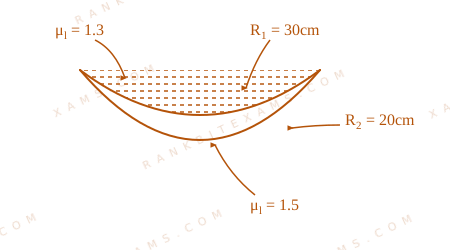
A concave-convex lens of refractive index 1.5$1.5$ and the radii of curvature of its surfaces are 30~cm$30\mathrm{~cm}$ and 20~cm$20\mathrm{~cm}$, respectively. The concave surface is upwards and is filled with a liquid of refractive index 1.3$1.3$. The focal length of the liquid-glass combination will be
Sees: Glass lens with liquid poured on top → Think of it as a double lens system (liquid lens + glass lens).
Trap: Be extremely careful with sign conventions for radii of curvature of the boundaries! Assume light travels from air through the liquid and then through the glass. This defines a consistent spatial propagation direction. ✓
Chapter Mix
Class 12 Physics: Ray Optics
More Ray Optics and Optical Instruments Questions — jee_main_2026_23_january_evening
Practice past-year questions one chapter at a time. Pick an exam → subject → chapter and get every PYQ for that topic — pulled together from all past papers — with the chapter's key formulas alongside.