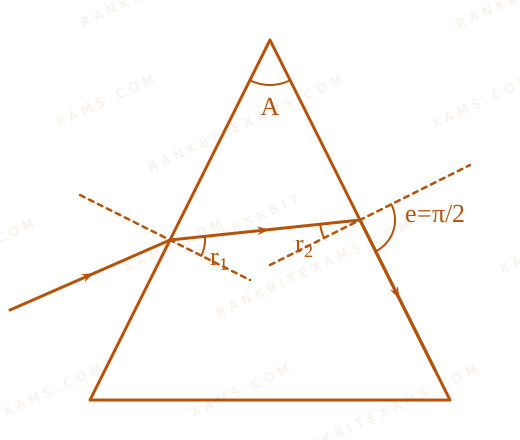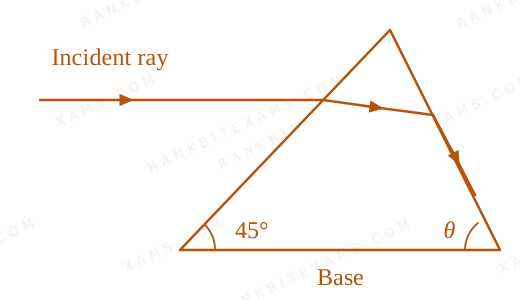
As shown in the diagram, when the incident ray is parallel to base of the prism, the emergent ray grazes along the second surface.
Ray diagram through prism for Q45 - JEE Main 2026 Evening
Ray of light grazing the second surface of a prism after incident parallel to the base.
If refractive index of the material of prism is sqrt2, the angle theta of prism is.

Solution & Explanation

### Related Formula A = r_1 + r_2 mu = fracsin isin r ### Core Logic
Detailed ray angles in prism for Q45 solution - JEE Main 2026 Evening
Ray of light grazing the second surface of a prism after incident parallel to the base.
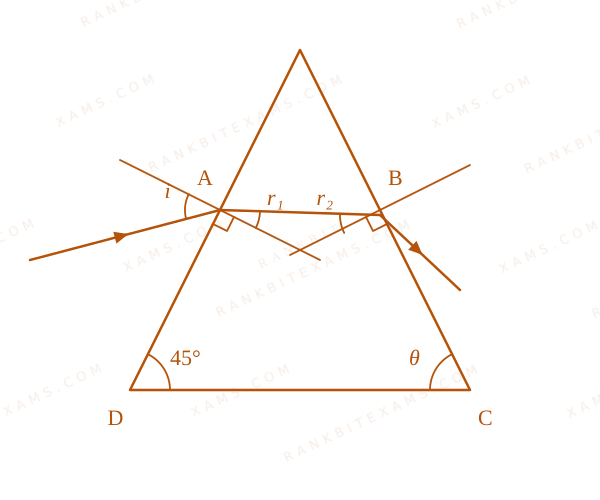
Since the incident ray is parallel to the base, looking at the geometry, the angle of incidence on the first face can be derived. The base angle is 45^circ. Thus, the normal to the first surface makes an angle of 45^circ with the incident ray. Therefore, i_1 = 45^circ. For the emergent ray to graze the second surface, the angle of emergence e = 90^circ. Applying Snell's Law at the second surface: mu sin r_2 = 1 cdot sin 90^circ sqrt2 sin r_2 = 1 implies sin r_2 = frac1sqrt2 r_2 = 45^circ ### Step 1: First Surface Analysis Applying Snell's Law at the incident surface: 1 cdot sin(45^circ) = mu sin(r_1) frac1sqrt2 = sqrt2 sin(r_1) sin(r_1) = frac12 implies r_1 = 30^circ ### Step 2: Prism Geometry The prism angle A at the apex is the sum of the internal angles of refraction: A = r_1 + r_2 = 30^circ + 45^circ = 75^circ ### Step 3: Final Conclusion In the triangle of the prism, the sum of angles is 180^circ. A + 45^circ + theta = 180^circ 75^circ + 45^circ + theta = 180^circ 120^circ + theta = 180^circ implies theta = 60^circ ### Pattern Recognition Grazing emergence means r_2 = theta_c (critical angle). Horizontal incidence with a known base angle gives i_1. Combining these through A = r_1 + r_2 resolves the full geometry. ### Evaluation Rubric / Model Answer null ### Chapter Mix Class 12 Physics: Ray Optics and Optical Instruments

Reference Study Guides

More Ray Optics and Optical Instruments Questions — jee_main_2026_21_jan_evening

Practice all Ray Optics and Optical Instruments previous-year questions →

Rankbit System
JEE Physics: Waves (+15.5%) | Electrostatics: Concentric Shells (-29.7%) | Modern Physics: Photoelectric Clones (+34.2%) | Mathematics: Definite Integrals (+18.1%) | Chemistry: Coordination Splitting (-11.4%) | JEE Physics: Waves (+15.5%) | Electrostatics: Concentric Shells (-29.7%) | Modern Physics: Photoelectric Clones (+34.2%) | Mathematics: Definite Integrals (+18.1%) | Chemistry: Coordination Splitting (-11.4%)