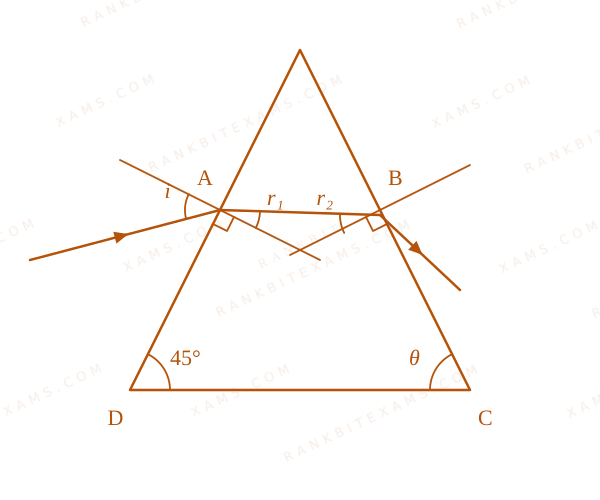
Consider an equilateral prism (refractive index sqrt2$\sqrt{2}$). A ray of light is incident on its one surface at a certain angle i. If the emergent ray is found to graze along the other surface then the angle of refraction at the incident surface is close to \_\_\_\_.
A.15^circ$15^{\circ}$
B.20^circ$20^{\circ}$
C.40^circ$40^{\circ}$
D.30^circ$30^{\circ}$
Solution & Explanation
### Related Formula
mu sin r_2 = 1 sin e, quad r_1 + r_2 = A$$\mu \sin r_2 = 1 \sin e, \quad r_1 + r_2 = A$$
### Core Logic
Solution prism ray diagram for Q40 - JEE Main 2026 Morning
For grazing emergence (e = 90^circ$e = 90^{\circ}$):
mu sin r_2 = 1 implies sqrt2 sin r_2 = 1 implies r_2 = 45^circ$$\mu \sin r_2 = 1 \implies \sqrt{2} \sin r_2 = 1 \implies r_2 = 45^{\circ}$$
Since prism is equilateral (A = 60^circ$A = 60^{\circ}$):
r_1 = A - r_2 = 60^circ - 45^circ = 15^circ$$r_1 = A - r_2 = 60^{\circ} - 45^{\circ} = 15^{\circ}$$
### Pattern Recognition
Sees: Equilateral prism with grazing emergence.
Shortcut: Use critical angle condition at second surface and prism angle relation r_1 + r_2 = A$r_1 + r_2 = A$.
Check: Matches option (1). ✓
### Chapter Mix
Class 12 Physics: Ray Optics and Optical Instruments
Keywords:#Consider an equilateral prism refractive index root 2#JEE Main 2026 Morning Q40#Ray Optics and Optical Instruments JEE Main 2026#Prism Refraction and Grazing Emergence JEE Main 2026
More Ray Optics and Optical Instruments Previous-Year Questions
Qjee_main_2026_21_jan_morningLenses
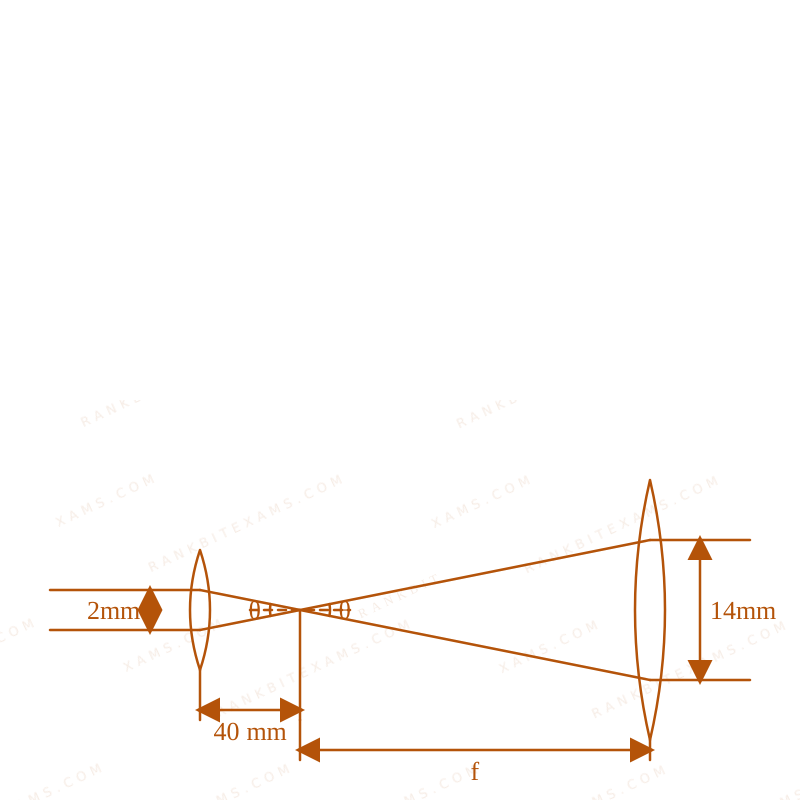
A collimated beam of light of diameter 2 mm is propagating along x-axis. The beam is required to be expanded in a collimated beam of diameter 14 mm using a system of two convex lenses. If first lens has focal length 40 mm, then the focal length of second lens is ____ mm.
Numerical Answer.Answer: 280 to 280
Solution
### Related Formula
textMagnification m = fracD_textoutD_textin = fracf_2f_1$$\text{Magnification } m = \frac{D_{\text{out}}}{D_{\text{in}}} = \frac{f_2}{f_1}$$
### Core Logic
For a beam expander using two convex lenses, the lenses are arranged such that their focal points coincide. This creates an afocal system where parallel input rays remain parallel upon output.
Lenses solution diagram for Q46 - JEE Main 2026 Morning
By similar triangles at the focal point:
tan theta = fracD_1 / 2f_1 = fracD_2 / 2f_2$$\tan \theta = \frac{D_1 / 2}{f_1} = \frac{D_2 / 2}{f_2}$$
### Step 1: Solving for f2
fracD_1f_1 = fracD_2f_2$$\frac{D_1}{f_1} = \frac{D_2}{f_2}$$frac240 = frac14f_2$$\frac{2}{40} = \frac{14}{f_2}$$f_2 = 14 times frac402 = 14 times 20 = 280text mm$$f_2 = 14 \times \frac{40}{2} = 14 \times 20 = 280\text{ mm}$$
### Pattern Recognition
A standard beam expander (Keplerian telescope design used in reverse) has f_2/f_1 = D_2/D_1$f_2/f_1 = D_2/D_1$.
### Evaluation Rubric / Model Answer
null
### Chapter Mix
Class 12 Physics: Ray Optics and Optical Instruments
Q50jee_main_2026_21_jan_morningMicroscope
In a microscope the objective is having focal length f_0 = 2text cm$f_{0} = 2\text{ cm}$ and eye-piece is having focal length f_e = 4text cm$f_{e} = 4\text{ cm}$. The tube length is 32 cm. The magnification produced by this microscope for normal adjustment is ____.
Numerical Answer.Answer: 100 to 100
Solution
### Related Formula
m approx fracLf_0 times fracDf_e$$m \approx \frac{L}{f_0} \times \frac{D}{f_e}$$
### Core Logic
For a compound microscope in normal adjustment (image formed at infinity), the magnifying power is given by the standard approximation:
m simeq fracl Df_0 f_e$$m \simeq \frac{l D}{f_{0} f_{e}}$$
where l$l$ is the tube length, D = 25text cm$D = 25\text{ cm}$ is the least distance of distinct vision.
### Step 1: Substitute Values
Given values:
l = 32text cm$l = 32\text{ cm}$f_0 = 2text cm$f_0 = 2\text{ cm}$f_e = 4text cm$f_e = 4\text{ cm}$D = 25text cm$D = 25\text{ cm}$ (standard assumption when not given)
m = frac322 times frac254$$m = \frac{32}{2} \times \frac{25}{4}$$m = 16 times frac254 = 4 times 25 = 100$$m = 16 \times \frac{25}{4} = 4 \times 25 = 100$$Microscope solution diagram for Q50 - JEE Main 2026 Morning
### Pattern Recognition
Compound microscope formulas: Normal adjustment to$\to$ image at infty$\infty$, m = (L/f_0)(D/f_e)$m = (L/f_0)(D/f_e)$. Image at near point D$D$, m = (L/f_0)(1 + D/f_e)$m = (L/f_0)(1 + D/f_e)$. Default to standard approximation when given tube length.
### Evaluation Rubric / Model Answer
null
### Chapter Mix
Class 12 Physics: Ray Optics and Optical Instruments
Q45jee_main_2026_21_jan_eveningPrism
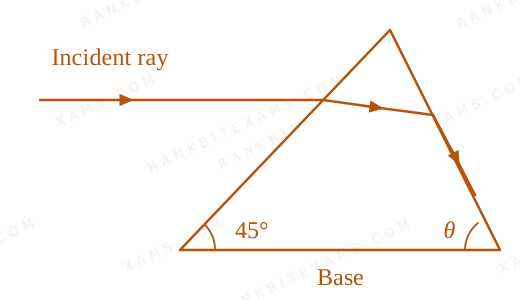
As shown in the diagram, when the incident ray is parallel to base of the prism, the emergent ray grazes along the second surface.
Ray of light grazing the second surface of a prism after incident parallel to the base.
If refractive index of the material of prism is sqrt2$\sqrt{2}$, the angle theta$\theta$ of prism is.
A.60^circ$60^{\circ}$
B.75^circ$75^{\circ}$
C.90^circ$90^{\circ}$
D.45^circ$45^{\circ}$
Solution
### Related Formula
A = r_1 + r_2$A = r_1 + r_2$mu = fracsin isin r$$\mu = \frac{\sin i}{\sin r}$$
### Core Logic
Ray of light grazing the second surface of a prism after incident parallel to the base.
Since the incident ray is parallel to the base, looking at the geometry, the angle of incidence on the first face can be derived. The base angle is 45^circ$45^{\circ}$. Thus, the normal to the first surface makes an angle of 45^circ$45^{\circ}$ with the incident ray. Therefore, i_1 = 45^circ$i_1 = 45^{\circ}$.
For the emergent ray to graze the second surface, the angle of emergence e = 90^circ$e = 90^{\circ}$.
Applying Snell's Law at the second surface:
mu sin r_2 = 1 cdot sin 90^circ$$\mu \sin r_2 = 1 \cdot \sin 90^{\circ}$$sqrt2 sin r_2 = 1 implies sin r_2 = frac1sqrt2$$\sqrt{2} \sin r_2 = 1 \implies \sin r_2 = \frac{1}{\sqrt{2}}$$r_2 = 45^circ$$r_2 = 45^{\circ}$$
### Step 1: First Surface Analysis
Applying Snell's Law at the incident surface:
1 cdot sin(45^circ) = mu sin(r_1)$$1 \cdot \sin(45^{\circ}) = \mu \sin(r_1)$$frac1sqrt2 = sqrt2 sin(r_1)$$\frac{1}{\sqrt{2}} = \sqrt{2} \sin(r_1)$$sin(r_1) = frac12 implies r_1 = 30^circ$$\sin(r_1) = \frac{1}{2} \implies r_1 = 30^{\circ}$$
### Step 2: Prism Geometry
The prism angle A$A$ at the apex is the sum of the internal angles of refraction:
A = r_1 + r_2 = 30^circ + 45^circ = 75^circ$$A = r_1 + r_2 = 30^{\circ} + 45^{\circ} = 75^{\circ}$$
### Step 3: Final Conclusion
In the triangle of the prism, the sum of angles is 180^circ$180^{\circ}$.
A + 45^circ + theta = 180^circ$$A + 45^{\circ} + \theta = 180^{\circ}$$75^circ + 45^circ + theta = 180^circ$$75^{\circ} + 45^{\circ} + \theta = 180^{\circ}$$120^circ + theta = 180^circ implies theta = 60^circ$$120^{\circ} + \theta = 180^{\circ} \implies \theta = 60^{\circ}$$
### Pattern Recognition
Grazing emergence means r_2 = theta_c$r_2 = \theta_c$ (critical angle). Horizontal incidence with a known base angle gives i_1$i_1$. Combining these through A = r_1 + r_2$A = r_1 + r_2$ resolves the full geometry.
### Evaluation Rubric / Model Answer
null
### Chapter Mix
Class 12 Physics: Ray Optics and Optical Instruments
Q39jee_main_2026_22_january_morningLens Combinations and Magnification
A thin convex lens of focal length 5 cm and a thin concave lens of focal length 4 cm are combined together (without any gap) and this combination has magnification m_1$m_{1}$, when an object is placed 10 cm before the convex lens. Keeping the positions of convex lens and object undisturbed a gap of 1 cm is introduced between the lenses by moving the concave lens away, which lead to a change in magnification of total lens system to m_2$m_{2}$. The value of left|fracm_1m_2right|$\left|\frac{m_{1}}{m_{2}}\right|$ is \_\_\_\_.
A.frac59$\frac{5}{9}$
B.frac527$\frac{5}{27}$
C.frac32$\frac{3}{2}$
D.frac2527$\frac{25}{27}$
Solution
### Related Formula
frac1f = frac1f_1 + frac1f_2 - fracdf_1 f_2, quad m = fracvu$$\frac{1}{f} = \frac{1}{f_1} + \frac{1}{f_2} - \frac{d}{f_1 f_2}, \quad m = \frac{v}{u}$$
### Core Logic
This question was officially dropped by the examining authority. Full marks awarded to all candidates.
### Pattern Recognition
Sees: Lens combination with separation gap introduced.
Shortcut: Note official exam status (Dropped question).
Check: Question dropped in final key. ✓
### Chapter Mix
Class 12 Physics: Ray Optics and Optical Instruments
More Ray Optics and Optical Instruments Questions — jee_main_2026_22_january_morning
We Map Every Repeating Question in Competitive Exams.
Say goodbye to generic mock test fatigue. RankBit uses smart analysis to group past exam questions into their foundational Repeating Question Types. Find chapter weightage, track repeating questions, and score higher with targeted practice.
Select Your Target Exam
Choose an exam track below to find formulas per chapter and patterns.
Syncing Exam Intelligence
Mapping formulas and patterns across all tracks…
PATH A — FULL LENGTH PRACTICE
Full Mock Test Hub
Simulate real NTA exam conditions with fully tracked mocks. Time yourself against past papers.
Practice past-year questions one chapter at a time. Pick an exam → subject → chapter and get every PYQ for that topic — pulled together from all past papers — with the chapter's key formulas alongside.