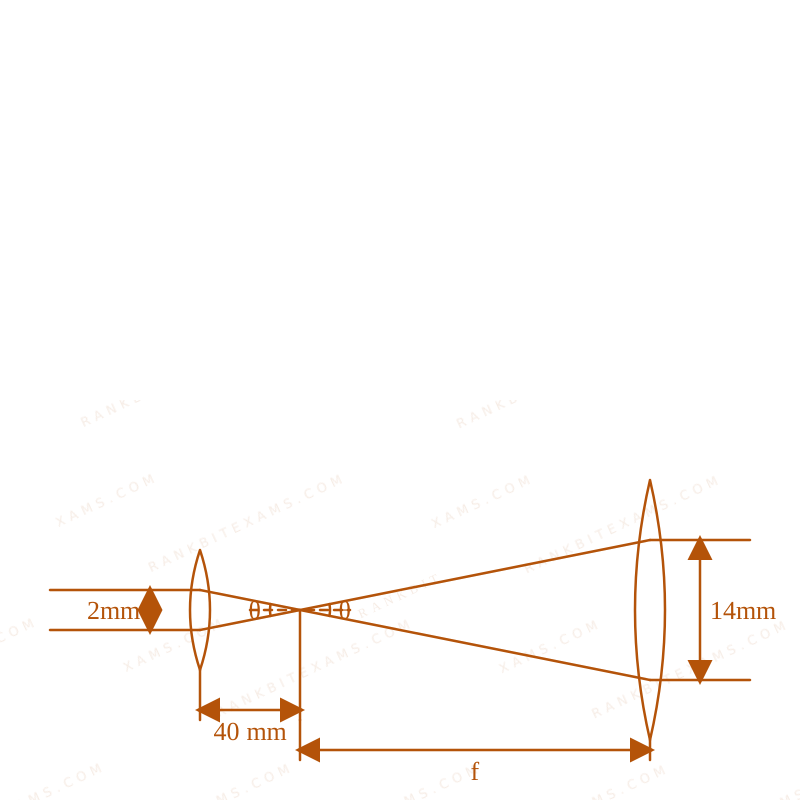
Rankbit System
JEE Physics: Waves (+15.5%) | Electrostatics: Concentric Shells (-29.7%) | Modern Physics: Photoelectric Clones (+34.2%) | Mathematics: Definite Integrals (+18.1%) | Chemistry: Coordination Splitting (-11.4%) | JEE Physics: Waves (+15.5%) | Electrostatics: Concentric Shells (-29.7%) | Modern Physics: Photoelectric Clones (+34.2%) | Mathematics: Definite Integrals (+18.1%) | Chemistry: Coordination Splitting (-11.4%)

The radii of curvature for a thin convex lens are 10mathrm~cm and 15mathrm~cm respectively. The focal length of the lens is 12mathrm~cm. The refractive index of the lens material is:

Solution & Explanation

### Related Formula Lens Maker's Formula: frac1f = (mu - 1) left(frac1R_1 - frac1R_2right) where, f = focal length of the lens, mu = refractive index of the material, R_1, R_2 = radii of curvature with standard Cartesian sign convention. ### Core Logic For a thin bi-convex lens, using standard coordinate conventions: - R_1 = +10mathrm~cm (positive since first surface centers to the right of light trajectory), - R_2 = -15mathrm~cm (negative since second surface centers to the left), - Focal length f = +12mathrm~cm. ### Step 1: Substituting in the Equation Substitute the values into Lens Maker's formula: frac112 = (mu - 1) left(frac110 - frac1-15right) frac112 = (mu - 1) left(frac110 + frac115right) frac112 = (mu - 1) left(frac3 + 230right) frac112 = (mu - 1) left(frac530right) = (mu - 1) left(frac16right) mu - 1 = frac612 = 0.5 implies mu = 1.5 ### Pattern Recognition Convex lenses always have opposite signs for R_1 and R_2. The term left(frac1R_1 - frac1R_2right) is additive: left(frac1|R_1| + frac1|R_2|right). ### Evaluation Rubric / Model Answer null ### Chapter Mix Class 12 Physics: Ray Optics and Optical Instruments

Reference Study Guides

More Ray Optics and Optical Instruments Previous-Year Questions

Q 2025 Spherical Mirrors and Magnification
Two identical objects are placed in front of convex mirror and concave mirror having same radii of curvature of 12 \, textcm , at the same distance of 18 \, textcm from the respective mirrors. The ratio of sizes of the images formed by convex mirror and by concave mirror is:
  • A. 1 / 2
  • B. 2
  • C. 3
  • D. 1 / 3

Solution

### Related Formula 1. Mirror focal length: f = fracR2 2. Magnification (image size relative to object size): m = frach_ih_o = fracff - u where u is the object distance. ### Core Logic Given parameters: - Radius of curvature R = 12 \ mathrmcm implies |f| = 6 \ mathrmcm - Object distance u = -18 \ mathrmcm Let's calculate magnification for both mirrors: 1. **For Convex Mirror:** - Focal length f_textconvex = +6 \ mathrmcm (using Cartesian sign convention) - Magnification: m_1 = fracf_textconvexf_textconvex - u = frac66 - (-18) = frac624 = frac14 Thus, image size is frac14 h_o. ### Step 1: Calculate magnification of concave mirror 2. **For Concave Mirror:** - Focal length f_textconcave = -6 \ mathrmcm - Magnification:
Convex and concave mirror ray diagram representations
m_2 = fracf_textconcavef_textconcave - u = frac-6-6 - (-18) = frac-612 = -frac12 Thus, image size is frac12 h_o. ### Step 2: Calculate the ratio of image sizes Since the objects are identical (same height h_o), the ratio of the sizes of the images is:
Convex and concave mirror ray diagram representations
textRatio = frac|h_i1||h_i2| = frac|m_1||m_2| = frac1/41/2 = frac12 Thus, the ratio of sizes is 1/2. ### Pattern Recognition Sees: Parallel convex vs concave mirror magnification. Trap: Reversing the signs of focal lengths (Convex focal length is +, Concave is - in standard coordinate systems). Shortcut: Use direct magnification equation m = fracff-u. For convex, m = frac624 = frac14. For concave, m = frac-612 = -frac12. Ratio of absolute values is frac1/41/2 = 1/2. ### Evaluation Rubric / Model Answer null ### Chapter Mix Class 12 Physics: Ray Optics and Optical Instruments
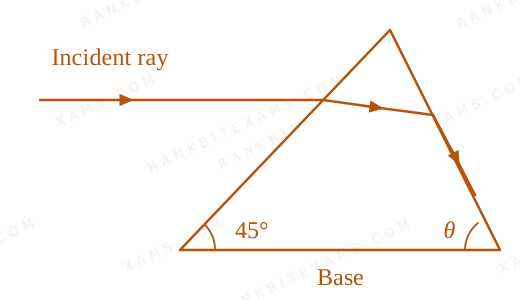
Q17 2025 Lens Maker's Formula
A bi-convex lens has radius of curvature of both the surfaces same as 1/6 cm. If this lens is required to be replaced by another convex lens having different radii of curvatures on both sides ( R_1 neq R_2 ), without any change in lens power then possible combination of R_1 and R_2 is:
  • A. frac13 mathrm~cm and frac13 mathrm~cm
  • B. frac15 mathrm~cm and frac17 mathrm~cm
  • C. frac13 mathrm~cm and frac17 mathrm~cm
  • D. frac16 mathrm~cm and frac19 mathrm~cm

Solution

### Related Formula Lens Maker's Formula: frac1f = (mu - 1) left(frac1R_1 - frac1R_2right) For a bi-convex lens of equal radii (R_1 = +R, R_2 = -R): frac1f = (mu - 1) frac2R Power P propto frac1f. ### Core Logic For the initial lens: - R = frac16 \ mathrmcm - frac1f_1 = (mu - 1) frac21/6 = 12 (mu - 1) For the replacement lens (R_1 = +R_1, R_2 = -R_2): frac1f_2 = (mu - 1) left(frac1R_1 + frac1R_2right) Since power must be preserved (f_1 = f_2): frac1R_1 + frac1R_2 = frac2R = 12 \ mathrmcm^-1 We need to find a combination where the sum of the reciprocals of the radii equals 12. ### Step 1: Verify the options Let's check each choice: - **Option (1):** R_1 = frac13, R_2 = frac13: frac11/3 + frac11/3 = 3 + 3 = 6 neq 12 - **Option (2):** R_1 = frac15, R_2 = frac17: frac11/5 + frac11/7 = 5 + 7 = 12 quad checkmark quad text(Correct Combination) - **Option (3):** R_1 = frac13, R_2 = frac17: frac11/3 + frac11/7 = 3 + 7 = 10 neq 12 - **Option (4):** R_1 = frac16, R_2 = frac19: frac11/6 + frac11/9 = 6 + 9 = 15 neq 12 Thus, only Option (2) meets the physical conditions. ### Pattern Recognition Sees: Equivalent thin lens power with modified surfaces. Trap: Neglecting sign convention for the second spherical surface during substitution. Shortcut: If the radii are of the form 1/n, then the sum of n_1 + n_2 must equal 2 times n_textinitial. Since initial n = 6, 2 times 6 = 12. The only pairing whose denominators add up to 12 is 5 + 7. ### Evaluation Rubric / Model Answer null ### Chapter Mix Class 12 Physics: Ray Optics and Optical Instruments
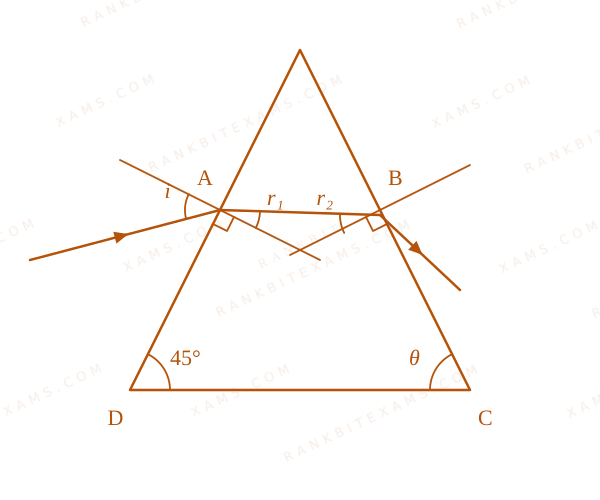
Q23 2025 Prism Formula and Minimum Deviation
A ray of light suffers minimum deviation when incident on a prism having angle of the prism equal to 60^circ . The refractive index of the prism material is sqrt2 . The angle of incidence (in degrees) is ______.
Numerical Answer. Answer: 45 to 45

Solution

### Related Formula 1. Prism Formula relating refractive index to minimum deviation: mu = fracsinleft(fracA + delta_m2right)sinleft(fracA2right) 2. Under the condition of minimum deviation: i = fracA + delta_m2 Thus, the formula simplifies to: mu = fracsin isin(A/2) ### Core Logic Given parameters: - Angle of prism A = 60^circ - Refractive index of material mu = sqrt2 Substitute the parameters into the simplified formula: sqrt2 = fracsin isin(60^circ / 2) sqrt2 = fracsin isin(30^circ) ### Step 1: Solve for angle of incidence Since sin(30^circ) = 0.5: sin i = sqrt2 times frac12 = frac1sqrt2 Solving for i: i = 45^circ Thus, the angle of incidence is 45 degrees. ### Pattern Recognition Sees: Prism minimum deviation and refracting index relations. Trap: Mistaking the computed angle of incidence (i) for the angle of minimum deviation (delta_m). Shortcut: Snell's law at the symmetrical boundary reduces to mu = sin i / sin(A/2). Because A = 60^circ, the denominator is sin 30^circ = 1/2. Therefore, sin i = 0.5 times sqrt2 = 1/sqrt2 implies i = 45^circ. ### Evaluation Rubric / Model Answer null ### Chapter Mix Class 12 Physics: Ray Optics and Optical Instruments
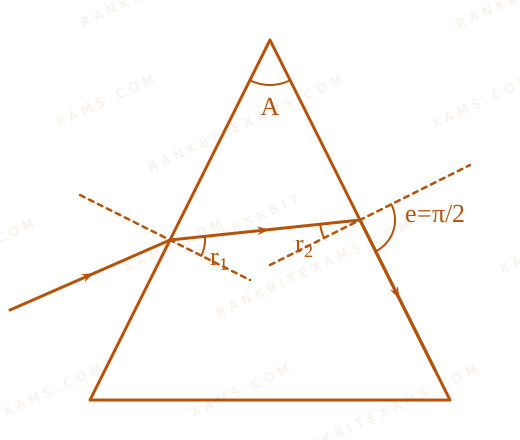
Q 2025 Refraction at Spherical Surfaces
Light from a point source in air falls on a spherical glass surface (refractive index, mu=1.5 and radius of curvature =50 cm). The image is formed at a distance of 200 cm from the glass surface inside the glass. The magnitude of distance of the light source from the glass surface is ________ m.
Numerical Answer. Answer: 4 to 4

Solution

### Related Formula The refraction equation at a single spherical interface is given by: fracmu_2v - fracmu_1u = fracmu_2 - mu_1R where: - mu_1 is the refractive index of the initial medium (air, mu_1 = 1.0) - mu_2 is the refractive index of the second medium (glass, mu_2 = 1.5) - u is the object distance - v is the image distance - R is the radius of curvature ### Core Logic Given parameters: - mu_1 = 1.0, mu_2 = 1.5 - Radius of curvature R = +50mathrm~cm - Image distance v = +200mathrm~cm (real image inside glass)
Refraction at Spherical Surfaces
### Step 1: Substitute parameters into refraction formula $frac1.5200 - frac1u = frac1.5 - 1.050 frac3400 - frac1u = frac0.550 = frac1100 ### Step 2: Solve for object distance (u) -frac1u = frac1100 - frac3400 -frac1u = frac4 - 3400 = frac1400 u = -400mathrm~cm = -4mathrm~m The magnitude of the distance of the light source is 4\mathrm{~m}. ### Pattern Recognition Remember standard sign convention: Light travels from object to refracting surface. Distances measured in the direction of incident light are positive. Here, v and R are positive, whereas u$ is negative. ### Evaluation Rubric / Model Answer null ### Chapter Mix Class 12 Physics: Ray Optics and Optical Instruments

Q9 2025 Refraction of Light and Refractive Index
A monochromatic light of frequency 5times10^14mathrm~Hz travelling through air, is incident on a medium of refractive index '2'. Wavelength of the refracted light will be :
  • A. 300 nm
  • B. 600 nm
  • C. 400 nm
  • D. 500 nm

Solution

### Related Formula For light propagation, wave velocity, frequency, and wavelength are related by: v = f lambda Rightarrow lambda_textair = fraccf When light passes into a medium of refractive index mu, the frequency remains constant, but the wavelength scales down to: lambda_textmedium = fraclambda_textairmu ### Core Logic Given parameters: - Frequency f = 5 times 10^14mathrm~Hz - Speed of light in vacuum/air c approx 3 times 10^8mathrm~m/s - Refractive index of medium mu = 2 ### Step 1: Calculate Wavelength in Air (Vacuum) lambda_textair = frac3 times 10^8mathrm~m/s5 times 10^14mathrm~Hz = 0.6 times 10^-6mathrm~m = 600mathrm~nm ### Step 2: Calculate Refracted Wavelength in Medium lambda_textmedium = fraclambda_textairmu = frac600mathrm~nm2 = 300mathrm~nm ### Pattern Recognition Remember: Frequency is a source characteristic and never changes during refraction. Speed and wavelength both decrease by a factor of mu inside the medium. ### Evaluation Rubric / Model Answer null ### Chapter Mix Class 12 Physics: Ray Optics and Optical Instruments

More Ray Optics and Optical Instruments Questions — jee_main_2025_03_april_morning

Practice all Ray Optics and Optical Instruments previous-year questions →

YOUR FIRST PREP STEP STARTS HERE

We Map Every Repeating Question in Competitive Exams.

Say goodbye to generic mock test fatigue. RankBit uses smart analysis to group past exam questions into their foundational Repeating Question Types. Find chapter weightage, track repeating questions, and score higher with targeted practice.

Select Your Target Exam

Choose an exam track below to find formulas per chapter and patterns.

Syncing Exam Intelligence

Mapping formulas and patterns across all tracks…

PATH A — FULL LENGTH PRACTICE

Full Mock Test Hub

Simulate real NTA exam conditions with fully tracked mocks. Time yourself against past papers.

Under Development
PATH B — TARGETED PRACTICE

Topic-wise Practice Hub

Practice past-year questions one chapter at a time. Pick an exam → subject → chapter and get every PYQ for that topic — pulled together from all past papers — with the chapter's key formulas alongside.

Loading Questions... Browse Topics
Latest from the Blog
View all →

Loading articles...