JEE Main · Physics ↓ Falling

Mechanical Properties of Fluids appeared 32 times across 3 years — 3.7% of Physics. This question is from Bernoulli's Principle.

Year 2026 2025 2024 Total
Questions 9 15 8 32

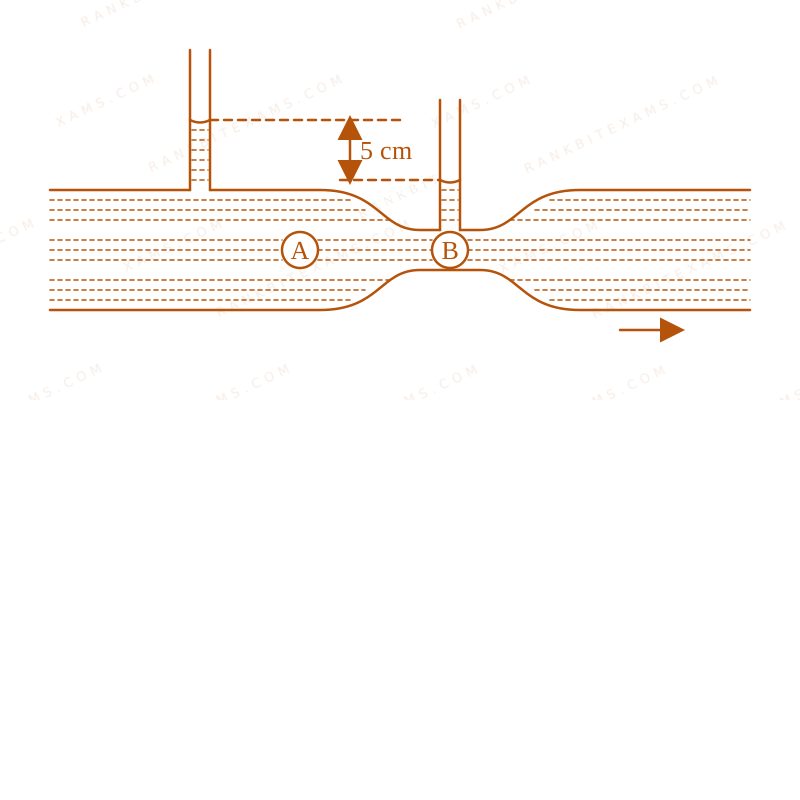
Water flows through a horizontal tube as shown in the figure. The difference in height between the water columns in vertical tubes is 5 cm and the area of cross-sections at A and B are 6 cm² and 3 cm² respectively. The rate of flow will be ____ cm³/s. (take g = 10 m/s²)
Bernoulli's Principle diagram for Q29 - JEE Main 2026 Morning
The figure illustrates a Venturi meter setup with water flowing through a variable cross-section tube.

Solution & Explanation

Related Formula
A₁ V₁ = A₂ V₂ P₁ + (1)/(2)ρ V₁² = P₂ + (1)/(2)ρ V₂² P₁ - P₂ = ρ g h
Core Logic

From the continuity equation between A and B:

AAVA = ABVB 6VA = 3VB VB = 2VA

Applying Bernoulli's equation between A and B for a horizontal pipe:

PA + (1)/(2)ρ VA² = PB + (1)/(2)ρ VB² PA - PB = (1)/(2)ρ(VB² - VA²)

Since the height difference is h = 5 cm = 0.05 m, the pressure difference is ρ gh.

ρ g × 0.05 = (1)/(2)ρ( (2VA)² - VA² ) g × 0.05 = (1)/(2)(3VA²)
Step 1: Calculate Velocity and Volume Flow Rate

Solving for VA:

VA = √((2 × 10 × 0.05)/(3)) = √((1)/(3)) = 1√(3) m/s VA = 100√(3) cm/s

Volume flow rate Q = AA VA:

Q = 6 cm² × 100√(3) cm/s = 600√(3) = 200√(3) cm³/s
Pattern Recognition

In a horizontal Venturi meter, substituting V₂ = V₁ (A₁/A₂) directly into ρ g h = (1)/(2)ρ (V₂² - V₁²) is the standard path. Working in CGS vs MKS units requires careful tracking; convert VA to cm/s before multiplying by AA in cm².

Chapter Mix

Class 11 Physics: Mechanical Properties of Fluids

More Mechanical Properties of Fluids Previous-Year Questions — Page 2

Q45 jee_main_2026_23_january_evening Viscosity and Terminal Velocity
A small metallic sphere of diameter 2 mm and density 10.5 g/cm³ is dropped in glycerine having viscosity 10 Poise and density 1.5 g/cm³ respectively. The terminal velocity attained by the sphere is ____ cm/s. (π = (22)/(7) and g = 10 m/s²)
  • A. 2.0
  • B. 1.0
  • C. 3.0
  • D. 1.5

Solution

Related Formula
VT = (2r² g)/(9η) (ρb - ρ)
Core Logic

Given data: Radius r = 1 mm = 0.1 cm. Density of sphere ρb = 10.5 g/cm³. Density of liquid ρ = 1.5 g/cm³. Viscosity η = 10 Poise = 10 g/cm· s (since 1 Poise = 1 CGS unit of viscosity). Gravity g = 10 m/s² = 1000 cm/s² (Wait, standard gravity for CGS is 980, but the problem specifies g = 10 m/s² = 1000 cm/s²).

Step 1: Calculation in CGS Units
VT = (2)/(9) · ((0.1)² × 1000)/((10)) · (10.5 - 1.5) VT = (2)/(9) · (0.01 × 1000)/(10) · (9) VT = 2 · (10)/(10) · 1 VT = 2 cm/s
Pattern Recognition

Watch the units closely. Poise is the CGS unit for viscosity, so converting all values to CGS (cm, g, s) makes the calculation direct and prevents factor-of-10 errors common when mixing SI and CGS.

Chapter Mix

Class 11 Physics: Mechanical Properties of Fluids

Q50 jee_main_2026_24_january_morning Terminal Velocity
Sixty four rain drops of radius 1 mm each falling down with a terminal velocity of 10 cm/s coalesce to form a bigger drop. The terminal velocity of bigger drop is ____ cm/s.
Numerical Answer. Answer: 160 to 160

Solution

Related Formula
VT = (2r² g)/(9η) (ρ - σ)

VT ∝ r²

Core Logic

Coalescing rain drops volume conservation

When 64 small drops (radius R₁) coalesce to form a bigger drop (radius R₂), mass and volume are conserved.

64 ((4)/(3) π R₁³) = (4)/(3) π R₂³ R₂³ = 64 R₁³ R₂ = 4 R₁

Coalescing rain drops volume conservation

Step 1: Terminal Velocity Ratio

Since terminal velocity VT ∝ R²:

((VT)₁)/((VT)₂) = ( (R₁)/(R₂) )² = ( (1)/(4) )² = (1)/(16)

Given (VT)₁ = 10 cm/s:

(10)/((VT)₂) = (1)/(16) (VT)₂ = 160 cm/s
Pattern Recognition

When N identical drops coalesce, the new radius is N1/3 times the old radius. Consequently, the new terminal velocity scales precisely as N2/3. For N=64, 642/3 = 16. Just multiply initial v by 16.

Chapter Mix

Class 11 Physics: Mechanical Properties of Fluids

Q37 jee_main_2026_24_january_evening Buoyancy and Archimedes Principle
A cubical block of density ρb = 600 kg/m³ floats in a liquid of density ρₑ = 900 kg/m³ . If the height of block is H = 8.0 cm then height of the submerged part is ____ cm.
  • A. 7.3
  • B. 4.3
  • C. 6.3
  • D. 5.3

Solution

Related Formula
Fbuoyancy = Mg ρliquid Vsubmerged g = ρblock Vtotal g
Core Logic

For a floating block, the weight of the block equals the buoyant force exerted by the liquid.

M g = Fb

ρb × A × H × g = ρₑ × A × h × g
Step 1: Calculation
600 × 8 cm = 900 × h h = (600 × 8)/(900) h = (16)/(3) cm h ≈ 5.33 cm
Pattern Recognition

Submerged fraction is exactly the ratio of densities: (h)/(H) = ρobjectρfluid.

Chapter Mix

Class 11 Physics: Mechanical Properties of Fluids

Q50 jee_main_2026_24_january_evening Surface Tension and Work Done
A soap bubble of surface tension 0.04 N/m is blown to a diameter of 7 cm. If (15000 - x) μJ of work is done in blowing it further to make its diameter 14 cm, then the value of x is ____. (π = 2 2 / 7)
Numerical Answer. Answer: 11304 to 11304

Solution

Related Formula
W = Δ U = S · Δ A

For a soap bubble with two surfaces:

Δ A = 2 × 4π (r₂² - r₁²)
Core Logic

Given: S = 0.04 N/m Initial diameter = 7 cm r₁ = 3.5 cm = 3.5 × 10⁻² m Final diameter = 14 cm r₂ = 7 cm = 7 × 10⁻² m

W = S × (8π r₂² - 8π r₁²)
Step 1: Compute the Work Done
W = 0.04 × 8π ((7²) - (3.5²)) × 10⁻⁴ W = 0.04 × 8 × (22)/(7) × (49 - 12.25) × 10⁻⁴ W = 0.04 × 2 × (22)/(7) × (147) × 10⁻⁴ × 4

Wait, the solution uses an alternate factorizing logic: 8π(49 - 12.25) = 8π(36.75) = 294π. Let's follow the PDF strictly:

W = 0.04 × 2 × (22)/(7) × 147 × 10⁻⁴ W = 3696 × 10⁻⁶ J = 3696
Step 2: Solve for x
3696 = 15000 - x x = 15000 - 3696 x = 11304
Pattern Recognition

A soap bubble has two free surfaces; always multiply area changes by 2 (W = 8π S Δ r²). Failing to account for both surfaces yields exactly half the answer, acting as a common trap.

Chapter Mix

Class 11 Physics: Mechanical Properties of Fluids

Q4 jee_main_2025_02_april_evening Surface Tension and Surface Energy
Two water drops each of radius r coalesce to form a bigger drop. If T is the surface tension, the surface energy released in this process is:
  • A. 4π r² T [2 - 2(2)/(3)]
  • B. 4π r² T [2 - 2(1)/(3)]
  • C. 4π r² T [1 + √(2)]
  • D. 4π r² T [√(2) - 1]

Solution

Related Formula
  • Surface Energy:
U = T · A = T · (4π R²)
  • Conservation of Volume during coalescence of drops:
2 × ((4)/(3)π r³) = (4)/(3)π R³
Core Logic

When two drops of radius r coalesce into a single larger drop of radius R, volume is conserved:

R³ = 2r³ R = 21/3 r
  • Initial surface area of the two separate drops:
Aᵢ = 2 × 4π r² = 8π r²
  • Final surface area of the combined single drop:
Af = 4π R² = 4π (21/3 r)² = 4π r² 22/3
  • Surface energy released:
Δ E = Uᵢ - Uf = T(Aᵢ - Af) Δ E = T ( 8π r² - 4π r² 22/3 ) = 4π r² T [ 2 - 22/3 ]
Pattern Recognition

Sees: Coalescence of N identical drops. Trap: Forgetting to conserve volume first, or confusing initial and final surface areas. Shortcut: Energy released when N drops coalesce into one big drop is:

Δ E = 4π r² T [ N - N2/3 ]

Here, substituting N = 2 directly gives 4π r² T [ 2 - 22/3 ].

Chapter Mix

Class 11 Physics: Mechanical Properties of Fluids

More Mechanical Properties of Fluids Questions — jee_main_2026_21_jan_morning

Practice all Mechanical Properties of Fluids previous-year questions →

Rankbit System
JEE Physics: Waves (+15.5%) | Electrostatics: Concentric Shells (-29.7%) | Modern Physics: Photoelectric Clones (+34.2%) | Mathematics: Definite Integrals (+18.1%) | Chemistry: Coordination Splitting (-11.4%) | JEE Physics: Waves (+15.5%) | Electrostatics: Concentric Shells (-29.7%) | Modern Physics: Photoelectric Clones (+34.2%) | Mathematics: Definite Integrals (+18.1%) | Chemistry: Coordination Splitting (-11.4%)