A 4 kg mass moves under the influence of a force vecmathrmF = (4mathrmt^3hatmathrmi - 3mathrmthatmathrmj)text N where t is the time in second. If mass starts from origin at t = 0, the velocity and position after t = 2texts will be:

Solution & Explanation

### Related Formula veca = fracvecFm vecv = int veca \, dt vecr = int vecv \, dt ### Core Logic Given vecF = 4t^3hati - 3thatj and mass m = 4text kg. Acceleration: veca = fracvecFm = frac4t^3hati - 3thatj4 = t^3hati - frac34thatj ### Step 1: Calculating Velocity Velocity is the integral of acceleration with v(0) = 0: vecv = int left( t^3hati - frac34thatj right) dt = fract^44hati - frac38t^2hatj At t = 2text s: vecv(2) = frac(2)^44hati - frac38(2)^2hatj = 4hati - frac32hatj ### Step 2: Calculating Position Position is the integral of velocity with vecr(0) = vec0: vecr = int vecv \, dt = int left( fract^44hati - frac38t^2hatj right) dt vecr = fract^520hati - frac324t^3hatj = fract^520hati - fract^38hatj At t = 2text s: vecr(2) = frac(2)^520hati - frac(2)^38hatj = frac3220hati - frac88hatj = frac85hati - hatj ### Pattern Recognition Recognize F to a to v to r means consecutive integrations. Because the initial state is from rest at origin, we don't have to worry about constants of integration. ### Evaluation Rubric / Model Answer null ### Chapter Mix Class 11 Physics: Laws of Motion Class 11 Physics: Kinematics
Reference Study Guides

More Laws of Motion Previous-Year Questions — Page 4

Q36 jee_main_2024_27_jan_morning Banking of Tracks
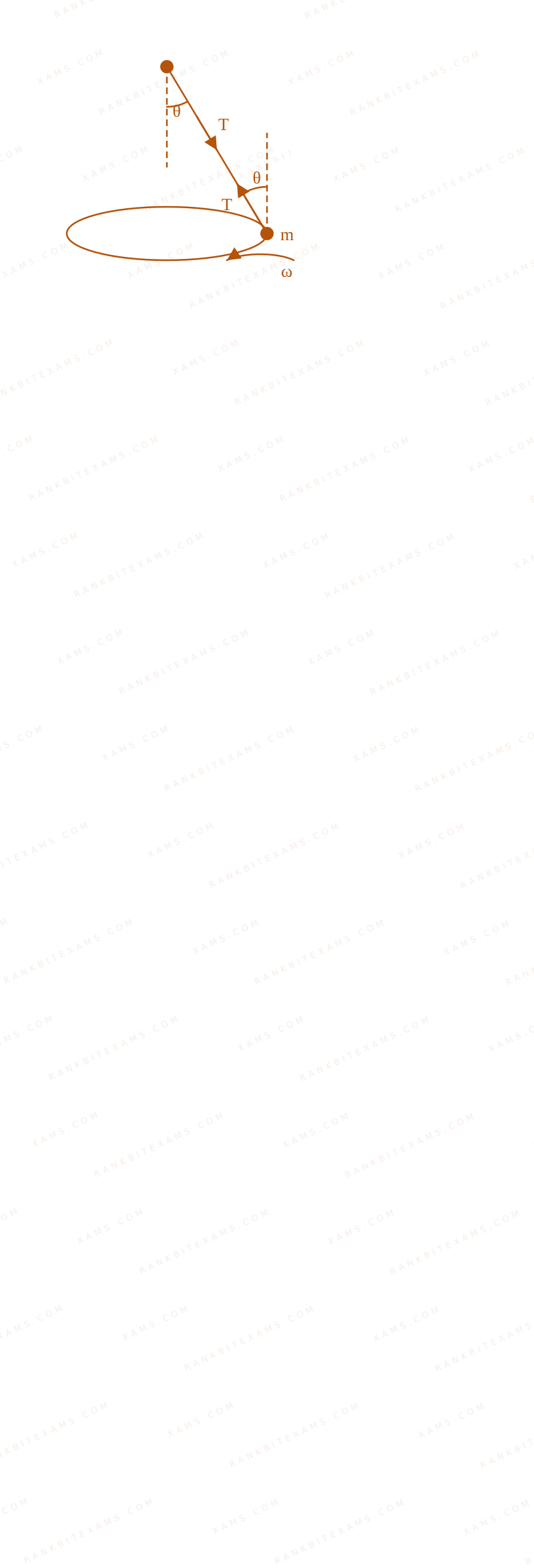
A train is moving with a speed of 12text m/s on rails which are 1.5text m apart. To negotiate a curve of radius 400text m, the height by which the outer rail should be raised with respect to the inner rail is (Given, g = 10text m/s^2):
  • A. 6.0text cm
  • B. 5.4text cm
  • C. 4.8text cm
  • D. 4.2text cm

Solution

### Related Formula tantheta = fracv^2Rg For small angles, tantheta approx sintheta = frachd, where h is the raised height and d is the separation between the tracks. ### Core Logic Equating the two relationships: frachd = fracv^2Rg frach1.5 = frac12 times 12400 times 10 ### Step 1: Compute height value h = 1.5 times frac1444000 = 1.5 times 0.036 = 0.054text m Converting to centimeters: h = 0.054 times 100 = 5.4text cm ### Pattern Recognition Whenever theta is small, geometry permits approximating tantheta with frachtextwidth, vastly reducing computational transcendental overhead. ### Evaluation Rubric / Model Answer null ### Chapter Mix Class 11 Physics: Laws of Motion
Q45 jee_main_2024_27_jan_morning Conservation of Linear Momentum
A body of mass 1000text kg is moving horizontally with a velocity 6text m/s. If 200text kg extra mass is added, the final velocity (in m/s) is:
  • A. 6
  • B. 2
  • C. 3
  • D. 5

Solution

### Related Formula m_1 v_1 = m_2 v_2 ### Core Logic Since there is no external horizontal force acting on the body, linear momentum along the horizontal axis is conserved. Initial mass m_1 = 1000text kg, initial velocity v_1 = 6text m/s. Final mass m_2 = 1000 + 200 = 1200text kg. ### Step 1: Balance conservation equation 1000 times 6 = 1200 times v_2 6000 = 1200 v_2 implies v_2 = frac60001200 = 5text m/s ### Pattern Recognition Inelastic mass addition transitions are classic momentum-balance equations, scaling velocity inversely with total expanded mass profiles. ### Evaluation Rubric / Model Answer null ### Chapter Mix Class 11 Physics: Laws of Motion
Q39 jee_main_2024_29_jan_morning Friction and Work Done
A block of mass 100 mathrm~kg slides over a distance of 10 mathrm~m on a horizontal surface. If the co-efficient of friction between the surfaces is 0.4, then the work done against friction (in J) is:
  • A. 4200
  • B. 3900
  • C. 4000
  • D. 4500

Solution

### Related Formula Kinetic frictional force (f) on a flat surface: f = mu N = mu m g Work done against friction (W_textagainst): W_textagainst = f cdot s = mu m g s ### Core Logic Given values: m = 100 mathrm~kg, quad s = 10 mathrm~m, quad mu = 0.4 Take g = 10 mathrm~m/s^2. ### Step 1: Calculate Friction Force The normal force on a horizontal surface is: N = mg = 100 times 10 = 1000 mathrm~N The force of friction is: f = mu N = 0.4 times 1000 = 400 mathrm~N ### Step 2: Calculate Work Done The work done against friction is: W_textagainst = f cdot s = 400 mathrm~N times 10 mathrm~m = 4000 mathrm~J Therefore, the work done is 4000 mathrm~J. ### Pattern Recognition Work done *by* friction is negative (-4000 mathrm~J) because the frictional force opposes displacement. Work done *against* friction is positive (+4000 mathrm~J) because it represents the external energy that must be spent to sustain slide. ### Evaluation Rubric / Model Answer null ### Chapter Mix Class 11 Physics: Laws of Motion
Q32 jee_main_2024_30_january_evening Work Done by Friction on Incline
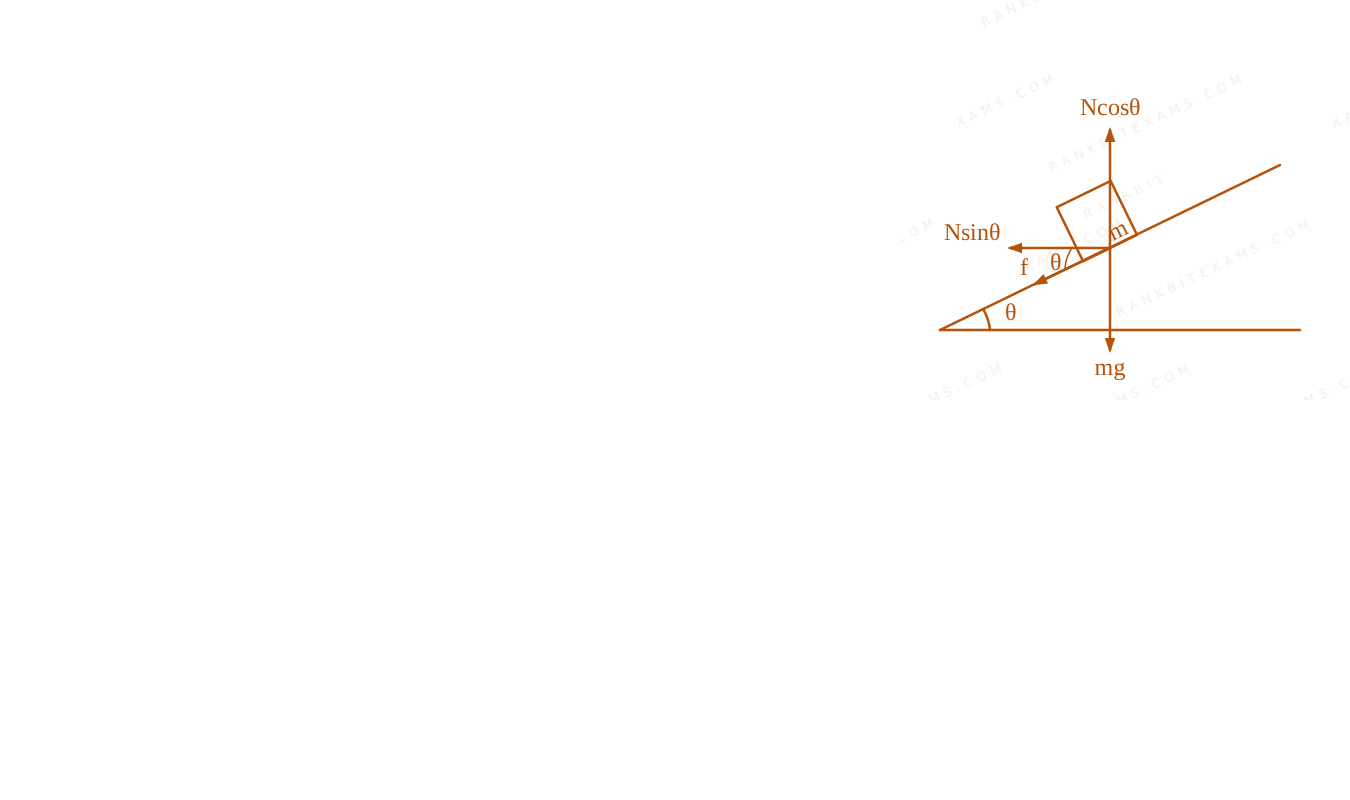
A block of mass 1 mathrm~kg is pushed up a surface inclined to horizontal at an angle of 60^circ by a force of 10 mathrm~N parallel to the inclined surface as shown in figure. When the block is pushed up by 10 mathrm~m along inclined surface, the work done against frictional force is: left[mathrmg = 10 mathrm~m / mathrms^2right]
Work Done by Friction on Incline diagram for Q32 - JEE Main 2024 Evening
A block of mass M on an incline at 60 degrees, pulled by 10 N force, with coefficient of static friction 0.1.
  • A. 5sqrt3 mathrm~J
  • B. 5 mathrm~J
  • C. 5 times 10^3 mathrm~J
  • D. 10 mathrm~J

Solution

### Related Formula W_f = f_k cdot d f_k = mu N N = mg costheta ### Core Logic The work done against the frictional force is the product of the kinetic friction force and the displacement along the plane. The normal force N on the block is given by N = mg costheta, where theta = 60^circ. ### Step 1: Calculate Normal and Frictional Force Given: mu = 0.1 m = 1 mathrm~kg theta = 60^circ d = 10 mathrm~m Normal force N = 1 times 10 times cos(60^circ) = 10 times frac12 = 5 mathrm~N. Frictional force f_k = mu N = 0.1 times 5 = 0.5 mathrm~N. ### Step 2: Work Done Against Friction Work done against frictional force = f_k times d W = 0.5 mathrm~N times 10 mathrm~m = 5 mathrm~J ### Pattern Recognition Whenever asked for "work done against friction", simply compute mu mg costheta times d. The applied force (10 mathrm~N) is irrelevant to the friction calculation itself since it is parallel to the plane. ### Evaluation Rubric / Model Answer null ### Chapter Mix Class 11 Physics: Laws of Motion Class 11 Physics: Work, Energy and Power
Q39 jee_main_2024_30_january_evening Equilibrium on a Rough Parabolic Curve
A block of mass m is placed on a surface having vertical cross section given by y = x^2 / 4. If coefficient of friction is 0.5, the maximum height above the ground at which block can be placed without slipping is:
  • A. 1 / 4 mathrm~m
  • B. 1 / 2 mathrm~m
  • C. 1 / 6 mathrm~m
  • D. 1 / 3 mathrm~m

Solution

### Related Formula tan theta = mu fracmathrmdymathrmdx = tan theta ### Core Logic For a block to remain stationary on a rough surface without slipping, the maximum slope of the surface it can rest on is determined by the angle of repose. tan theta le mu The slope of the given parabolic curve at any point (x,y) is fracmathrmdymathrmdx. ### Step 1: Evaluate the Slope Given curve equation: y = fracx^24 Differentiating with respect to x: fracmathrmdymathrmdx = frac2x4 = fracx2 ### Step 2: Find Maximum Valid Position At the critical point of slipping, slope equals mu: fracx2 = mu Given mu = 0.5 = frac12, we have: fracx2 = frac12 implies x = 1 ### Step 3: Calculate Maximum Height Substitute x = 1 back into the curve equation to find the maximum height y: y = frac(1)^24 = frac14 mathrm~m ### Pattern Recognition When asked for maximum height on a curve y=f(x) without slipping, set fracmathrmdymathrmdx = mu, solve for x, and plug it back into the original equation to find y. ### Evaluation Rubric / Model Answer null ### Chapter Mix Class 11 Physics: Laws of Motion

More Laws of Motion Questions — jee_main_2026_21_jan_morning

Practice all Laws of Motion previous-year questions →

Rankbit System
JEE Physics: Waves (+15.5%) | Electrostatics: Concentric Shells (-29.7%) | Modern Physics: Photoelectric Clones (+34.2%) | Mathematics: Definite Integrals (+18.1%) | Chemistry: Coordination Splitting (-11.4%) | JEE Physics: Waves (+15.5%) | Electrostatics: Concentric Shells (-29.7%) | Modern Physics: Photoelectric Clones (+34.2%) | Mathematics: Definite Integrals (+18.1%) | Chemistry: Coordination Splitting (-11.4%)
YOUR FIRST PREP STEP STARTS HERE

We Map Every Repeating Question in Competitive Exams.

Say goodbye to generic mock test fatigue. RankBit uses smart analysis to group past exam questions into their foundational Repeating Question Types. Find chapter weightage, track repeating questions, and score higher with targeted practice.

Select Your Target Exam

Choose an exam track below to find formulas per chapter and patterns.

Syncing Exam Intelligence

Mapping formulas and patterns across all tracks…

PATH A — FULL LENGTH PRACTICE

Full Mock Test Hub

Simulate real NTA exam conditions with fully tracked mocks. Time yourself against past papers.

Now Live Open
PATH B — TARGETED PRACTICE

Topic-wise Practice Hub

Practice past-year questions one chapter at a time. Pick an exam → subject → chapter and get every PYQ for that topic — pulled together from all past papers — with the chapter's key formulas alongside.

Loading Questions... Browse Topics
Latest from the Blog
View all →

Loading articles...