Let a = - i + 2 j + 2 k$\vec{a} = -\hat{i} + 2\hat{j} + 2\hat{k}$ , b = 8 i + 7 j - 3 k$\vec{b} = 8\hat{i} + 7\hat{j} - 3\hat{k}$ and c$\vec{c}$ be a vector such that a × c = b$\vec{a} \times \vec{c} = \vec{b}$ . If c. ( i + j + k) = 4$\vec{c}. (\hat{i} + \hat{j} + \hat{k}) = 4$ , then | a + c|²$|\vec{a} + \vec{c}|^2$ is equal to:
Let the unknown vector be c = c₁ i + c₂ j + c₃ k$\vec{c} = c_1\hat{i} + c_2\hat{j} + c_3\hat{k}$.
Given a = - i + 2 j + 2 k$\vec{a} = -\hat{i} + 2\hat{j} + 2\hat{k}$ and b = 8 i + 7 j - 3 k$\vec{b} = 8\hat{i} + 7\hat{j} - 3\hat{k}$.
Compute the cross product a × c$\vec{a} \times \vec{c}$:
Whenever a × c = b$\vec{a} \times \vec{c} = \vec{b}$ and a dot product constraint is given, simply expand c$\vec{c}$ algebraically as (c₁, c₂, c₃)$(c_1, c_2, c_3)$. The cross product and dot product create an easily solvable 3x3 linear system.
Keywords:#vector algebra cross product#JEE Main 2026 Morning Q5#Vector Algebra JEE Main 2026#Cross Product and Dot Product Operations JEE Main 2026
More Vector Algebra Previous-Year Questions — Page 7
Q53jee_main_2025_28_jan_eveningComponents of Vectors
If the components of a=α i+β j+γ k$\vec{a}=\alpha\hat{i}+\beta\hat{j}+\gamma\hat{k}$ along and perpendicular to b=3 i+ j- k$\vec{b}=3\hat{i}+\hat{j}-\hat{k}$ respectively, are (16)/(11)(3 i+ j- k)$\frac{16}{11}(3\hat{i}+\hat{j}-\hat{k})$ and (1)/(11)(-4 i-5 j-17 k)$\frac{1}{11}(-4\hat{i}-5\hat{j}-17\hat{k})$, then α²+β²+γ²$\alpha^{2}+\beta^{2}+\gamma^{2}$ is equal to:
A.23$23$
B.18$18$
C.16$16$
D.26$26$
Solution
Related Formula
Any vector a$\vec{a}$ can be written as the sum of its component parallel to b$\vec{b}$ (along b$\vec{b}$) and its component perpendicular to b$\vec{b}$:
a = a∥ + a⊥$$\vec{a} = \vec{a}_{\parallel} + \vec{a}_{\perp}$$
Since parallel and perpendicular components are orthogonal vectors, you can also use directly | a|² = | a∥|² + | a⊥|²$|\vec{a}|^2 = |\vec{a}_{\parallel}|^2 + |\vec{a}_{\perp}|^2$ to save algebra step: | a∥|² = (16²)/(11²)(9+1+1) = (256)/(11)$|\vec{a}_{\parallel}|^2 = \frac{16^2}{11^2}(9+1+1) = \frac{256}{11}$, | a⊥|² = (1)/(11²)(16+25+289) = (330)/(121) = (30)/(11)$|\vec{a}_{\perp}|^2 = \frac{1}{11^2}(16+25+289) = \frac{330}{121} = \frac{30}{11}$. Total = (286)/(11) = 26$\frac{286}{11} = 26$.
Chapter Mix
Class 12 Mathematics: Vector Algebra
Q55jee_main_2025_29_jan_morningVector Cross Product and Dot Product
Let a = 2 i - j + 3 k$\vec{a} = 2\hat{i} - \hat{j} + 3\hat{k}$ , b = 3 i - 5 j + k$\vec{b} = 3\hat{i} - 5\hat{j} + \hat{k}$ and c$\vec{c}$ be a vector such that a × c = c × b$\vec{a} \times \vec{c} = \vec{c} \times \vec{b}$ and ( a + c) . ( b + c) = 168.$\left(\vec{\mathbf{a}} + \vec{\mathbf{c}}\right) . \left(\vec{\mathbf{b}} + \vec{\mathbf{c}}\right) = 168.$ Then the maximum value of | c|²$|\vec{\mathbf{c}}|^2$ is:
A. 77
B. 462
C. 308
D. 154
Solution
Related Formula
u × v = - v × u$$\vec{u} \times \vec{v} = -\vec{v} \times \vec{u}$$If u × v = 0 u ∥ v u = λ v$$\text{If } \vec{u} \times \vec{v} = 0 \implies \vec{u} \parallel \vec{v} \implies \vec{u} = \lambda \vec{v}$$
Core Logic
Given a × c = c × b a × c + b × c = 0$\vec{a} \times \vec{c} = \vec{c} \times \vec{b} \implies \vec{a} \times \vec{c} + \vec{b} \times \vec{c} = 0$
( a + b) × c = 0 c = λ( a + b)$$(\vec{a} + \vec{b}) \times \vec{c} = 0 \implies \vec{c} = \lambda(\vec{a} + \vec{b})$$
Recognize the cross-product rule inversion immediately: x × y = y × z ( x+ z) ∥ y$\vec{x} \times \vec{y} = \vec{y} \times \vec{z} \implies (\vec{x}+\vec{z}) \parallel \vec{y}$. This linear reduction circumvents solving complex linear systems.
Let a=-5 i+ j-3 k$\vec{a}=-5\hat{i}+\hat{j}-3\hat{k}$, b= i+2 j-4 k$\vec{b}=\hat{i}+2\hat{j}-4\hat{k}$ and c=((( a× b)× i)× i)× i.$\vec{c}=(((\vec{a}\times\vec{b})\times\hat{i})\times\hat{i})\times\hat{i}.$ Then c·(- i+ j+ k)$\vec{c}\cdot(-\hat{i}+\hat{j}+\hat{k})$ is equal to:
A.-12$-12$
B.-10$-10$
C.-13$-13$
D.-15$-15$
Solution
Related Formula
Vector Triple Product Identity:
( u × v) × w = ( u · w) v - ( v · w) a$$(\vec{u} \times \vec{v}) \times \vec{w} = (\vec{u} \cdot \vec{w})\vec{v} - (\vec{v} \cdot \vec{w})\vec{a}$$
Core Logic
Given vectors a$\vec{a}$ and b$\vec{b}$:
First, let's find the inner vector triple product ( a × b) × i$(\vec{a} \times \vec{b}) \times \hat{i}$:
( a × b) × i = ( a · i) b - ( b · i) a$$(\vec{a} \times \vec{b}) \times \hat{i} = (\vec{a} \cdot \hat{i})\vec{b} - (\vec{b} \cdot \hat{i})\vec{a} $$
From the given components:
a · i = -5$\vec{a} \cdot \hat{i} = -5$
b · i = 1$\vec{b} \cdot \hat{i} = 1$
( a × b) × i = -5 b - a$$(\vec{a} \times \vec{b}) \times \hat{i} = -5\vec{b} - \vec{a} $$
Step 1: Substitute Vector Coordinates
Substitute coordinates of a$\vec{a}$ and b$\vec{b}$ into the expression:
-5 b - a = -5( i + 2 j - 4 k) - (-5 i + j - 3 k)$$-5\vec{b} - \vec{a} = -5(\hat{i} + 2\hat{j} - 4\hat{k}) - (-5\hat{i} + \hat{j} - 3\hat{k})$$= -5 i - 10 j + 20 k + 5 i - j + 3 k = -11 j + 23 k$$= -5\hat{i} - 10\hat{j} + 20\hat{k} + 5\hat{i} - \hat{j} + 3\hat{k} = -11\hat{j} + 23\hat{k} $$
Now, perform successive cross products with i$\hat{i}$:
Sees: Repeated vector cross products with standard unit vectors.
Shortcut: Observe that crossing a vector in the y-z$y-z$ plane with i$\hat{i}$ rotates its components by 90°$90^{\circ}$ in that plane. Doing it twice returns it to the original plane with flipped coefficients and signs (v × i × i = - v$\vec{v} \times \hat{i} \times \hat{i} = -\vec{v}$).
Chapter Mix
Class 12 Mathematics: Vector Algebra
Qjee_main_2024_29_january_eveningArea of Quadrilateral and Parallelogram
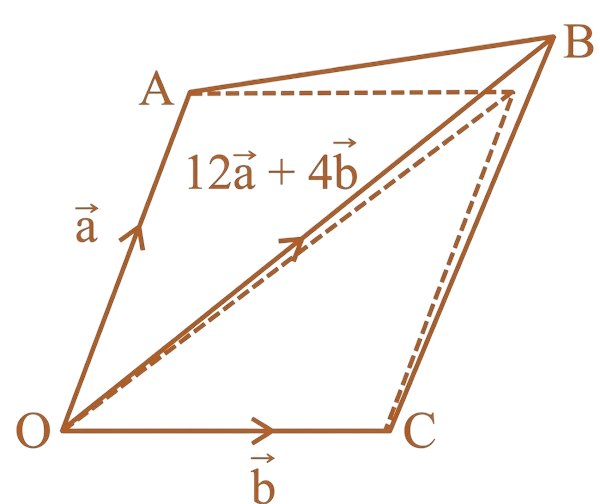
Let OA = a, OB = 12 a + 4 b$\overrightarrow{OA} = \vec{a}, \overrightarrow{OB} = 12\vec{a} + 4\vec{b}$ and OC = b$\overrightarrow{OC} = \vec{b}$, where O$O$ is the origin. If S$S$ is the parallelogram with adjacent sides OA$OA$ and OC$OC$, then the ratio of the area of the quadrilateral OABC to the area of S$S$ is equal to
A. 6
B. 10
C. 7
D. 8
Solution
Related Formula
Area of Parallelogram S = | a × b|$$\text{Area of Parallelogram } S = |\vec{a} \times \vec{b}|$$Area of Quadrilateral OABC = Area(Δ OAB) + Area(Δ OBC)$$\text{Area of Quadrilateral OABC} = \text{Area}(\Delta OAB) + \text{Area}(\Delta OBC)$$
Core Logic
Let us compute the component areas using vector cross products:
Area(Δ OAB) = (1)/(2) | OA × OB| = (1)/(2) | a × (12 a + 4 b)| = (1)/(2) |4( a × b)| = 2| a × b|$$\text{Area}(\Delta OAB) = \frac{1}{2} |\overrightarrow{OA} \times \overrightarrow{OB}| = \frac{1}{2} |\vec{a} \times (12\vec{a} + 4\vec{b})| = \frac{1}{2} |4(\vec{a} \times \vec{b})| = 2|\vec{a} \times \vec{b}|$$Area(Δ OBC) = (1)/(2) | OB × OC| = (1)/(2) |(12 a + 4 b) × b| = (1)/(2) |12( a × b)| = 6| a × b|$$\text{Area}(\Delta OBC) = \frac{1}{2} |\overrightarrow{OB} \times \overrightarrow{OC}| = \frac{1}{2} |(12\vec{a} + 4\vec{b}) \times \vec{b}| = \frac{1}{2} |12(\vec{a} \times \vec{b})| = 6|\vec{a} \times \vec{b}|$$
Step 1: Finding Total Ratio
Adding both triangles to find the total area of the quadrilateral OABC:
Area(OABC) = 2| a × b| + 6| a × b| = 8| a × b|$$\text{Area(OABC)} = 2|\vec{a} \times \vec{b}| + 6|\vec{a} \times \vec{b}| = 8|\vec{a} \times \vec{b}|$$
Area of Quadrilateral and Parallelogram diagram for Q8 - JEE Main 2024 Evening
Dividing this total by the area of the baseline parallelogram S = | a × b|$S = |\vec{a} \times \vec{b}|$:
Ratio = 8| a × b|| a × b| = 8$$\text{Ratio} = \frac{8|\vec{a} \times \vec{b}|}{|\vec{a} \times \vec{b}|} = 8$$
Pattern Recognition
Since a × a = 0$\vec{a} \times \vec{a} = 0$ and b × b = 0$\vec{b} \times \vec{b} = 0$, cross product distributions yield terms with purely a × b$\vec{a} \times \vec{b}$, ensuring absolute scalability independent of vectors chosen.
Chapter Mix
Class 12 Mathematics: Vector Algebra
Qjee_main_2024_29_january_eveningVector Operations and Angles
Let a unit vector u = x i + y j + z k$\hat{\mathbf{u}} = x\hat{\mathbf{i}} + y\hat{\mathbf{j}} + z\hat{\mathbf{k}}$ make angles (π)/(2)$\frac{\pi}{2}$, (π)/(3)$\frac{\pi}{3}$, and (2π)/(3)$\frac{2\pi}{3}$ with the vectors 1√(2) i + 1√(2) k$\frac{1}{\sqrt{2}}\hat{\mathbf{i}} + \frac{1}{\sqrt{2}}\hat{\mathbf{k}}$, 1√(2) j + 1√(2) k$\frac{1}{\sqrt{2}}\hat{\mathrm{j}} + \frac{1}{\sqrt{2}}\hat{\mathrm{k}}$, and 1√(2) i + 1√(2) j$\frac{1}{\sqrt{2}}\hat{\mathbf{i}} + \frac{1}{\sqrt{2}}\hat{\mathrm{j}}$ respectively. If v = 1√(2) i + 1√(2) j + 1√(2) k$\vec{\mathrm{v}} = \frac{1}{\sqrt{2}}\hat{\mathrm{i}} + \frac{1}{\sqrt{2}}\hat{\mathrm{j}} + \frac{1}{\sqrt{2}}\hat{\mathrm{k}}$, then | u - v|²$|\hat{\mathbf{u}} - \bar{\mathbf{v}}|^2$ is equal to
A.(11)/(2)$\frac{11}{2}$
B.(5)/(2)$\frac{5}{2}$
C. 9
D. 7
Solution
Related Formula
A · B = | A| | B| φ$$\vec{A} \cdot \vec{B} = |\vec{A}| |\vec{B}| \cos \phi$$
Core Logic
Let the given baseline vectors be p₁, p₂, p₃$\vec{p}_1, \vec{p}_2, \vec{p}_3$. Note that | p₁| = | p₂| = | p₃| = 1$|\vec{p}_1| = |\vec{p}_2| = |\vec{p}_3| = 1$.
Angle with p₁$\vec{p}_1$ is (π)/(2)$\frac{\pi}{2}$:
u · p₁ = 0 x√(2) + z√(2) = 0 x + z = 0 (i)$$\hat{u} \cdot \vec{p}_1 = 0 \implies \frac{x}{\sqrt{2}} + \frac{z}{\sqrt{2}} = 0 \implies x + z = 0 \quad \dots (i)$$
Angle with p₂$\vec{p}_2$ is (π)/(3)$\frac{\pi}{3}$:
u · p₂ = (π)/(3) y√(2) + z√(2) = (1)/(2) y + z = 1√(2) (ii)$$\hat{u} \cdot \vec{p}_2 = \cos\frac{\pi}{3} \implies \frac{y}{\sqrt{2}} + \frac{z}{\sqrt{2}} = \frac{1}{2} \implies y + z = \frac{1}{\sqrt{2}} \quad \dots (ii)$$
Angle with p₃$\vec{p}_3$ is (2π)/(3)$\frac{2\pi}{3}$:
u · p₃ = (2π)/(3) x√(2) + y√(2) = -(1)/(2) x + y = - 1√(2) (iii)$$\hat{u} \cdot \vec{p}_3 = \cos\frac{2\pi}{3} \implies \frac{x}{\sqrt{2}} + \frac{y}{\sqrt{2}} = -\frac{1}{2} \implies x + y = -\frac{1}{\sqrt{2}} \quad \dots (iii)$$
Step 1: Finding Vector Coordinates
Subtracting (ii) from (iii):
(x + y) - (y + z) = - 1√(2) - 1√(2) x - z = -√(2) (iv)$$(x + y) - (y + z) = -\frac{1}{\sqrt{2}} - \frac{1}{\sqrt{2}} \implies x - z = -\sqrt{2} \quad \dots (iv)$$
Solving (i) and (iv):
2x = -√(2) x = - 1√(2)$$2x = -\sqrt{2} \implies x = -\frac{1}{\sqrt{2}}$$z = 1√(2)$$z = \frac{1}{\sqrt{2}}$$
From (ii): y = 1√(2) - 1√(2) = 0$y = \frac{1}{\sqrt{2}} - \frac{1}{\sqrt{2}} = 0$.
So, u = - 1√(2) i + 0 j + 1√(2) k$\hat{u} = -\frac{1}{\sqrt{2}}\hat{i} + 0\hat{j} + \frac{1}{\sqrt{2}}\hat{k}$.
Step 2: Evaluating the Norm Difference
Given v = 1√(2) i + 1√(2) j + 1√(2) k$\vec{v} = \frac{1}{\sqrt{2}}\hat{i} + \frac{1}{\sqrt{2}}\hat{j} + \frac{1}{\sqrt{2}}\hat{k}$:
Practice past-year questions one chapter at a time. Pick an exam → subject → chapter and get every PYQ for that topic — pulled together from all past papers — with the chapter's key formulas alongside.