Permutations and Combinations appeared 40 times across 3 years — 4.6% of Mathematics.
This question is from Strictly Increasing Functions and Derangements.
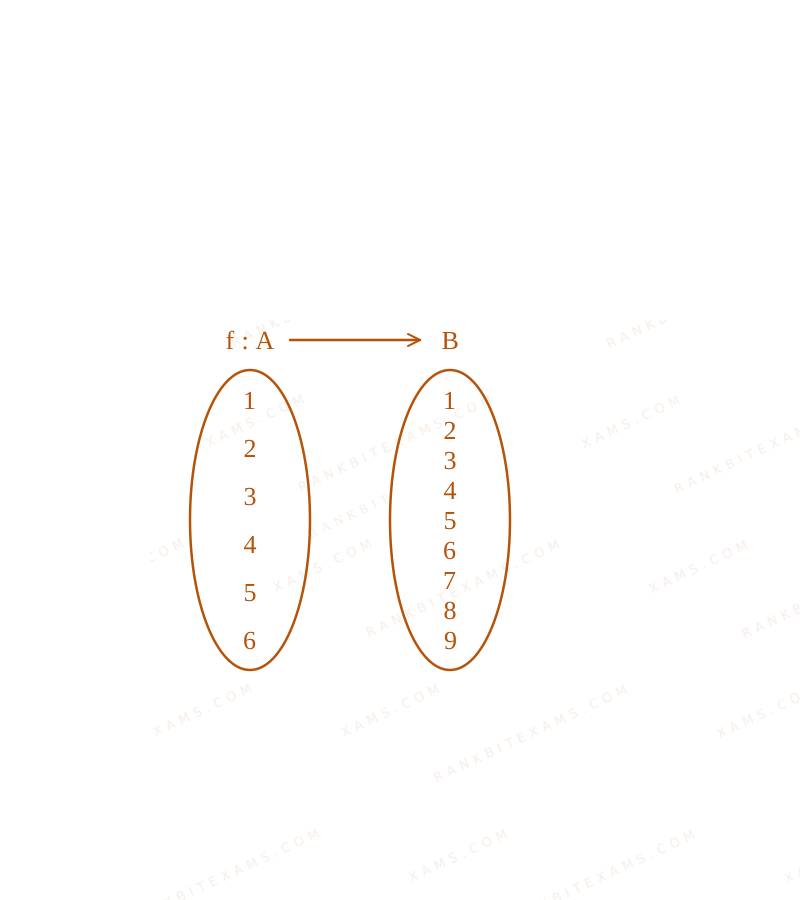
The number of strictly increasing functionsf$f$ from the set 1, 2, 3, 4, 5, 6$\{1, 2, 3, 4, 5, 6\}$ to the set 1, 2, 3, …, 9$\{1, 2, 3, \ldots, 9\}$ such that f(i) ≠ i$f(i) \neq i$ for 1 ≤ i ≤ 6$1 \leq i \leq 6$ , is equal to:
A.21
B.27
C.22
D.28
Solution & Explanation
Related Formula
For a strictly increasing function f: A → B$f: A \to B$ where |A| = m$|A| = m$ and |B| = n$|B| = n$, the number of functions without restrictions is nm$\binom{n}{m}$.
Core Logic
We need strictly increasing functionsf: 1,2,3,4,5,6 → 1,2, ,9$f: \{1,2,3,4,5,6\} \to \{1,2,\dots,9\}$ subject to f(i) ≠ i$f(i) \neq i$.
Since f$f$ is strictly increasing, f(i) ≥ i$f(i) \geq i$ must always hold because the target values are drawn from an equally spaced domain. If f(i) = i$f(i) = i$ for any i$i$, it forces a strict ladder down to 1. But we are given f(i) ≠ i$f(i) \neq i$. Thus, f(i) > i$f(i) > i$ for all 1 ≤ i ≤ 6$1 \leq i \leq 6$.
This implies f(1) ≥ 2$f(1) \geq 2$.
Function mapping sets diagram Q9 - JEE Main 2026 Morning
Step 1: Case Analysis on f(1)
Since f(1) > 1$f(1) > 1$, we evaluate possible starting points:
Case 1: f(1) = 2$f(1) = 2$
Remaining 5 values f(2)$f(2)$ to f(6)$f(6)$ must be strictly increasing and chosen from 3, 4, 5, 6, 7, 8, 9$\{3, 4, 5, 6, 7, 8, 9\}$ (7 available numbers). Since f(1)=2$f(1)=2$, f(i)>i$f(i)>i$ is naturally preserved for subsequent elements (e.g., f(2) ≥ 3 > 2$f(2) \ge 3 > 2$).
Number of ways = 75 = 21$= \binom{7}{5} = 21$.
Function mapping sets diagram Q9 - JEE Main 2026 Morning
Step 2: Subsequent Cases
Case 2: f(1) = 3$f(1) = 3$
Remaining 5 values chosen from 4, 5, 6, 7, 8, 9$\{4, 5, 6, 7, 8, 9\}$ (6 available numbers).
Number of ways = 65 = 6$= \binom{6}{5} = 6$.
Case 3: f(1) = 4$f(1) = 4$
Remaining 5 values chosen from 5, 6, 7, 8, 9$\{5, 6, 7, 8, 9\}$ (5 available numbers).
Number of ways = 55 = 1$= \binom{5}{5} = 1$.
Case 4: f(1) = 5$f(1) = 5$
Requires choosing 5 values from 6,7,8,9$\{6,7,8,9\}$, which is impossible.
Step 3: Total Sum
Total number of valid functions = 21 + 6 + 1 = 28$21 + 6 + 1 = 28$.
Pattern Recognition
For f(i) ≠ i$f(i) \neq i$ on strictly increasing integer arrays, f(x) - x > 0$f(x) - x > 0$. Using the substitution g(x) = f(x) - x$g(x) = f(x) - x$, you convert a constrained increasing function into a standard non-decreasing one, or simply pivot on f(1)$f(1)$ and sum the cascading binomials.
Chapter Mix
Class 11 Maths: Permutations and Combinations
Class 12 Maths: Functions
Keywords:#strictly increasing functions#JEE Main 2026 Morning Q9#Permutations and Combinations JEE Main 2026#Strictly Increasing Functions and Derangements JEE Main 2026
More Permutations and Combinations Previous-Year Questions — Page 7
Q56jee_main_2025_29_jan_morningDistribution into Groups
Let P$\mathrm{P}$ be the set of seven digit numbers with sum of their digits equal to 11. If the numbers in P$\mathrm{P}$ are formed by using the digits 1, 2 and 3 only, then the number of elements in the set P$\mathrm{P}$ is :
A. 158
B. 173
C. 164
D. 161
Solution
Related Formula
Number of permutations of multinomial set = (n!)/(n₁! n₂! )$$\text{Number of permutations of multinomial set} = \frac{n!}{n_1! n_2! \dots}$$
Core Logic
Let the 7 digits be formed using 1s, 2s, and 3s. We seek combinations whose sum is 11. Since minimum value for 7 digits using '1' is 7, we evaluate the distribution of surplus elements (11 - 7 = 4$11 - 7 = 4$ remaining to add).
Total elements = 21 + 105 + 35 = 161$$\text{Total elements} = 21 + 105 + 35 = 161$$
Pattern Recognition
Always set a base state (e.g., all 1s) to compute the baseline sum, then distribute the remainder explicitly via integer partitions to verify all distinct permutation paths systematically.
Chapter Mix
Class 11 Mathematics: Permutations and Combinations

Q74jee_main_2025_29_jan_morningPermutations with Repetition
The number of 6-letter words, with or without meaning, that can be formed using the letters of the word MATHS such that any letter that appears in the word must appear at least twice, is
Numerical Answer.Answer: 1405
Solution
Related Formula
Total Words = Σ Permutations of each selection partition distribution case$$\text{Total Words} = \sum \text{Permutations of each selection partition distribution case}$$
Core Logic
The word MATHS has 5 distinct letters: {M, A, T, H, S}. We need to form 6-letter words such that any chosen letter appears ≥ 2$\geq 2$ \times. We analyze combinations by structural frequency cases.
Case 1: Single letter used 6 \times
Format: a a a a a a$a a a a a a$
Choose 1 letter out of 5: 51 = 5$\binom{5}{1} = 5$ words.
Case 2: Two distinct letters used
Subcase 2a: One letter 4 \times, another 2 \times (aaaa bb$aaaa bb$)
Total Words = 5 + 500 + 900 = 1405$$\text{Total Words} = 5 + 500 + 900 = 1405$$
Pattern Recognition
When constraints enforce frequencies ≥ 2$\geq 2$, organize calculations strictly by number of distinct letters to cover all possibilities without overcounting.
Chapter Mix
Class 11 Mathematics: Permutations and Combinations
Q5jee_main_2024_01_february_morningPartitioning of Objects
If n$n$ is the number of ways five different employees can sit into four indistinguishable offices where any office may have any number of persons including zero, then n$n$ is equal to:
A.47$47$
B.53$53$
C.51$51$
D.43$43$
Solution
Related Formula
The number of ways to distribute m$m$ distinct items into k$k$ indistinguishable groups is given by the sum of Stirling numbers of the second kind:
Σr=1k S(m, r)$$\sum_{r=1}^{k} S(m, r)$$
Core Logic
Since the offices are indistinguishable, we look at partitions of the number 5$5$ into at most 4$4$ parts. Let's analyze each case based on distribution patterns:
Step 1: Calculate Case Combinations
Case 1: 5, 0, 0, 0$5, 0, 0, 0$
All employees in one office: (5!)/(5!) = 1 way$\frac{5!}{5!} = 1 \text{ way}$
Case 2: 4, 1, 0, 0$4, 1, 0, 0$
Four employees in one office, one in another: (5!)/(4!1!) = 5 ways$\frac{5!}{4!1!} = 5 \text{ ways}$
Case 3: 3, 2, 0, 0$3, 2, 0, 0$
Three employees in one office, two in another: (5!)/(3!2!) = 10 ways$\frac{5!}{3!2!} = 10 \text{ ways}$
Case 4: 3, 1, 1, 0$3, 1, 1, 0$
Three in one, and one each in two other offices. Since the two single-person offices are identical:
Sees: Distinct items placed into identical/indistinguishable containers.
Trap: When dividing items into groups of equal sizes (like two groups of 2$2$ or three groups of 1$1$), you must divide by the factorial of the frequency of those groups (2!$2!$ and 3!$3!$) to avoid overcounting permutations.
Chapter Mix
Class 11 Mathematics: Permutations and Combinations
Q22jee_main_2024_01_february_morningIntegral Solutions of Equations
The number of elements in the set S = (x, y, z): x,y,z in Z, x + 2y + 3z = 42, x, y, z ≥ 0$S = \{(x, y, z): x,y,z \in Z, x + 2y + 3z = 42, x, y, z \ge 0\}$ equals
Numerical Answer.Answer: 169 to 169
Solution
Related Formula
For a linear equation x + 2y = k$x + 2y = k$, where x, y ≥ 0$x, y \ge 0$ are non-negative integers, the number of distinct integral pairs (x,y)$(x,y)$ is equal to the number of possible non-negative values that y$y$ can take, which is given by:
Sees: Linear multi-variable diophantine solution constraints.
Shortcut: Grouping into alternating arithmetic sequences can expedite the total calculation step instead of adding each discrete integer row manually.
Chapter Mix
Class 11 Mathematics: Permutations and Combinations
Q2jee_main_2024_29_january_eveningPartitioning of Identical Objects
Number of ways of arranging 8 identical books into 4 identical shelves where any number of shelves may remain empty is equal to
A. 18
B. 16
C. 12
D. 15
Solution
Related Formula
Since both the objects (books) and the containers (shelves) are identical, this problem is equivalent to finding the number of partitions of the integer 8$8$ into at most 4$4$ parts.
Core Logic
Let us systematically list out all the possible distributions based on the number of empty shelves:
Be very careful to identify if containers/objects are identical or distinct. Identical into identical means simple partition of integers. Listing them in descending order ensures no partition is missed or duplicated.
Chapter Mix
Class 11 Mathematics: Permutations and Combinations
More Permutations and Combinations Questions — jee_main_2026_21_jan_morning
Practice past-year questions one chapter at a time. Pick an exam → subject → chapter and get every PYQ for that topic — pulled together from all past papers — with the chapter's key formulas alongside.