Solution
Related Formula
For a strictly increasing function f: A → B where |A| = m and |B| = n, the number of functions without restrictions is nm.
Core Logic
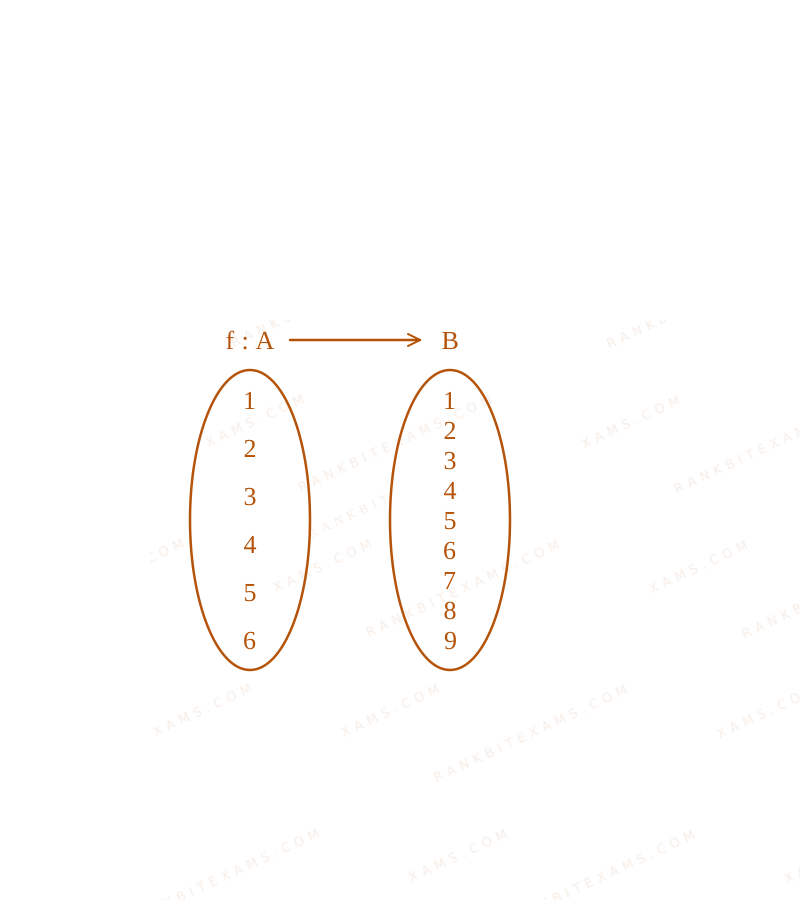
We need strictly increasing functions f: 1,2,3,4,5,6 → 1,2, ,9 subject to f(i) ≠ i. Since f is strictly increasing, f(i) ≥ i must always hold because the target values are drawn from an equally spaced domain. If f(i) = i for any i, it forces a strict ladder down to 1. But we are given f(i) ≠ i. Thus, f(i) > i for all 1 ≤ i ≤ 6. This implies f(1) ≥ 2.

Step 1: Case Analysis on f(1)
Since f(1) > 1, we evaluate possible starting points: Case 1: f(1) = 2 Remaining 5 values f(2) to f(6) must be strictly increasing and chosen from 3, 4, 5, 6, 7, 8, 9 (7 available numbers). Since f(1)=2, f(i)>i is naturally preserved for subsequent elements (e.g., f(2) ≥ 3 > 2). Number of ways = 75 = 21.
Step 2: Subsequent Cases
Case 2: f(1) = 3 Remaining 5 values chosen from 4, 5, 6, 7, 8, 9 (6 available numbers). Number of ways = 65 = 6.
Case 3: f(1) = 4 Remaining 5 values chosen from 5, 6, 7, 8, 9 (5 available numbers). Number of ways = 55 = 1.
Case 4: f(1) = 5 Requires choosing 5 values from 6,7,8,9, which is impossible.
Step 3: Total Sum
Total number of valid functions = 21 + 6 + 1 = 28.
Pattern Recognition
For f(i) ≠ i on strictly increasing integer arrays, f(x) - x > 0. Using the substitution g(x) = f(x) - x, you convert a constrained increasing function into a standard non-decreasing one, or simply pivot on f(1) and sum the cascading binomials.
Chapter Mix
Class 11 Maths: Permutations and Combinations Class 12 Maths: Functions

