Keywords:#Integer Partition#Identical Objects Identical Bins#Permutations and Combinations#JEE Main 2024 Q2
More Permutations and Combinations Previous-Year Questions
Q9jee_main_2026_21_jan_morningStrictly Increasing Functions and Derangements
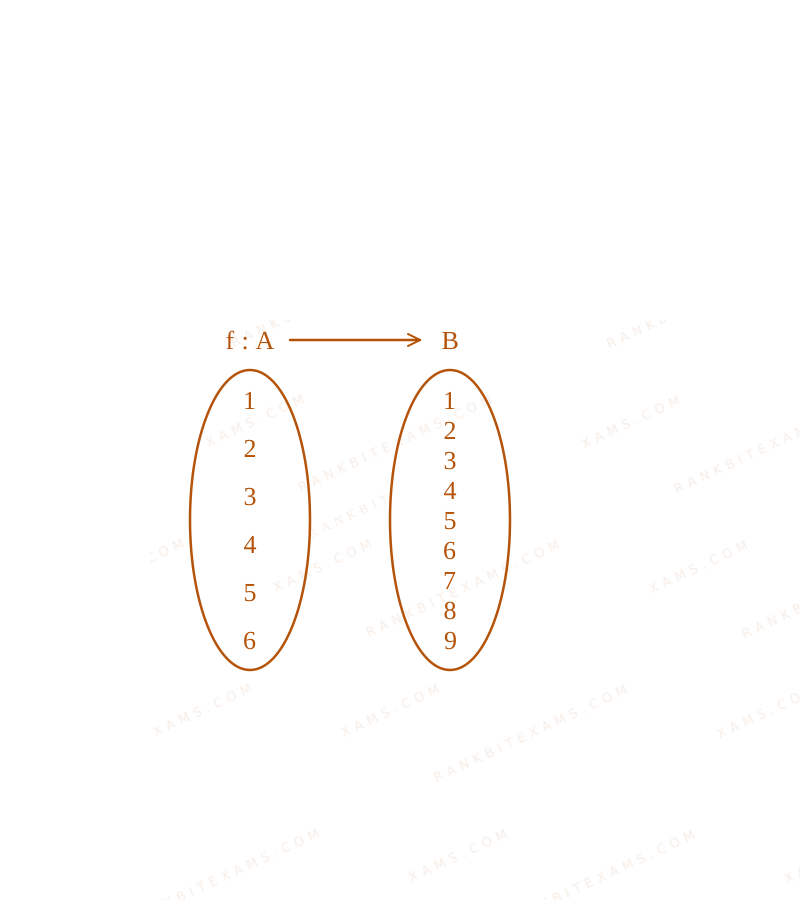
The number of strictly increasing functionsf$f$ from the set \1, 2, 3, 4, 5, 6\$\{1, 2, 3, 4, 5, 6\}$ to the set \1, 2, 3, ldots, 9\$\{1, 2, 3, \ldots, 9\}$ such that f(i) neq i$f(i) \neq i$ for 1 leq i leq 6$1 \leq i \leq 6$ , is equal to:
A. 21
B. 27
C. 22
D. 28
Solution
### Related Formula
For a strictly increasing function f: A to B$f: A \to B$ where |A| = m$|A| = m$ and |B| = n$|B| = n$, the number of functions without restrictions is binomnm$\binom{n}{m}$.
### Core Logic
We need strictly increasing functionsf: \1,2,3,4,5,6\ to \1,2,dots,9\$f: \{1,2,3,4,5,6\} \to \{1,2,\dots,9\}$ subject to f(i) neq i$f(i) \neq i$.
Since f$f$ is strictly increasing, f(i) geq i$f(i) \geq i$ must always hold because the target values are drawn from an equally spaced domain. If f(i) = i$f(i) = i$ for any i$i$, it forces a strict ladder down to 1. But we are given f(i) neq i$f(i) \neq i$. Thus, f(i) > i$f(i) > i$ for all 1 leq i leq 6$1 \leq i \leq 6$.
This implies f(1) geq 2$f(1) \geq 2$.
Function mapping sets diagram Q9 - JEE Main 2026 Morning
### Step 1: Case Analysis on f(1)
Since f(1) > 1$f(1) > 1$, we evaluate possible starting points:
Case 1: f(1) = 2$f(1) = 2$
Remaining 5 values f(2)$f(2)$ to f(6)$f(6)$ must be strictly increasing and chosen from \3, 4, 5, 6, 7, 8, 9\$\{3, 4, 5, 6, 7, 8, 9\}$ (7 available numbers). Since f(1)=2$f(1)=2$, f(i)>i$f(i)>i$ is naturally preserved for subsequent elements (e.g., f(2) ge 3 > 2$f(2) \ge 3 > 2$).
Number of ways = binom75 = 21$= \binom{7}{5} = 21$.
Function mapping sets diagram Q9 - JEE Main 2026 Morning
### Step 2: Subsequent Cases
Case 2: f(1) = 3$f(1) = 3$
Remaining 5 values chosen from \4, 5, 6, 7, 8, 9\$\{4, 5, 6, 7, 8, 9\}$ (6 available numbers).
Number of ways = binom65 = 6$= \binom{6}{5} = 6$.
Case 3: f(1) = 4$f(1) = 4$
Remaining 5 values chosen from \5, 6, 7, 8, 9\$\{5, 6, 7, 8, 9\}$ (5 available numbers).
Number of ways = binom55 = 1$= \binom{5}{5} = 1$.
Case 4: f(1) = 5$f(1) = 5$
Requires choosing 5 values from \6,7,8,9\$\{6,7,8,9\}$, which is impossible.
### Step 3: Total Sum
Total number of valid functions = 21 + 6 + 1 = 28$21 + 6 + 1 = 28$.
### Pattern Recognition
For f(i) neq i$f(i) \neq i$ on strictly increasing integer arrays, f(x) - x > 0$f(x) - x > 0$. Using the substitution g(x) = f(x) - x$g(x) = f(x) - x$, you convert a constrained increasing function into a standard non-decreasing one, or simply pivot on f(1)$f(1)$ and sum the cascading binomials.
### Evaluation Rubric / Model Answer
null
### Chapter Mix
Class 11 Maths: Permutations and Combinations
Class 12 Maths: Functions
Q23jee_main_2026_21_jan_morningDivisibility and Counting Rules
Let S = \(m, n): m, n in \1, 2, 3, dots, 50\ \$S = \{(m, n): m, n \in \{1, 2, 3, \dots, 50\} \}$ . If the number of elements (m, n)$(m, n)$ in S$S$ such that 6^m + 9^n$6^m + 9^n$ is a multiple of 5 is p$p$ and the number of elements (m, n)$(m, n)$ in S$S$ such that m + n$m + n$ is a square of a prime number is q$q$ , then p + q$p + q$ is equal to......
Numerical Answer.Answer: 1333 to 1333
Solution
### Related Formula
Modular arithmetic reductions for power cycles:
a equiv b pmodm Rightarrow a^k equiv b^k pmodm$$a \equiv b \pmod{m} \Rightarrow a^k \equiv b^k \pmod{m}$$
### Core Logic
Analyze condition p$p$: (6^m + 9^n)$(6^m + 9^n)$ is divisible by 5.
6 equiv 1 pmod 5 Rightarrow 6^m equiv 1^m equiv 1 pmod 5$6 \equiv 1 \pmod 5 \Rightarrow 6^m \equiv 1^m \equiv 1 \pmod 5$.
9 equiv -1 pmod 5 Rightarrow 9^n equiv (-1)^n pmod 5$9 \equiv -1 \pmod 5 \Rightarrow 9^n \equiv (-1)^n \pmod 5$.
For the sum to be divisible by 5:
1 + (-1)^n equiv 0 pmod 5 Rightarrow (-1)^n = -1$1 + (-1)^n \equiv 0 \pmod 5 \Rightarrow (-1)^n = -1$.
This implies n$n$ must be an ODD integer.
Since m in \1, 2, dots, 50\$m \in \{1, 2, \dots, 50\}$, m$m$ can be anything (50 choices).
Since n$n$ must be odd in \1, dots, 50\$\{1, \dots, 50\}$, n$n$ has 25 choices.
p = 50 times 25 = 1250$p = 50 \times 25 = 1250$.
### Step 1: Compute q
Analyze condition q$q$: (m + n)$(m + n)$ is the square of a prime number.
Max value of m+n = 50+50 = 100$m+n = 50+50 = 100$.
Primes whose squares are leq 100$\leq 100$: 2, 3, 5, 7$2, 3, 5, 7$.
Their squares are 4, 9, 25, 49$4, 9, 25, 49$.
So m+n$m+n$ can be 4, 9, 25, 49$4, 9, 25, 49$.
Match List-I with List-II:
m+n=4$m+n=4$
m+n=9$m+n=9$
m+n=25$m+n=25$
m+n=49$m+n=49$
No. of ways
3
8
24
48
Explanation for counts:
If m+n = S$m+n = S$, and m, n geq 1$m, n \geq 1$, the number of ways is S-1$S-1$ (since S leq 50$S \leq 50$).
For S=4$S=4$: 3 ways.
For S=9$S=9$: 8 ways.
For S=25$S=25$: 24 ways.
For S=49$S=49$: 48 ways.
q = 3 + 8 + 24 + 48 = 83$q = 3 + 8 + 24 + 48 = 83$.
### Step 2: Final Sum
p + q = 1250 + 83 = 1333$$p + q = 1250 + 83 = 1333$$
### Pattern Recognition
Modular exponentiation immediately shrinks large powers to pm 1$\pm 1$. The sum m+n=S$m+n=S$ where 1 le m,n le N$1 \le m,n \le N$ has exactly S-1$S-1$ solutions if S le N$S \le N$, allowing instant combinatorics tallying without manual counting.
### Evaluation Rubric / Model Answer
null
### Chapter Mix
Class 11 Maths: Permutations and Combinations
Q66jee_main_2025_02_april_eveningArrangements
The number of ways, in which the letters A, B, C, D, E can be placed in the 8 boxes of the figure below so that no row remains empty and at most one letter can be placed in a box, is:
The grid diagram shows 8 boxes arranged in three horizontal rows of sizes 3, 2, and 3.
A. 5880
B. 960
C. 840
D. 5760
Solution
### Related Formula
textNumber of arrangements of r text items in n text boxes = binomnr cdot r!$$\text{Number of arrangements of } r \text{ items in } n \text{ boxes} = \binom{n}{r} \cdot r!$$
### Core Logic
This is a permutations problem with row constraints. We compute the total arrangements of placing 5 distinct letters into 8 boxes and then subtract the invalid cases where one or more rows are left completely empty.
### Step 1: Compute total unrestricted arrangements
The grid has a total of 8 boxes. We have 5 distinct letters (A, B, C, D, E):
textTotal unrestricted arrangements = binom85 cdot 5! = 56 cdot 120 = 6720$$\text{Total unrestricted arrangements} = \binom{8}{5} \cdot 5! = 56 \cdot 120 = 6720$$
### Step 2: Identify and subtract the invalid empty-row cases
Let the rows be R_1$R_1$, R_2$R_2$, and R_3$R_3$, with box counts 3, 2, and 3 respectively.
Since we must distribute 5 letters, it is impossible for 2 rows to be empty simultaneously (as the remaining single row would have at most 3 boxes, which cannot fit 5 letters). Thus, we only subtract cases where exactly one row is empty:
- Case 1: Row R_1$R_1$ (3 boxes) is empty. The 5 letters must go to the remaining 5 boxes of R_2$R_2$ and R_3$R_3$:
textWays = binom55 cdot 5! = 120$$\text{Ways} = \binom{5}{5} \cdot 5! = 120$$
- Case 2: Row R_3$R_3$ (3 boxes) is empty. Same as Case 1, the 5 letters must go to the remaining 5 boxes of R_1$R_1$ and R_2$R_2$:
textWays = binom55 cdot 5! = 120$$\text{Ways} = \binom{5}{5} \cdot 5! = 120$$
- Case 3: Row R_2$R_2$ (2 boxes) is empty. The 5 letters must go to the remaining 6 boxes of R_1$R_1$ and R_3$R_3$:
textWays = binom65 cdot 5! = 6 cdot 120 = 720$$\text{Ways} = \binom{6}{5} \cdot 5! = 6 \cdot 120 = 720$$
### Step 3: Calculate the final valid arrangements
Subtracting all empty-row cases from the total arrangements:
textValid arrangements = 6720 - (120 + 120 + 720) = 6720 - 960 = 5760$$\text{Valid arrangements} = 6720 - (120 + 120 + 720) = 6720 - 960 = 5760$$
### Pattern Recognition
Inclusion-Exclusion Principle: For distribution problems with simple boundary exclusions, subtracting the complement set (invalid configurations) is mathematically much cleaner than calculating all possible partitions of row assignments.
### Evaluation Rubric / Model Answer
null
### Chapter Mix
Class 11 Mathematics: Permutations and Combinations
Qjee_main_2025_02_april_morningExponent of Prime in a Factorial
The largest n in mathbbN$n \in \mathbb{N}$ such that 3^n$3^n$ divides 50!$50!$ is:
A.21$21$
B.22$22$
C.20$20$
D.23$23$
Solution
### Related Formula
The exponent of a prime p$p$ in N!$N!$ is given by Legendre's formula:
E_p(N!) = left[fracNpright] + left[fracNp^2right] + left[fracNp^3right] + dots$$E_p(N!) = \left[\frac{N}{p}\right] + \left[\frac{N}{p^2}\right] + \left[\frac{N}{p^3}\right] + \dots$$
### Core Logic
To find the highest power of 3$3$ that divides 50!$50!$, calculate the sum of the greatest integer functions for successive powers of 3$3$ up to 50$50$.
### Step 1: Computation
Applying the formula for N = 50$N = 50$ and p = 3$p = 3$:
E_3(50!) = left[frac503right] + left[frac509right] + left[frac5027right] + left[frac5081right]$$E_3(50!) = \left[\frac{50}{3}\right] + \left[\frac{50}{9}\right] + \left[\frac{50}{27}\right] + \left[\frac{50}{81}\right]$$E_3(50!) = 16 + 5 + 1 + 0 = 22$$E_3(50!) = 16 + 5 + 1 + 0 = 22$$
### Pattern Recognition
Quickly divide by powers of 3$3$: 50/3 rightarrow 16$50/3 \rightarrow 16$; 16/3 rightarrow 5$16/3 \rightarrow 5$; 5/3 rightarrow 1$5/3 \rightarrow 1$. Summing them up yields 16 + 5 + 1 = 22$16 + 5 + 1 = 22$ instantly.
### Evaluation Rubric / Model Answer
null
### Chapter Mix
Class 11 Mathematics: Permutations and Combinations
Qjee_main_2025_02_april_morningPermutation of Multiset
The number of sequences of ten terms, whose terms are either 0 or 1 or 2, that contain exactly five 1s and exactly three 2s, is equal to:
A.360$360$
B.45$45$
C.2520$2520$
D.1820$1820$
Solution
### Related Formula
The number of permutations of n$n$ objects where p$p$ are of one kind, q$q$ are of another kind, and r$r$ are of a third kind is:
textTotal Permutations = fracn!p! cdot q! cdot r!$$\text{Total Permutations} = \frac{n!}{p! \cdot q! \cdot r!}$$
### Core Logic
The sequence has 10$10$ terms chosen from \0, 1, 2\$\{0, 1, 2\}$. It contains exactly five 1$1$s and exactly three 2$2$s. This leaves exactly 10 - 5 - 3 = 2$10 - 5 - 3 = 2$ terms to be filled by 0$0$s.
### Step 1: Arrangement Calculation
We need to arrange five 1$1$s, three 2$2$s, and two 0$0$s. The number of unique sequences is:
textTotal Sequences = frac10!5! cdot 3! cdot 2!$$\text{Total Sequences} = \frac{10!}{5! \cdot 3! \cdot 2!}$$textTotal Sequences = frac10 times 9 times 8 times 7 times 63 times 2 times 1 times 2 times 1 = 2520$$\text{Total Sequences} = \frac{10 \times 9 \times 8 \times 7 \times 6}{3 \times 2 \times 1 \times 2 \times 1} = 2520$$
### Pattern Recognition
Note that sequences can start with 0$0$ since it asks for general sequences of ten terms rather than a standard non-zero multi-digit number representation.
### Evaluation Rubric / Model Answer
null
### Chapter Mix
Class 11 Mathematics: Permutations and Combinations
More Permutations and Combinations Questions — jee_main_2024_29_january_evening
We Map Every Repeating Question in Competitive Exams.
Say goodbye to generic mock test fatigue. RankBit uses smart analysis to group past exam questions into their foundational Repeating Question Types. Find chapter weightage, track repeating questions, and score higher with targeted practice.
Select Your Target Exam
Choose an exam track below to find formulas per chapter and patterns.
Syncing Exam Intelligence
Mapping formulas and patterns across all tracks…
PATH A — FULL LENGTH PRACTICE
Full Mock Test Hub
Simulate real NTA exam conditions with fully tracked mocks. Time yourself against past papers.
Practice past-year questions one chapter at a time. Pick an exam → subject → chapter and get every PYQ for that topic — pulled together from all past papers — with the chapter's key formulas alongside.