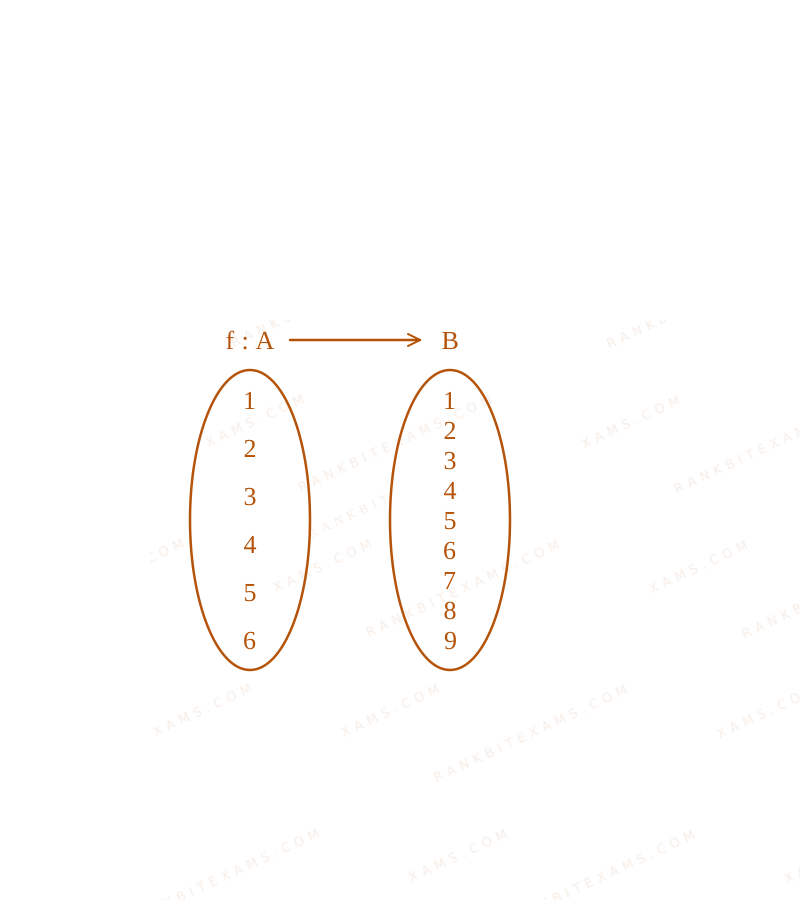
The number of strictly increasing functions f from the set \1, 2, 3, 4, 5, 6\ to the set \1, 2, 3, ldots, 9\ such that f(i) neq i for 1 leq i leq 6 , is equal to:

Solution & Explanation

### Related Formula For a strictly increasing function f: A to B where |A| = m and |B| = n, the number of functions without restrictions is binomnm. ### Core Logic We need strictly increasing functions f: \1,2,3,4,5,6\ to \1,2,dots,9\ subject to f(i) neq i. Since f is strictly increasing, f(i) geq i must always hold because the target values are drawn from an equally spaced domain. If f(i) = i for any i, it forces a strict ladder down to 1. But we are given f(i) neq i. Thus, f(i) > i for all 1 leq i leq 6. This implies f(1) geq 2.
Function mapping sets diagram Q9 - JEE Main 2026 Morning
### Step 1: Case Analysis on f(1) Since f(1) > 1, we evaluate possible starting points: Case 1: f(1) = 2 Remaining 5 values f(2) to f(6) must be strictly increasing and chosen from \3, 4, 5, 6, 7, 8, 9\ (7 available numbers). Since f(1)=2, f(i)>i is naturally preserved for subsequent elements (e.g., f(2) ge 3 > 2). Number of ways = binom75 = 21.
Function mapping sets diagram Q9 - JEE Main 2026 Morning
### Step 2: Subsequent Cases Case 2: f(1) = 3 Remaining 5 values chosen from \4, 5, 6, 7, 8, 9\ (6 available numbers). Number of ways = binom65 = 6. Case 3: f(1) = 4 Remaining 5 values chosen from \5, 6, 7, 8, 9\ (5 available numbers). Number of ways = binom55 = 1. Case 4: f(1) = 5 Requires choosing 5 values from \6,7,8,9\, which is impossible. ### Step 3: Total Sum Total number of valid functions = 21 + 6 + 1 = 28. ### Pattern Recognition For f(i) neq i on strictly increasing integer arrays, f(x) - x > 0. Using the substitution g(x) = f(x) - x, you convert a constrained increasing function into a standard non-decreasing one, or simply pivot on f(1) and sum the cascading binomials. ### Evaluation Rubric / Model Answer null ### Chapter Mix Class 11 Maths: Permutations and Combinations Class 12 Maths: Functions

Reference Study Guides

More Permutations and Combinations Previous-Year Questions — Page 6

Q26 jee_main_2024_30_january_evening Selection of Objects
In an examination of Mathematics paper, there are 20 questions of equal marks and the question paper is divided into three sections: A, B and C. A student is required to attempt total 15 questions taking at least 4 questions from each section. If section A has 8 questions, section B has 6 questions and section C has 6 questions, then the total number of ways a student can select 15 questions is
Numerical Answer. Answer: 11376 to 11376

Solution

### Related Formula textCombinations: ^nC_r = fracn!r!(n-r)! ### Core Logic Total Questions = 20 (A: 8, B: 6, C: 6). Total to attempt = 15. Minimum required from each section = 4. Base attempt gives: 4 (textfrom A) + 4 (textfrom B) + 4 (textfrom C) = 12 questions. We have to distribute the remaining 15 - 12 = 3 questions across the sections A, B, and C. Let the additional questions picked be x, y, z for sections A, B, C respectively. Then x + y + z = 3, with constraints based on the maximum questions per section: A max extra = 8 - 4 = 4 Rightarrow x le 4 B max extra = 6 - 4 = 2 Rightarrow y le 2 C max extra = 6 - 4 = 2 Rightarrow z le 2 ### Step 1: Identifying Valid Selection Cases The possible sets of (x, y, z) are: Case 1: (1, 1, 1) Rightarrow Total picks: A(5), B(5), C(5) Case 2: (2, 1, 0) and its permutations (respecting constraints). Valid permutations: - A gets 2, B gets 1, C gets 0 Rightarrow A(6), B(5), C(4) - A gets 2, C gets 1, B gets 0 Rightarrow A(6), B(4), C(5) - B gets 2, A gets 1, C gets 0 Rightarrow A(5), B(6), C(4) - C gets 2, A gets 1, B gets 0 Rightarrow A(5), B(4), C(6) (Note: B(2), C(1) or C(2), B(1) are not allowed if it forces A to take 0, wait, A gets 0 means A(4). A is allowed to have 4.) Let's check permutations of (2, 1, 0): - A(4), B(6), C(5) [x=0, y=2, z=1] - A(4), B(5), C(6) [x=0, y=1, z=2] Case 3: (3, 0, 0) and permutations. Since y le 2 and z le 2, only x can be 3. So, x=3, y=0, z=0 Rightarrow A(7), B(4), C(4). ### Step 2: Calculating Combinations per Case Let's list all valid final section breakdowns (A, B, C): 1) (5, 5, 5) Rightarrow ^8C_5 cdot ^6C_5 cdot ^6C_5 = 56 cdot 6 cdot 6 = 2016 2) (6, 5, 4) Rightarrow ^8C_6 cdot ^6C_5 cdot ^6C_4 = 28 cdot 6 cdot 15 = 2520 3) (6, 4, 5) Rightarrow ^8C_6 cdot ^6C_4 cdot ^6C_5 = 28 cdot 15 cdot 6 = 2520 4) (5, 6, 4) Rightarrow ^8C_5 cdot ^6C_6 cdot ^6C_4 = 56 cdot 1 cdot 15 = 840 5) (5, 4, 6) Rightarrow ^8C_5 cdot ^6C_4 cdot ^6C_6 = 56 cdot 15 cdot 1 = 840 6) (4, 6, 5) Rightarrow ^8C_4 cdot ^6C_6 cdot ^6C_5 = 70 cdot 1 cdot 6 = 420 7) (4, 5, 6) Rightarrow ^8C_4 cdot ^6C_5 cdot ^6C_6 = 70 cdot 6 cdot 1 = 420 8) (7, 4, 4) Rightarrow ^8C_7 cdot ^6C_4 cdot ^6C_4 = 8 cdot 15 cdot 15 = 1800 ### Step 3: Summing the Total Ways Total ways = 2016 + 2520 + 2520 + 840 + 840 + 420 + 420 + 1800 Total ways = 2016 + 5040 + 1680 + 840 + 1800 = 11376 ### Pattern Recognition Combinatorial distribution with rigid lower bounds is solved by shifting the baseline. Allocate the minimums immediately (4+4+4=12), then distribute the remaining items via casework ensuring upper capacities aren't breached. ### Evaluation Rubric / Model Answer null ### Chapter Mix Class 11 Maths: Permutations and Combinations
Q1 jee_main_2024_31_jan_evening Distribution of Identical Objects
The number of ways in which 21 identical apples can be distributed among three children such that each child gets at least 2 apples, is
  • A. 406
  • B. 130
  • C. 142
  • D. 136

Solution

### Related Formula textWays to distribute n text identical objects among r text persons = ^n+r-1C_r-1 ### Core Logic First, distribute 2 apples to each of the 3 children to satisfy the minimum requirement. Remaining apples = 21 - 3 times 2 = 15. Now distribute the remaining 15 identical apples among the 3 children without restrictions. textNumber of ways = ^15+3-1C_3-1 = ^17C_2 = frac17 times 162 = 136 ### Pattern Recognition Beggar's Method: For x_1+x_2+dots+x_r = n with x_i ge k, pre-allocate k to each and apply standard distribution formula on remainder. ### Evaluation Rubric / Model Answer null ### Chapter Mix Class 11 Maths: Permutations and Combinations
Q17 jee_main_2024_31_jan_evening Combinations and Permutations Formula
If for some m, n; ^6C_m + 2(^6C_m+1) + ^6C_m+2 > ^8C_3 and ^n-1P_3 : ^nP_4 = 1:8, then ^nP_m+1 + ^n+1C_m is equal to
  • A. 380
  • B. 376
  • C. 384
  • D. 372

Solution

### Related Formula ^nC_r + ^nC_r-1 = ^n+1C_r ### Core Logic Simplify the binomial combination: ^6C_m + 2(^6C_m+1) + ^6C_m+2 = (^6C_m + ^6C_m+1) + (^6C_m+1 + ^6C_m+2) Using Pascal's rule, this becomes: ^7C_m+1 + ^7C_m+2 = ^8C_m+2 Given condition: ^8C_m+2 > ^8C_3 = 56. For N=8, the central combinations yield the maximum value: ^8C_4 = 70. Others like ^8C_5 = 56, which is not strictly greater than 56. So m + 2 = 4 implies m = 2. Solve the permutations ratio: frac^n-1P_3^nP_4 = frac18 frac(n-1)(n-2)(n-3)n(n-1)(n-2)(n-3) = frac18 implies frac1n = frac18 implies n = 8 Calculate the target expression: ^nP_m+1 + ^n+1C_m = ^8P_3 + ^9C_2 = (8 times 7 times 6) + frac9 times 82 = 336 + 36 = 372 ### Pattern Recognition Binomial coefficient reduction using Pascal's triangle quickly collapses expanded nCr sums. ### Evaluation Rubric / Model Answer null ### Chapter Mix Class 11 Maths: Permutations and Combinations
Q23 jee_main_2024_31_jan_morning Word Formation
The total number of words (with or without meaning) that can be formed out of the letters of the word 'DISTRIBUTION' taken four at a time, is equal to
Numerical Answer. Answer: 3734 to 3734

Solution

### Core Logic Letters in 'DISTRIBUTION': I(3), T(2), D, S, R, B, U, O, N. There are 9 distinct letters. ### Step 1: Case Analysis **Case 1: 3 alike, 1 distinct** Selection: Choose the letter 'I' (^1C_1) and 1 from the remaining 8 distinct letters (^8C_1). Arrangement: ^8C_1 times frac4!3! = 8 times 4 = 32. **Case 2: 2 alike of one kind, 2 alike of another kind** Since only 'I' and 'T' appear at least twice, we must choose both. Arrangement: ^2C_2 times frac4!2!2! = 1 times 6 = 6. ### Step 2: Further Cases **Case 3: 2 alike, 2 distinct** Selection: Choose 1 from the 2 repeated sets (^2C_1) and 2 from the remaining 8 distinct letters (^8C_2). Arrangement: ^2C_1 times ^8C_2 times frac4!2! = 2 times 28 times 12 = 672. **Case 4: All 4 distinct** Selection: Choose 4 from the 9 distinct letters (^9C_4). Arrangement: ^9C_4 times 4! = 126 times 24 = 3024. ### Step 3: Total Words Total = 3024 + 672 + 6 + 32 = 3734. ### Evaluation Rubric / Model Answer null ### Chapter Mix Class 11 Maths: Permutations and Combinations

More Permutations and Combinations Questions — jee_main_2026_21_jan_morning

Practice all Permutations and Combinations previous-year questions →

Rankbit System
JEE Physics: Waves (+15.5%) | Electrostatics: Concentric Shells (-29.7%) | Modern Physics: Photoelectric Clones (+34.2%) | Mathematics: Definite Integrals (+18.1%) | Chemistry: Coordination Splitting (-11.4%) | JEE Physics: Waves (+15.5%) | Electrostatics: Concentric Shells (-29.7%) | Modern Physics: Photoelectric Clones (+34.2%) | Mathematics: Definite Integrals (+18.1%) | Chemistry: Coordination Splitting (-11.4%)
YOUR FIRST PREP STEP STARTS HERE

We Map Every Repeating Question in Competitive Exams.

Say goodbye to generic mock test fatigue. RankBit uses smart analysis to group past exam questions into their foundational Repeating Question Types. Find chapter weightage, track repeating questions, and score higher with targeted practice.

Select Your Target Exam

Choose an exam track below to find formulas per chapter and patterns.

Syncing Exam Intelligence

Mapping formulas and patterns across all tracks…

PATH A — FULL LENGTH PRACTICE

Full Mock Test Hub

Simulate real NTA exam conditions with fully tracked mocks. Time yourself against past papers.

Now Live Open
PATH B — TARGETED PRACTICE

Topic-wise Practice Hub

Practice past-year questions one chapter at a time. Pick an exam → subject → chapter and get every PYQ for that topic — pulled together from all past papers — with the chapter's key formulas alongside.

Loading Questions... Browse Topics
Latest from the Blog
View all →

Loading articles...